HomeAuto Silent Hill Townfall’s 19-Minute Trailer Shows CRTV Built From Destroyed TVs
Silent Hill Townfall’s 19-Minute Trailer Shows CRTV Built From Destroyed TVs
August 20, 2026:
Konami.com
Konami and Annapurna Interactive released a nearly 19-minute gameplay trailer for Silent Hill: Townfall on Wednesday, delivering the most complete public look yet at the horror title ahead of its September 24 launch on PS5 and PC — and the footage reveals far more than mechanics: it shows, for the first time, the game’s Otherworld transformation sequence and confirms that the game’s central gadget, the CRTV, was built using footage run through physically damaged analog hardware. Director and writer Jon McKellan of Glasgow studio Screen Burn Interactive spent part of development holding magnets to old television sets — not as an aesthetic gesture, but as a production method.
Thirty-five days separate players from the game itself. What this trailer provides is the first uninterrupted view of how Townfall actually plays: how Simon Ordell moves through the fog-choked Scottish island of St. Amelia, how the CRTV functions as both tool and story delivery system, what a monster encounter looks like when your only weapon is a plank of wood, and what happens when the world breaks open into the Otherworld.
Who Is Simon Ordell, and Why Can’t He Leave?
Simon Ordell keeps waking up at the docks of St. Amelia. He has a hospital tag on his wrist. A disembodied voice tells him the people there need to hear something from him — that he needs to go back and “put things right.” The island is deserted in 1996, its streets swallowed by dense fog, its apartment buildings stripped of everyone who once lived there except for whatever is still moving in the dark.
Inside the apartment of a woman named Zoe Ellis, Simon finds a combination-locked organ donor box, a fuse box that needs a prepaid power card to restore electricity — and a photograph of his own face. A stranger on an island he cannot explain has a picture of him. That single detail is the engine of Townfall‘s horror: not what is in the fog, but what Simon cannot remember about why he belongs there.
The game’s emotional register is cold and isolated. The horror is psychological rather than visceral — fog as both literal obstacle and metaphor for fragmented memory, the threat of the unknown filtered through unreliable perception. A reader who wants to know whether Townfall is for them can test that register against a single sentence: Simon is known by someone he does not know, in a place he cannot explain, and he cannot leave until he understands why.
What Screen Burn Did to Those Televisions
The CRTV — a pocket-sized handheld television set — is Townfall‘s replacement for the series’ iconic portable radio. The radio crackled with static to warn players that monsters were near; the CRTV takes that idea and expands it into the game’s entire operating system.
Building it required physical destruction. Screen Burn ran game footage and cutscene material through real analog hardware — broadcast monitors, consumer televisions, portable receivers — and then deliberately damaged those devices to produce authentic signal degradation. According to GamingBolt’s report on CRTV production, McKellan described the method to Eurogamer: “We would take gameplay footage and cutscenes and actually run them through old hardware, old TVs, pocket televisions, to create something that was truly authentic. We would damage the cables, hold magnets to them, and then get that footage back into the game.” The interference on the CRTV’s screen is not a digital CRT filter applied in post-production. It is what analog signal distortion actually looks like when a cable is cut and a magnet is applied to a phosphor-coated screen.
That commitment to material authenticity — to the specific visual texture of degraded analog technology rather than a simulation of it — is the third iteration of a singular design philosophy that has run through every Screen Burn project. Stories Untold (2017) unfolded across 1980s text-adventure terminals and tape decks; Observation (2019) took place entirely through a space station’s camera systems. Each game used a specific, historically real, slightly malfunctioning interface as both mechanic and metaphor: the technology doesn’t just show the horror, it mediates it, limits it, and shapes what kind of horror is even possible within its frame.
McKellan was explicit about why the first-person perspective was not a stylistic choice but an architectural requirement. “For Silent Hill: Townfall, a first-person viewpoint was an indispensable foundation for integrating the mechanics around the CRTV device,” he said in a PlayStation Blog McKellan interview published July 30, 2026. “Honestly, the CRTV couldn’t work from any other perspective.”
In practice, the CRTV operates across multiple overlapping functions. Players tune it to detect enemy outlines through interference — threats become visible through the device’s static before they are visible to the eye, adding a layer of tension distinct from standard horror-game threat indicators. The device also delivers narrative through tunable audio and video transmissions, handles environmental puzzle cues, and can be used to create distractions: a noisy signal broadcast to lure an enemy away from a corridor. On PS5, the DualSense gyroscope integrates into tuning — players physically tilt the controller to lock onto a signal, a design decision that grounds the analog metaphor in the body of the person holding the controller.
Entering the Otherworld
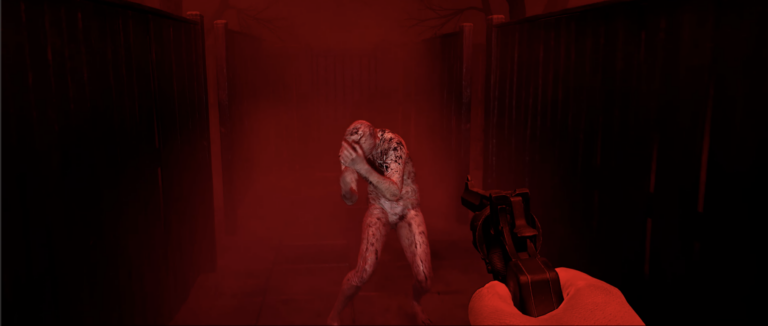
At timestamp 10:58 in the gameplay footage, St. Amelia transforms. The town’s surface reality — the fog, the empty residential streets, Zoe’s apartment — gives way to something structurally different, the Otherworld sequence that is a visual constant of the franchise. This is the first time any Otherworld footage from Townfall has been made public.
The trailer shows Simon entering that sequence with a pistol in hand — the first confirmation that the game’s weapon set extends beyond melee to include a firearm. The earlier plank-of-wood encounter framed combat as a desperate last resort; the pistol, appearing at the threshold of the Otherworld, suggests that the game’s tone shifts when the reality beneath the reality is exposed.
What Determines How the Game Ends
Townfall will offer five endings. Three are accessible on a first playthrough; two remain locked until New Game+. The endings are not determined by binary dialogue choices but by aggregate player behavior across the entire game — how aggressively the player engages with threats, how thoroughly they investigate St. Amelia’s buildings and spaces, how they manage encounters.
“The choices you make as a player throughout will determine the ending, and it should feel that the ending is very appropriate to the experience you had,” McKellan said according to GamingBolt’s five endings report. “The goal is for the player to feel like it’s the natural conclusion to the story in terms of the way they played.” Producer Motoi Okamoto confirmed that no single ending will be designated as canonical — a continuation of the franchise’s long tradition of withholding definitive answers about what “really” happened.
The 10-to-14-hour completion window estimated by preview coverage suggests the New Game+ endings are a meaningful investment, not a brief bonus.
Screen Burn at Eleven
Screen Burn Interactive was founded on August 19, 2015 — making yesterday the studio’s eleventh birthday, a coincidence that aligns with the trailer’s release date almost precisely. The studio, founded by McKellan and Omar Khan in Glasgow, spent its first decade publishing through Devolver Digital (Stories Untold, Observation) before the Townfall partnership brought it into collaboration with Konami and Annapurna Interactive simultaneously — its largest project and its first with major publishers, as detailed on the Screen Burn Interactive Wikipedia page.
McKellan came to the studio from Creative Assembly, where he directed the DLC packs for Alien: Isolation — another game built around a single technological object (the motion tracker) that mediates the player’s relationship to an unseen threat. The lineage from motion tracker to text terminal to space station camera to pocket CRT television reads, in retrospect, as a sustained career-long investigation of the same question: what kind of horror is only possible through a specific, limited, imperfect interface?
Observation won the BAFTA 2020 Best British Game award — the first time a Scottish studio had taken that prize. Townfall is the studio’s first major-publisher release and its biggest platform yet.
What the Franchise Looks Like Now
Silent Hill: Townfall will be the fourth Silent Hill release since Konami revived the franchise in 2024. Silent Hill 2 Remake (2024, Bloober Team) reopened the franchise; Silent Hill f (2025, Ryukishi07) transported it to 1960s Japan; Townfall places it on a Scottish island entirely outside the franchise’s original geography and mythology. A remake of the original Silent Hill from Bloober Team is in development with no release date confirmed.
The revival’s defining characteristic has been structural plurality: different studios, different tones, different countries, different design philosophies — all sharing only the franchise’s commitment to psychological horror and environmental atmosphere. Konami has not published a single sequel continuing a prior game’s story or cast; every new entry operates as a standalone.
Townfall‘s most dramatic departure from franchise tradition is the camera: no other mainline Silent Hill title has been played entirely in first-person. That shift, as McKellan has made clear, was not a market trend response but a direct consequence of the CRTV as a design object. The game’s perspective exists because the gadget required it.
Gamescom Next, September After
A new Townfall trailer will premiere at Gamescom Opening Night Live on August 25, 2026, at 2 PM ET on YouTube, Twitch, and Steam, as confirmed in the TechTimes Gamescom 2026 schedule. The event will also include closed journalist preview sessions for the game and a Konami-themed interactive area open to the public on the Gamescom floor.
Silent Hill: Townfall is scheduled to launch September 24, 2026, for PS5 and PC via Steam and the Epic Games Store.
Frequently Asked Questions
What exactly does the CRTV do in Silent Hill: Townfall, and why is it replacing the radio?
The CRTV is a handheld pocket television that functions as the game’s primary tool across four overlapping uses: detecting enemies (their outlines become visible through the device’s static interference before they are visible to the naked eye), delivering narrative (players tune to frequencies to find audio and video transmissions that carry story information), solving puzzles (environmental clues are discoverable through the device), and creating distractions (the CRTV can broadcast signals to lure enemies away). The shift from radio to CRTV was motivated by the move to first-person perspective — director Jon McKellan has stated that the CRTV “couldn’t work from any other perspective” — and by the studio’s desire to evolve a passive warning system into an active, multi-purpose tool the player depends on throughout the game. The device’s interference effects were produced using real analog hardware that was physically damaged during production, not digital CRT simulation filters, according to PlayStation Blog McKellan interview.
How many endings does Silent Hill: Townfall have, and how do you unlock them?
The game has five endings total. Three are accessible during a first playthrough; two are secret endings locked behind New Game+. Unlike many narrative games, the endings are not determined by explicit A/B dialogue choices. Instead, they emerge from aggregate player behavior throughout the full game — factors include how aggressively or stealthily the player handles encounters, and how thoroughly they explore St. Amelia’s environments. Director Jon McKellan has stated that no single ending will be designated the canonical conclusion, per GamingBolt’s five endings report.
Who is Screen Burn Interactive, and what have they made before?
Screen Burn Interactive is a Glasgow, Scotland-based studio founded on August 19, 2015, by Jon McKellan and Omar Khan. Previously operating as No Code Limited (until July 2025), the studio is best known for Stories Untold (2017), an anthology horror game built around 1980s text-adventure terminals, and Observation (2019), a sci-fi thriller played through a space station’s AI camera systems. Observation won BAFTA’s Best British Game award in 2020 — the first Scottish studio to win that prize. McKellan previously worked at Creative Assembly on Alien: Isolation. Silent Hill: Townfall is the studio’s largest project and its first with major publishers, as covered on the Screen Burn Interactive Wikipedia page.
What is the Otherworld, and what does the trailer show of it?
The Otherworld is a recurring franchise element — a distorted, nightmarish transformation of a Silent Hill location that reveals its underlying horror beneath the surface reality. In the Townfall gameplay trailer, the Otherworld sequence begins at approximately the 11-minute mark, when St. Amelia visibly transforms into something structurally different from the fog-choked surface town. This is the first public footage of the Otherworld in Townfall. The trailer shows Simon entering the sequence with a pistol — the first confirmation of a firearm in his weapon set, expanding on the melee-only encounters shown in the earlier portion of the footage, according to Gematsu’s Townfall trailer timestamps.