HomeAuto Saqqara Tomb Reveals 4,300-Year-Old Egypt Judge Who Heard Citizen Complaints Under Maat
Saqqara Tomb Reveals 4,300-Year-Old Egypt Judge Who Heard Citizen Complaints Under Maat
September 10, 2026:
Mota.gov.eg
Egypt’s Ministry of Tourism and Antiquities announced on Monday that archaeologists have uncovered a 4,300-year-old mastaba at Saqqara belonging to a senior judge whose specific job was to receive and process the complaints of ordinary citizens — making the find one of the clearest physical demonstrations to date that ancient Egypt’s concept of Maat, the governing principle of justice and cosmic order, was not merely a theological ideal but a functioning bureaucratic system staffed with appointed officials.
The tomb belongs to Yunmin, a high-ranking official who served under Pharaoh Djedkare Isesi during the late Fifth Dynasty — a reign that Egyptologists broadly recognize as one of the most consequential periods of administrative reform in ancient Egyptian history. Yunmin held a cluster of titles that tell a precise institutional story: judge, director of the court, and chief of the scribes responsible for reviewing petitions and complaints from the kingdom’s subjects.
Who Was Yunmin, and What Did He Actually Do?
Yunmin’s formal role placed him at the administrative intake point of ancient Egypt’s citizen-facing legal apparatus. The court system in the Old Kingdom, called the djatjat, operated at both local and national levels. At the local level, councils of elders adjudicated everyday disputes. At the national level, viziers presided over high courts, with scribes recording complaints and verdicts. Petitioners of all social classes represented themselves directly, swore oaths of truthfulness, and waited — sometimes in line, day after day — to bring their cases before judges. Surviving evidence suggests the system was surprisingly non-discriminatory: ancient texts record that the lowliest peasant could petition the vizier and his court for redress, just as any nobleman could.
Yunmin was the official who organized the scribal side of this intake process. His title — head of the scribes responsible for reviewing petitions and complaints — makes him not simply a judge issuing verdicts, but the administrative manager of the mechanism by which citizens could formally approach the state. In modern terms, he would be something like the director of a civil petition office: the person who ensured that public grievances were received, recorded, and routed through the correct legal machinery.
Amr Al-Tayeb, director of the Saqqara archaeological site, told AFP that Yunmin’s duties closely aligned with Maat — the ancient Egyptian concept of truth, justice, cosmic balance, and social order that sat at the philosophical center of Egyptian civilization. In practice, Maat was not simply a word inscribed on temple walls. It was the justification for the entire judicial apparatus: kings, viziers, and officials like Yunmin were understood to hold their positions as embodiments and enforcers of Maat’s principles. Britannica describes the king’s core role as setting “maat in place of isfet” — order in place of disorder — with that mandate operationally distributed to a hierarchy of officials who made Maat real in the daily lives of subjects.
Djedkare Isesi and the Reforms That Created Yunmin’s Job
Djedkare Isesi, who likely reigned for more than 40 years during the late 25th to mid-24th centuries BCE, is recognized by Egyptologists as the pharaoh who effected comprehensive reforms of Egypt’s state administration, the first undertaken since the inception of the system of ranking titles. These reforms were wide-ranging: the vizierate was restructured, with up to three viziers serving simultaneously; viziers gained authority over the scribal administration; provincial governors received greater autonomous power; and artistic patronage expanded beyond the royal court to elite officials who could now commission their own elaborate monuments.
Yunmin’s tomb is physical evidence of how those reforms were staffed at the judicial level. A position like his — a dedicated judge-administrator overseeing the scribal management of public petitions — required the kind of elaborated bureaucratic infrastructure that Djedkare’s reorganizations made possible. The find does not simply document a single official’s career; it documents an entire class of specialized state function that Djedkare’s reign brought into existence.
The reign of Djedkare is also associated with the composition of The Maxims of Ptahhotep — a wisdom text attributed to Djedkare’s own vizier, Ptahhotep, widely regarded as one of the earliest surviving works of philosophical literature addressing ethics, governance, and conduct in public life. Yunmin’s tomb and the Ptahhotep maxims together represent a remarkable pairing: in the same reign, Egypt produced what may be the world’s oldest philosophical text on justice and the administrative officials whose job was to implement that justice for ordinary people. One is the theory; the other is the institutional infrastructure.
That said, those same administrative reforms have a complicated scholarly reputation. Egyptologist Naguib Kanawati has argued that Djedkare’s policy of decentralization — which empowered officials like Yunmin and his peers — ultimately transferred so much autonomous power to provincial governors that it contributed significantly to the collapse of the Old Kingdom roughly two centuries later, during the First Intermediate Period (c. 2160–2055 BCE). Nigel Strudwick disputes this interpretation, arguing that even Djedkare’s most powerful officials never accumulated enough authority to rival the king. The scholarly argument remains unresolved, but it adds a structural irony to the Yunmin find: the elaborate petition-handling machinery documented by his tomb was part of a bureaucratic flourishing that may have contained, within its own logic, the seeds of the system’s eventual fragmentation.
A Double-Chapel Mastaba at the Mariette Cemetery
The tomb itself takes the form of a mastaba — the flat-roofed rectangular superstructure typical of elite Old Kingdom burials, distinguished from later pyramid architecture by its simpler rectangular form. This mastaba is medium-sized and contains two funerary chapels that open onto its eastern wall, the orientation conventionally aligned with the rising sun and the realm of the living.
The northern and principal chapel belongs to Yunmin himself. The southern chapel was dedicated to his father, Ity, who held clerical positions linked to the management of agricultural land and offerings — a role that placed him at the intersection of the bureaucratic and agricultural economies that sustained the pharaonic state. Together, the two chapels document an administrative family spanning generations, with the son rising to a more senior judicial appointment than his father.
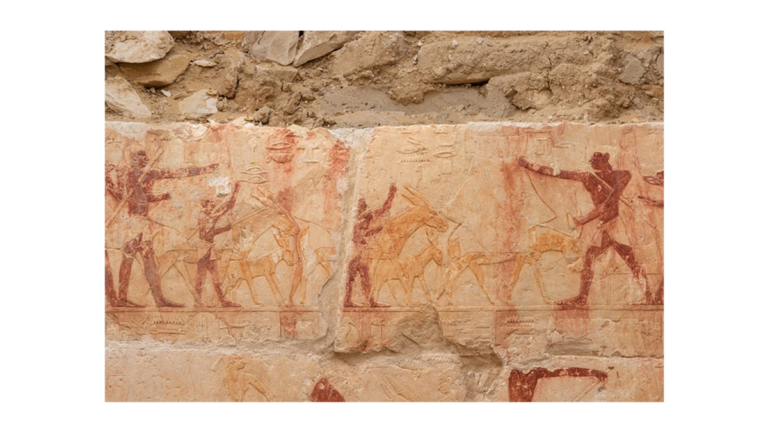
Dr. Josep Cervelló Autuori, head of the mission from the Autonomous University of Barcelona, reported that Yunmin’s chapel features a distinctive architectural facade bearing funerary inscriptions and offering formulas, alongside a formal depiction of the tomb owner. The walls are decorated with prominent relief scenes — farmers at work, servants carrying offerings, processions of goods approaching the deceased — many of which retain their original colors despite spending more than four millennia beneath the desert sand. Relief scenes retain original colors, reflecting the exceptional artistic skill of the craftsmen of that period, according to the mission’s announcement.
Polychrome decoration from the Old Kingdom is notoriously fragile. Humidity, salt crystallization, and centuries of human disturbance destroy it routinely. When it survives in anything approaching its original state, it provides researchers with pigment composition data, iconographic programs, and artistic-convention evidence that worn or undecorated tombs cannot supply. The agricultural and offering-procession scenes in Yunmin’s chapel are independently valuable as documentation of Fifth Dynasty economic life — what crops were grown, how they were transported, and how surplus goods moved through an elite household’s redistribution networks.
Ity’s southern chapel, while less intact than his son’s, preserves a false door — a symbolic architectural gateway through which the deceased was believed to receive sustenance and communication from the world of the living — alongside partial painted offering scenes.
A Known Site, Newly Documented
The Mariette Cemetery, where the mastaba was found, takes its name from Auguste Mariette, the pioneering French Egyptologist who conducted excavations at Saqqara beginning in the 1850s. Mariette’s teams had noted the location of the mastaba and logged it in their records, but — as Dr. Hisham El-Leithy, Secretary-General of Egypt’s Supreme Council of Antiquities emphasized in the official announcement — the site had never previously undergone comprehensive scientific excavation and documentation.
More than 150 years separated Mariette’s catalog notation from the Barcelona team’s first systematic archaeological examination of the structure. The application of modern methodologies — controlled excavation, stratigraphic recording, conservation treatment, photographic documentation — to a previously noted but unstudied feature has now unlocked evidence that the 19th century could see but not yet read.
The find was made during the 2026 excavation season, as part of a long-running joint scientific project between the Autonomous University of Barcelona and Egypt’s Supreme Council of Antiquities. Conservation and restoration work on the newly uncovered architectural and decorative features is already underway, the mission reported. The team continues its work in the northern Saqqara area.
Saqqara’s Continuing Significance
Saqqara, located roughly 20 miles (32 km) south of Cairo, is one of the ancient world’s most extensively studied and archaeologically rich burial grounds. Its recorded history spans from the Early Dynastic Period — when the first monuments to Egyptian kingship were constructed here — through the Greco-Roman era, a run of more than 3,000 years during which successive generations chose this plateau as the proper destination for the dead. It is home to the Step Pyramid, the Serapeum, and thousands of tombs reflecting every period of Egyptian history.
The discovery of Yunmin’s tomb is also situated against Egypt’s broader archaeological momentum. Egypt welcomed nearly 19 million tourists in 2025 — a roughly 21 percent increase over the prior year — with visits to archaeological sites and museums rising even faster. The Ministry of Tourism and Antiquities has made a deliberate practice of publicizing significant finds as part of a strategy to sustain that trajectory, and the Yunmin tomb fits the pattern: a high-quality discovery at one of Egypt’s most visited and recognizable sites, announced precisely when the 2026 excavation season’s most significant work can be shared.
What makes this find unusual within that stream of announcements is its specificity. Many discovery announcements offer painted reliefs, impressive architecture, and the biographical titles of a named official. Yunmin’s announcement offers all of that plus a specific institutional function — the management of citizen petitions and complaints — that connects ancient bureaucracy to a concept readers immediately recognize: the right to bring a grievance before the state, and to have a designated official whose job is to make sure it gets heard.
Whether or not Yunmin’s Maat-guided petition system ultimately held the Old Kingdom together or helped unravel it, the fact that his job existed at all — and that it warranted a carefully decorated, double-chapel mastaba lasting 4,300 years — is a testament to how seriously his society took the administrative machinery of justice.
Frequently Asked Questions
What is Maat, and why does it matter for understanding Yunmin’s role?
Maat was the ancient Egyptian concept — and personified goddess — of truth, justice, cosmic balance, and social order. Britannica describes the king’s central function as placing order in the seat of disorder, with that mandate carried down through a hierarchy of officials. Yunmin’s titles explicitly connect his judicial duties to Maat, which means his job as a petition-and-complaint administrator was understood not as a technicality but as a direct implementation of the foundational ethical principle governing Egyptian civilization. He was, in the most literal institutional sense, a guardian of Maat for ordinary citizens who needed access to the state.
How did the ancient Egyptian petition and complaint system actually work?
The Old Kingdom court system was called the djatjat. It operated at multiple levels: local councils of elders handled minor disputes in each village; regional courts under nomarchs addressed mid-level cases; viziers presided over high courts for the most serious matters. Citizens represented themselves directly, swore oaths to truth, and scribes recorded the proceedings. Access was relatively democratic by ancient standards: surviving texts indicate that peasants and aristocrats alike held the formal right to petition. Yunmin’s specific role — as head of the scribes processing these petitions — made him the administrative manager of this intake system, not simply a judge of individual cases.
Who is Djedkare Isesi and why does his reign matter for this discovery?
Djedkare Isesi was the eighth ruler of Egypt’s Fifth Dynasty, reigning for what Egyptologists believe was at least 40 years in the late 25th to mid-24th centuries BCE. His reign is distinguished by comprehensive administrative reforms — the first wholesale restructuring of Egypt’s state apparatus in generations — that elaborated the vizierate, empowered viziers over the scribal administration, and expanded provincial autonomy. The same reign also produced The Maxims of Ptahhotep, a wisdom text by Djedkare’s own vizier that is among the oldest surviving philosophical works on justice and ethical governance. Yunmin’s position was a direct product of this administrative era: his job would not have existed in the same form without the bureaucratic elaboration that Djedkare’s reforms enabled.
What is a mastaba, and what does the double-chapel structure tell us about Yunmin?
A mastaba is the flat-roofed, rectangular tomb superstructure characteristic of Old Kingdom elite burials — the architectural form that preceded the pyramid. The double-chapel layout of this mastaba, with a northern chapel for Yunmin and a southern one for his father Ity, is notable: it documents two generations of the same administrative family sharing a funerary monument, suggesting that Yunmin’s judicial career built on a scribal tradition established by his father. The northern chapel’s elaborate facade, inscribed offering formulas, and polychrome agricultural and procession reliefs mark Yunmin as a senior official whose surviving monument is intended to communicate rank, piety, and institutional significance to any visitor — or any archaeologist — who might one day enter it. These architectural features of the mastaba reinforce how seriously the Fifth Dynasty commemorated its judicial officials.