HomeAuto San Diego Drone Grounds 400 Flights Labor Day; Airports Have No Detection Requirement
San Diego Drone Grounds 400 Flights Labor Day; Airports Have No Detection Requirement
September 6, 2026:
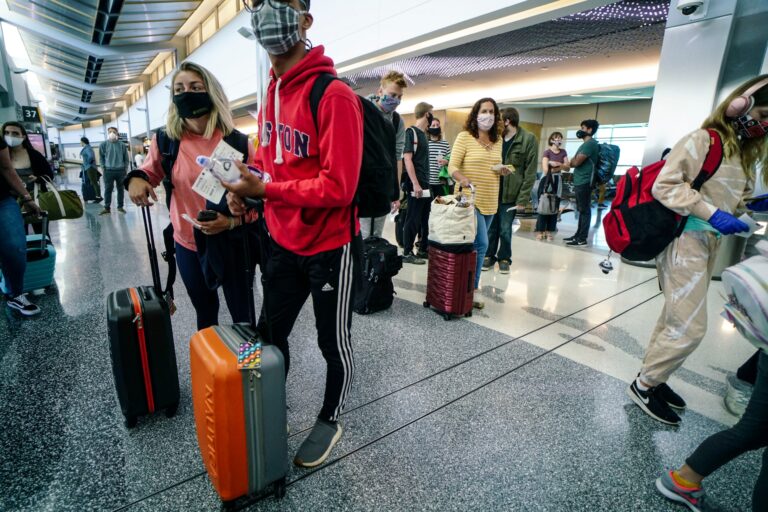
Passengers board an American Airlines flight to Charlotte, North Carolina at San Diego International Airport on May 20, 2020 in San Diego, California. Sandy Huffaker/Getty Images
A drone that hovered close enough to San Diego International Airport’s air traffic control tower to be visible from the ground on September 4, 2026, triggered an FAA ground stop that delayed more than 400 flights on the busiest single-runway commercial airport in the United States during Labor Day weekend. What the Transportation Security Administration cannot tell you is who operated it — because no detection system at the airport, or at any U.S. commercial airport, was monitoring airspace in real time when the drone appeared. The FAA’s Remote ID framework governs how drones identify themselves, but it does not require any airport to actually monitor those broadcasts.
That structural fact is not an investigative shortcoming. It is the predictable output of how drone identification works in the United States. The FAA’s Remote ID mandate, codified at 14 CFR Part 89 and in force since September 2023, requires most registered drones to continuously broadcast their identification number, position, altitude, and the location of their operator over short-range Bluetooth and Wi-Fi signals. What it does not require is for any airport, any air traffic control facility, or any law enforcement agency at a commercial airport to monitor those broadcasts. When the TSA’s investigators arrived to search for the San Diego operator, they had no sensor data, no trajectory history, and no operator position — because the legal architecture that governs drone identification produces exactly that outcome when a drone operates in airport airspace and then leaves. The SAFER SKIES Act implementing rules published in July 2026 address what law enforcement can do with a drone threat — but only if they know one is there.
What Happened Over San Diego’s Runway
Multiple drones were spotted on September 4 in the immediate vicinity of San Diego International Airport, beginning at approximately 2:00 p.m. local time (5:00 p.m. ET). Airport Public Information Officer Nicole Hall confirmed to NBC 7 San Diego that a drone and a weather balloon were observed near the airport, prompting the FAA to pause all arrivals and departures.
The two objects had nothing to do with each other and operated at radically different altitudes. The drone or drones that directly caused the ground stop were reported in the immediate vicinity of the airfield — with witness accounts placing at least one drone approximately 20 to 25 feet above the control tower, one of the most operationally dangerous positions possible for an unauthorized unmanned aircraft. A second drone was reportedly spotted by a departing flight crew before their takeoff was halted. A separately spotted silvery object at extreme altitude was later identified as a high-altitude balloon tracked at approximately 53,800 feet (about 16,398 meters) over the region — well above commercial cruising altitude and posing no operational threat to the airport. Simple Flying identified the object as a stratospheric platform belonging to a U.S. aerospace company returning from a Pacific test mission.
The FAA issued its all-clear at approximately 4:30 p.m. local time (7:30 p.m. ET), roughly two and a half hours after the ground stop began, with full operations resuming at 4:30 per airport confirmation.
America’s Most Constrained Major Airport
The scale of the disruption was not accidental. San Diego International is the busiest single-runway airport in the United States, handling 25,320,556 passengers in 2025 through a single 9,401-foot (2,865-meter) runway designated 09/27. When a ground stop hits SAN, there is no operational redundancy. Every arrival and every departure stops simultaneously. There is no parallel runway, no backup movement corridor — just the one chokepoint, closed.
By 5:00 p.m. local time (8:00 p.m. ET) on September 4, FlightAware tracking data showed more than 400 flights had been delayed, with average departure holdups running approximately 122 minutes at the peak of the disruption. The cascade was not limited to San Diego. The Los Angeles–San Diego corridor is among the highest-frequency domestic routes in the country, served multiple times per hour by Southwest Airlines, Alaska Airlines, American, and United. Aircraft already airborne and bound for San Diego were placed in fuel-burning holding patterns over the Pacific and Southern California coastline; some were diverted entirely. Passenger accounts across the network reported delays rippling outward from San Diego’s backlog hours after the airport reopened.
Residual delays from FAA traffic management programs continued into Saturday, September 5, as airlines worked through the accumulated backlog. The full disruption timeline covering September 4 through 5 has been documented by aviation tracking sources.
Why Nobody Can Find the Operator
The FAA’s Remote ID standard works like a digital license plate — but one that only broadcasts to whoever happens to be listening nearby.
Under 14 CFR Part 89, a standard Remote ID drone in flight broadcasts its serial number, position, altitude, velocity, and operator location continuously using Bluetooth Low Energy on channels 37, 38, and 39, and Wi-Fi on 2.4 GHz and 5 GHz frequencies — a signal readable by smartphones and dedicated receivers within a few hundred meters. The Remote ID standard does not require any airport, any air traffic control facility, or any law enforcement agency deployed at a commercial airport to run those receivers or monitor those signals. No such monitoring infrastructure exists at San Diego International Airport.
The standard also has structural blind spots that matter in the San Diego context. Drones weighing under 250 grams (8.8 ounces) are exempt from Remote ID registration requirements. Home-built drones are exempt. A class of drones sometimes described by aviation security researchers as “dark drones” navigate entirely by GPS waypoints, transmitting no radio frequency signal at all — rendering them invisible to any RF-based detection system. The JetBlue JFK incident in June 2026 surfaced the same Remote ID exemptions that apply here. None of these categories necessarily applies to the September 4 San Diego incident; the drone type is unknown because investigators have no information about it at all.
The SAFER SKIES Act, signed into law December 18, 2025, as part of the Fiscal Year 2026 National Defense Authorization Act, gave state and local law enforcement — including the San Diego Police Department — new legal authority to detect, track, and potentially disable drones posing a credible threat to critical infrastructure. The full text of S.3481 is available through Congress.gov. But authority to act against a drone is meaningless without the sensor infrastructure to know the drone is there. The SAFER SKIES Act does not mandate detection equipment at commercial airports. Individual officers must be certified through a DOJ-approved training program; the equipment they use must come from a federal approved list. The operational requirements for SLTT agencies under the SAFER SKIES Act make clear that certification is individual and federally overseen — the infrastructure to deploy it was still being built when the Labor Day incident occurred.
Drone Incursions Near US Airports Are Accelerating
The September 4 San Diego incident was not an anomaly in a stable landscape. It was the peak, so far, of an accelerating pattern.
FAA quarterly data released July 6, 2026, showed that reported close encounters between drones and manned aircraft near U.S. airports nearly doubled from 320 sightings in the first quarter of 2026 to 601 in the second quarter. A separate Government Accountability Office analysis covering 2021 through 2024 documented more than 2,000 drone sightings near U.S. airports in that period, including at least 60 instances in which pilots executed evasive maneuvers to avoid collisions. The FAA’s UAS sightings page confirms the agency receives more than 100 drone sighting reports near airports every month and describes the volume as consistently high even as the registered drone fleet has grown to hundreds of thousands of aircraft.
San Diego has its own recent history. In April 2026, the crew of United Airlines Flight 1980, a Boeing 737-800 approaching SAN from San Francisco, reported a possible drone encounter at roughly 3,000 to 4,000 feet on descent. United Airlines initially described the incident as a possible strike before revising that language; a post-flight inspection found no damage, and the FAA characterized it as the crew observing a drone in the vicinity rather than a confirmed collision. The object was described as small, red, and shiny — and the operator was never identified.
The national pattern is documented at airports far from the United States as well. In August 2026, two consumer drones shut down Tan Son Nhat International Airport in Ho Chi Minh City, Vietnam, for more than two hours — disrupting 73 flights and triggering three low-fuel emergency declarations. Vietnam’s Civil Aviation Authority publicly acknowledged that the closures occurred because Vietnamese airports rely entirely on pilot eyesight for drone detection, with no radar, no radio-frequency sensors, and no automated early-warning systems. The TechTimes investigation of the Vietnam closures documented the detection gap in detail.
The operational gap at the heart of the Vietnam closures and the San Diego investigation failure is structurally the same: without detection infrastructure, enforcement agencies have no information about a drone’s presence until a human happens to see it — and by then, in most cases, the opportunity to locate the operator has already passed.
Can Federal Penalties Actually Deter Anyone Who Won’t Be Caught?
The legal framework for unauthorized drone operations near airports is genuinely severe on paper. Flying a drone in controlled airport airspace without authorization violates 14 CFR Part 107 and 14 CFR Part 89. Civil penalties can reach $75,000 per violation under FAA regulations, and the FAA’s updated 2026 enforcement policy makes legal action the mandatory default — not a discretionary option — when a drone operation endangers the public or violates airspace restrictions. Additional details are available from FAA enforcement policy announcements.
Criminal interference with aircraft operations carries additional potential penalties under federal law, and a landmark 2025 prosecution established that the consequences can be real: Peter Akemann, whose DJI Mini 3 drone struck a Canadair CL-415 Super Scooper firefighting aircraft during the Los Angeles Palisades Fire in January 2025, was sentenced to two weeks in federal prison plus approximately $156,000 in restitution.
But every one of those penalties requires identifying the operator first. When no detection infrastructure exists — when the TSA’s investigation of the San Diego incident began with no sensor logs, no trajectory data, no RF signature from the operator’s controller, and no visual confirmation of where the operator was standing — the statutory severity of the penalty framework is an enforcement tool with no mechanism to deploy it. The FAA’s own guidance to law enforcement agencies facing drone incidents instructs officers to “attempt to locate and identify individuals operating the drone” by looking at windows, balconies, and rooftops. In a major metropolitan airport environment with thousands of people in the vicinity, that guidance reflects the actual state of drone identification technology at U.S. airports.
What Travelers Should Know for the Rest of Labor Day Weekend
San Diego’s FAA traffic management programs began winding down on Saturday, September 5, as the flight network recovered. Travelers whose flights on September 4 were delayed by more than three hours or canceled are entitled to a full cash refund to their original form of payment under the DOT’s automatic refund rule — airlines may not substitute vouchers or travel credits without the passenger’s explicit agreement.
Anyone flying through San Diego International Airport or other high-frequency, constrained airports — particularly those served by a single runway — should build additional buffer time into Labor Day weekend itineraries and monitor FAA airspace status for active traffic management programs before departing for the airport.
The more durable takeaway from September 4 is structural: an anonymous drone operator shut down America’s busiest single-runway airport for two and a half hours, delayed more than 400 flights on a peak travel day, cascaded disruptions across the West Coast aviation network, and left no traceable signature behind. The TSA investigation remains open. The gap that made it possible — no mandatory real-time drone detection at U.S. commercial airports, no airport-level monitoring of Remote ID broadcasts, a passive identification standard that gives law enforcement nothing to work with until after the aircraft has flown away — remains in place at every airport in the country.
Frequently Asked Questions
Why can’t the TSA identify the drone operator who shut down San Diego Airport on Labor Day?
Because the U.S. airport system has no mandatory real-time drone detection infrastructure, and Remote ID — the FAA’s primary drone identification framework — is a passive broadcast standard that no U.S. airport is required to monitor. Remote ID requires most registered drones to broadcast their identification and operator location over short-range Bluetooth and Wi-Fi signals, but the signals are only useful if someone with a receiver is actively monitoring them at the airport. No such monitoring system is required at any commercial airport in the United States. When TSA investigators arrived at San Diego International Airport on September 4, they had no sensor logs, no trajectory data, and no operator location to work from. Exemptions for drones under 250 grams and home-built drones, plus the existence of “dark drones” that navigate by GPS with no radio transmission, mean that a large class of aircraft producing zero identifiable signature is legal to own. The Remote ID standard’s architecture — passive broadcast with no required monitoring infrastructure — makes this outcome predictable for any airport in the country.
What is the difference between Remote ID and actual drone detection at an airport?
Remote ID is a broadcast standard: the drone transmits information about itself, but there is no system at the airport that receives it, analyzes it, or triggers an alert. Actual drone detection uses purpose-built sensor networks — radar tuned to track small, slow-moving objects; radio-frequency receivers that monitor drone control-link frequencies and can identify a drone’s manufacturer and model from its RF signature; acoustic sensors that detect propeller noise; and AI-assisted optical cameras. Countries and airports that have deployed these layered detection systems can identify a drone’s position several kilometers from the airport boundary, giving air traffic controllers time to respond proportionally rather than shutting down all operations. No such system is mandated at U.S. commercial airports, and San Diego International has none. The Vietnam airport closures of August 2026 demonstrate what happens when pilot eyesight is the only detection mechanism.
Why did one drone delay over 400 flights at San Diego but similar incidents elsewhere cause less disruption?
San Diego International is the busiest single-runway airport in the United States. When a ground stop is issued at SAN, every arrival and every departure halts simultaneously — there is no parallel runway, no backup movement corridor. At a multi-runway hub such as Los Angeles International (four runways), Phoenix Sky Harbor (three runways), or San Francisco International (four runways), controllers can often continue partial operations while managing a security concern on one runway. At SAN, there is one chokepoint, and it stops completely. The LAX–SAN corridor is among the busiest domestic air routes in the country, served by Southwest, Alaska Airlines, American, and United multiple times per hour. Every disruption at SAN produces an immediate cascade across those airlines’ networks — delays at departure airports, aircraft in holding patterns, and missed connections that propagate across the continent.
What can travelers do to protect themselves if a drone disrupts their airport?
If your flight was delayed by more than three hours or canceled as a result of September 4’s San Diego disruption, you are entitled to a full cash refund to your original payment method under the Department of Transportation’s automatic refund rule — airlines may not substitute vouchers without your explicit consent. For future travel, checking FAA NASSTATUS before leaving for the airport shows active traffic management programs that may signal significant delays. Travelers flying out of single-runway airports during peak holiday weekends should build additional buffer time into their itineraries. Drone-caused ground stops are classified as security events and may be categorized as extraordinary circumstances under some airline policies, affecting delay compensation claims, but the DOT’s refund right for cancellations and significant delays applies regardless of cause.