HomeAuto Samsung Unifies Humanoid Robot Hardware and AI Under Software Chief for CES Reveal
Samsung Unifies Humanoid Robot Hardware and AI Under Software Chief for CES Reveal
September 8, 2026:
Rainbow-robotics.com
Samsung Electronics has completed the command structure of its humanoid robot program by placing its most senior software executive atop both the hardware and artificial intelligence development teams — a structurally unusual arrangement that the industry is reading as Samsung’s formal rejection of the sequential build model that has constrained most of its competitors. The company completed its robotics command structure, according to industry sources cited by the Seoul Economic Daily.
Yoon Jang-hyun, president and chief technology officer of Samsung’s Device eXperience (DX) Division, has been named concurrent head of both the hardware development team and the AI software development team within the Robotics eXperience (RX) Business Promotion Office, which reports directly to DX CEO Roh Tae-moon. The appointment, per Seoul Economic Daily reporting on September 8, 2026, completes the executive chain Samsung has been assembling since the RX division’s formal launch on July 21. Industry sources confirmed the development to the Seoul Economic Daily; Samsung declined to comment on its plans.
With this appointment in place, Samsung has set its sights on presenting a general-purpose humanoid prototype at CES 2027 in Las Vegas — the world’s largest consumer electronics show, scheduled for January — according to the same Seoul Economic Daily reporting. Samsung has not officially confirmed that plan.
Why Putting a Software Expert in Charge of Hardware Is Samsung’s Key Bet
Yoon is, by every account of his career, a software and platform specialist. He previously served as head of the MX Division’s IoT and Tizen development team, head of the Software Platform Team, and head of Software before becoming CEO of Samsung Venture Investment — where he led investments in AI, robotics, biotechnology, and semiconductors. He was named DX Division president and CTO in November 2025 as part of a broader executive reorganization that installed TM Roh as DX co-CEO.
Placing a software executive atop the hardware organization is, as the Seoul Economic Daily noted, unusual even by industry standards of the robotics industry, where hardware and software organizations are almost universally kept separate.
The choice reflects a specific and deliberate engineering philosophy. The traditional model for building a humanoid robot is sequential: design and manufacture the mechanical frame, then write or train the AI software to run on that hardware. That approach made sense when software capabilities advanced on product timescales of years. It no longer does. Samsung’s stated rationale, described by industry observers and reported by the Seoul Economic Daily, is that artificial intelligence advances are now moving faster than product cycles — and a robot body designed without knowing what the AI will require is almost certain to impose constraints that slow the software’s performance.
By giving Yoon, a software expert, full authority over both the hardware and AI development organizations simultaneously, Samsung is attempting what engineers call hardware-software co-design: building the robot’s physical structure and its AI architecture together, so that each can inform the other’s requirements from the earliest design stage. The result, Samsung’s plan holds, should be a robot whose physical body is genuinely optimized for the AI that runs it — not a mechanical frame adapted after the fact to software it was never designed to accommodate.
The organizational line from this appointment runs: DX CEO Roh Tae-moon → Yoon Jang-hyun (concurrent hardware and AI software head) → hardware development team and AI software development team. Executive Vice President Lee Dongkun, recruited in May 2026 from Hyundai Motor Group — where he led robotics strategy overseeing programs including the electric Atlas humanoid and Spot quadruped robot — leads the division’s strategy team. Ajou University professor Kim Eui-gyeom (also written Eui-Kyum Kim), whose research focuses on dexterous robot hands and manipulation technology, heads the manipulation development team.
What Shallow-π Requires From the Robot Body It Runs On
Samsung’s robotics AI program is not starting from scratch. Before the RX division’s formal launch, Samsung Research had already published research on Shallow-π, a Vision-Language-Action (VLA) model — the AI architecture class that currently underpins most advanced humanoid programs.
A VLA model fuses three capabilities into a single end-to-end system: a visual encoder that processes what the robot’s cameras see, a language backbone that interprets instructions, and an action decoder that translates both into physical motor commands. The critical engineering challenge is that this translation must happen fast enough for the robot to control its limbs in real time.
Shallow-π achieves 17 decisions per second — approximately double the 8-per-second rate of prior-generation systems — by compressing the AI’s sequential processing steps to roughly one-third of what previous VLA architectures required. In factory testing, it achieved a 95% success rate on sub-millimeter water hose insertion tasks and coordinated 22 degrees of freedom across dual robot arms and hands in 40 milliseconds.
What 17 decisions per second means in engineering terms: commercial manipulation control loops require at least 10 decisions per second for stable, collision-free real-time control. Shallow-π exceeds that threshold, but only if the hardware it runs on can execute commands within the latency budget the AI model assumes. Actuator latency, sensor frame rates, and onboard compute response time all impose physical limits on how fast the AI’s decisions can translate into joint movement.
This is precisely why co-designing the robot body with Shallow-π’s architecture matters. If the AI is designed to issue commands every 58 milliseconds (17 Hz), the actuators it controls must be able to respond within that window. If they cannot, the AI’s speed is wasted. Building the hardware after the AI model is finalized — traditional sequential development — risks exactly that mismatch. Building both simultaneously, under a single executive authority, allows Samsung’s teams to specify actuator latency and sensor architecture together with the AI inference budget, and to trade off cost and performance in both domains at once.
Samsung has also filed patents for hip joints and robot hands that reflect this integrated approach: a 2024 US patent for humanoid hip joint design technology (which determines bipedal walking stability) and an April 2026 US patent for a next-generation robot hand that uses camera vision to flex finger arrangements dynamically around object geometry. Both patents signal that Samsung is designing physical components with the AI’s sensing and control requirements already in mind.
Two Tracks: Internal General-Purpose vs. Rainbow Robotics Industrial
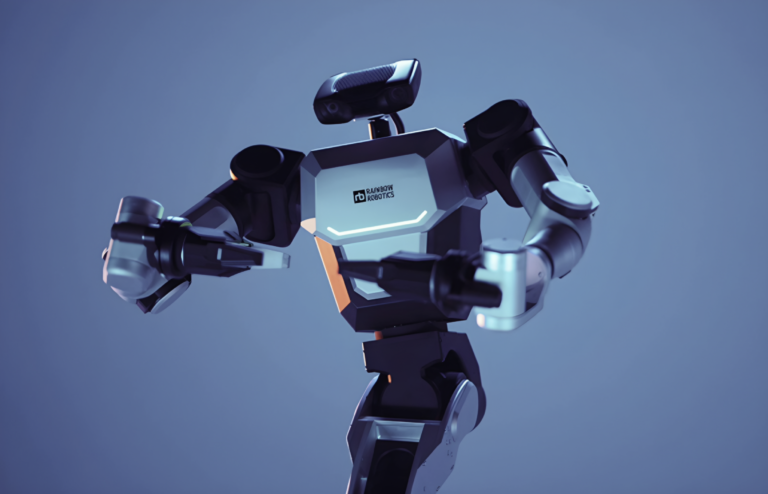
Samsung’s humanoid program operates on two parallel tracks, with Yoon’s appointment completing the internal track’s command structure. Industry officials, as reported by the Seoul Economic Daily, describe the division of labor as deliberate: Rainbow Robotics, the KAIST-origin company in which Samsung completed a controlling stake acquisition in early 2025, is concentrating on industrial applications — specifically expanding the payload capacity and working radius of its Rainbow Robotics dual-arm robot. An improved RB-Y2 model could make its public appearance at Robot World 2026 in November, per industry officials in September.
Samsung Electronics’ internal RX program, by contrast, is described as targeting the general-purpose humanoid market — the longer-term commercial prize of a machine capable of operating across varied environments and unstructured tasks. The CES 2027 appearance, should the reported plans materialize, would represent Samsung’s public entry into that category with an internally developed system and a “blueprint” for how Samsung intends to integrate physical mechanics, perception, and AI decision-making.
Rainbow Robotics’ RB-Y1 wheeled dual-arm platform is already in logistics pilots at Coupang fulfillment centers, and Samsung SDS announced on September 8 that it will build a “robot orchestration platform” targeting approximately 1,000 Samsung worksites and roughly 430 external companies that use Samsung’s manufacturing execution systems — a software infrastructure layer designed to coordinate humanoid robots, autonomous mobile robots, and collaborative robots across Samsung’s global factory network. The Samsung SDS announcement came at the company’s REAL Summit 2026 conference in Seoul.
Can Chinese Companies Be Beaten in the Humanoid Robot Race?
Samsung’s urgency has a specific competitive source. Global humanoid robot shipments reached 19,100 units in the first half of 2026 — a 272% surge from the prior year’s comparable period — and Chinese manufacturers accounted for more than 97% of that total, according to Smart Analytics Global (SAG). AgiBot, a Shanghai-based startup, led the market with approximately 8,400 units and a 44% global share, having surpassed prior leader Unitree Robotics (31% share, approximately 5,900 units). SAG projects full-year 2026 shipments will approach 60,000 units, generating approximately $1.6 billion in market revenue.
Unitree’s G1 humanoid ships at around $16,000 — a price established by China’s integrated domestic supply chain, which allows manufacturers to source motors, sensors, and batteries at manufacturing scale. TrendForce projected China’s humanoid output would surge approximately 94% in full-year 2026, with Unitree and AgiBot combined expected to account for nearly 80% of total shipments.
One emerging factor that changes the competitive calculation: the US Federal Communications Commission moved in late July 2026 to ban new imports of foreign-made humanoid and quadruped robots, citing cybersecurity and national security concerns — a FCC ban on Chinese humanoid imports that affects Unitree, AgiBot, and other Chinese manufacturers. The ban applies to new versions of covered products rather than units already approved or deployed, making it a wall against future Chinese humanoid expansion in the US market rather than a recall of existing deployments.
That restriction creates a specific opening for Samsung. South Korean manufacturers are not subject to the FCC order. An industry official told the Seoul Economic Daily that a robot supply chain free of security risks is exactly what the US and its allies need, and that Samsung, along with Hyundai Motor and LG Electronics, is positioned to fill that role given their world-class manufacturing competitiveness. The article noted the supply chain security opportunity in its reporting. CES 2027, held in Las Vegas, is Samsung’s stated target for establishing itself on that stage.
Can Samsung Build a Humanoid Prototype in Four Months?
The CES 2027 timeline — roughly four months from Yoon’s appointment completing the command structure — is compressed by any standard. Samsung’s program does not begin from zero: Shallow-π has cleared factory testing, the RX division’s personnel structure (strategy, manipulation development, academic partnerships) was assembled over the preceding months, and prior reporting from Korean media outlets ZDNet Korea and Maeil Business Newspaper in August 2026 described a separate, confidential in-house humanoid development program that industry sources said had been running for years and already outperformed several domestic rivals, using proprietary actuator technology derived from Samsung’s home-appliance motor manufacturing.
Samsung has also secured relevant intellectual property: the Samsung Bot trademark was registered in 2022, and the company’s 2024 hip-joint patent and 2026 robot-hand patent indicate sustained engineering work predating the RX division’s formal existence.
The group-level capital commitment behind the program provides additional context for what “accelerated development” means at Samsung’s scale. Samsung Electronics and Samsung SDS have committed ₩19 trillion (approximately $14.1 billion at current exchange rates) to the Gumi complex investment in North Gyeongsang Province for humanoid robot mass production and associated AI data center infrastructure. Samsung SDI has committed ₩16 trillion (approximately $11.9 billion) to its Ulsan plant for solid-state battery production lines for humanoid robots and electric vehicles. Samsung Heavy Industries has committed ₩10 trillion (approximately $7.4 billion) to an autonomous shipyard in Geoje. The total Samsung Group investment in this robotics and physical AI initiative is estimated at ₩60 trillion (approximately $44.6 billion).
South Korea’s domestic competitive pressure adds to the timeline urgency. Hyundai Motor Group presented its new electric Atlas humanoid earlier in 2026 — a program whose former strategy lead, Lee Dongkun, Samsung subsequently recruited. LG Group has launched its CLOi’d humanoid platform. The first Korean conglomerate to present a credible general-purpose humanoid on a global stage will shape the narrative of which country — and which company — leads the non-Chinese humanoid supply chain.
Exchange rate as of September 8, 2026; conversions are approximate.
Frequently Asked Questions
Why is it unusual for a software executive to lead both the hardware and AI software development teams?
In most large technology companies, hardware and software development operate as separate organizational domains with their own reporting structures, timelines, and tooling. For robotics specifically, the convention has been to build the physical platform first — design the frame, select the actuators, finalize the sensor suite — and then bring in the software team to write control algorithms for the resulting hardware. Placing a software and platform specialist in direct authority over both teams eliminates that handoff and forces both organizations to design simultaneously. The engineering rationale is that a VLA-based robot AI like Shallow-π has specific, non-trivial requirements for actuator latency, sensor modalities, and onboard compute — requirements that must be designed into the hardware from the start rather than accommodated after the body is built. Samsung’s reported rationale is that AI advances at a pace that makes the sequential model too slow: by the time a conventionally designed robot body is ready, the AI it was built for may already be superseded.
What is Samsung’s strategy for competing with Chinese humanoid manufacturers that control 97% of the market?
Samsung’s approach operates on three levels. First, on the AI side, the Shallow-π VLA model gives Samsung a proprietary robot intelligence system already proven in factory conditions. Second, on the hardware side, Samsung’s manufacturing heritage — specifically its large-scale production of brushless DC motors for home appliances, which share core architecture with robot joint actuators — offers a structural cost advantage in the most expensive component category (actuators account for 30 to 60% of a humanoid robot’s bill of materials by most industry estimates). Third, on the supply chain side, the US Federal Communications Commission’s late-July 2026 ban on new imports of Chinese-made humanoid robots opens a market for alternatives not subject to that order. Samsung is South Korean — its products are not covered by the FCC restriction — and the company appears to be positioning CES 2027 as the moment it establishes itself as the premium non-Chinese alternative. The FCC import ban specifically affects Unitree, AgiBot, and other foreign manufacturers of covered robotic devices.
What is a Vision-Language-Action (VLA) model, and why does it matter for humanoid robots?
A VLA model is an AI architecture that combines visual perception, natural language understanding, and physical motor control into a single end-to-end system. Where earlier robotics AI required separate systems for seeing, reasoning, and acting — each passing outputs to the next — a VLA model processes all three in a unified framework, enabling a robot to translate what it sees and hears directly into joint commands without intermediate steps. The practical significance for humanoid robots is generalization: a VLA-based robot can, in principle, perform tasks it has not seen before by leveraging the language model’s broad understanding of the world, rather than requiring explicit pre-programming for every new task or object. Samsung’s Shallow-π is a VLA model optimized for real-time dexterous control at 17 decisions per second — a speed that enables the precise manipulation tasks (sub-millimeter insertion accuracy, multi-joint coordination across 22 degrees of freedom) that industrial humanoid deployment requires. More detail on the VLA model architecture and its engineering implications is available in Samsung Research’s published work on the technology.
When could Samsung humanoid robots actually be available for purchase or deployment?
Samsung’s stated deployment sequence places industrial robots first — deployed in Samsung’s own manufacturing facilities as a proving ground — before any commercial sale to other manufacturers or consumers. The Gumi Robot Data Factory is being designed to generate AI training data from actual production operations, improving robot precision through real-world deployment feedback. Samsung has stated it expects to show “concrete humanoid progress” in the near term; the CES 2027 appearance, if it occurs, would represent a prototype reveal, not a commercial launch. Independent analysts project meaningful commercial humanoid deployment in industrial settings not before 2028–2030, with consumer-facing home-service robots remaining a longer-term target beyond that.