HomeAuto Russia’s GRU Hacked Ukraine’s Sanctioned-Asset Agency Days Before $165M Deadline
Russia’s GRU Hacked Ukraine’s Sanctioned-Asset Agency Days Before $165M Deadline
August 19, 2026:
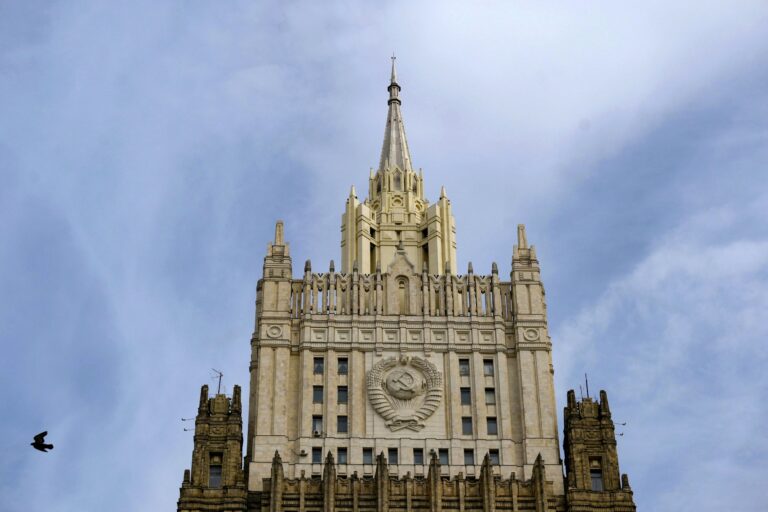
A bird flies past the Russian Foreign Ministry headquarters in Moscow on April 19, 2021. NATALIA KOLESNIKOVA/AFP via Getty Images
Russia’s military intelligence agency has turned its state cyberespionage apparatus against Ukraine’s asset-seizure bureaucracy, breaching the agency that manages seized oligarch assets with a cyberattack timed to the final days before the deadline for a competition to award independent management of a $165 million bottled water conglomerate linked to sanctioned Russian billionaire Mikhail Fridman. Ukraine’s security service opened an investigation, and the agency said the process would proceed.
Ukraine’s Asset Recovery and Management Agency — known by its Ukrainian acronym ARMA — confirmed on August 18, 2026 that its servers had been struck by unauthorized intrusion, disclosing the incident as it prepares to close the application window for the management competition for IDS Ukraine, the producer of Morshynska, Myrhorodska, Alaska, and Aqua Life bottled water. ARMA’s acting head Yaroslava Maksymenko said the agency had also detected unauthorized access to an internal database of ARMA officials since the spring of 2026, and that specialists were analyzing whether the attack and the IDS Ukraine competition were connected — though the agency provided no public evidence linking the attack to any specific individuals or groups. The Record reported further details on the agency’s internal investigation and Maksymenko’s statement that Russian oligarchic capital had built a “network of people willing to serve its interests from within our country.”
Applications to compete for the IDS Ukraine management contract are due August 22, making the timing of the intrusion, several days before the submission window closes, conspicuous to Ukrainian officials even if they stopped short of a public attribution.
GRU’s New Economic Front: Attacking Sanctions Enforcement, Not Just Military Networks
What makes this incident strategically significant is not what was attacked but why the target matters. ARMA is not a military institution. It is not a telecommunications network. It is the legal instrument through which Ukraine’s government seizes the economic assets of Russian oligarchs and their collaborators and attempts to transfer control of those assets away from Russian capital. Attacking it during a sensitive competitive process is a different category of operation from APT28’s documented history of GRU espionage against Ukraine — compromising the country’s power grid, its prosecutors’ email accounts, or its telecom infrastructure.
Russia’s GRU Unit 26165 — the military intelligence directorate indicted by US prosecutors in 2018 and tracked by cybersecurity firms under a thicket of names including APT28, Fancy Bear, BlueDelta, and Forest Blizzard — has been conducting a running cyberespionage campaign against Ukraine’s prosecutors and anti-corruption institutions for years. In April 2026, Ukrainian officials confirmed APT28 targeted prosecutors and agencies as part of a broader campaign that compromised more than 170 email accounts belonging to Ukrainian prosecutors and investigators. Taras Dzyuba, head of the information communications department at Ukraine’s State Service of Special Communications and Information Protection, told Recorded Future News that Ukrainian authorities had been tracking the campaign since 2023 and had identified three distinct waves of attacks.
The April 2026 campaign exploited vulnerabilities in Roundcube, a widely used open-source webmail platform, through a technique that required targets to do nothing more than open an email. No link click. No attachment. The malicious JavaScript executed within the victim’s authenticated browser session the moment the email was displayed — exfiltrating inbox contents, stealing credentials, harvesting two-factor authentication secrets from the webmail client’s authenticator plugin, and installing hidden Sieve rules that silently forwarded every incoming message to attacker-controlled email addresses, as Ctrl-Alt-Intel Roundcube research documented in detail. Researchers at Ctrl-Alt-Intel, who attributed that campaign to APT28 with high confidence, discovered an operational security blunder that exposed APT28’s command-and-control infrastructure — and with it, evidence of 11,000 emails and 240 credentials stolen, as well as 140 Sieve forwarding rules silently redirecting the inboxes of compromised Ukrainian government and military accounts.
ARMA’s Maksymenko said at the time that APT28’s April intrusion had failed to penetrate the agency’s internal systems. Whether the August 2026 attack used the same Roundcube vector or a different mechanism has not been confirmed; ARMA provided no technical details about the latest incident.
What Is at Stake: Morshynska, Myrhorodska, and a Three-Year Legal Fight
IDS Ukraine is one of the most commercially consequential seized assets in ARMA’s portfolio. The group — which operates the Morshynska Mineral Water Plant and several related companies producing the Myrhorodska, Alaska, and Aqua Life brands — reported UAH 7.4 billion revenue (approximately $165 million USD) in 2025. It is also one of the most legally complicated: the company’s corporate rights were seized by Ukraine’s Bureau of Economic Security in late 2022 after investigators determined it was ultimately linked to Fridman, who has been placed under a Fridman UK sanctions designation RUS0664 by Ukraine, the United States, the European Union, the United Kingdom, Canada, and numerous allied countries.
The legal path has been anything but direct. A first management competition concluded in March 2023 with the selection of a firm called Carpathian Mineral Waters, but the Carpathian Mineral Waters deal terminated because Ukraine’s Antimonopoly Committee never approved the agreement, ending it in 2025 without ever taking effect. In parallel, Ukraine’s Ministry of Justice escalated the matter in late 2024 by filing a lawsuit with the High Anti-Corruption Court seeking full nationalization of IDS Ukraine and related assets linked to Fridman, his Alfa Group co-founders Petr Aven and Andrei Kosogov, and associated holding companies. The current competition runs on a separate track from that nationalization proceeding, meaning whatever manager is selected now does so against a legal backdrop that could ultimately transfer the assets permanently to the Ukrainian state.
IDS Ukraine international shareholder structure has been at the center of the company’s dispute with ARMA. IDS Ukraine has argued that sanctioned shareholders have exercised no influence over the business since 2022, and pointed out that the majority of its shares are held by international investors — including the Patarkatsishvili family and the Georgian government — rather than by Fridman directly. No dividends have been paid to any shareholder since the corporate rights were frozen.
Who Is Mikhail Fridman and Why Does Russia’s GRU Protect His Assets?
Mikhail Fridman, born in Lviv, Ukraine, built one of the largest business empires in the former Soviet Union through Alfa-Bank and its associated holding company ABH Holdings. His net worth has been estimated by Forbes at approximately $11.8 billion at peak valuation before the invasion. Beyond banking, his Alfa Group held significant stakes in the telecom sector — including through Kyivstar, Ukraine’s largest mobile operator — as well as retail through X5 Group and natural resources investments.
Fridman’s legal exposure has multiplied since Russia’s February 2022 full-scale invasion. Ukraine’s SBU security service charged Fridman September 2025 with financing actions aimed at violently changing Ukraine’s constitutional order, an allegation connected to reported cash injections into Russian military industrial plants in the early days of the invasion. The UK National Crime Agency opened an investigation and searched his London home in December 2022 but NCA dropped Fridman personal investigation in September 2025, while noting that related investigations into associated suspects remained ongoing.
For a sanctioned billionaire with assets frozen under multiple jurisdictions, the question of who wins the IDS Ukraine management competition is not abstract. A well-connected manager with favorable terms could preserve the economic value of Fridman’s former holdings in a form more easily recoverable if sanctions were ultimately lifted. A hostile manager — or outright nationalization — would permanently sever the asset from any future claim. That structural reality is what ARMA’s acting head alluded to when she warned of a “network of people willing to serve” Russian oligarchic interests from within Ukraine.
Does Russia Use Cyberattacks to Protect Oligarch Assets?
Ukraine is not the only country that has documented Russian state actors interfering in sanctions enforcement proceedings. But the combination of factors here — APT28’s involvement, the specific timing to a competition deadline, the prior intrusion into ARMA’s officials database, and the agency’s explicit framing of the incidents as potentially coordinated — represents a documented instance of a state intelligence apparatus being deployed not against a military or communications target but against a privatization and enforcement process.
ARMA has faced persistent cyber pressure since the invasion. The agency’s own website confirms a pattern of DDoS attacks attributed to Russia, and in July 2024 ARMA July 2024 DDoS attack report notes the agency publicly flagged anomalous traffic from Russian IP addresses and from users masking their locations with VPN services. The pattern suggests that ARMA’s adversaries understand that cyber interference with the agency’s processes offers a return on investment distinct from anything achievable by attacking Ukraine’s power grid: disrupting a legal competition can yield years of additional control over an asset worth hundreds of millions of dollars.
What Comes Next for Ukraine’s Largest Seized Asset
Ukraine’s SBU is conducting a technical and forensic investigation into the August 2026 attack. ARMA said its specialists were analyzing both the cyberattack and the sequence of surrounding events to determine whether the incidents were connected. Separately, the HACC nationalization lawsuit filed by the Ministry of Justice in late 2024 continues on its own track — meaning IDS Ukraine faces both a near-term question (who manages it) and a long-term question (whether it remains in private management at all).
The ARMA competition proceeds despite attack, with the August 22 deadline for manager applications remaining in place. ARMA said it intended to conclude the selection through Ukraine’s Prozorro transparent public procurement platform. The attack on ARMA underscores an increasingly clear reality in the conflict’s cyber dimension: Ukraine’s economic governance infrastructure — the agencies that manage, sell, and transfer the proceeds of sanctions enforcement — has become a deliberate target alongside the country’s military networks. For adversaries seeking to preserve Russian oligarchic influence over assets already seized under Ukrainian law, disrupting the agencies responsible for severing those ties may prove as durable a strategy as any battlefield operation. Cyberattacks that introduce legal uncertainty, delay competitive processes, or expose bidder information accomplish something that no missile can: they make the enforcement of sanctions feel unreliable to anyone trying to participate in Ukraine’s legal markets, which is itself a victory for the sanctioned interests that enforcement is supposed to eliminate.
Frequently Asked Questions
What is ARMA and why was it targeted?
ARMA — Ukraine’s Asset Recovery and Management Agency — is the government body authorized to locate, seize, and manage assets taken from criminals and sanctioned individuals in criminal proceedings. It manages billions in property connected to Russian oligarchs, wartime collaborators, and organized crime. It was targeted, according to officials, because it is preparing to select an independent manager for IDS Ukraine, the producer of Morshynska bottled water, which is linked to sanctioned billionaire Mikhail Fridman. Disrupting or compromising the competition process could benefit those whose assets ARMA controls.
How does APT28’s Roundcube exploit work, and who should be concerned?
APT28 — Russia’s GRU Unit 26165, also known as Fancy Bear — exploited cross-site scripting (XSS) vulnerabilities in Roundcube, a widely used open-source webmail platform, as part of a 2026 campaign targeting Ukrainian prosecutors and anti-corruption officials. The technique is effectively zero-click: malicious JavaScript embedded in a spearphishing email executes within the victim’s authenticated browser session the moment they open the message. The code can then steal credentials, exfiltrate inbox contents, extract two-factor authentication secrets, and install hidden email-forwarding rules that silently redirect all future incoming mail to attacker-controlled addresses. Because Roundcube is the default webmail interface for many shared hosting platforms, patching lags are systemic — any government agency, nonprofit, or business running an unpatched Roundcube installation is operating within APT28’s documented Roundcube attack surface.
Does Russia use state cyberattacks to protect sanctioned oligarchs’ assets?
No Russian government body has acknowledged such a strategy. But the pattern documented in the ARMA case — APT28, a unit of Russia’s GRU military intelligence directorate, targeting Ukraine’s asset-seizure agency in the specific window of a sensitive competition — represents a form of operational alignment between state cyber capability and private oligarchic economic interests that goes beyond traditional espionage. The April 2026 APT28 campaign that compromised 170+ Ukrainian prosecutors’ accounts, and the August 2026 attack on ARMA during the IDS Ukraine deadline window, collectively suggest that protecting Russian capital from Ukraine’s enforcement machinery has become part of GRU’s operational mandate in the war — a use of state cyber power to preserve private wealth that is structurally distinct from anything Russia’s GRU has previously been documented pursuing in Ukraine.
Will the IDS Ukraine competition proceed after the attack?
ARMA has stated explicitly that the competition will proceed as planned, with applications due August 22 and the selection to be conducted through Ukraine’s Prozorro transparent public procurement system. The SBU investigation into the attack is ongoing. Separately, Ukraine’s Ministry of Justice has a pending nationalization lawsuit before the High Anti-Corruption Court that could ultimately result in IDS Ukraine being transferred to full state ownership — a different outcome from the managed-privatization track the current competition represents.