HomeAuto Roman Space Telescope Launches: Spy-Satellite Mirror to Map Billion Galaxies
Roman Space Telescope Launches: Spy-Satellite Mirror to Map Billion Galaxies
August 30, 2026:
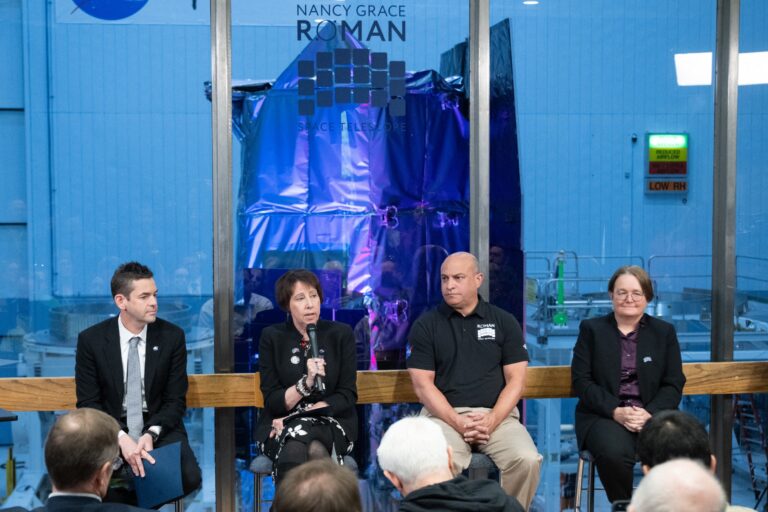
NASA Administrator Jared Isaacman (L) speaks alongside Nicky Fox (2nd L), associate administrator of Science Mission Directorate, Jamie Dunn (2nd R), Roman telescope project manager, and Julie McEnery (R), Roman telescope senior project scientist, in front of the Nancy Grace Roman Space Telescope after it was unveiled to the public at NASA’s Goddard Space Flight Center in Greenbelt, Maryland on April 21, 2026. SAUL LOEB/AFP via Getty Images
At 7:26 a.m. ET this morning, a SpaceX Falcon Heavy is scheduled to carry the Nancy Grace Roman Space Telescope off Launch Complex 39A at Kennedy Space Center — and when it does, the oldest part of that telescope’s story will already have spent nearly 15 years in civilian hands. Roman’s 2.4-meter (7.9-foot) primary mirror began not as an astronomy instrument but as surplus hardware from a canceled Cold War spy satellite program, and whether that hardware can help settle one of physics’ deepest live debates — whether dark energy is a fixed constant or something that changes over time — is among the most consequential questions in science launching into orbit today.
Live coverage begins at 6:20 a.m. ET at nasa.gov/live and on NASA+, NASA’s YouTube channel, and SpaceX’s feeds. The window is instantaneous: if Sunday’s attempt is scrubbed, the backup window opens Monday, August 31, at 7:22 a.m. ET.
What Made This Mirror
Roman’s primary mirror has an unusual provenance — its origins in spy satellite hardware are now thoroughly documented. In 1999, the National Reconnaissance Office contracted Boeing to build a new generation of high-resolution surveillance satellites under a classified program called the Future Imagery Architecture — hardware capable of imaging objects smaller than a coffee mug from orbit. The program ran billions of dollars over budget and was canceled in 2005. Two completed, flight-qualified optical telescope systems — mirrors, support structures, baffles, and controllers — sat unused in a warehouse in Rochester, New York.
In 2012, the NRO donated both to NASA. Each telescope was estimated to be worth at least $250 million. NASA stripped the classified electronics the NRO had removed from its paperwork, built an entirely new spacecraft and instrument suite around one of the mirrors, and named the result for Nancy Grace Roman — NASA’s first Chief of Astronomy, the agency’s first female executive, and the astronomer whose advocacy in the 1960s and 70s made the Hubble Space Telescope possible.
The NRO heritage gave Roman a 2.4-meter (7.9-foot) aperture — exactly Hubble’s size — when the original WFIRST design had called for a 1.3-meter (4.3-foot) mirror. That larger mirror also made room for an instrument that the smaller design could not have accommodated: a coronagraph, which will be the focus of some of this mission’s most consequential science.
Whether using repurposed spy optics actually saved money remains genuinely contested among mission analysts. The donated hardware came with removed electronics, redacted documentation, and the cost of building new instruments and a new spacecraft around it. The total mission cost was $4.3 billion. What is clear is that the donated 2.4-meter mirror transformed the mission’s scientific scope.
A Telescope That Survived Four Attempts to Kill It
The fact that Roman is at a launch pad at all reflects as much political endurance as engineering. The Trump administration proposed canceling Roman four separate times between 2018 and 2025. The most recent attempt came in April 2025, when the White House budget office proposed cutting NASA science funding nearly in half — from $7.5 billion to $3.9 billion — and canceling dozens of space missions. At that point Roman had already cost approximately $4 billion and was nearing final integration.
Congress blocked each attempt. In January 2026, lawmakers passed a $24.4 billion NASA budget that explicitly described Roman as “currently ahead of schedule and under budget” and protected it from further cancellation pressure. Bipartisan support from the Congressional Planetary Science Caucus provided the political insulation the mission needed.
“You’ve built it, and you’re not going to do the final step to finish it? That is such a waste of taxpayers’ money,” David Spergel, former co-chair of Roman’s science team and president of the Simons Foundation, said during the 2025 fight.
The $255 million SpaceX launch contract — a fixed-price competitive procurement — adds a final cost discipline that flagships of prior generations rarely had.
How Roman’s Camera Works — and Why Width Matters
Roman’s Wide Field Instrument is a 300-megapixel infrared camera built from 18 mercury cadmium telluride detector arrays — specifically H4RG-10 chips from Teledyne Technologies — arranged in a mosaic that covers 0.28 square degrees of sky per single exposure. That field of view is more than 100 times larger than Hubble’s infrared camera, which means Roman can image in a single pointing a patch of sky that would require Hubble 100 separate observations to cover.
The camera covers wavelengths from 0.48 to 2.30 micrometers — visible blue light through the near-infrared — with a rotating filter and spectroscopy wheel carrying eight science filters, a high-dispersion grism, and a lower-dispersion prism that lets scientists switch between imaging and spectroscopy during a survey. The focal plane sits on actuators that reposition it throughout the mission to maintain optimal focus as the telescope ages.
The width is not an aesthetic choice — it is a scientific necessity. To measure dark energy by counting the shapes and distances of roughly a billion galaxies, or to monitor 200 million stars simultaneously for the brief brightening events that betray a planet in front of a background star, you need area. No targeted, narrow-field telescope can assemble that statistical picture. Roman’s Wide Field Instrument generates approximately 20,000 terabytes of data over its five-year primary mission — more than 100 times the total data volume the Hubble Space Telescope produced in 30 years.
All of that data will be publicly released through NASA’s archives following the open-access model used for Hubble and Webb, with no proprietary period.
What Dark Energy Actually Means — and Why the Answer Matters Now
About 70 percent of the energy content of the universe appears to be dark energy — an unknown force causing the universe’s expansion to accelerate rather than slow, a discovery that earned the 2011 Nobel Prize in Physics. The leading candidate explanation is Einstein’s cosmological constant: a fixed vacuum energy inherent in the fabric of spacetime, characterized by the equation-of-state parameter w = -1. If dark energy is the cosmological constant, the universe expands forever at an accelerating rate that never changes. If w differs from -1, or changes over time, the entire picture changes — including the universe’s ultimate fate.
This is not an abstract dispute. Results from the Dark Energy Spectroscopic Instrument (DESI) suggested dark energy may be evolving — that w is not exactly -1. Three years of DESI data, analyzed through 2026, have strengthened this signal. If confirmed, that would mean Einstein’s cosmological constant as the sole explanation for cosmic acceleration is ruled out, and physics requires something new. The question is live and contested, and Roman is arriving to settle it.
Roman will attack dark energy using three independent and complementary techniques:
Weak gravitational lensing: Intervening mass — dark matter and ordinary matter — bends and distorts light from distant galaxies, subtly warping their apparent shapes. Individual distortions are unmeasurable; only statistical correlations across millions of galaxy shapes reveal the signal. Roman’s billion-galaxy sample will map the distribution of dark matter across cosmic history with unprecedented precision. If those measurements disagree with predictions from the Planck satellite’s cosmic microwave background data, standard cosmological models will require modification.
Baryon acoustic oscillations: Sound waves propagating through the hot plasma of the early universe froze in place when the universe cooled, imprinting a preferred scale on galaxy clustering — roughly 500 million light-years — that can be used as a “standard ruler” to trace cosmic expansion. Roman will extend DESI’s measurements to higher redshifts, providing a new window into dark energy’s behavior across cosmic time.
Type Ia supernovae: Exploding white dwarf stars with consistent peak brightness serve as “standard candles” for measuring cosmic distances. Roman will detect thousands of supernovae across vast stretches of cosmic time, extending the measurement that originally revealed accelerating expansion in 1998.
Together, these three techniques will constrain the dark energy equation of state — whether it is w = -1 exactly, or something that evolves — to a precision previously unachievable from any single observatory.
What the Coronagraph Is Actually For
Roman’s second instrument, the Coronagraph Instrument (CGI), is a compact technology demonstrator packed alongside the primary camera. It addresses a problem separate from dark energy: blocking a star’s light precisely enough to photograph the planets beside it.
The challenge is scale. A planet is typically billions of times dimmer than its host star. Even after a physical mask blocks the star’s direct light, enough photons scatter around the mask’s edges — due to imperfections in the telescope’s optics — to overwhelm a planet’s faint signal. Every prior space coronagraph has been passive: once deployed, it cannot correct for those optical imperfections.
Roman’s CGI changes that. It contains two deformable mirrors, each with a 48-by-48 grid of actuators — 2,304 tiny piezoelectric pistons — beneath a thin deformable sheet of glass. Applying small voltages to those actuators nudges each patch of mirror by as much as 0.5 micrometers (roughly one-fourth the diameter of a red blood cell). Before each observation, CGI measures what residual starlight is leaking into its field of view and reshapes the mirrors to drive that scattered light into a region astronomers call the “dark hole.” The cycle repeats — measure, correct, observe — until starlight is suppressed to roughly one part in a billion. Ground testing in 2024 achieved better than 5×10^-8 raw contrast in flight-representative conditions, exceeding its minimum requirement.
That is three orders of magnitude better than the best passive space coronagraphs. But it is still short of the one part in 10 billion (10^-10) that NASA’s planned Habitable Worlds Observatory would need to photograph an Earth-like rocky planet around a sun-like star and search its atmosphere for biosignatures — chemical signs of life.
“I hope it’s remembered for being that critical stepping stone for finding Earth 2.0,” said Brandon Creager, CGI’s lead mechanical engineer at JPL, in an interview with MIT Technology Review, as cited in prior TechTimes reporting.
If CGI underperforms in space, the engineering roadmap to the Habitable Worlds Observatory stalls, because active-wavefront-control coronagraphy has not been validated in the actual space environment and no obvious alternative architecture exists for a life-detection mission. If it succeeds, HWO’s feasibility improves substantially.
Roman’s Journey and What Comes Next
After separation from the Falcon Heavy’s upper stage, Roman will spend approximately 30 days cruising to the Sun-Earth Lagrange Point 2, a gravitationally stable position roughly 1.5 million kilometers (930,000 miles) from Earth in the direction opposite the Sun. L2 is also home to the James Webb Space Telescope and offers a thermally stable, unobstructed view of the sky — the same environment Roman’s infrared detectors require.
Once at L2, the observatory will undergo roughly 100 days of commissioning — instrument calibration, mirror alignment checks, and system verification — before science operations begin in early 2027. If that process goes smoothly, the first public science images could arrive before the end of 2026.
Roman and Webb are designed as complements, not competitors. Webb stares at small patches of sky with extraordinary sensitivity, studying individual galaxies, star-forming regions, and exoplanet atmospheres in extraordinary detail. Roman surveys enormous areas of sky at speed — covering more than 100 times the area of Hubble’s infrared camera in a single exposure. In practice, Roman’s wide-field surveys will identify which specific objects and regions are worth Webb’s narrow-field attention. The two missions were deliberately designed to work as a system.
Roman was the top-ranked large space science priority in the 2010 Astronomy and Astrophysics Decadal Survey — the field’s collective research agenda. That ranking secured its conceptual backing more than a decade before today’s launch, making Roman’s survival through four cancellation attempts not just a political story but a story about how the scientific community’s priority-setting process ultimately prevailed.
Who Nancy Grace Roman Was
The telescope bears the name of Nancy Grace Roman (1925–2018), NASA’s first Chief of Astronomy and the agency’s first female executive. A pioneering astronomer who earned her doctorate from the University of Chicago in 1949 at a time when women were routinely told they did not belong in science, Roman spent her career championing what became the Hubble Space Telescope. She founded the Hubble planning committee that defined the telescope’s scientific specifications in the 1960s, secured NASA’s institutional commitment, and testified before Congress through the 1970s to keep the program alive. Edward Weiler, Hubble’s chief scientist, called her “the mother of the Hubble Space Telescope.” Roman was uncomfortable with that title in her later years — given the contributions of so many others — but the name stuck.
She died in December 2018. In May 2020, NASA Administrator Jim Bridenstine announced the observatory would carry her name. Today’s launch is the first time a NASA flagship mission bears the name of a woman.
A post-launch press conference with NASA Administrator Jared Isaacman and members of the Roman mission team is scheduled for 9:30 a.m. ET.
Frequently Asked Questions
How is the Roman Space Telescope different from the James Webb Space Telescope?
The two observatories are designed for opposite scientific modes and are intended to complement, not duplicate, each other. Webb has a 6.5-meter (21.3-foot) mirror and looks at small patches of sky with extraordinary sensitivity — studying individual galaxies, exoplanet atmospheres, and star-forming regions in precise detail. Roman has a 2.4-meter mirror but a camera that covers more than 100 times the sky area of Hubble’s infrared camera per exposure, allowing it to survey enormous swaths of the universe at Hubble-like resolution. That speed is what Roman needs to count one billion galaxies for dark energy mapping and to monitor 200 million stars simultaneously for gravitational microlensing planet detections. Neither telescope does what the other does well; Roman’s surveys will tell astronomers where to point Webb for follow-up study.
Why does it matter whether dark energy is a cosmological constant or something that changes?
If dark energy is Einstein’s cosmological constant — fixed, unchanging vacuum energy with equation-of-state parameter w = -1 — then the universe expands forever at an accelerating rate that never changes, and our current theoretical framework holds. If dark energy is dynamic — if w varies over time — then the cosmological constant is ruled out as a complete explanation, and physics requires something new: a new field, a modification of general relativity, or something else entirely. Recent results from the Dark Energy Spectroscopic Instrument (DESI) have raised real suspicion that w may not equal -1. Roman is the next major observatory designed to test that suspicion with statistical power no prior mission has had. The stakes are not abstract: this is the question of what the universe is fundamentally made of and where it is going.
What will happen to the Falcon Heavy’s three boosters during the launch?
The two side boosters will separate from the vehicle approximately 2 minutes and 28 seconds after liftoff and fly back to propulsive landings at Cape Canaveral Space Force Station’s Landing Zone 2 and Landing Zone 40 — roughly 7 minutes and 23 seconds after launch. Those simultaneous twin landings are among the most visually dramatic events in contemporary rocketry. The center core, however, will not return. Roman’s mass — approximately 10,150 kilograms (22,381 pounds) — and its destination at L2, roughly 1.5 million kilometers from Earth, require every kilogram of thrust the rocket can generate; the fuel a center core landing burn would consume is needed instead for useful payload velocity. SpaceX designed the Falcon Heavy from the start to expend the center core on high-energy missions of this type.
When will Roman’s first science images be available to the public?
After launch, Roman will spend approximately 30 days cruising to L2, then about 100 days in commissioning — instrument calibration, mirror alignment, and system verification. Science operations are expected to begin in early 2027. All of Roman’s science data will be released publicly through NASA archives following the same open-access model used for Hubble and Webb, with no proprietary period for mission-team-only use. If commissioning goes smoothly, the first public science images could arrive before the end of 2026.