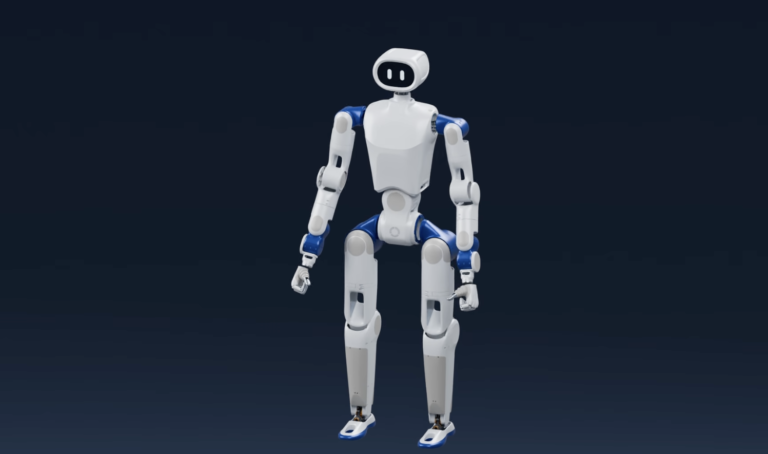
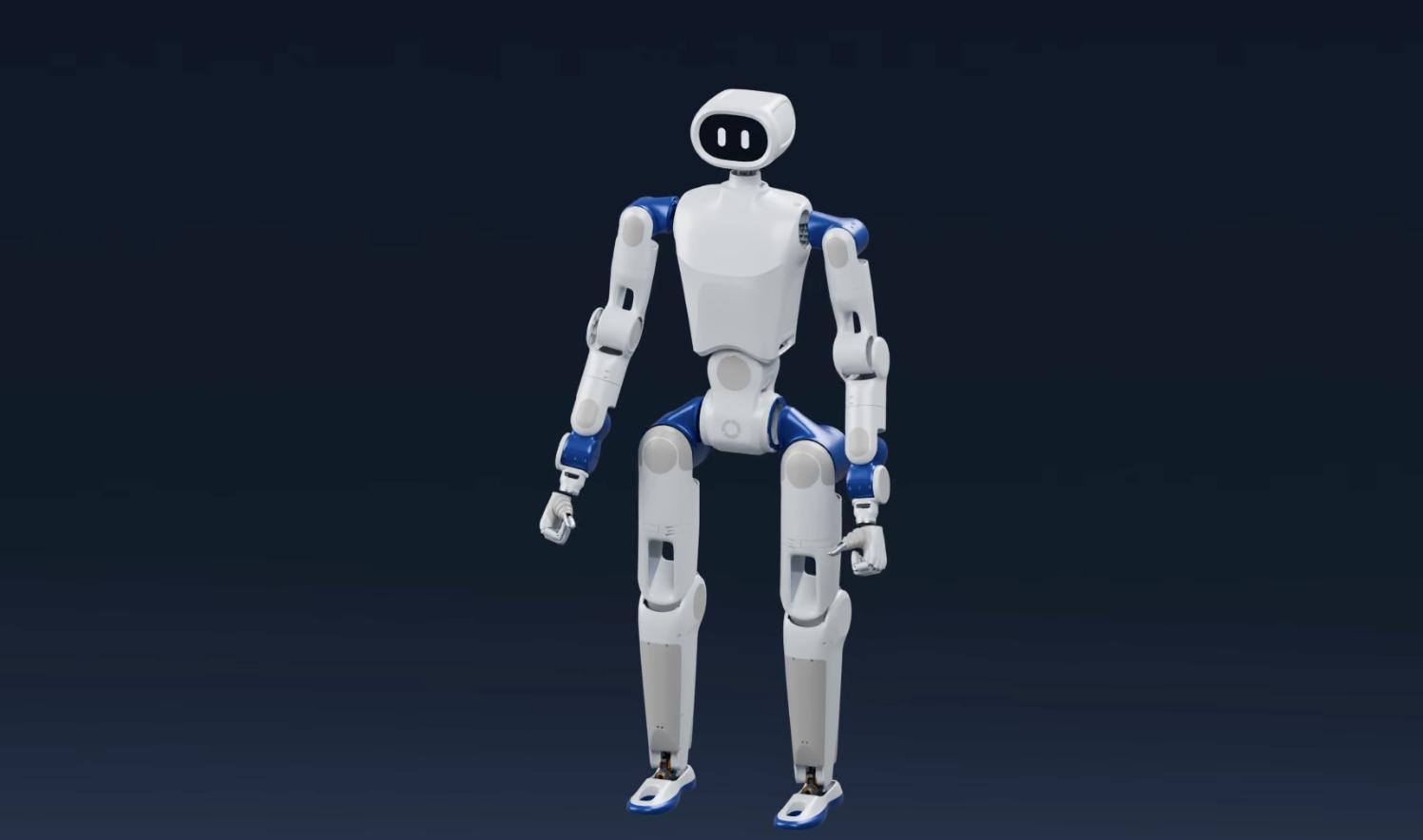
Shanghai startup RoboParty, founded in early 2025 by 22-year-old robotics engineer Yi Huang, has published the hardware and software designs for its RP1 humanoid robot on GitHub — releasing SolidWorks CAD assemblies, fabrication-ready Gerber files for 14 custom circuit boards, and NVIDIA Isaac Lab reinforcement-learning training workflows in a single open-source package that ranks among the most comprehensive humanoid open-source releases ever produced for a full-size bipedal robot.
Before adopting the platform, researchers and developers need to weigh two material caveats in the release itself — a missing actuator firmware layer that limits real-world reproducibility, and a non-commercial license restriction that blocks industry use of the core motion-learning framework — alongside the obligations that China’s National Intelligence Law imposes on every company operating in Shanghai.
The RP1 stands approximately 1.35 meters tall (4 ft 5 in) and is offered in standard 24- and 30-DoF configurations. No pricing or shipping date has been announced for either version.
From IROS Demo to Full GitHub Release
RoboParty’s public trajectory has been unusually fast. Founded in February 2025, the company shipped its predecessor open-source project RPO (ROBOTO ORIGIN) to GitHub in January 2026; that repository has since accumulated more than 2,600 GitHub stars and spawned documented community builds. The RP1 builds directly on that foundation.
The robot made its global debut on September 28, 2026, at the IROS 2026 debut in Pittsburgh — the IEEE/RSJ International Conference on Intelligent Robots and Systems in Pittsburgh, Pennsylvania — where RoboParty staged a booth demonstration dubbed “Kick Me”: visitors were invited to physically push and disturb the standing robot, which recovered balance in real time using the company’s motion-control stack. RoboParty announced the GitHub full-stack release on October 14 via X/Twitter, and an independent technical breakdown by Engineering.com published confirms all five design repositories are publicly accessible.
The company reported a CATL-led Pre-A funding round of approximately ¥500 million (approximately $74.9 million USD) with prior backing from Xiaomi, SenseTime, and Shunwei Capital. Founder Yi Huang’s stated rationale for full-stack openness is direct: “Humanoid robots should not be closed systems that only a small number of teams can build while everyone else can do little more than watch,” founder Yi Huang said. “Full-stack open source has been our technical direction since the RPO project.”
Inside RP1: Compute, Joints, and Swappable Heads
The standard RP1 weighs approximately 39 kg (86 lbs) with battery and end effectors installed; the Pro adds roughly 2 kg (about 4 lbs). Both frames are built from AL6061 and AL7075-T6 aluminum alloy, with a polycarbonate chest enclosure and resin and polyurethane surface coverings.
Compute architecture: The standard RP1 centers on a Rockchip RK3588 application processor — an octa-core chip with a 6 TOPS (tera-operations-per-second) neural processing unit — paired with 8 GB of LPDDR4x memory and 32 GB of eMMC storage. The RK3588 and Jetson Orin NX Pro supplement this with an Allwinner A733 co-processor and an NVIDIA Jetson Orin NX 16 GB module, adding approximately 40 TOPS of dedicated AI inference capacity for perception-heavy tasks. A separate 480 MHz real-time MCU handles motion scheduling, power sequencing, and emergency-stop functions across both models, keeping latency-sensitive control isolated from the main application processor.
Degrees of freedom: The standard RP1 distributes its 24 DoF as six per leg, five per arm, and two for the waist. The Pro extends this to 30 DoF with two additional wrist-roll axes per arm (yielding 7-DoF arms) and a two-axis neck joint — relevant for manipulation tasks requiring wrist orientation control.
RP Hand: The RP Hand is a five-finger dexterous end effector with six actively controlled axes and 11 total mechanical degrees of freedom (the remaining five are passive or coupled through worm-gear transmissions). It weighs approximately 379 grams (13.4 oz) and communicates over CAN-FD. Optional tactile sensing is supported. The standard RP1 ships with passive dummy hands; the Pro includes 6-DoF dexterous hands by default.
Head modularity: RoboParty designed four interchangeable head modules — a locomotion head with an LED eye display for basic motion research, an interaction head with display, speaker, and microphone, a perception head adding an Intel RealSense D435i depth camera and 3D LiDAR, and a data-collection head with stereo RGB cameras for training data capture. Both models include a 6-axis IMU.
Motion performance and power: The RP1 Pro achieves a maximum running speed of 4 m/s (about 8.9 mph) and can climb slopes up to 30 degrees. Maximum step height is 50 mm (about 2 in). A 10 Ah hot-swap battery system supports hot-swapping without powering down: a 48V main lithium pack covers primary systems while a 30V auxiliary battery maintains critical control power during a swap. Runtime is rated at up to three hours, with an approximately 1.5-hour recharge time via 140W USB-C fast charging or a magnetic connector. Wireless connectivity covers Wi-Fi 6, Bluetooth 5.2, and 4G cellular; a hardwired or 433 MHz emergency-stop signal can halt all motion immediately.
CAN-FD Distributed Actuation: Why the Architecture Matters
The RP1’s mechanical core is RoboParty’s in-house ROMOMO actuator family, and understanding how it works is essential to understanding where the open-source release helps and where it falls short.
Each ROMOMO module is a self-contained joint unit using a two-stage planetary gear reduction paired with an inner-rotor motor. The largest variant — a 100 mm-diameter (3.9 in) module deployed at the hips and knees — delivers up to 160 N·m (118 lb-ft) of peak torque: enough for dynamic locomotion in a 39 kg (86 lb) biped, where peak hip moments during running can approach that range. Four ROMOMO module designs cover the different joints of the body.
Each module runs its own current, velocity, and position control loops locally on an embedded MCU. The main controller communicates setpoints and reads feedback over a CAN-FD bus — an automotive-derived fieldbus standard (ISO 11898-1) that supports data frames of up to 64 bytes at bitrates up to 8 Mbps, roughly eight times the payload and bandwidth of classic CAN. This distributed architecture offloads inner-loop computation from the central processor and keeps latency low: each joint runs its own fast control loop, while the main controller handles motion scheduling, not microsecond current regulation.
The published ROMOMO joint module specifications include joint-module specifications, mechanical drawings, CAN-FD protocol documentation, and test reports. It does not include the embedded firmware source code—the software running the control loops inside each module—and that gap is the most consequential limitation of the release.
PartyOS Ecosystem: What the GitHub Repos Contain
The software release spans five PartyOS GitHub repositories organized under the PartyOS umbrella:
RP1_hardware covers SolidWorks assemblies, Parasolid models, mechanical drawings, wiring harnesses, bills of materials, and manufacturing files for 14 custom PCBs — including Gerber fabrication files, component placement coordinates, 3D models, and BOMs. This repository is licensed under CERN-OHL-W-2.0, a “weakly reciprocal” open hardware license developed by CERN that requires modifications to the published designs to be released under the same license, but does not require products that incorporate the designs unchanged to be open.
RP1_firmware publishes the Linux BSP (board support package), USB-to-CAN-FD bridge firmware, and software packaging tools.
roboparty_deploy is a ROS 2-based deployment framework covering motor and IMU drivers, Intel RealSense camera integration, ONNX-format policy inference on the RK3588 NPU, robot configuration files, and a Python SDK.
RP1_description publishes URDF and MJCF robot model files, meshes, and simulation assets for use with NVIDIA Isaac Lab and MuJoCo.
roboparty_train contains the roboparty_train RL training stack built on NVIDIA Isaac Lab, including: AMP (Adversarial Motion Priors) for motion imitation from reference data, BeyondMimic and MimicLite (RoboParty’s own methods), the RSL-RL training loop, and MuJoCo Sim2Sim testing for validating policies in a second simulator before hardware deployment.
The UFO (Unsupervised Framework for Opportunities) motion-learning framework, which uses unsupervised reinforcement learning to discover motor skills from motion capture data without hand-engineered reward functions, is available within this stack — but under a CC BY-NC 4.0 license.
Open Source With Limits: What Is and Is Not Published
Two specific gaps in the release define the practical boundary of what you can actually build independently.
The ROMOMO firmware gap: The embedded control software running inside each ROMOMO joint module was not included in the initial GitHub publication. This matters specifically for sim-to-real transfer. URDF and MJCF models describe the robot’s kinematics and nominal inertial properties, but accurate joint-level simulation also requires precise models of actuator dynamics: the transfer function from commanded torque to actual motor current, the friction characteristics of the planetary gears, the bandwidth and phase response of the embedded PID loops. Without the firmware, researchers must either measure actuator behavior empirically on physical hardware to build a model, or make simplifying approximations — and those approximations introduce a sim-to-real gap specifically at the joint level, in addition to the contact-dynamics gap that all sim-to-real research faces. The “training-to-real pathway” RoboParty advertises is real and functional for the 24-DoF RP1 configuration; it is more constrained than the platform’s documentation implies.
The CC BY-NC commercial restriction on UFO: The Creative Commons Attribution-NonCommercial 4.0 license on the UFO framework prohibits commercial use — which, under standard CC BY-NC interpretation, includes researchers employed by a company, even when the research output is not itself sold. Industry R&D labs, startup developers, and university researchers with commercial funding agreements cannot use UFO in their workflows without negotiating a separate license from RoboParty. This is a hard boundary, not a nuance: it defines who this platform is open to and who it is not.
Two additional gaps apply to the Pro configuration: the 30-DoF RP1 Pro body has no dedicated RL training tasks or released default policy files yet, and the RP1 Pro deployment guide coming is described as “coming soon.” Researchers targeting the Pro’s additional dexterity will need to build their own training setups.
How RP1 Compares to Other Research Humanoids
The RP1 enters a substantially more competitive research-humanoid landscape than existed two years ago. Unitree’s R1, a 1.21-meter robot with 26 DoF, launched in mid-2025 at approximately $5,900. Fourier’s N1 targets a similar research audience with EtherCAT-based actuation. The Raspberry Pi-powered SamuRoid, a 22-DoF platform with multimodal LLM support, debuted earlier in 2026.
What distinguishes the RP1 is the combination of hardware transparency depth and toolchain integration. Publishing full PCB Gerber files is almost without precedent in humanoid robotics — most competitors release CAD geometry or algorithms, not the fabrication files that allow any PCB manufacturer to reproduce the electronics. The Isaac Lab and MuJoCo integration means the software stack runs on mainstream RL toolchains rather than custom frameworks, lowering the barrier to contribution. And the community of 5,000 developers inherited from the RPO predecessor project gives RoboParty an ecosystem foundation that most new hardware entrants lack.
The 160 N·m (118 lb-ft) peak torque in the ROMOMO hip/knee modules is notably high for a 39 kg (86 lb) robot, suggesting the actuators were sized with eventual manipulation tasks in mind — loads that require force-controlled contact, not just walking.
Chinese Law and Your Research Data
Researchers and institutions considering the RP1 platform need a clear-eyed view of four dimensions that the hardware specifications alone do not capture.
Performance and specification gaps: The published specifications — 160 N·m torque, 4 m/s top speed, 6 TOPS NPU inference — are manufacturer-reported figures with no independent verification at time of writing. No third-party benchmark or independent audit of the RP1’s real-world performance exists yet. The standard RP1’s RK3588 NPU provides 6 TOPS of inference capacity: sufficient for locomotion policy inference (well-trained locomotion networks are small) but limiting for perception-heavy research tasks, which is why the Pro adds the Jetson Orin NX module. Additionally, the ROMOMO embedded firmware omission limits reproducibility of the core mechanical system; the deployment guide for the 30-DoF Pro configuration remains unpublished.
Benchmark reliability: No named independent organization has confirmed RoboParty’s published performance figures. For a company headquartered in an authoritarian jurisdiction, benchmark claims should be treated as unverified until confirmed by a named independent source — a standard that applies regardless of the technical plausibility of the claims. The RP1 is new hardware; the gap between datasheet figures and real-world performance in contact-rich tasks is an empirical question, not yet answered.
Ecosystem and operational maturity: Primary documentation is in Chinese; English materials exist but are less complete. No pricing has been announced, and no firm shipping schedule is confirmed. The CC BY-NC restriction on UFO, combined with the ROMOMO firmware gap, means the platform’s effective openness for commercial-context researchers is meaningfully narrower than the headline “full-stack open source” suggests. Community support is active but young — the company was founded 20 months ago.
State data-sharing obligations — the legal framework that cannot be waived: RoboParty is incorporated and operates in Shanghai, People’s Republic of China. Three Chinese laws create binding obligations that apply to the company regardless of any privacy policy, Western business address, or server location:
China’s National Intelligence Law (2017), Article 7 requires that “all organizations and citizens shall support, assist, and cooperate with national intelligence work in accordance with law.” This is not a risk to be weighed against convenience — it is the operative law. RoboParty has no legal mechanism to refuse a request from Chinese intelligence authorities.
The Data Security Law (2021) requires Chinese organizations to classify data by sensitivity, implement protective measures, and cooperate with government data access requests. The Cybersecurity Law (2017) requires network operators to store user data within China and cooperate with security inspections.
The data an RP1 collects that could be subject to these obligations includes: continuous camera and depth sensor feeds (perception and data-collection head configurations), IMU orientation and acceleration data, CAN-FD bus logs recording every joint command and feedback value (a detailed kinematic record of all robot motion), research policy files and training datasets, Wi-Fi 6 and 4G cellular network traffic, and audio from the interaction head’s microphone.
The FCC voted to ban imports of Chinese humanoid robots on July 29, 2026, citing national security concerns related to exactly this data-collection capability combined with Chinese government access obligations. The ban currently prohibits commercial import; its application to research and academic institutions should be confirmed with legal counsel before procurement.
The most effective technical mitigation is network isolation: run the RP1 on an air-gapped or VLAN-isolated research network with Wi-Fi 6 and 4G radios disabled, and audit all ROS 2 nodes and firmware for network call-home behavior before deployment. No technical mitigation fully addresses the structural legal risk, because the company’s obligation to cooperate with Chinese intelligence requests exists independently of how the robot is configured.
Availability
All five design repositories are currently available on GitHub. Product documentation is published at roboparty.com. RoboParty has not confirmed pricing or a shipping schedule for the RP1 or RP1 Pro. A mass-production program is described as planned per the company’s Q4 2026 mass production plan.
Researchers evaluating the RP1 as a development platform are weighing a genuinely unusual degree of hardware transparency — Gerber files, SolidWorks assemblies, and a complete Isaac Lab RL stack in a single release — against two specific technical gaps (missing ROMOMO firmware, commercial-use restriction on UFO), incomplete Pro documentation, and the fixed legal condition that China’s National Intelligence Law places on any Shanghai-headquartered company. The technical openness is real; so is the legal framework. Both belong in the evaluation.
Frequently Asked Questions
Is the RP1 available to purchase, and how much does it cost?
RoboParty has no confirmed price announced for either the RP1 or the RP1 Pro. Informal listings place the RP1 at roughly $16,000 USD, but that figure is unconfirmed by the company. The full hardware and software designs are freely downloadable from GitHub now; the physical robot has no confirmed commercial availability date.
What can’t you actually build with the open-source files alone?
The embedded firmware source code for the ROMOMO joint actuators was not published in the initial GitHub release. This means a builder cannot fully reproduce the inner control loops running inside each joint module, and cannot accurately model those loops in simulation without either measuring actuator behavior empirically or making approximations that introduce sim-to-real errors. Additionally, the UFO motion-learning framework is licensed under CC BY-NC 4.0, which prohibits use by commercial entities — including industry researchers and startup developers — without a separate commercial license from RoboParty. The 30-DoF Pro configuration has no default RL policy files yet.
Are Chinese humanoid robots currently legal to import and use in the United States?
The FCC voted July 29, 2026 to ban the commercial import of Chinese humanoid robots into the United States, citing national security concerns. The ban applies to humanoid robots capable of autonomous locomotion, sensor data collection, and wireless communication from companies subject to Chinese government oversight — a description that includes the RP1. Researchers and institutions considering procurement should consult legal counsel on whether research or academic use falls under any exemption before attempting to import the device.
What does China’s National Intelligence Law mean for data my robot collects?
China’s National Intelligence Law (2017), Article 7, legally requires every Chinese organization to cooperate with government intelligence requests — and RoboParty, as a Shanghai company, cannot refuse such a request. In practical terms, this means any research data that flows through RoboParty-controlled infrastructure, or that Chinese authorities request access to, is potentially subject to disclosure. The robot itself collects camera feeds, joint position logs, network traffic, and audio, depending on which head module is installed. The most effective mitigation is running the RP1 on a fully network-isolated research environment with wireless radios disabled, though no configuration fully eliminates the manufacturer’s statutory legal obligation.