HomeAuto Regent Seaglider Factory Opens With Marine Corps Endorsement, 180-Mile Electric Range
Regent Seaglider Factory Opens With Marine Corps Endorsement, 180-Mile Electric Range
October 3, 2026:
Regentcraft.com
The electric Viceroy Seaglider that flew above Narragansett Bay on September 2, 2026, covering 1,956 feet (596 meters) at 33 feet (10 meters) altitude with two captains aboard, could do something no comparably sized battery-electric aircraft can: it promises 180 miles (290 km) on a single charge at 180 mph (290 km/h). The reason is not a breakthrough in battery chemistry. It is a 90-year-old piece of aerodynamic physics that the Soviets weaponized, that DARPA later studied and abandoned, and that a Rhode Island startup founded by two MIT engineers has now, as of October 1, 2026, turned into a running production line.
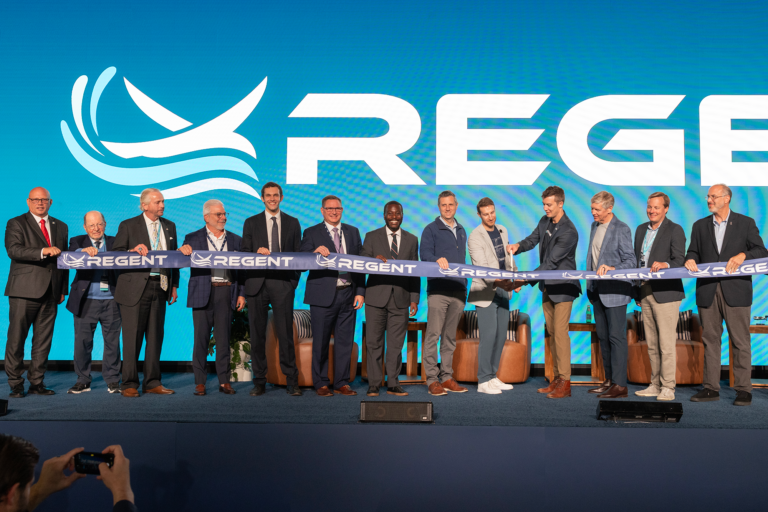
On that date, Regent Craft held a ribbon-cutting ceremony at its 255,000-square-foot (23,690-sq-m) Seaglider Manufacturing Facility at 1 Seaglider Way, Quonset Business Park in North Kingstown, Rhode Island, before approximately 600 investors, customers, and officials. Regent’s factory opening and Phase IV also came alongside a new $5 million contract from the U.S. Marine Corps Warfighting Lab, bringing the total value of that defense partnership to $19.25 million. The Phase IV Marine Corps contract was announced the day before. Earlier in the day, the Viceroy prototype demonstrated its float-foil-fly sequence for the crowd. The first flight attempt was aborted — a tailwind of two to four knots made the vehicle unstable — but the crew waited about 15 minutes and tried again, and this time the Viceroy rose onto its hydrofoils, climbed clear of the water, and flew. Viceroy’s aborted then successful flight was the vehicle’s fifth test flight overall.
Ground Effect, and the Two Reasons It Doubles Battery Range
Here is the physics that no electric aircraft startup based on rotors or conventional fixed wings can replicate, and that explains why a battery-electric vehicle can credibly promise 180 miles.
When a wing flies close to a surface — within approximately one wingspan of it — the surface blocks the formation of the wingtip vortices that are the primary source of lift-induced drag. The wing cannot shed that low-pressure wake downward because the water is in the way. Instead, the air is compressed between the wing and the surface, raising pressure below the wing and increasing lift. The result is a lift-to-drag ratios of 20 to 30 for ground-effect vehicles, compared with roughly 15 to 17 for a conventional turboprop commuter aircraft of similar capacity. The closer the wing operates to the water, the more powerful the effect, with maximum benefit below about half a wingspan’s height.
For a battery-electric vehicle, that aerodynamic efficiency gain is worth approximately 50 percent more range. But that is only half the story. Conventional aircraft must carry a 30-minute fuel reserve (45 minutes at night) at all times, because an unprepared forced landing on terrain is almost always fatal. A WIG vehicle that loses power over water simply lands on water — a predictable, relatively safe surface. Maritime regulations do not require that fuel reserve, which means the Viceroy can use the energy that an electric aircraft would have to hold back. Combined, the aerodynamic efficiency gain and the maritime reserve advantage approximately double the range of a WIG vehicle compared with a comparable all-electric aircraft with identical batteries.
That is why the Viceroy can fly 180 miles when comparable electric aircraft struggle to reach 80 to 100 miles. It is not a better battery. It is a smarter use of physics.
The Viceroy’s 65-foot (20-meter) wingspan establishes its operational altitude ceiling: it is classified as an IMO Type A WIG classification craft, meaning it is certified to fly only within ground effect — at most within one wingspan of the surface. At 33 feet of altitude in its September flight, it was operating well within that envelope.
How the Viceroy Actually Works
The Viceroy, which spans 57.5 feet (17.5 meters) in length and weighs up to 15,400 pounds (6,985 kg) at max takeoff, operates in three distinct phases. Viceroy’s wingspan, weight, and capacity are among the key specifications that define its operating envelope.
At the dock and in harbor, it floats on its hull like a conventional vessel, with captains operating it using standard marine controls — left, right, fast, and slow. Once it clears the harbor and reaches a safe speed, retractable hydrofoils extend and lift the fuselage clear of the water, giving the vehicle roughly two meters (6.5 feet) of wave tolerance and enabling speeds up to 50 knots (58 mph, 93 km/h) before flight — about twice as fast as any production hydrofoil vessel currently in service. The hydrofoils retract for the transition into flight.
Then the Viceroy takes off. Twelve electric motors positioned along the wing’s leading edge — an architecture known as distributed electric propulsion — drive high-velocity air over the wing surface, dramatically augmenting lift at modest speeds without requiring a long high-speed takeoff run. This “blown wing” configuration is borrowed from aerospace programs including DARPA’s X-57 Maxwell experimental aircraft. Once airborne, a triple-redundant fly-by-wire control system manages pitch, roll, and altitude moment to moment, because the highly nonlinear aerodynamics of ground-effect flight — where lift, drag, and altitude are tightly coupled near the water surface — exceed what a human pilot can manually manage at 180 mph. First crewed Viceroy flight details from the September 2 test validated this control architecture with two captains aboard.
One constraint the announcement does not name: the Viceroy is designed for waves up to five feet (1.52 meters) in foiling and flight modes. Open-ocean routes in heavy swell — typical offshore conditions around Hawaii run six to eight feet on a typical spring day — are outside the current operating envelope. The vehicle’s primary target market is protected coastal bays, island chains with lower swell, and short inter-coastal corridors such as Boston-to-Nantucket or New York-to-the-Hamptons.
A Certification Pathway That Bypasses the FAA
Perhaps the most strategically valuable aspect of Regent’s program is that the Viceroy does not need a Federal Aviation Administration type certificate. Because it operates exclusively over water and never climbs above ground-effect altitude — it cannot climb over terrain; if something blocks its path, it must maneuver around it — it falls under U.S. Coast Guard jurisdiction as a maritime vessel. Regent’s Design Basis Agreement to Coast Guard was submitted in March 2025.
The DBA is the foundational document that establishes what the Viceroy must demonstrate to achieve an equivalent level of safety to other certified high-speed passenger vessels. The agency was expected to approve the agreement by mid-2025; as of October 2026, no public approval announcement has been made, though the certification process remains active. Crews will hold a U.S. Coast Guard Master Near Coastal 25-ton license or international equivalent — the same credential a fast-ferry captain holds — rather than an FAA pilot certificate.
The regulatory classification question is not fully settled internationally. As recently as 2019, national regulatory agencies disagreed on whether WIG vehicles should be classified as boats or aircraft. Congress has directed the Coast Guard to lead certification and provided funding for it, but the absence of a completed DBA approval signals that the 2027 delivery target depends on a compression of the certification schedule that has not yet been publicly confirmed.
What Happened in October 2025
The draft program narrative that leads to October 1’s ribbon-cutting omits one material data point: the test campaign was not uninterrupted.
In October 2025, during foil-mode testing in Narragansett Bay, the Viceroy prototype’s wing made contact with the water. The prototype was slightly damaged; the two captains and the operations team followed all safety procedures and were uninjured, and the company returned the vessel to its facility for repairs. Wing-water contact testing incident was subsequently confirmed by Regent’s own statement. This is exactly the failure mode that has defeated previous WIG programs for decades — the narrow margin between the operational flight altitude and the water surface has destroyed vehicles and ended programs in the past. That the incident occurred, that no one was hurt, that the company resumed testing and ultimately reached first crewed flight ten months later, and that the Marine Corps continued investing through Phase IV, is a meaningful indicator that the safety-system architecture works as designed.
The Factory and the Production Target
The 255,000-square-foot (23,690-sq-m) facility at Quonset Business Park was built on the site of the former Quonset Point Naval Air Station — a detail that carries both symbolic and practical weight. The site gives Regent direct waterfront access for sea trials and proximity to Rhode Island’s maritime and composites manufacturing workforce.
The factory includes dedicated areas for structural assembly, wing and hydrofoil integration, battery and systems installation, and water-based acceptance testing. Regent plans to hire and train at least 250 workers and begin building production Seagliders at the facility in 2027, with factory jobs and production targets of a fully ramped production capacity targeting 75 Viceroy vessels and 300 Squire Seaglider drones per year. Rhode Island committed up to $13 million in incentives tied to 300 jobs, with potential expansion to 750 positions over the decade.
The company’s commercial over ten billion dollar order book exceeds $10 billion across six continents, according to Regent’s own reporting — though the distinction between firm orders and letters of intent is not publicly itemized. The Twenty Five, a luxury coastal travel operator, holds an agreement for up to 60 Viceroy vessels and plans to launch membership-based service between New York and the Hamptons and Boston and Nantucket starting in 2027, with early reporting from the Boston Globe noting the company’s order had grown in stages from eight to 21 to 40 vessels, with options beyond that.
Regent closed its two hundred forty million Series B on August 27, 2026, co-led by Mare Liberum and AE Ventures, with Erebor Bank providing the debt capital, bringing total capital raised to approximately $340 million. Existing investors Founders Fund, Caffeinated Capital, Lockheed Martin Ventures, Japan Airlines, and Giant Step Capital participated.
Why the Marine Corps Is Paying for Phase IV
The $5 million Phase IV Marine Corps Warfighting Lab contract takes the partnership to $19.25 million and marks a specific transition. The previous three phases validated technical feasibility and demonstrated the full-scale prototype in controlled conditions. Phase IV puts the Viceroy prototype through testing in operationally relevant environments — varied sea states, weather conditions, and mission profiles — and examines how Seagliders integrate with military command-and-control systems. Six-deliverable Phase IV details were spelled out in Regent’s September 30 press release.
“Phase IV lets us test the full-scale Viceroy prototype outside controlled conditions and moves us from developmental test to operational test,” Becky Russo, Regent’s VP of Defense, told Zag Daily.
The Marine Corps is evaluating the platform for contested logistics, medical evacuation, and search-and-rescue. The appeal is specific to the mission: a vehicle that needs no runway, can operate from any calm coastal waterway, travels at 180 mph, and requires no fixed infrastructure has an obvious role in the distributed, forward-operating-area doctrine that currently shapes Marine Corps planning.
The defense and commercial tracks are not competitors for factory capacity. Regent has stated that dual-use development allows the military program to inform the commercial roadmap’s basic fleet-management and command-coordination requirements, and vice versa.
What Has to Go Right Before Anyone Boards as a Passenger
Regent has acknowledged that it expects up to 24 months of additional testing and refinement before commercial service begins. That implies the 2027 delivery window, while real, refers to delivery of vessels to operators — not the start of revenue passenger service. Certification, crew training, and launch-route regulatory approvals are additional steps beyond delivery.
The immediate milestones that will determine whether that window holds are: the rate at which production tooling becomes embedded in the Quonset facility in 2027; whether the Coast Guard’s Design Basis Agreement process produces a formal approval that resolves the certification timeline; and how Phase IV Marine Corps operational testing performs in the field. The Viceroy is no longer a concept or a prototype — it has flown, the factory is open, and the military is writing increasingly large checks — but the distance between “first delivery” and “first paying passenger” remains the program’s most consequential open question.
Does It Qualify as a Flying Boat?
How does a seaglider qualify for maritime certification if it flies?
The International Maritime Organization classifies WIG craft as ships under its 2005 framework, with the specific classification depending on altitude capability. A Type A WIG craft — what the Viceroy is designed to be — is certified for operation only in ground effect, within one wingspan of the water’s surface. Because the Viceroy cannot escape ground effect and fly as a conventional aircraft, it is treated as a fast-speed vessel under maritime law rather than an aircraft under aviation law. This is not a loophole: it reflects a regulatory determination that a vehicle constrained to the maritime surface environment, operated by a mariner rather than an aviator, belongs under maritime safety standards. IMO Type A maritime classification framework was established in 2005 and defines the Viceroy’s regulatory home.
Frequently Asked Questions
Why can the Viceroy fly 180 miles on a battery when other electric aircraft can’t?
Two mechanisms combine. First, ground effect — flying within one wingspan of the water’s surface — suppresses the wingtip vortices that are the primary source of lift-induced drag, improving the lift-to-drag improvement in ground effect from approximately 15–17 (a typical turboprop commuter) to 20–30. Less drag means less energy per mile. Second, maritime rules do not require the 30-to-45-minute fuel reserve that aviation rules mandate for aircraft — because an emergency landing on water is survivable. The Viceroy can use the energy an electric aircraft would have to keep in reserve. Together, these two factors approximately double the useful range versus a comparable all-electric aircraft with the same batteries.
How does it take off if it’s classified as a boat?
The Viceroy’s captains operate it like a boat from the dock. As it accelerates, retractable hydrofoils lift the hull off the water, giving it wave tolerance and intermediate speed. The hydrofoils retract as the craft transitions into flight, when the twelve leading-edge motors generate enough blown lift for the wing to take over. Viceroy’s float foil fly modes make it unique among maritime vessels. The classification as a maritime vessel reflects where it flies (exclusively over water, within one wingspan of the surface) and who certifies it (the U.S. Coast Guard, not the FAA).
What happened at the October 1 investor demonstration?
The Viceroy’s first flight attempt at the demonstration was aborted — a tailwind of two to four knots created instability during the takeoff run. The crew waited about 15 minutes, conditions improved, and the second attempt was successful. About 600 investors and customers watched from two large ferries offshore. The drone variant, Squire, also demonstrated its hydrofoiling and ground-effect flight during the same event. Viceroy’s aborted then successful flight is described in detail in local coverage.
Can a seaglider replace a regular ferry or a commuter flight?
On protected coastal routes with calmer water — think New York harbor to the Hamptons, Boston to Nantucket, or Miami to the Bahamas — it has a compelling case: six times faster than a conventional ferry, quieter and lower-emissions than a short-hop aircraft, and operating from existing dock infrastructure without runways. On high-swell open-ocean routes, the current five-foot wave tolerance limit in flight is a real constraint — typical offshore Hawaii swell of six to eight feet is outside the operating envelope. Regent’s next-generation battery upgrade path targets over 400 nautical miles (460 miles) of range as battery technology matures, potentially opening longer routes.