HomeAuto POLYSTRIKE Drops Gameplay Reveal: Top-Down 5v5 Replaces Camera Geometry With Aim-Direction Vision
POLYSTRIKE Drops Gameplay Reveal: Top-Down 5v5 Replaces Camera Geometry With Aim-Direction Vision
August 19, 2026:
Robin-ent.com
When you remove the vertical axis from a tactical shooter, something unexpected happens: the entire information economy shifts. No more peeking from angles that hide 90% of your body. No more elevation advantage to exploit or deny. Every player on the map occupies the same readable plane — and suddenly, the skill-expressive dimension of competitive play is no longer about reflexes and geometry but about reading sound, controlling vision, and coordinating movement with a team that can see everything the same way you do. That is the design argument at the core of POLYSTRIKE on Steam, the debut title from international indie studio Robin Entertainment, whose official gameplay reveal trailer dropped August 17 as part of Steam’s Ukrainian Games Festival 2026.
This is not a nostalgia play or a gimmick pitch. POLYSTRIKE is a 5v5 objective-based tactical shooter built from scratch for a top-down camera, and its development team — more than 30 contributors from Ukraine, Europe, the United States, and Canada, working through power outages, mobilization orders, and the ongoing war in Ukraine — has been making that argument with engineering specificity for over two years of development. The gameplay reveal is the clearest statement yet of what the game claims to prove.
Top-Down View Isn’t a Limitation — It’s a Design Choice With Consequences
The most common objection to top-down competitive shooters is that removing the vertical axis removes tactical depth. POLYSTRIKE’s design inverts that argument directly.
In a first-person tactical game, your field of vision is fixed to wherever your camera points. You can cover one angle at a time. The consequence is that information gathering — knowing where the enemy is before they know where you are — depends on movement, positioning, and the narrow sightlines that first-person geometry creates. Every engagement is a question of who occupies the better angle.
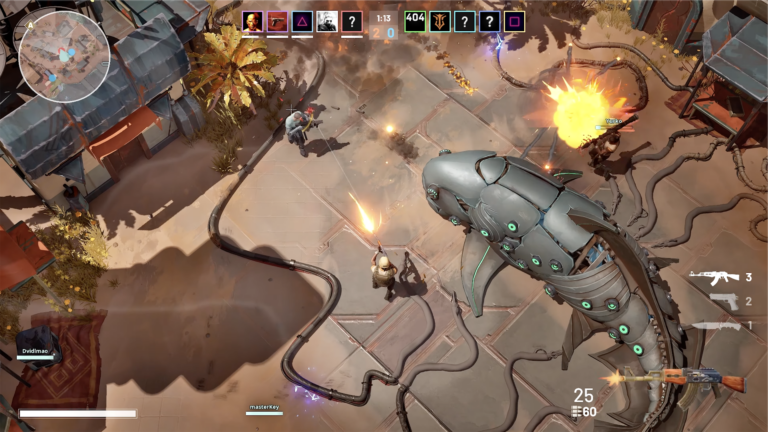
POLYSTRIKE replaces this with a dynamic fog-of-war system tied to aim direction. Players view the battlefield from overhead, but their field of vision changes based on the direction they are aiming. Checking a corner requires pointing your weapon into it. The visual information you receive and the tactical threat you present to an opponent are functions of the same physical action. The result is an information asymmetry that operates through deliberate positioning and aim control rather than camera geometry — a different kind of tactical depth, not an absent one.
Alongside fog-of-war, the game treats spatial audio as primary information, not background atmosphere. Footsteps produce distinct signatures depending on surface material and movement speed. Environmental sounds can identify enemy positioning before any visual contact is established. For veteran Counter-Strike players, the audio-as-radar design philosophy will be immediately familiar — but in a top-down context, where your eyes already see more of the map than a first-person game allows, the audio layer carries proportionally greater weight. You are never fully blind; you are always partially informed. The skill is knowing what to do with imperfect information at speed.
No Heroes, No Z-Axis: What POLYSTRIKE Actually Takes Away From the Genre
The competitive shooter market of the last decade has converged on a specific formula: hero characters with unique abilities, which means loadout decisions happen before a match and role flexibility is constrained by character selection. POLYSTRIKE rejects this entirely.
Players mix armor, helmets, weapons, and utility items freely before each deployment. A shotgun paired with a ballistic shield is a valid combination. A grenade launcher with long-range optics is another. The game’s armory reportedly includes flamethrowers, multiple firearm types with distinct recoil profiles, and ballistic shields — each with handling characteristics tuned for top-down play. The role you occupy in a given round is determined by what you brought to the fight, not by which character you selected.
Equipment is also physically displayed on character models during the match. Opponents’ armor, helmets, weapons, and grenades are visible from overhead view, enabling at-a-glance loadout reading that functions as the visual equivalent of a verbal callout. You do not need to hear a teammate say “the enemy is running a flamethrower” if you can see the flamethrower on their model from above.
What the game removes — the Z-axis — is equally significant. POLYSTRIKE is not Counter-Strike viewed from a helicopter; it is a competitive game whose maps, visibility rules, gunplay, and objectives were designed for overhead perspective from the ground up. Every map functions as what the developers call an independent operation, with distinct visual identity, atmosphere, and tactical challenges — arriving by boat in one, alongside armored vehicles or helicopters in another.
A Living Objective: The Iron Fish and Spider Drone
POLYSTRIKE’s central objective mechanic departs from the plant/defuse template that has dominated tactical shooters since Counter-Strike’s early days.
A mechanical Spider Drone hunts the Iron Fish — a living, reactive entity that moves through the environment and can influence the course of a match. The Spider Drone hacks the Iron Fish and triggers a self-destruct sequence. The Iron Fish is not a static prop; it responds to the battle around it. The objective, in other words, has agency.
The design implication is significant: unlike a planted bomb, which sits fixed while one team defends and one attacks, the Iron Fish can create unpredictable shifts in where the critical action happens. A match that appeared won can be disrupted by the objective’s movement.
Two Factions, One War
POLYSTRIKE divides players between Iron Will and Vanguard — two factions that are not cosmetic distinctions. The Iron Will and Vanguard factions differ across characters, weapons, equipment, vehicles, voice acting, sound design, interface elements, and mission objectives based on which side a player is on. The developers describe the rivalry not as two teams competing over isolated matches but as two sides of a broader ongoing conflict, expressed through every element of the game’s presentation. The distinction is meant to be felt before the first round begins.
How Does a Top-Down Game Maintain Competitive Clarity?
The challenge for any top-down competitive game is visual readability: at a high level of play, where every frame of information matters, the overhead view must be clean enough that players can immediately parse what they see. POLYSTRIKE addresses this through cohesive stylized art direction, high-contrast lighting, and environments built specifically for overhead legibility.
On the technical side, the game runs on Unreal Engine 5 using Epic’s Lyra framework — a multiplayer-centric UE5 template that was not originally designed for top-down gameplay and had to be adapted for the game’s camera and sightline systems, according to studio founder Mark Møcherad in a 2024 interview with VICE Waypoint. The team used UE5’s Nanite and Lumen rendering systems for environment fidelity and optimization — tools that enabled detailed, readable maps without sacrificing competitive performance.
The game also features a dedicated animated weapon view displayed in the HUD, mirroring the player character’s real-time actions — run, fire, reload — providing tactile visual feedback on par with first-person games despite the overhead camera.
The resulting system requirements are accessible: a GTX 1060 and Intel i5-8400 handle minimum settings, while a full recommended experience calls for an RTX 3060 and an AMD Ryzen 7 5800X.
What Is POLYSTRIKE’s Origin Story?
POLYSTRIKE began as a mod for DOTA 2, combining that game’s isometric view with Counter-Strike’s tactical mechanics. As a mod, it attracted enough attention that esports platform Gfinity reached out about competitive tournament integration — but the engine constraints of modding tools made deep customization impossible. Møcherad sought outside partners.
The connections that followed are notable. Garry Newman, founder of Facepunch Studios and creator of Garry’s Mod and Rust, reached out to offer Møcherad first access to a new Source 2-based Sandbox engine — a direct expression of interest in POLYSTRIKE’s potential from one of independent game development’s most recognizable figures. Valve itself, separately, offered Møcherad official use of the Counter-Strike IP to create a formally branded top-down version of the franchise, tentatively named “Top-Down Counter-Strike.” Møcherad declined both offers to keep POLYSTRIKE original and independently owned.
The team ultimately moved to Unreal Engine 5 and restarted development from scratch. The restart happened after a rupture: when the full-scale Russian invasion of Ukraine began in 2022, Møcherad was in advanced negotiations with two major studios for investment and had to halt development entirely. He fled Ukraine with his disabled father, relocated to Poland, and worked multiple jobs simultaneously to stabilize before returning to POLYSTRIKE.
Built During a War
The human context behind POLYSTRIKE’s development is not incidental to understanding what the game represents.
Most of Robin Entertainment’s core team is based in Ukraine. During development, the team worked through power outages up to 12 hours per day caused by attacks on Ukrainian energy infrastructure, using generators, power banks, and mobile internet to maintain productivity during available windows, according to Møcherad. The game was originally planned for release in October 2025; the studio missed that window in part because team members were mobilized into the Ukrainian Armed Forces, including a contributor named Yura who was responsible for weapon, character, and animation work. Some team members lost their lives in the conflict.
The game’s reveal trailer arrived on August 17 — the opening day of the Ukrainian Games Festival 2026 on Steam, an annual Steam event organized by Palaye to spotlight Ukrainian game developers for a global audience. The festival runs through August 24, Ukraine’s Independence Day, and this year features over 680 Ukrainian-developed titles. POLYSTRIKE is participating as a wishlist addition rather than a sale item, since it has not yet released.
When Does POLYSTRIKE Release, and How Can Readers Try It?
POLYSTRIKE currently lists its release date as “To be announced” on Steam. The game is available to wishlist on Steam. Given the studio’s stated goal of conducting public playtests before launch and the pace of development following the trailer reveal, an early access period or closed beta is likely the next public milestone — though Robin Entertainment has not formally announced a timeline.
The pace of updates and the development disclosure from Møcherad suggest the project is in active final development rather than early prototype stage. The gameplay reveal trailer, viewable on Robin Entertainment’s official YouTube channel, shows fully realized environments, UI, faction designs, and objective animations that reflect a project closer to playable than announced.
Frequently Asked Questions
How is POLYSTRIKE different from Counter-Strike or Valorant?
The most fundamental difference is the camera angle: POLYSTRIKE is played from a bird’s-eye view, which eliminates vertical geometry as a tactical factor. Where CS and Valorant reward players who master specific camera angles and peeking duels, POLYSTRIKE rewards players who read spatial audio, manage aim-direction fog of war, and coordinate team movement across a fully visible horizontal battlefield. There are also no hero characters — loadouts are freely assembled from armor, weapons, and utility before each round, meaning roles emerge from pre-match decisions rather than from character selection.
What is the Ukrainian Games Festival 2026?
The Ukrainian Games Festival 2026 is a free annual event organized on Steam by Palaye, a Ukrainian publishing agency, running August 17 through August 24. It is now in its fifth year and features over 680 Ukrainian-developed games, including discounted titles, free demos, and wishlist additions for upcoming releases. The festival closes on Ukraine’s Independence Day. POLYSTRIKE is participating as an upcoming release during this year’s event.
Does POLYSTRIKE have predefined character roles or hero abilities?
No. POLYSTRIKE explicitly rejects the hero-shooter model. Players freely combine armor, helmets, weapons, and equipment items before each deployment. The role a player fills — aggressive fragger, support, long-range — is determined entirely by that loadout selection. Equipment is physically displayed on character models during the match, allowing opponents to read what each player is carrying from overhead view.
What does “fog of war tied to aim direction” mean in practice?
In most top-down games, fog of war limits vision based on a fixed radius around the player. In POLYSTRIKE, that visibility cone changes with the direction you are aiming. To check a corner, you must physically point your weapon into it — which exposes you to threats from other directions. This creates the same tactical tension as peeking in Counter-Strike but expressed through aim-direction control rather than first-person camera geometry, rewarding deliberate, careful play over fast reflexes alone.