HomeAuto Plant-Stress Satellite FLEX Launches Sept. 15, Closing Gap in Global Food Security
Plant-Stress Satellite FLEX Launches Sept. 15, Closing Gap in Global Food Security
September 4, 2026:
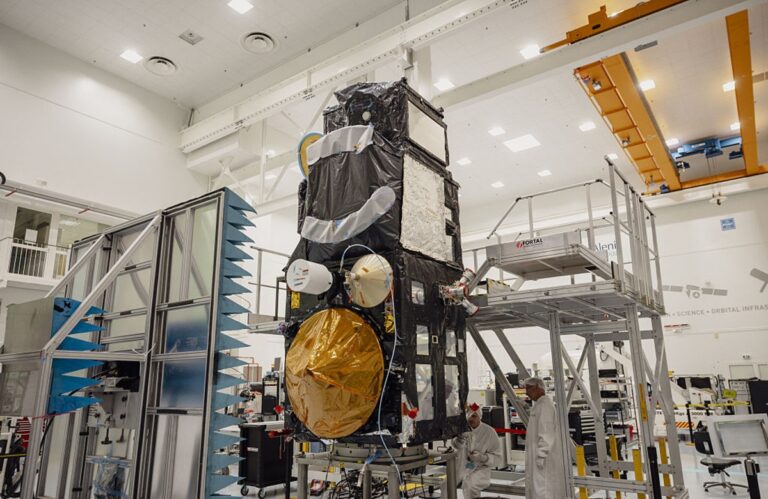
Employees work on a service module Sentinel 3C during a press presentation at the Thales Alenia Space facilities in Cannes, southeastern France, on April 16, 2026. Three satellites were presented : the Copernicus Sentinel-3C Earth observation satellite, FLuorescence EXplorer (FLEX), and the second imager of the Meteosat Third Generation programme before their departure for a launch site. Frederic DIDES/AFP via Getty Images
On September 15, a rocket carrying two European Space Agency satellites will lift off from South America and — if all goes as planned — place the first instrument ever designed to measure photosynthesis itself from space into orbit. For the first time in history, a satellite will detect plant stress before it becomes visible, reading the faint glow crops and forests emit while converting sunlight into energy rather than simply measuring how green they look from above. The distinction matters for every country whose food supply depends on early warning of drought, heat stress, or disease — which is to say, most of them.
World’s First Photosynthesis Satellite Will See What NDVI Cannot
Every existing satellite-based vegetation monitoring system — from NASA’s MODIS to the European Sentinel-2 constellation — works by measuring reflected sunlight. The go-to metric is the Normalized Difference Vegetation Index, or NDVI, which compares how much red light plants absorb versus how much near-infrared light they reflect. When chlorophyll is abundant and structurally healthy, NDVI goes high. When a crop is stressed, NDVI eventually falls — a pattern confirmed by the NDVI vegetation index explained documentation maintained by NASA EarthData.
The problem is the word “eventually.” NDVI measures the physical greenness of leaf structure. A field can be metabolically collapsing — its photosynthetic machinery shutting down in response to water deficit, heat, or disease — while its cellular structure, and therefore its reflected color, still looks healthy. By the time NDVI captures the damage, a farmer or food-security analyst may have lost the window to intervene.
The FLEX (FLuorescence EXplorer) satellite is designed to close that gap entirely. It carries a single instrument, the Fluorescence Imaging Spectrometer (FLORIS), which instead of measuring reflected light detects vegetation fluorescence from orbit — the faint glow that plants emit as a byproduct of photosynthesis itself. This signal, called solar-induced chlorophyll fluorescence (SIF), is a direct proxy for the plant’s metabolic activity in real time. When photosynthesis slows under stress, SIF weakens. Days before the leaf structure changes enough to register on NDVI, the fluorescence signal has already shifted. FLEX will map that signal globally, at a resolution of 300 meters (about 984 feet) per pixel, on a 27-day repeat cycle covering latitudes between 56 degrees South and 75 degrees North — a scope detailed on ESA’s FLEX mission page.
Scientists have known this signal existed for more than 50 years. What they have never been able to do before FLEX is measure it directly from orbit at the precision and resolution required to turn it into a usable global dataset. FLEX is the first satellite ever designed specifically to do so.
How FLORIS Reads the Glow Plants Cannot Hide
The engineering challenge behind FLEX is formidable. The fluorescence signal FLORIS must detect is only roughly one to two percent of the reflected solar signal at the same wavelengths. Separating it from the much stronger reflected light requires an instrument of exceptional spectral precision, as described in detail in a Fraunhofer IOF FLORIS components release published in September 2026.
FLORIS exploits a specific quirk of the sun’s spectrum. At two sets of wavelengths — the oxygen absorption bands designated O₂-A (759–769 nanometers) and O₂-B (686–697 nanometers) — the Earth’s atmosphere absorbs incoming sunlight so strongly that almost no reflected solar light reaches the sensor at those frequencies. But plant fluorescence does pass through. By comparing what the instrument sees inside versus just outside these bands, FLORIS can isolate the fluorescence emission from the noise of reflected light, a technique analyzed in depth in SPIE proceedings on FLORIS optical design.
The instrument is built around two complementary push-broom spectrometers sharing a common telescope. The high-resolution channel samples at 0.1 nanometers inside the O₂ bands — fine enough to resolve the tiny fluorescence signal with confidence. The low-resolution channel covers the full 500–780 nanometer range at 0.6–2.0 nanometers per sample, capturing the plant’s full reflectance signature alongside the fluorescence measurement, per FLORIS specifications on eoportal.org. Together, the dual-channel design means each FLEX pass produces not just a fluorescence map but a complete spectral characterization of the vegetation below — the photochemical reflectance index, the chlorophyll absorption band, and the standard reflectance data that researchers have used for decades.
The holographic gratings that disperse light inside FLORIS were manufactured to extraordinarily tight tolerances. The double-slit assembly — the precision component that separates the two spectrometer channels — was built by the Fraunhofer Institute for Applied Optics and Precision Engineering (Fraunhofer IOF) in Jena, Germany. “The fluorescence signals emitted by plants are very weak,” noted Dr. Falk Kemper, FLEX project manager at Fraunhofer IOF. “For FLORIS to analyze these signals reliably, the optical components must be manufactured and assembled with exceptional precision.” The instrument also carries an onboard calibration unit with a rotating carousel mechanism and a sun-illuminated Lambertian diffuser, allowing it to self-calibrate its absolute radiometric readings on orbit — essential for generating consistent long-term data records, as described on the ESA FLORIS instrument page.
FLORIS was built by Leonardo in Florence, Italy, which was awarded the instrument contract in November 2016. The satellite platform was assembled by Thales Alenia Space, first at the company’s Belfast, Northern Ireland, cleanroom, then integrated with the FLORIS instrument in Cannes, France, in August 2025. Thales Alenia Space also served as the satellite’s prime contractor, having been selected by ESA in January 2019, as confirmed in the Wikipedia article on the FLEX satellite. The FLEX satellite weighs approximately 425 kilograms (about 937 pounds), per FLORIS mission specifications on eoportal.org.
Flying in Convoy: The Tandem Science Design
Fluorescence measurements alone are not enough. To interpret what FLORIS reads — to distinguish the plant stress signal from confounding factors like cloud cover, atmospheric aerosols, and varying surface temperature — scientists need simultaneous observations from complementary instruments. That is where the tandem architecture comes in.
After launch, FLEX will fly in tight formation with Sentinel-3A, the European Earth observation satellite already in orbit. FLEX will position itself approximately 100 kilometers (about 62 miles) ahead of Sentinel-3A along the same ground track, meaning both spacecraft will pass over the same patch of Earth within 6 to 15 seconds of each other, according to ESA’s August 2026 FLEX fuelling update. Sentinel-3A’s instruments — particularly OLCI (Ocean and Land Colour Instrument) and SLSTR (Sea and Land Surface Temperature Radiometer) — will provide the atmospheric correction parameters and vegetation context, including surface temperature and land cover type, that FLORIS needs to correctly interpret the fluorescence signal. Together, these near-simultaneous observations will deliver what ESA calls “an unprecedented view of the function and condition of vegetation across the globe.”
This trailing-formation concept mirrors NASA’s A-Train constellation, in which CALIPSO, CloudSat, and Aqua once flew in coordinated formation over the same ground strip within minutes of one another, as documented in the Wikipedia article on satellite formation flying. FLEX applies that architecture to a targeted data-fusion problem: pairing a specialized fluorescence sensor with an existing broadband observer to close a gap that neither could address alone.
FLEX and Sentinel-3C are being launched together for orbital efficiency. Once in their sun-synchronous orbit at approximately 820 kilometers (about 510 miles) altitude, they will each settle into their respective mission configurations: Sentinel-3C will join Sentinel-3A and Sentinel-3B in the operational constellation, while FLEX begins its science tandem with Sentinel-3A.
Sentinel-3C: Sustaining a Decade of Earth Observation
Weighing roughly 1,150–1,200 kilograms (approximately 2,535–2,646 pounds), Copernicus Sentinel-3C is the third member of a satellite family that has served as a workhorse of European Earth observation for a decade. Sentinel-3A launched in February 2016, followed by Sentinel-3B in April 2018. Sentinel-3A is now more than ten years old; Sentinel-3C’s addition to the constellation will sustain the mission’s continuous data record into the 2030s, when a fourth member of the family is expected to follow, per the ESA Sentinel-3 mission page.
The satellite carries four main instruments that operate simultaneously, as listed on the ESA Sentinel-3 instruments page: The Ocean and Land Colour Instrument (OLCI) measures reflected sunlight in 21 spectral bands at 300-meter resolution, enabling vegetation monitoring, water quality assessment, and atmospheric aerosol characterization. The Sea and Land Surface Temperature Radiometer (SLSTR) measures surface temperatures in nine spectral bands — critical for heatwave monitoring, wildfire detection, and tracking sea surface anomalies. The SAR Radar Altimeter (SRAL) measures sea surface topography and ice sheet elevation with centimeter-level precision, supporting ocean forecasting and cryosphere research. The MicroWave Radiometer (MWR) provides water vapor corrections for the altimeter.
Sentinel-3C is owned, funded, and managed by the European Commission as part of the Copernicus Programme, Europe’s flagship Earth observation initiative. In-orbit operations will be jointly managed by ESA and EUMETSAT, as detailed in the European Commission Sentinel-3C launch article. Sentinel-3C was built by Thales Alenia Space as prime contractor.
What Does the Faint Glow of Photosynthesis Actually Mean?
A plant absorbing sunlight runs two separate energy-conversion systems inside each cell. Together, they drive photosynthesis — the process that converts carbon dioxide and light into the carbohydrates that sustain virtually all life on Earth. Most of the absorbed energy is channeled into that chemical work. But a small fraction — roughly one to two percent — is released as light rather than stored as chemistry. That is the fluorescence signal FLEX will measure, as described on ESA’s plant-health satellite page.
The signal is not a quirk. It is a window. The amount of fluorescence a plant emits tracks directly with how efficiently its photosynthetic machinery is running. A healthy plant under good conditions fluoresces at a predictable rate tied to how much light it is absorbing. A stressed plant — one whose water supply is failing, or whose leaf temperature has climbed past the enzyme optimum, or which is fighting a pathogen — begins to divert light away from photosynthetic work and toward protective heat dissipation. The fluorescence drops first, before any structural change in the leaf occurs. NDVI cannot see this. FLORIS can.
The scientific significance extends well beyond agriculture. Photosynthesis is the dominant mechanism by which land ecosystems absorb carbon dioxide from the atmosphere. The global carbon cycle models that underpin climate projections depend on estimates of terrestrial Gross Primary Productivity — how much carbon plants absorb globally each year. Those estimates currently carry substantial uncertainty because they rely on reflectance-based methods that cannot distinguish between a green leaf and a productive one. SIF measurements from FLEX are expected to reduce that uncertainty significantly, improving the carbon cycle models that both climate scientists and policymakers use, as documented in FLEX carbon cycle applications.
In food security terms, the practical benefit is direct: a 300-meter resolution global fluorescence map updated on a 27-day cycle means that stress events in crop-growing regions — representing individual agricultural or forestry management units — would be detectable days before they produce yield losses visible to conventional remote sensing. At that resolution, differences between adjacent fields under different irrigation or fertilization regimes become resolvable. The implications for precision agriculture, drought early warning, and international food supply monitoring are significant.
Vega-C: Longer Streak Than Ever Before
For the European launch industry, VV30 is as much a statement about the rocket as about the science it carries. Vega-C, Avio’s small-satellite workhorse, has had a turbulent history.
The rocket’s maiden flight came in July 2022 (VV21), a success. Its second mission, VV22 in December 2022, was a catastrophic failure. About two minutes and 27 seconds after liftoff, carrying the Pléiades Neo 5 and 6 imaging satellites for Airbus Defence and Space, a progressive drop in chamber pressure in the Zefiro-40 second-stage engine caused a loss of thrust. The vehicle and its payload were destroyed over the Atlantic, as documented in the ESA VV22 Independent Enquiry Commission findings.
ESA’s Independent Enquiry Commission traced the failure to a carbon-carbon (C-C) throat insert in the Zefiro-40 nozzle — the component where exhaust exits the combustion chamber — that had been procured by Avio from Ukraine’s KB Pivdenne. Unexpected thermo-mechanical over-erosion, likely due to a flaw in the material’s homogeneity, caused progressive nozzle degradation. The commission also found that the acceptance criteria proved insufficient to demonstrate flightworthiness. Avio moved to source a replacement C-C material from ArianeGroup, which had already been in use for other Vega nozzles.
The recovery was not straightforward. A static-fire test of the redesigned Zefiro-40 nozzle on June 28, 2023, also failed, with the nozzle suffering significant damage from a different cause: the combination of the insert’s new geometry and its different thermo-mechanical properties produced progressive damage to adjacent nozzle parts, per the ESA Zefiro-40 test IEC conclusions. A second redesign effort followed, with additional ground tests before the rocket was cleared to fly.
The return to flight came on December 5, 2024, when VV25 successfully placed the Copernicus Sentinel-1C satellite into orbit. Since then, Vega-C has flown five consecutive successful missions: VV26 (Biomass, April 2025), VV27 (CO3D and MicroCarb, July 2025), VV28 (KOMPSAT-7, December 2025), and VV29 (the SMILE ESA-CAS mission, May 2026 — the first launch operated by Avio directly as Launch Service Operator, following the transition from Arianespace), per the Vega-C launch history on keeptrack.space. VV30 would, if successful, be Vega-C’s longest consecutive success streak since its introduction, according to Avio’s VV29 launch announcement.
What to Expect on Launch Night
VV30 is scheduled to lift off from the Guiana Space Centre in Kourou, French Guiana, on September 14 at 10:21 p.m. local time — that is 9:21 p.m. ET, or 1:21 a.m. UTC on September 15, per the CNES VV30 event page. Preparations are on schedule: FLEX was fuelled with approximately 30 kilograms (about 66 pounds) of propellant at the launch site in August 2026, and both satellites have been encapsulated in the Vega-C fairing, according to ESA’s FLEX fuelling update.
Inside the fairing, the two satellites are stacked vertically using a secondary payload adapter called Vespa (Vega Secondary Payload Adapter). Sentinel-3C sits above FLEX and will be the first to separate; FLEX then follows into a slightly lower position in the same orbital plane. From the separation of the first satellite to the release of the last, the full deployment sequence will take approximately 116 minutes.
Both satellites will enter a sun-synchronous orbit inclined at 98.6 degrees, at an altitude of approximately 820 kilometers (about 510 miles), with a local time of descending node near 10:00 a.m. — a standard morning illumination geometry chosen to ensure consistent solar angles for optical measurements over many years.
After separation, Sentinel-3C will enter a commissioning period before ESA hands its operational management to EUMETSAT. FLEX will remain under ESA science operations throughout its planned minimum 3.5-year mission lifetime — enough for at least three full annual vegetation cycles in both hemispheres.
Live coverage of the launch will be available through ESA and Avio’s streaming channels.
Does It Matter That a Rocket Glows in the Dark?
Why does any of this require a dedicated satellite rather than an airborne or ground-based instrument? The answer is scale. Ground stations and aircraft can measure chlorophyll fluorescence with high precision over individual fields or forest plots. But the global carbon cycle operates across every forest, every cropland, and every grassland on Earth simultaneously. No ground network or fleet of research aircraft can provide the continuous, planet-wide coverage needed to close the models. Only a sun-synchronous satellite with a 150-kilometer (about 93-mile) swath and a 27-day repeat cycle can do that, as described in FLEX mission capabilities on eoportal.org.
That is the gap FLEX was designed to fill — not to replace NDVI, but to add the functional dimension that reflectance-based monitoring has always lacked. A field of crops photographed from space can look green and healthy while already losing the metabolic battle against water stress. When FLEX is operational, that gap between appearance and function will become visible from orbit for the first time.
Currency conversions in this article are approximate, based on rates at time of publication.
Frequently Asked Questions
What does the FLEX satellite actually measure, and why is that different from what existing satellites do?
FLEX measures solar-induced chlorophyll fluorescence — the faint light that plants emit as a byproduct of photosynthesis — rather than reflected sunlight. All existing vegetation satellites, including those carrying NDVI-based instruments, measure how much sunlight plants reflect. That reflectance tracks the physical greenness of leaf structure, which only changes after a stress event has already done metabolic damage. Fluorescence changes immediately when the plant’s photosynthetic machinery slows down, making it detectable days to weeks before conventional satellite imagery would show anything wrong. FLEX is the first satellite ever designed to make this measurement globally and at a resolution — 300 meters (about 984 feet) per pixel — useful for monitoring individual agricultural and forestry management units.
How does FLORIS detect a signal that is only one to two percent as strong as ordinary reflected light?
The FLORIS instrument exploits the oxygen absorption bands in Earth’s atmosphere. At the O₂-A (759–769 nanometers) and O₂-B (686–697 nanometers) wavelengths, the atmosphere absorbs incoming sunlight so strongly that almost no reflected solar light passes through to the sensor. Plant fluorescence, however, does. By comparing light intensities inside and just outside these atmospheric absorption windows, FLORIS can isolate the faint fluorescence signal from the much stronger reflected light background — a technique that requires spectral sampling of 0.1 nanometers precision in the high-resolution channel. The holographic gratings and precision double-slit assembly built by Germany’s Fraunhofer IOF institute in Jena make that separation possible.
Why will FLEX fly alongside Sentinel-3A rather than Sentinel-3C, the satellite it is launching with?
Sentinel-3C is launching on the same Vega-C rocket as FLEX as a co-passenger, but the two satellites will separate into different operational roles after orbit insertion. Sentinel-3C will join the existing Sentinel-3 constellation and begin its own operational life. FLEX, meanwhile, needs to fly in tight formation with a Sentinel-3 satellite already in service — one whose instruments can provide the simultaneous atmospheric correction data and surface characterization that FLORIS needs to correctly interpret the fluorescence signal. Sentinel-3A has been in orbit since 2016 and is already positioned in the right orbital plane; FLEX will maneuver to fly approximately 100 kilometers (about 62 miles) ahead of it, overflying each location within 6 to 15 seconds of the Sentinel-3A pass.
What does FLEX mean for food security and carbon science?
For agriculture, FLEX data will offer the first global, space-based early-warning system for crop metabolic stress — allowing analysts and governments to identify food-supply risks days before they become visible in conventional satellite imagery. For carbon science, FLEX will reduce a long-standing uncertainty in estimates of how much carbon dioxide land vegetation absorbs each year; fluorescence measurements directly track photosynthetic activity rather than inferring it from greenness, which should significantly improve the terrestrial carbon cycle models used by climate scientists and policymakers.