HomeAuto Original Star Wars 1977 Film Gets First-Ever IMAX 70mm Premiere: Only 41 Locations
Original Star Wars 1977 Film Gets First-Ever IMAX 70mm Premiere: Only 41 Locations
September 9, 2026:
Lucasfilm.com
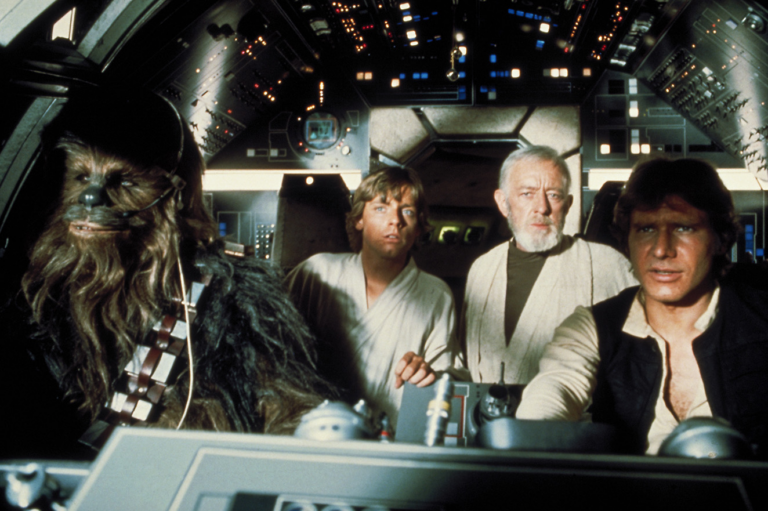
For nearly five decades, the original 1977 Star Wars film has never been presented in IMAX in any format, digital or film. That changes on February 19, 2027, when Lucasfilm will release the newly restored 1977 original cut of the film across a select number of IMAX 70mm film locations and in select theaters for a limited time, kicking off the franchise’s yearlong 50th anniversary celebration. This is the first IMAX screening of the original 1977 Star Wars in the format’s history. The version screening will be the pre-Special Edition 1977 theatrical cut — no CGI Jabba the Hutt, no revised cantina, no Greedo shooting first.
Then, on May 28, 2027 — the exact weekend the original film premiered fifty years earlier — Lucasfilm will release Star Wars: Starfighter in IMAX 70mm. Directed by Shawn Levy (Deadpool & Wolverine, Stranger Things) and starring Ryan Gosling, Starfighter was shot with IMAX-certified film cameras and will be converted to 70mm film prints for IMAX film locations. Two Star Wars films. Same format. One year.
Before you buy a ticket, there is something important to know: there is IMAX, and then there is IMAX 70mm film — and they are not the same thing.
What IMAX 70mm Film Actually Is
When most people say they saw a movie “in IMAX,” they almost certainly saw it on a digital screen — one of the roughly 1,800-plus IMAX systems operating globally as of 2026, projecting two stacked 4K images onto a screen typically around 21 meters wide. The experience is genuinely better than standard theaters: brighter, louder, wider.
But IMAX 70mm film is something else entirely. Only 41 such projectors exist on the entire planet. The format is known technically as “15/70”: 70mm-wide film running horizontally through the camera and projector, with 15 sprocket perforations per frame instead of the 5 used in standard 70mm cinema. That configuration produces a single film frame measuring 69.6mm × 48.5mm (2.74 in × 1.91 in) — a physical area approximately 8.3 times larger than a 35mm film frame and about 3.4 times larger than standard vertical 70mm.
The result, when projected on a purpose-built IMAX screen measuring up to 18 by 24 meters (59 by 79 feet), fills essentially the entire human visual field. At that scale, the peripheral nervous system activates in response to implied motion. Vestibular responses — the physical sensation of movement — can be triggered by spacecraft pulling into a turn. This is not hyperbole; it is the documented perceptual consequence of filling peripheral vision at sufficient resolution, and it is what makes the 41 film locations functionally different from any other theatrical experience available in 2027.
The estimated digital resolution equivalent for a native 15/70 frame is up to approximately 18,000 lines — though comparisons between silver-halide grain density and digital pixel count are imprecise. For reference, IMAX Digital reaches about 2.9K in maximum perceived resolution. The film format stores its image not in pixels but in silver halide crystals — silver-bonded chemical compounds that respond to photons through the photoelectric effect, creating a physical record of the light that passed through the lens. No two frames of film are geometrically identical at the microscopic level. The resulting visual texture is the quality popularly called “grain,” and at IMAX frame sizes it is virtually invisible because the enlargement ratio from frame to screen is so much lower than for smaller formats.
Why There Are Only 41 of These Projectors — and Why That Number Won’t Change
An IMAX 70mm projector weighs up to 1.8 metric tons, stands over 178 cm (5.8 ft) tall, and runs film through its mechanism at 102.7 meters (337 ft) per minute. The xenon lamps that illuminate the frame operate at 15 kilowatts under 25 atmospheres of pressure; projectionists wear protective body armor when replacing them in case the quartz envelope shatters. A feature-length film arrives at the theater on multiple reels that must be hand-spliced into a single 250-kilogram platter — a process that can take many hours. And a single IMAX 70mm print costs approximately $36,000 to produce.
No new IMAX film projectors have been manufactured for decades. The 41 installations that remain operational represent essentially the entirety of what exists. They are vintage mechanical systems requiring specialized technicians, and when one breaks down, the parts must be sourced or fabricated — not ordered from a catalog.
This scarcity is part of what makes the economics of IMAX 70mm film so striking. When Christopher Nolan’s The Odyssey opened on July 17, 2026 — the first feature film ever shot entirely on IMAX film cameras, using a new generation of cameras developed specifically for the production — those 41 locations generated $6.3 million in their opening weekend alone, averaging $153,000 per screen. Many sold out into the seventh week and beyond of the film’s run. The Odyssey set a record $52 million opening weekend across all IMAX formats worldwide.
If you want to see Star Wars in IMAX 70mm in February 2027, the lesson from The Odyssey is clear: plan now, find your nearest film location, and buy tickets early.
How to Tell the Difference: Finding a Genuine IMAX 70mm Location
IMAX’s own website allows filtering by theater technology. Look specifically for locations labeled “IMAX 70mm Film” or “IMAX 70mm” — not “IMAX with Laser” or “IMAX Digital,” which are distinct digital projection systems. The 1.43:1 “tall” aspect ratio is the visual signature of a genuine IMAX film theater; digital IMAX screens typically present content at 1.90:1. If the screen doesn’t look dramatically taller than wide, you are probably not at a 15/70 film location.
The industry nickname “LieMAX” — coined by critics of IMAX’s marketing strategy — arose precisely from the confusion between the 1,800-plus digital IMAX screens and the 41 genuine film locations. Both carry the same “The IMAX Experience” branding. For the Star Wars screenings, the distinction matters: the 1977 film’s IMAX 70mm presentation is a fundamentally different sensory event than a standard IMAX digital screening.
The 35mm Blow-Up: What the 1977 Film’s IMAX Presentation Actually Is
There is an important technical distinction between what Star Wars (1977) and Star Wars: Starfighter will each deliver on an IMAX 70mm screen — and readers deserve to understand it before deciding where to see either film.
The original Star Wars was shot on 35mm anamorphic film in 1976, producing a 2.35:1 widescreen frame approximately 18mm × 24mm in the camera gate. That is a tiny frame relative to the 69.6mm × 48.5mm IMAX 15/70 frame. To create the IMAX 70mm prints for the 2027 re-release, Lucasfilm will perform what is known in the industry as a “blow-up”: the original 35mm negative is scanned at the highest available resolution, digital restoration work is performed, and the result is then written back onto 70mm film stock through a film recorder. The process was pioneered by IMAX’s Digital Media Remastering system.
The resolution of the resulting IMAX 70mm print is bounded by the source material — approximately 6K to 8K equivalent from a well-preserved 35mm negative. The enlarged IMAX frame will not manufacture resolution that did not exist in the original. What it will deliver is a different perceptual geometry: a screen so large that it fills your peripheral vision even at comfortable viewing distance, and a projection brightness that reveals tonal information in shadows and highlights that smaller formats suppress. As Steven Spielberg remarked when his film Raiders of the Lost Ark was similarly transferred to IMAX format, the blow-up process made the film look better than what he had seen on smaller screens years before.
There is also a compositional question Lucasfilm has not yet answered: the original Star Wars frame is 2.35:1, while the native IMAX aspect ratio is the near-square 1.43:1. The 1977 film will either be letterboxed within the IMAX window (horizontal black bars), pillarboxed (vertical black bars), or presented with open-matte elements if any were preserved from the original production. Lucasfilm has not specified which approach has been taken.
Starfighter, by contrast, will be shot with IMAX-certified film cameras, capturing the native 1.43:1 frame throughout. When it arrives on IMAX 70mm screens on May 28, 2027, the presentation will be a true, native IMAX image — the same category of experience as The Odyssey, with no blow-up ceiling.
Neither presentation is inferior; they are different. The blow-up delivers the 1977 film — the actual analog photographic event of 1976 filmmaking, digitally restored and printed on the largest theatrical film stock that exists — at a scale and geometry audiences in 1977 never imagined. The native IMAX capture of Starfighter delivers what the format was designed to do at the highest possible technical level. For the Star Wars 50th anniversary, Lucasfilm is offering both experiences in the same calendar year.
ILM Built the Galaxy in a Warehouse
To understand why these 2027 IMAX presentations carry such cultural weight, it helps to understand what the original 1977 Star Wars was made of.
George Lucas founded Industrial Light & Magic in May 1975 in a warehouse in Van Nuys, California, after discovering that 20th Century Fox had shut down its in-house special effects department. The name was deliberately chosen to sound like a boring electronics supplier and disguise what was actually being built inside. What Lucas and visual effects supervisor John Dykstra built in that warehouse was the first motion-control photography camera system — the Dykstraflex — a computer-controlled camera rig that allowed precise camera movements to be recorded and reproduced identically across multiple separate takes. For the first time in film history, a camera could sweep in and pull back on the same path with the same motion blur, multiple times, over multiple separately photographed model elements, enabling the optical compositing of those elements into a single believable frame.
The X-Wings were three-foot model kits, coated with airbrushed grime and carbon scoring to achieve the “used future” aesthetic Lucas demanded. The Death Star trench run was a table-sized physical model, with the Dykstraflex suspended above it on motorized rails. The lightsaber hum was constructed by sound designer Ben Burtt from an old television set’s interference pattern combined with a film projector motor. The blaster sound came from striking a guy-wire on a radio tower with a hammer.
Every one of those elements was captured on 35mm film. The 2027 restoration will be a digital scan of that 35mm record, written onto IMAX 70mm film and projected at the largest possible scale. Whether audiences will perceive details invisible on smaller screens is a legitimate question: at the extreme viewing distances on IMAX’s largest screens, the spatial relationship between the viewer and the projected image changes fundamentally, and human visual acuity allows the brain to process more distinct points of information per second than at standard theatrical distances.
What Starfighter Is: The Story Behind the New Film
Star Wars: Starfighter stars Ryan Gosling as Kade Auberon, described by Lucasfilm as a cynical rogue who, when confronted by his mysterious past, finds himself hurled into a dangerous adventure across the galaxy on a crash course with destiny. The film is set approximately five years after the events of Star Wars: Episode IX — The Rise of Skywalker, in a period of the Star Wars timeline that has never been explored on screen. It is a standalone adventure featuring entirely new characters.
The story is built around Auberon’s entanglement with a world — and possibly a person — he has been running from. Levy, who described the script as “filled with so much heart and adventure,” has emphasized that the film shares the emotional terrain of the original trilogy: loss, discovery, and the reluctant hero. At D23 2026, Levy said: “Our film is releasing in May 2027. I am honored we’re releasing on the same exact weekend as the original Star Wars, 50 years later. Starfighter embodies the themes of hope and family that have always been at the heart of these films.”
The ensemble supporting Gosling includes Matt Smith, Mia Goth, Aaron Pierre, Simon Bird, Jamael Westman, Daniel Ings, Flynn Gray, and Amy Adams. The film is written by Jonathan Tropper, who also wrote The Adam Project and This Is Where I Leave You for Levy. Cinematography is by Claudio Miranda, the Academy Award winner for Life of Pi, who also shot Top Gun: Maverick and F1.
Filming has completed. The production used IMAX-certified film cameras — the same category of equipment that shot scenes in recent Nolan films — and those original negatives will be converted to 70mm film prints specifically for the IMAX film locations.
Star Wars Celebration and the Full 50th Anniversary Picture
The IMAX 70mm announcements are part of a broader yearlong celebration that Lucasfilm has been assembling throughout 2026. Star Wars Celebration 2027 is confirmed for Los Angeles, timed to the half-century milestone. The Lucas Museum of Narrative Art opened in Los Angeles in September 2026, and the convention center for Celebration is within the same geographic area — giving the franchise’s fiftieth year a physical home in the city where the galaxy far, far away was first imagined.
The choice to present the 1977 original in IMAX 70mm is also, in its own way, a statement about archival permanence. IMAX 70mm prints, stored correctly in cold vaults, can survive for centuries — a longer effective lifespan than any current digital storage format. The IMAX 70mm prints struck from the restored 1977 negative will themselves become archival artifacts of the anniversary. The original negative, restored and written to the largest theatrical film stock that exists, will be physically present in the projection booth of every IMAX 70mm theater that runs it — not a digital signal, not a file on a server, but photographic silver on cellulose, projected by a machine that weighs two tons and requires a licensed operator and protective armor.
That is not a sentimental detail. It is a description of what the 41 surviving IMAX 70mm installations are: functional remnants of an analog technology developed during the same decade that Star Wars was made, still performing the role they were built for, and now being asked to present the film that defined a generation of moviegoers at a scale that generation never had access to.
Frequently Asked Questions
What is the difference between IMAX 70mm film and regular IMAX?
Most IMAX theaters — roughly 1,800 globally — use digital projectors running two stacked 4K images on screens typically around 21 meters (69 feet) wide. IMAX 70mm film uses physical 70mm-wide film stock running horizontally through the projector at 15 perforations per frame, on screens up to 18 by 24 meters (59 by 79 feet). The film format offers up to approximately 18,000 lines of digital resolution equivalent — compared to the approximately 2.9K effective resolution of digital IMAX — and fills the entire human visual field at comfortable viewing distance, activating peripheral vision and vestibular responses in a way digital presentations cannot replicate. As of 2026, only 41 of these projectors exist in the world.
Does the Star Wars IMAX 70mm presentation use the same original negative?
The 2027 IMAX 70mm print of Star Wars (1977) is a digital scan of the restored original 35mm anamorphic negative, then written back onto 70mm film stock through a film recorder — a process called a “blow-up.” This is not the same as shooting natively on IMAX 70mm cameras. The resolution is bounded by what the original 35mm negative contains (roughly 6K to 8K equivalent). What the blow-up provides is the perceptual geometry of an IMAX film screen — the size, the brightness, and the peripheral-vision coverage — rather than natively captured IMAX resolution. Star Wars: Starfighter, shot with IMAX-certified cameras, will be a native IMAX presentation when it opens May 28, 2027. Both experiences are historically significant; they are technically distinct.
How do I find out if my local IMAX theater is one of the 41 genuine film locations?
On IMAX’s website and ticketing partners, genuine 70mm film locations are labeled as “IMAX 70mm Film” or “IMAX 70mm” — not “IMAX with Laser” or “IMAX Digital.” The most reliable visual signal: a genuine IMAX film screen has an aspect ratio close to 1.43:1, meaning it looks nearly square and dramatically taller than wide. A standard IMAX digital screen is typically 1.90:1 — slightly wider than standard widescreen but not the tall, wall-filling format of the original IMAX theaters. When in doubt, contact the specific venue and ask whether the projection system is 15/70 film or digital.
What does the restored 1977 cut actually restore?
Lucasfilm confirmed via io9 that the 2027 re-release will be a new transfer of the original 1977 theatrical release — not the 1997 Special Edition that introduced CGI additions including a new Han-Jabba scene in the Mos Eisley hangar bay, CGI aliens in the cantina, a revised dewback, and the controversial change to the Han Solo-Greedo cantina confrontation. The 1977 version also predates the “Episode IV: A New Hope” subtitle that was added to the opening crawl for the 1981 re-release. The specific technical details of the restoration process — which scan resolution, which lab, what color grading — have not yet been publicly confirmed by Lucasfilm as of this report’s publication date.