HomeAuto Nuri Rocket Gives Hanwha Aerospace Full Command for Korea’s First Constellation Deploy
Nuri Rocket Gives Hanwha Aerospace Full Command for Korea’s First Constellation Deploy
September 16, 2026:
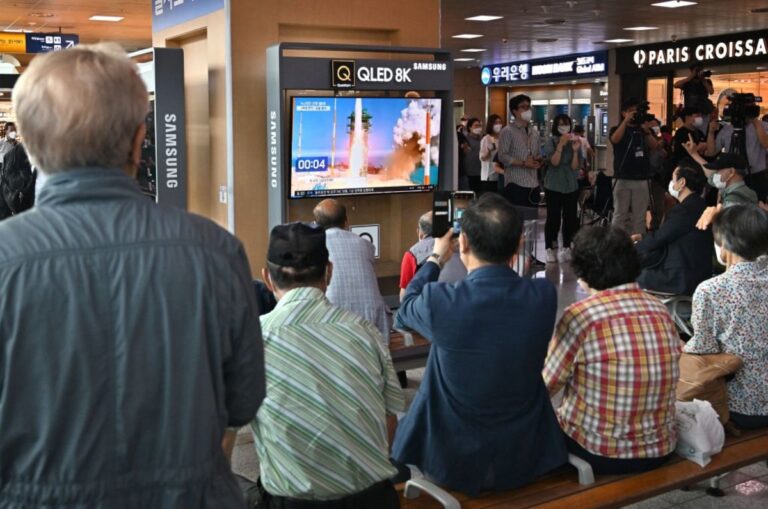
JUNG YEON-JE/AFP via Getty Images
South Korea’s Nuri rocket is three weeks from an October 7 launch that will attempt two simultaneous firsts: the country’s debut multi-satellite constellation deployment from its own soil, and the first time a commercial company has held complete, end-to-end operational authority over a Korean government launch vehicle. Underlying both milestones is a third story that implicates the entire allied-nation space industry — a global satellite-thruster supply shortage, triggered by the post-2022 exclusion of Russia’s EDB Fakel from Western procurement channels, that caused three successive postponements and confirmed the structural fragility of commercial manufacturing models for government space programs.
The Korea AeroSpace Administration (KASA) and Korea Aerospace Research Institute (KARI) confirmed at a joint media briefing in Jongno District, Seoul on Tuesday that final assembly of the fifth Nuri rocket is nearing completion at the Naro Space Center in Goheung. Assembly is due to wrap up by the end of September, followed by final inspections through October 5 and a roll to the launchpad on October 6. KARI senior official Park Jong-chan announced that engineers have established a 200-kilometer-by-50-kilometer (124-mile-by-31-mile) ellipsoidal space-object avoidance zone to finalize the precise launch time within the day’s window.
Record Payload, Record Complexity
The fifth Nuri flight will carry 15 satellites — five NEONSAT (New-space Earth Observation Satellite Constellation for National Safety) microsatellites numbered 2 through 6, plus ten CubeSats developed by Korean universities, research institutions, and startups. The 15-satellite manifest is the largest payload count in Nuri’s five-year history and Korea’s first multi-satellite sequential release from a single Korean rocket.
The launch window runs from 12:23 p.m. to 1:23 p.m. Korea Standard Time (03:23–04:23 ET), with a backup period extending from October 8 through October 14 if weather or technical conditions force a delay.
Safely releasing 15 satellites is the mission’s most demanding engineering challenge. After the third-stage engine shuts down at approximately 575 kilometers (357 miles) altitude, the five NEONSAT microsatellites will be released at 35-to-40-second intervals. KARI has equipped Nuri with low-shock satellite separation devices and a multi-satellite adapter specifically for the sequence. The timing of the intervals is not arbitrary: each spacecraft needs enough initial separation from its neighbor to avoid the “cascading collision” risk — a satellite too close to another during deployment can generate debris that damages both.
How the Constellation Will Actually Work
The five NEONSAT microsatellites are each under 100 kilograms (220 lbs), jointly developed by the Satellite Technology Research Center at KAIST and satellite manufacturer Satrec Initiative. Each carries an electro-optical camera capable of 1-meter black-and-white and 4-meter color imagery — sufficient resolution for monitoring wildfire perimeters, flood extent, and vehicle-level activity for national security purposes.
The mission targets a sun-synchronous orbit (SSO) at 500 kilometers (311 miles) altitude. SSO is a specific class of near-polar orbit in which the satellite crosses any given point on Earth at the same local solar time on every pass — ensuring that the lighting angle on the ground is consistent, which is essential for comparing images day to day to detect changes. The standard altitude for SSO Earth-observation satellites is 600–800 km (373–497 miles); NEONSAT uses 500 km to achieve a slightly faster revisit rate at the cost of more atmospheric drag and shorter satellite lifespan. For a program planning to mass-produce and replenish its constellation, that tradeoff is deliberate.
Once the remaining five NEONSAT satellites (numbered 7 through 11) join them on Nuri’s sixth launch in 2027, the ten-satellite network will be spread across two orbital planes. The geometry of two planes at 500 km SSO enables the constellation to image the Korean Peninsula more than three times daily and revisit any specific location within 24 hours — a coverage rhythm no single satellite can achieve.
The NEONSAT prototype (No. 1) reached orbit on a Rocket Lab Electron flight from New Zealand in April 2024. A verification satellite, NEONSAT-1A, launched in January 2026 to confirm on-orbit thruster performance and altitude-maintenance capabilities in the afternoon orbit. The mission launching October 7 is the first time the constellation itself will fly from Korean soil on a Korean rocket.
Hanwha Aerospace Takes Full Command
The institutional change embedded in Flight 5 is as significant as the payload. For the fourth Nuri launch in November 2025, Hanwha Aerospace managed assembly and manufacturing while KARI retained launch operations authority. For Flight 5, Hanwha holds both — full Nuri operational command for the first time, with KASA shifting from operational lead to a supervisory and advisory role.
A separate company, HD Hyundai Heavy, continues to manage launchpad operations at Naro Space Center — a function that was not transferred in the technology handover.
In July 2025, Hanwha Aerospace signed a ₩24 billion technology transfer agreement with KARI covering the full lifecycle of launch vehicle development: design, manufacturing, and launch operations. KASA Administrator Oh Tae-seog framed the shift in explicit sovereign terms at the K-LEO constellation briefing in July 2026: “Leading space nations are making all-out efforts to build low-Earth orbit satellite communications networks, which are critical infrastructure for safeguarding national security and communications sovereignty, as well as a strategic foundation for the 6G era.”
The authority transfer is central to South Korea’s longer-horizon space strategy. Seoul has committed to conducting at least one Nuri launch per year by 2032, eventually scaling to four annual launches — a cadence that officials have said is incompatible with government-institute-led operations.
What the Thruster Shortage Is and Why It Delayed This Mission
The October 7 date is, notably, the third scheduled launch date for this mission — originally planned for June 2026 before being pushed back twice to reach October 7, after engineers at KASA and KAIST’s Satellite Technology Research Center identified thrusters on some of the nanosatellite payloads as underperforming against mission specifications.
“There were some areas where the thrusters’ performance fell short of expectations,” said Kim Jin-hee, director-general of the Satellite Directorate at KASA. “We have completed the necessary improvements to enhance stability.” The team replaced thrusters and reran verification tests — necessary because mass-production processes introduce batch-level variability not always captured by initial qualification testing.
Kim also acknowledged the broader tradeoff inherent in the move to commercial-style manufacturing: “Recently, as we have adopted mass production methods used by private companies, some areas require additional verification. Although we replaced the components with products from the same manufacturer, further examinations were required.” This is not a concession unique to Korea — it is the structural cost of applying commercial, volume-optimized manufacturing to space hardware. Space-grade components, tested individually at much higher cost, did not share this risk. Commercial off-the-shelf components, manufactured for volume in global supply chains, share batch-level failure rates that individual space-grade qualification testing historically avoided.
Thruster Supply Crisis: A Global Story Behind a Korean Delay
The propulsion supply problem is not an isolated Korean procurement incident. It is a downstream consequence of one of the most significant supply chain disruptions in the satellite industry’s recent history.
Before February 2022, Russia’s EDB Fakel — a subsidiary of Roscosmos headquartered in Kaliningrad — was the world’s dominant supplier of low-power Hall-effect thrusters. When Russia invaded Ukraine, Western sanctions barred allied-nation programs from purchasing Fakel hardware. Satellite operators including OneWeb had to find alternative suppliers mid-program. Busek, a Massachusetts-based electric propulsion company that had already worked with OneWeb, ramped to 20 monthly thrusters within months of receiving the call.
The shortage cascaded into the U.S. government market. The Space Development Agency’s Proliferated Warfighter Space Architecture — a LEO constellation of hundreds of satellites — encountered the same bottleneck. Redwire CTO Al Tadros estimated 100 monthly thrusters needed to meet current industry demand, with potential 10x growth as mega-constellation programs matured.
The NEONSAT delay confirms what propulsion analysts had warned: the post-Fakel thruster shortage has now propagated from commercial operators to allied-nation government constellation programs. Every nation building a small-satellite constellation in this environment — including South Korea’s planned K-LEO network — faces the same structural constraint unless domestic or allied thruster manufacturing scales significantly to meet demand.
Kim noted, pointing to the nuanced reality of the commercial model: even sourcing from the same supplier does not guarantee batch consistency at the verification threshold that constellation formation-flying requires.
What Comes Next: K-LEO and the Real Test Ahead
The September 3 joint launch safety drill at Naro Space Center — involving twelve organizations including government agencies, the military, police, and local governments — completed preparations from the safety side. If the October 7 launch succeeds, it will validate two simultaneous transitions in South Korea’s space program: commercially manufactured satellites deployed by a commercially operated launch vehicle.
But the larger question it will answer is whether that model scales. The driver behind the urgency is South Korea’s K-LEO program — the country’s plan for a sovereign low-Earth orbit communications network, ratified by Korea’s National Space Council in July 2026 as a target for 2035. The plan calls for between 128 and 512 satellites, with total investment estimated between ₩4 trillion and ₩13.2 trillion ($2.9–9.6 billion USD) per five-year period. Hanwha Group has backed this trajectory with a ₩55 trillion aerospace commitment in aerospace and AI investment through 2040 — approximately $40 billion at September 2026 exchange rates.
“This fifth Nuri launch will carry a record 15 satellites and mark Korea’s first mission to place a satellite cluster into orbit,” KASA Administrator Oh Tae-seog said at the August 27 Launch Management Committee meeting. “It will provide an opportunity to take Nuri’s mission capabilities and Korea’s space transportation capacity to the next level.”
Flight 5, in that context, is a live operational test of whether the privatization model works at the delivery cadence K-LEO demands. The remaining five NEONSAT satellites and Nuri’s sixth mission are scheduled for 2027. Beyond that, the KSLV-III — Nuri’s planned successor, confirmed as Korea’s reusable methane rocket in November 2025 — is targeting its maiden flight in the early 2030s.
What South Korea’s Space Program Offers That Others Cannot
The October 7 launch places South Korea in a specific global context. As nations and commercial operators race to establish small-satellite constellations for imaging, communications, and security applications, South Korea is demonstrating that a government program — built on a fully indigenous launch vehicle with no foreign rocket engine involvement — can make the transition to commercially operated constellation deployment. Nuri uses Korean engines (the KRE-075 and KRE-007), Korean propellants, and now Korean operational command.
What it cannot yet offer is reusability. Chang Young-keun, a professor at Korea Aerospace University, has noted that Korea “may face challenges in developing reusable engines in the near future, a technology that has already been mastered by SpaceX.” SpaceX’s Falcon 9 can deliver 23 metric tons (50,700 lbs) to low Earth orbit and reuse its first stage; Nuri’s payload capacity to SSO is approximately 1.9 metric tons (4,200 lbs) on an expendable vehicle. The KSLV-III program is the answer to that gap — but it requires an entirely new development cycle.
Whether South Korea can build and sustain K-LEO at the cost point and cadence that sovereign infrastructure demands remains the central test ahead. The October 7 mission will not resolve that question. It will, however, establish whether commercial operational command of a government launch vehicle delivers the program discipline and cost profile it is designed to.
Currency conversions in this article are approximate and based on exchange rates as of September 15, 2026.
Frequently Asked Questions
What is the difference between Nuri’s fourth and fifth launches in terms of who runs them?
For the fourth launch in November 2025, Hanwha Aerospace handled rocket assembly and manufacturing under a government technology transfer, but KARI retained authority over actual launch operations. For the fifth launch on October 7, Hanwha Aerospace holds full end-to-end authority — assembly, manufacturing, and launch operations — with KASA in a supervisory role only. It is the first time a private company has fully commanded a Korean government launch vehicle from the ground up.
Why were multiple launch dates set for this mission, and what does the delay reveal about satellite manufacturing?
The mission was originally planned for June 2026 before being pushed back twice to reach October, after engineers found that thrusters on some of the nanosatellite payloads were underperforming. The thrusters had to be replaced and the entire verification test battery rerun. This exposed a structural challenge in commercial satellite manufacturing: when programs adopt the high-volume production techniques that reduce cost, they accept batch-level variability — meaning components from the same supplier can fail at different rates across a production batch. Individual space-grade testing catches this; commercial batch processes may not.
What is the global thruster shortage, and does it affect other countries’ space programs?
Since Russia invaded Ukraine in February 2022, Western and allied nations have been cut off from EDB Fakel, which had been the world’s dominant supplier of low-power Hall-effect thrusters for satellites. Programs from OneWeb (which pivoted to Busek in Massachusetts) to the U.S. Space Development Agency’s warfighter constellation have all encountered this bottleneck. The NEONSAT delay is the first documented case of it affecting an allied-nation government constellation program specifically — and the same shortage will be a structural challenge for South Korea’s planned K-LEO network of 128 to 512 satellites unless domestic or allied thruster manufacturing scales significantly before that program enters procurement.
What is K-LEO, and why does the Nuri privatization matter for it?
K-LEO is South Korea’s plan for a sovereign low-Earth orbit communications network of 128 to 512 satellites, ratified by the National Space Council in July 2026 and targeting 2035 completion. The total cost over five-year periods is estimated at ₩4 trillion to ₩13.2 trillion ($2.9–9.6 billion USD). Sustaining K-LEO requires multiple launches per year — a cadence that government-institute-led operations cannot realistically maintain. Whether private-sector command of Nuri launches works efficiently and cost-effectively is therefore not just a milestone question but a prerequisite for K-LEO: if Flight 5 validates the commercial model, it de-risks the launch procurement that K-LEO depends on.