HomeAuto Nobel Laureate-Led Starshade Could Find Alien Earths Six Times Faster Than HWO
Nobel Laureate-Led Starshade Could Find Alien Earths Six Times Faster Than HWO
August 26, 2026:
Nasa.gov
The scientist who helped prove the Big Bang with COBE and spent nearly three decades shepherding the James Webb Space Telescope from blueprint to orbit now believes the fastest and cheapest path to detecting life on another world may be neither JWST nor NASA’s planned $11 billion Habitable Worlds Observatory: a $1 billion hybrid design that pairs a 328-foot (100-meter) orbital starshade with the enormous ground telescopes already rising from the mountains of Chile and Hawaii, as published in Nature Astronomy.
That scientist is John C. Mather, a Nobel Laureate in Physics and senior astrophysicist at NASA’s Goddard Space Flight Center. He is the principal investigator of the Hybrid Observatory for Earth-like Exoplanets (HOEE), a concept that Mather and a NASA team published on the cover of Nature Astronomy in March 2026 and that drew new media attention this week after Mather’s colleague Vladimir Airapetian, also a NASA Goddard senior astrophysicist, described the mission’s science goals in Paris at the Origins 2026 astrobiology conference. Airapetian’s description in Paris drew significant interest from the astronomy community. The HOEE team has completed its initial NASA Innovative Advanced Concepts Phase I study and has already submitted the Phase II proposal that, if approved, would provide $750,000 for two additional years of work, with a decision expected in coming months.
The timing is pointed. Five days from now, on August 30, NASA’s Nancy Grace Roman Space Telescope is scheduled to launch aboard a SpaceX Falcon Heavy from Kennedy Space Center. Its onboard coronagraph will be the most capable starlight-suppression instrument ever put into space; according to the HOEE paper’s authors, it still will not be able to directly image a rocky, Earth-like world in the habitable zone of a Sun-like star. HOEE, by contrast, is designed to do exactly that, at a small fraction of the cost and perhaps a decade before HWO could.
Why No Existing Telescope Can See an Earth-Like World
The core problem in finding Earth-like exoplanets is not sensitivity: it is contrast. In visible light, a star like our Sun is roughly ten billion times brighter than an orbiting Earth-like planet. To capture reflected light from such a planet, a telescope must suppress that stellar glare by a factor of ten billion to one (written as 10^10 in scientific notation).
The best internal coronagraph ever built, the kind that blocks starlight inside the telescope using carefully designed optical masks and deformable mirrors, achieves a contrast ratio of roughly one hundred million to one (10^8) in the most favorable conditions. That is the performance of the Roman Space Telescope’s Coronagraph Instrument, which will serve as a technology demonstration for the future Habitable Worlds Observatory. HWO itself is being designed to achieve 10^10, the same ratio HOEE requires, but doing so demands HWO’s six-meter mirror design held stable in space to within ten picometers, roughly one-tenth the diameter of a hydrogen atom. That engineering challenge is expected to take until the early 2040s and is estimated to cost at least $11 billion, according to the Astro2020 Decadal Survey estimate.
HOEE proposes a fundamentally different approach: block the star before its light ever reaches the telescope.
Artificial Eclipse: How the Starshade Works
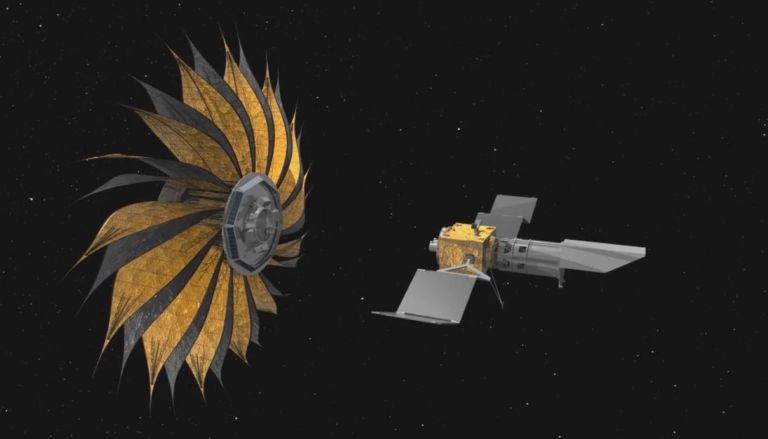
The HOEE starshade would be positioned approximately 175,000 kilometers (108,700 miles) from Earth, just under halfway to the Moon, in a long, elliptical orbit designed to match a ground telescope’s tracking motion as Earth rotates. From that position, it would hover directly on the line of sight between the telescope and a target star, creating what Airapetian describes as an “artificial eclipse.”
“The idea is to build a so-called hybrid observatory where we have a big telescope on the ground that can observe the exoplanetary system in optical light, visible light,” Airapetian said, told Universe Today in Paris. “The challenge is to block the star in order to reveal a planet that in optical light would be a billion times fainter than the star itself.”
The starshade’s design is elaborately precise. According to the Nature Astronomy paper, it would feature 48 petals extending 24 meters (80 feet) long, extending from a central disk 50 meters (164 feet) in diameter, producing an overall diameter of 100 meters (328 feet), roughly the length of an American football field. The petal shape is not decorative: it is mathematically optimized to prevent starlight from diffracting around the shade’s edges and flooding the telescope below.
To stay precisely centered on the line of sight between telescope and star, the starshade must be repositionable to within six meters (20 feet) of accuracy, a remarkably tight constraint for a structure at that altitude. The team proposes using hot hydrogen microthruster propulsion, chosen specifically because such propulsion produces no visible emissions that might contaminate the planet-light signal the ground telescope is trying to detect. Solar electric propulsion would handle retargeting between different star systems.
Because the starshade does all the optical suppression work mechanically, acting as a passive blocker rather than a precision optical instrument, the constraint on the ground telescope itself is dramatically relaxed. The telescope does not need to achieve 10^10 coronagraphic contrast on its own. It simply needs to be big, optically sound, and equipped with adaptive optics to deal with atmospheric turbulence. That is something the next generation of extremely large telescopes was already being built to be.
Why Ground Telescopes Make the Difference
HOEE is designed to work with three ground telescopes currently under construction: the European Southern Observatory’s Extremely Large Telescope (ELT), a 39-meter (128-foot) mirror array being built on Cerro Armazones in Chile’s Atacama Desert, with scientific first light scheduled for December 2030 per ESO’s March 2025 schedule update; the Thirty Meter Telescope (TMT), planned for Mauna Kea, Hawaii; and the Giant Magellan Telescope (GMT), also under construction in Chile.
The key advantage these telescopes give HOEE is aperture: raw light-gathering area. The ELT’s primary mirror, at 39 meters, is roughly six times larger in diameter than the six-meter mirror planned for HWO. Because telescope sensitivity scales with mirror area rather than diameter, the ELT collects light at a rate approximately 42 times higher than HWO’s planned design, enabling faster observations of the same faint planetary targets. Dr. Ahmed Soliman of NASA’s Jet Propulsion Laboratory, lead author on the Nature Astronomy paper, put it directly: Soliman told Universe Today that “HOEE can observe about many times faster because it uses a ground telescope roughly six times larger than the HWO.”
That aperture advantage is why the HOEE team estimates the system could detect the reflected light from an Earth-sized planet within the first minute of observation, a benchmark no existing or proposed instrument comes close to. The NASA Goddard’s HOEE page describes the observatory as capable of achieving imaging contrast no other proposed equipment can match.
What Does “Detect in Under a Minute” Actually Mean?
When HOEE researchers say the system could detect an Earth-sized world in under a minute, they mean detecting enough reflected light to confirm the planet’s presence and begin spectral analysis, not producing a resolved image. At visible wavelengths, reflected starlight from a planet’s surface encodes information about that surface: minerals, liquid water, continents, cloud patterns, and crucially, atmospheric chemistry, as detailed in the Nature Astronomy HOEE paper.
For atmospheric chemistry, the relevant signature is chemical disequilibrium: gases like oxygen and methane co-existing in concentrations that cannot be maintained by any known geological or abiotic process. The simultaneous presence of both gases at detectable levels would be among the strongest available evidence for biological activity on another world. HOEE would be sensitive enough to read those spectral signatures directly from reflected light, in the same visible and near-infrared wavelengths where the biosignature gases leave their strongest fingerprints.
There is, however, one critical engineering hurdle the starshade cannot solve: the atmosphere. Even with stellar glare eliminated from space, Earth’s own turbulent atmosphere still scrambles incoming planet light as it descends to the ground. HOEE addresses this with adaptive optics systems that are already standard on large ground-based telescopes. According to LLNL’s adaptive optics foundations page, a deformable mirror, a flexible optical surface controlled by hundreds to thousands of individual actuators, measures and corrects atmospheric distortion up to a thousand times per second, restoring incoming light to near-diffraction-limited quality. The ELT’s adaptive optics suite will include one of the most sophisticated such systems ever built. HOEE depends on, and is designed around, that capability.
An Inflatable Structure, Not a Rigid One
The engineering challenge at the heart of HOEE is the starshade itself. Building a 100-meter deployable structure that fits into a standard rocket fairing, survives launch in a collapsed state, unfurls in space with submillimeter accuracy, and then maintains that shape against thermal gradients and thruster firings is a problem that previous starshade concepts could not solve within affordable launch mass limits.
The HOEE team’s proposed solution is an inflatable and furled design under active development at ALPS lab at NASA’s Goddard Space Flight Center and JPL’s Advanced Large Precision Structures (ALPS) lab. The physics is conceptually similar to a camping tent that folds into a small bag but deploys into a rigid structure when pressurized. Applied to a 100-meter starshade, the approach allows the structure to collapse to a fraction of its deployed volume for launch, then expand to full size in orbit.
The goal is to hold total launch mass below 1,500 kilograms (3,307 pounds), a reduction of more than a factor of ten compared to earlier rigid starshade designs, according to the team. The design bet is that a structure that does not need to survive a violent launch in its final rigid form can be built far lighter, because the material only needs to handle the stresses of orbital deployment and steady-state operation in the gravitational gradient of its elliptical orbit.
The HOEE team’s cost estimate for the full mission sits “around the billion-dollar range,” Airapetian said in Paris, a figure that would make it one of the most cost-efficient flagship-class science missions in NASA’s modern history, and roughly eleven times cheaper than HWO’s current Astro2020 Decadal Survey estimate of $11 billion.
Can These Two Missions Coexist?
HOEE is not positioned by its team as a replacement for HWO. The two instruments occupy different scientific niches. HWO’s internal coronagraph, once perfected, would be able to observe in the ultraviolet, a spectral window inaccessible from the ground, and would not be subject to atmospheric limitations at all. For detecting ozone signatures (which require UV access), HWO remains the only proposed solution.
HOEE, by contrast, would operate purely in visible and near-infrared wavelengths and would rely on the ground-based ELT or its peers to collect the light. Its primary advantage is speed and cost: it could be operational a decade or more before HWO, using infrastructure already under construction, at roughly one-tenth the estimated cost.
For Airapetian, the scientific motivations extend beyond the familiar biosignature gases. He is interested specifically in rocky planets orbiting young, actively flaring F, G, and K-type stars, the same broad category as our own Sun, during the first billion years of their main-sequence lifetimes. High-energy stellar flares drive charged particles into planetary atmospheres, potentially triggering auroral emission at specific spectral lines. Airapetian told Universe Today: “We’re going for the spectral lines from red and green auroras that would signal that the atmospheres of these planets can support nitrogen and oxygen.” Those auroral signatures, if detected, would be a direct chemical fingerprint of nitrogen-oxygen atmospheres, a prerequisite for life as we know it.
How Does This Actually Get Built?
The path from a NIAC study to a flying mission is long, and it involves demonstrating technologies that have never been tested in space. No starshade has ever flown, not in HOEE’s 100-meter class, and not at all. Precise alignment of a starshade and a telescope has been demonstrated on the ground at small scales, but the formation-flying and fine-positioning problem at 175,000 kilometers has never been validated in orbit.
The HOEE team successfully completed its initial Phase I NIAC study, which NASA’s NIAC program confirmed as fulfilling all stated objectives. The Phase II proposal already submitted would provide funding to continue the mission concept study, develop a more detailed engineering roadmap, and advance the inflatable starshade design work. A decision in coming months is anticipated from the NIAC program.
If Phase II funding is secured and leads eventually to a Phase III development commitment, HOEE would join the queue of large NASA missions, a queue that already includes HWO (targeting the early 2040s), the Roman Space Telescope (launching August 30, 2026), and a series of mid-scale astrophysics missions. Each of those missions required years of concept maturation before receiving formal development approval. HOEE is early in that process.
What distinguishes it is who is asking. John Mather, the Nobel Laureate who spent three decades on COBE and JWST, is not known for reckless optimism. He said in a Hertz Foundation interview with Mather that experience in large space missions has convinced him that “if you can imagine something, there is likely a path to achieving it.” For the question of whether we are alone in the universe, that confidence, backed by a serious technical concept and real NASA institutional support, is itself news.
Frequently Asked Questions
How does HOEE’s starshade differ from the coronagraph inside the Roman Space Telescope?
A coronagraph is an internal device inside the telescope itself that uses optical masks and deformable mirrors to block starlight after it has entered the telescope. Roman’s coronagraph can suppress starlight to a ratio of about one hundred million to one, impressive, but still roughly fifty to one hundred times short of the ten billion to one ratio needed to see an Earth-like planet. The HOEE starshade, by contrast, blocks starlight externally, tens of thousands of kilometers away from the telescope, before that light ever reaches Earth’s atmosphere. The starshade achieves the full ten billion to one contrast ratio in a passive structure, not an optical instrument, and leaves the ground telescope needing only adaptive optics to correct for atmospheric turbulence rather than a precision coronagraph, as described in the HOEE’s Nature Astronomy paper.
Why can HOEE observe Earth-like exoplanets six times faster than HWO if the starshade and the telescope are separate spacecraft?
The speed advantage comes from the ground telescope’s size, not from the starshade itself. HWO’s planned primary mirror is approximately six meters (20 feet) across. The ELT, which HOEE would partner with, has a 39-meter (128-foot) primary mirror, about six times larger in diameter and roughly forty-two times greater in light-collecting area. Because faint planetary signals require collecting enough photons to build a reliable spectrum, a larger telescope sees the same target in far less time. HOEE leverages that aperture advantage by handling the starlight-blocking problem from space, delegating the actual light collection to the largest telescopes humanity has ever built, as explained in Universe Today’s March 2026 interview.
What would HOEE be looking for, and what would a positive detection actually mean?
HOEE would analyze reflected starlight from rocky, Earth-sized planets within roughly 20 light-years (118 trillion miles) of Earth. The primary science goal is detecting signs of biological chemistry, specifically the combination of oxygen and methane, or ozone and other disequilibrium gases, in a planet’s atmosphere. Both gases react rapidly with each other in the absence of a continuous biological source. Finding both simultaneously on the same planet would be strong evidence for active biology, as discussed in the LIFE Fleet exoplanet biosignature mission context. Airapetian’s personal research goal adds a second target: aurora emission lines from nitrogen and oxygen, which would reveal that a rocky planet’s atmosphere could support life as we know it.
Is HOEE funded, and when could it fly?
HOEE is at an early conceptual stage, funded so far through NASA’s Innovative Advanced Concepts program. The team completed a Phase I award and has submitted a Phase II proposal that, if approved, would provide $750,000 for two more years of study. No development funding or formal mission approval has been granted. Proceeding from the current concept phase to a flying mission typically takes ten to fifteen or more years for large-scale astronomy projects. The team has not stated a target launch date.