No Dungeons, No Damage: Surfing Deckbuilder Rogue Waves Demo Is Free on Steam

August 23, 2026:

No Dungeons, No Damage: Surfing Deckbuilder Rogue Waves Demo Is Free on Steam
Rogue. Waves
Pomelogames.com

Roguelike deckbuilders have spent years refining a formula that almost every entry in the genre shares: draw cards, spend mana, deal damage, survive. Rogue Waves, a debut PC title from Montevideo, Uruguay-based indie studio Pomelo Games, launched a free Steam demo on August 20, 2026, built on the premise that none of that is mandatory — and its two-phase energy system suggests the premise is correct.

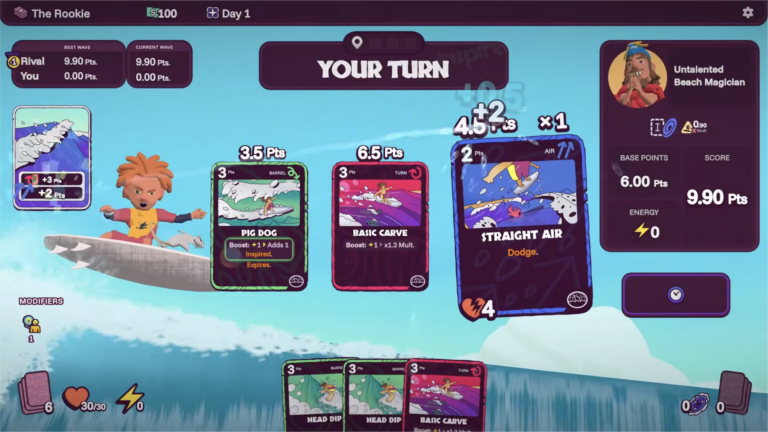
Set against the sun-soaked fictional beaches of Porto Calambre, Rogue Waves is a score-attack roguelike deckbuilder where the objective is not to defeat enemies but to outscore a rival surfer across four competition rounds. There are no hit points to drain, no mana pools to spend card by card, and no dedicated inventory screen — the architecture that defines virtually every other game in the genre has been replaced with a competitive surfing system built around two separate resource decisions that happen in sequence. Every round, you win or lose on points, not on survival.

Before Surfing, Bidding

Each round of a Rogue Waves competition opens with a wave auction. The player and the rival both spend from a shared Energy resource to claim the best available wave from the lineup. Waves carry color-coded bonuses that affect how many points specific cards can generate, so the wave auction bidding phase is a real strategic decision — not a warmup.

The structural innovation is what happens next: any Energy spent winning the auction is Energy no longer available during card play. Unlike combat deckbuilders, where a mana pool refreshes each turn for card costs, Rogue Waves uses a single Energy budget across both phases. Outbid your rival to ride the perfect wave, and you may arrive at it too depleted to fully power the tricks that would have made it worth fighting for. Concede the better wave and preserve your Energy, and you might score enough on a weaker wave to win the round anyway. Card Gamer’s day-one review described the resulting gameplay as “deceptively simple” with rules that “allow for a great deal of strategy and experimentation.”

How Is This Different From Slay the Spire?

The genre’s defining title, Slay the Spire, structures every encounter around a damage-and-defense loop: cards deplete enemy health while the player manages HP as a survival resource. Every significant entry that followed — Monster Train, Balatro, Inscryption — operates some variation of this loop. Balatro swapped dungeon combat for poker scoring in 2024 and sold over five million copies by January 2025, demonstrating that the combat assumption was not load-bearing.

Rogue Waves takes that argument into a sports-competition framing. Cards in Rogue Waves represent surf maneuvers, not attacks. Each wave has a limited number of available slots — some clear for any trick card, some marked as obstacle slots that require a Dodge-capable card or forfeit points. Once the slots are filled and the ride ends, scores are tallied. Win more points than the rival across the four-round competition, and the match is won. This is a score-attack model applied to deckbuilding: the question is not “do I survive?” but “do I score more?”

The roguelike deckbuilder sub-genre grew by over 35% in unit sales between 2023 and 2025, with Slay the Spire 2 selling five million copies in its first month in early 2026. In a market that crowded, Rogue Waves’ decision to abandon combat entirely is a genuine structural differentiation rather than a surface-level theme swap.

Who Are You Competing Against?

The demo ships with six rival surfers’ unique abilities — each interfering with the player’s score not by dealing damage, but by manipulating the numbers directly. Each rival, per the Steam page description, has “their own very specific issues, most of which are none of your business but all of which affect the score.” The game’s humor runs through these character sketches: Porto Calambre is a world of “suspicious sponsors,” fake brands, and what the developer calls “radical nonsense” — an irreverent tone that Card Gamer praised for its great charm.

Between competitions, players cycle through a progression loop: a shop to acquire new maneuver cards, a spa for healing, a gym for temporary stat upgrades, and sponsored events that reward board stickers. Those stickers — over 40 run-altering stickers from what the studio describes as “suspicious sponsors” — are modifier cards that attach to the board rather than the hand, creating persistent run-wide bonuses that stack and interact. Combine the right stickers with the right deck, and the point totals escalate toward what the studio’s marketing describes as chaining physically impossible tricks until the scoreboard breaks.

Adding volatility to every competition is the rogue wave mechanic itself: a random, unannounced intrusion into the lineup that offers higher rewards and higher risk simultaneously. The mechanic functions as a rogue wave random-event modifier — a high-stakes bet embedded inside an otherwise deterministic bidding round.

Who Made This, and Why Surfing?

Pomelo Games is a studio of more than 25 people working from seafront offices in Montevideo, Uruguay. The studio has spent over a decade making mobile and multiplatform games, including Outlanders, a city-building strategy title that launched on Apple Arcade in 2019 and was ported to Steam in March 2023, and its sequel Outlanders 2, released on Apple Arcade in July 2024. Rogue Waves, which will be Pomelo’s second Steam PC release, represents a significant genre pivot: from calm settlement-building to fast-paced competitive deckbuilding.

The demo, which launched simultaneously with the game’s Steam page, features the full wave-bidding system against all six rivals, plus a fully implemented Rookie deck of more than 50 cards. A full release date has not been announced. Players can wishlist the game on Steam to be notified at launch.

What Does Rogue Waves Demo Include?

The free demo available now on Steam includes: a Rookie deck of more than 50 maneuver cards; more than 40 run-altering board stickers from in-world sponsors; six rival surfers with unique score-disruption abilities; the full wave-drafting and wave-bidding system; the rogue wave random-event mechanic; and the between-competition shop, spa, gym, and sponsor-event loop. The full game is listed as “coming soon” with no release window announced. The demo is available on Windows and macOS — minimum specs for Windows require a dual-core 2.0 GHz processor, 4 GB of RAM, and an integrated GPU supporting DirectX 11.


Frequently Asked Questions

Is Rogue Waves free to play?

The full game is not yet released and has no announced price. The demo — which includes more than 50 cards, more than 40 stickers, and all six rivals — is free on Steam right now. Wishlist the full game on Steam to receive a notification when a release date is announced.

How does Rogue Waves differ from Slay the Spire or Balatro?

Both Slay the Spire and Balatro still resolve each run through some form of point accumulation that maps onto survival or score thresholds. Rogue Waves replaces the underlying loop entirely: there are no hit points, no card costs, and no damage output. Strategy is split across two sequential phases — a wave-bidding auction and a card-slotting execution phase — with a single Energy pool funding both. The game asks “can you out-score a rival?” rather than “can you survive long enough?” This puts Rogue Waves in a design lineage with Balatro (which similarly dropped combat for scoring) while operating in a completely different thematic context — competitive sports rather than gambling — suggesting that any scoreboard-based competitive activity, not just poker or dungeon-crawling, can carry a roguelike deckbuilder, per Card Gamer’s analysis.

Where is Pomelo Games based, and what have they made before?

Pomelo Games is an independent studio of more than 25 people based in Montevideo, Uruguay. The studio’s previous Steam title is Outlanders, a city-building strategy game that began as an Apple Arcade exclusive in 2019 before receiving a Windows PC release in March 2023. Rogue Waves is a deliberate genre departure: where Outlanders was a calm town-builder, Rogue Waves is a fast, comedic, competitive score-attack deckbuilder. More on the studio at Pomelo Games’ official studio page, and details on Outlanders are in the Wikipedia entry for Outlanders.

What platforms does Rogue Waves support?

The demo is available on Windows 10 (64-bit) and macOS 11 or later. Minimum specs for Windows require a dual-core 2.0 GHz processor, 4 GB of RAM, and an integrated GPU supporting DirectX 11 — accessible hardware requirements that reflect the game’s lightweight art style. No console versions have been announced. Full details are available on the Windows and macOS system requirements page on Steam.

Source link