HomeAuto New Star Trek Movie Casts Starfleet as Villain: Goldstein and Daley Reveal Training Day Template
New Star Trek Movie Casts Starfleet as Villain: Goldstein and Daley Reveal Training Day Template
September 3, 2026:
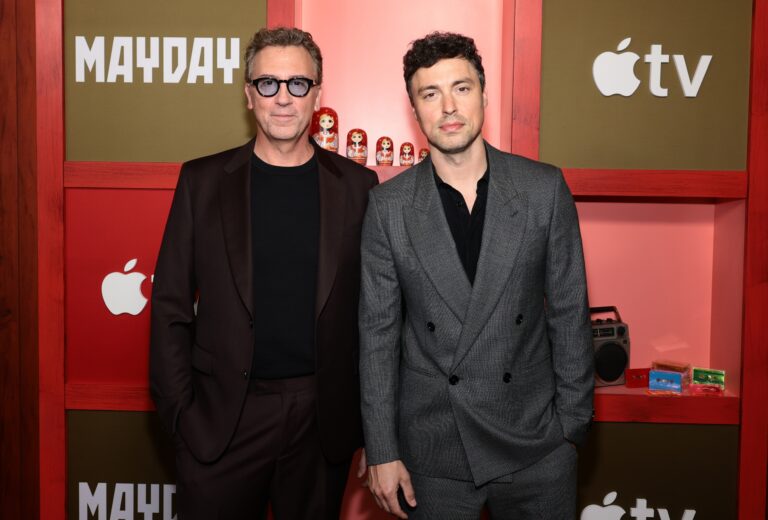
Jonathan Goldstein and John Francis Daley attend the premiere of Apple Original Films’ “Mayday” at AMC Lincoln Square Theater. Dimitrios Kambouris/Getty Images
The directors of the next Star Trek theatrical film have given their clearest account yet of what that film will actually be: not an adventure against an external enemy, but an interrogation of Starfleet itself — what happens when the franchise’s foundational institution, built on moral idealism, is corrupted from within. Goldstein and Daley spoke to Inverse on September 1, 2026, while promoting their Cold War action comedy Mayday, which premieres on Apple TV on September 4. They named two specific reference films for the Star Trek script: Antoine Fuqua’s Training Day (2001) and Tony Scott’s Crimson Tide (1995). Both happen to star Denzel Washington. Both are, at their core, stories about how a junior officer discovers that the institution he serves has been compromised by the person closest to him.
Jonathan Goldstein and John Francis Daley — the filmmakers behind Dungeons & Dragons: Honor Among Thieves and the Spider-Man: Homecoming screenplay — described their approach in conversations with both Inverse and The Playlist’s podcast “The Discourse” while on the Mayday press tour.
“Our approach is to really look at it from a question of, what is this institution of Starfleet that’s at the heart of Star Trek?” Goldstein told The Playlist. “And what would happen if all is not well in that institution? The movie that we talk about as the comp is Training Day.”
What “Training Day in Space” Actually Means for the Franchise
Training Day is not a thriller about crime. It is a thriller about how an institution — the LAPD narcotics unit — produces a figure like Alonzo Harris (Washington’s Oscar-winning turn) through years of systemic tolerance of his methods. The rookie officer (Ethan Hawke) is not catching a villain; he is discovering that the chain of command he trusted was the mechanism of the corruption all along.
Crimson Tide is structurally identical in its moral architecture. The submarine’s command authority — designed for clarity, built for catastrophic decisions — encounters an ambiguous signal and fragments. The question the film never quite resolves is whether Captain Ramsey (Gene Hackman) is wrong or right. The institution cannot answer the question on its own terms, because the institution’s logic is precisely what is in dispute.
Applied to Starfleet, those reference points suggest something considerably more demanding than a conventional sci-fi antagonist. They suggest a film in which the organization itself is the subject, not the backdrop.
“It takes place almost in real time,” Daley added in the Inverse interview, “and it just is a whole other look at what a Star Trek movie could be without betraying the fundamentals of what it should be.”
What Sociology Says Happens When Good Institutions Go Bad
The Goldstein/Daley creative framework has a precise analogue in organizational research. In 2003, Blake Ashforth of Arizona State University and Vikas Anand of the University of Arkansas published a landmark paper in Research in Organizational Behavior titled “The Normalization of Corruption in Organizations.” Their model identifies three mutually reinforcing processes by which corruption embeds itself in an institution until it becomes invisible to insiders: institutionalization (a corrupt act becomes routine procedure), rationalization (self-serving ideologies develop to justify it), and socialization (new members are inducted into treating it as acceptable).
“In most instances, the behavior creeps up on people,” Anand told the University of Arkansas at the time. “They are not intentionally evil and they don’t start out to be corrupt, but there are processes that take over and make their behavior seem normal.”
This is a structurally different claim from what most Star Trek films have dramatized. When a corrupt Admiral appears in Star Trek IV, Star Trek: Insurrection, or Star Trek Into Darkness, he is a bad actor subverting an otherwise sound system — a principal-agent problem with a detective-story resolution. Remove the villain; restore Starfleet’s integrity. The Anand-Ashforth model predicts a different scenario: an institution that has existed long enough for its corrupt practices to become procedure, rationalized by the institution’s own idealism, and transmitted to incoming officers as the normal way of doing business. That institution does not have a villainous Admiral at its center. It has a culture.
The franchise has gestured at this distinction before. Section 31 — the canonical Starfleet black-ops directorate introduced in Deep Space Nine and created by showrunner Ira Steven Behr — operates not as a rogue actor but as a sanctioned shadow beneath Starfleet’s official ethics structure, conducting covert operations so that other Starfleet captains can maintain their idealism. What the new Goldstein/Daley film appears to propose — though the script is still being written — is moving that interrogation from the margins to the structural center.
Does Star Trek Have to Ask This Question Now?
Daley’s framing suggests the film is not simply a cynical revision of Roddenberry’s optimism. “While this isn’t a cynical or nihilistic take on it,” he told Inverse, “I think it does acknowledge that there are some bad apples in every institution that can have a strong voice and can really make an impact on that institution and everything it stands for.”
The careful phrasing — “bad apples,” not “systemic rot” — leaves the film’s intellectual ambition deliberately unresolved. “Bad apples” is the Training Day reading: one corrupt officer, one revelatory day, one restoration of the hierarchy. The Anand-Ashforth model suggests the more demanding version: bad apples in a barrel that has normalized them.
Which version the film will dramatize is unknowable until a script exists. What is clear from the September 1 interview is that Goldstein and Daley are aware of the distinction, and that they consider the institutional-corruption angle to be the film’s genuine creative risk rather than a marketing frame. Goldstein described the ambition as launching “a new franchise” — not a sequel, not a reboot of known characters, but a fresh entry point that does not require Trekkie fluency.
How Far Into the Future Does “Further Into the Future” Actually Go?
One structural detail that has received less attention than the Training Day comparison is the timeline. Goldstein and Daley confirmed at San Diego Comic-Con July 2026 that the film is set further into the future than any prior Star Trek production.
The farthest Star Trek has previously ventured is the 32nd century — the setting of Star Trek: Discovery Seasons 3–5 and Star Trek: Starfleet Academy — approximately 900 years beyond the Original Series. In that century, an event called “The Burn” destabilized most warp-capable ships simultaneously, nearly annihilating the Federation. Starfleet Academy then dramatized the rebuilding of the first new class of cadets in nearly 120 years.
A film set “further into the future than that” would place it in the 33rd century or beyond — entirely uncharted canonical territory. An institution depicted in that setting would be roughly a millennium old. The sociology of millennial institutions is well-studied: organizations of that age tend to calcify their founding traditions into ritual, reinterpret founding documents to serve current power interests, and struggle to distinguish their accumulated procedural habits from objective moral truth. A Starfleet that has survived two near-extinction events — the Dominion War era and the Burn — and been rebuilt twice would be exactly the kind of institution Anand and Ashforth would predict carries the deepest normalization problem: each rebuilding would re-encode whatever compromises were struck into the next generation’s training.
How Real-Time Structure Changes the Stakes
The directors’ choice to place the action “almost in real time” is not incidental. Real-time narrative structure — in which the depicted duration of events closely tracks the film’s running time — defines a specific canon of moral-thriller cinema: 12 Angry Men, Rope, Locke, Phone Booth, and yes, Crimson Tide. That compression eliminates the franchise’s normal relief valve: Star Trek films typically manage emotional intensity by cutting across light-years, centuries, and encounter scales. Real time means the audience inhabits the moral decision at the same cadence as the characters, with no warp jump to reset the stakes.
In an institutional-corruption story, this is a particularly aggressive formal choice. If the corruption is embedded in the chain of command, and if the action unfolds in near-real time, then the audience cannot escape into worldbuilding spectacle. They have to watch the institution fail in the present tense, at the speed it actually happens.
Goldstein underscored that spectacle remains a requirement — this is still a theatrical franchise film, and the directors are aware it must justify the size of a cinema screen. “There has to be a spectacle to it,” Daley told Inverse. But how spectacle coexists with a near-real-time institutional thriller is one of the most interesting formal problems the film will need to solve.
What Have These Directors Done With Genre Before?
Goldstein and Daley are, at this stage of their careers, specialists in a specific kind of filmmaking: taking properties burdened with decades of established expectation and making them accessible without being dismissive. Dungeons & Dragons: Honor Among Thieves (2023) made the chaotic lore of a tabletop game feel like a studio adventure film without stripping out the game’s specific pleasures for insiders. Spider-Man: Homecoming (their screenplay, 2017) gave Marvel a Peter Parker who felt genuinely young and Queens-specific without requiring MCU context to enjoy.
The pattern that links those projects to the stated ambition for Star Trek is the same one Goldstein named explicitly in the Inverse interview: “We don’t want to rely on fandom. We don’t want to just hope that there are enough fans of the original [TOS] or The Next Generation or whatever who will turn out for this.”
That is a meaningful goal to state about Star Trek, which has among the most protective and encyclopedic fandoms in American pop culture. It is also the correct goal for a film that would have to commercially justify a budget — likely in the $150–200 million range for a Paramount theatrical release of this scale — against an audience that has not seen a Star Trek film in a decade. The last one, Star Trek Beyond (2016), directed by Justin Lin, grossed approximately $343 million worldwide against a reported $185 million production budget. By studio accounting standards, it underperformed enough to effectively end the Kelvin Timeline.
Chris Pine, whose Kirk helmed that film, was asked about the new project in January 2026 and offered a gracious non-comment. Speaking at the Sundance Film Festival, he said: “Have fun. Good luck. Live long and prosper.”
Is This What Happens When Trek Confronts Its Own Idealism?
Star Trek‘s utopian architecture has always been its central creative risk. The franchise’s fundamental premise — that humanity in the 23rd century and beyond has transcended greed, tribalism, and institutionalized cruelty — makes every story that contradicts that premise a mini-crisis for the canon. When corrupt Admirals appear in Star Trek IV or Insurrection, they are narrative exceptions, individual failures in an otherwise sound system. The system corrects itself.
What the organizational sociology underlying the Goldstein/Daley framework predicts is the harder version of that question: what if the system does not correct itself, because the corruption has been institutionalized, rationalized, and socialized across generations of officers? That is not a question Star Trek has ever placed at the center of a theatrical film. Deep Space Nine asked it in serialized television form over seven seasons. Star Trek Into Darkness gestured at it and retreated. A single theatrical film, unconnected to any existing continuity, with a near-real-time structure and a Training Day template, would be making the strongest formal argument the franchise has ever made that Roddenberry’s idealism is a condition to be interrogated, not assumed.
Whether Goldstein and Daley can deliver on that premise — and whether Paramount’s commercial requirements allow them to — is, as of September 2026, entirely open. The script remains in progress, with no cast attached and no production date announced. What exists is a creative intention, named with unusual specificity for a film this early in development, that suggests the people writing it understand the stakes of what they are proposing.
Frequently Asked Questions
When does the new Star Trek movie come out?
No release date has been set. As of September 2026, the script is still being written. Goldstein and Daley are writing, directing, and producing through their GoldDay banner for Paramount and Skydance. Industry estimates suggest a realistic release date, if production proceeds without delays, would be no earlier than 2029.
What does the Training Day comparison tell us about the film’s tone?
Training Day is not a simple good-cop/bad-cop story. It is a film about how an institution — a narcotics unit — systematically produces and protects a figure like Alonzo Harris through years of normalized corruption. Applied to Starfleet, it implies that the film’s antagonist may not be a single rogue officer but rather the command structure that enabled and protected him. Organizational sociologists Blake Ashforth and Vikas Anand have documented how this process — which they call normalization of corruption — works through institutionalization, rationalization, and socialization, ultimately making otherwise morally upright individuals capable of participating in corruption without experiencing conflict. That is the territory the Training Day comparison stakes out.
Will this Star Trek film connect to Discovery, Strange New Worlds, or the Chris Pine films?
No. Goldstein and Daley have confirmed — and Paramount has stated — that this film has no connection to any prior Star Trek series or film, including the Kelvin Timeline (Pine’s Enterprise crew) and the 32nd-century setting of Discovery and Starfleet Academy. The film features an entirely new cast of characters in a timeline set further into the future than any prior Trek production. The Chris Pine-led Star Trek 4 that was in development for several years is definitively not happening.
What is the organizational sociology behind the institutional corruption the film plans to explore?
The most directly relevant framework is Anand and Ashforth’s 2003 model, which argues that corruption in long-lived institutions does not typically arrive as a sudden rupture by a single villain — it embeds through three reinforcing processes: the corrupt act becomes routine (institutionalization), self-serving justifications develop (rationalization), and newcomers are inducted into treating it as normal (socialization). The implication for a Star Trek film is that removing one corrupt officer cannot restore the institution, because the corruption has become the institution’s operating procedure. Whether Goldstein and Daley’s script takes this harder path — or opts for the cleaner Training Day resolution of exposing and removing the bad actor — will determine whether the film delivers on its stated intellectual ambition.