October 11, 2026:


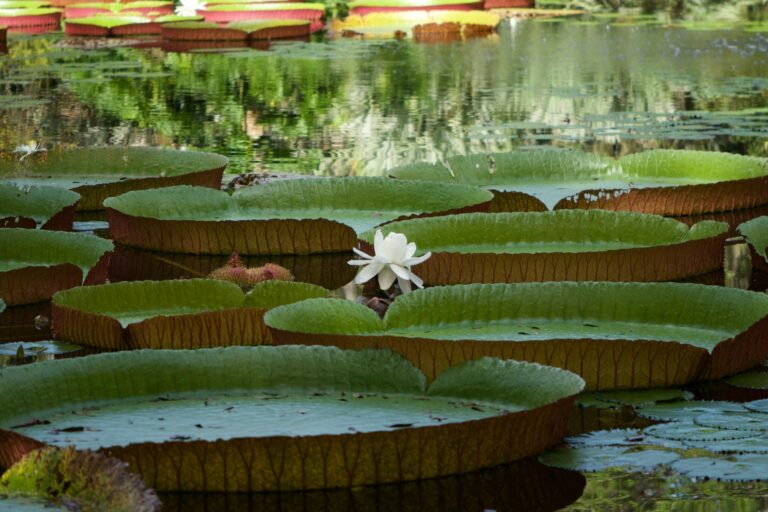
A plant large enough to appear in the background of a vacation selfie — and large enough to be confirmed from satellite orbit — had gone unrecognized by Western science until a trained botanist happened to scroll past the right Instagram photo. The result, published this week in the peer-reviewed journal Phytotaxa, is the formal scientific description of Victoria colombiana, a new species of giant waterlily found in the upper Orinoco watershed of Colombia, with an estimated wild population of 30 to 50 individual plants. The species may qualify as critically endangered.
In December 2021, Jeremiah Harris, the owner of Jeremiah Plants, a carnivorous-plant nursery based in Colorado Springs, Colorado, posted a photo of himself standing next to an enormous waterlily during a visit to the Inírida region of eastern Colombia. He assumed the plant was Victoria amazonica, the well-known giant Amazon waterlily. According to Gizmodo’s account of the discovery, it wasn’t.
Carlos Magdalena — a scientific and botanical research horticulturist at the Royal Botanic Gardens, Kew, in the United Kingdom, who has spent more than two decades studying the Victoria genus and is called the Plant Messiah — spotted the photo and immediately noticed something wrong with Harris’s assumption. Victoria amazonica is not known to occur naturally near the Inírida River, which drains not into the Amazon but into the upper Orinoco watershed. If the plant in the photo was real and in its correct native habitat, it belonged to a different species — possibly one unknown to science.
Magdalena cross-referenced the Instagram post’s location with satellite imagery of the region and confirmed that Victoria-type plant populations were indeed present in the Inírida area. Harris confirmed the satellite images matched the plants he had visited. Magdalena then began coordinating with Mauricio Bernal-Rodriguez, a researcher at Bogotá’s Jardín Botánico José Celestino Mutis, and with members of indigenous communities in the area. It took nearly two years before a field expedition became possible.
To formally name a new plant species under the International Code of Nomenclature for algae, fungi, and plants, researchers must designate a “type specimen” — a pressed and dried physical sample deposited in a herbarium that anchors the species name permanently. For the Victoria genus, whose species are distinguished primarily by their flower structure — petal count, sepal arrangement, flower color transition from white to pink, spine morphology on seed pods — this specimen must be “fertile,” meaning it must contain reproductive material. As botanical taxonomy practice establishes, a leaf alone is insufficient to anchor a formal species description.
Victoria flowers are nocturnal, thermogenic, and pollinated exclusively by scarab beetles of the genus Cyclocephala: the flower opens white on its first night, trapping beetles inside with heat and fragrance; it closes, turns pink, and reopens on night two — by which point it has become male, dusting the departing beetles with pollen. Collecting a specimen requires being at the right lake, on the right night.
The team’s five-day expedition to the Inírida region did not begin well. For several days, researchers found only two waterlilies, neither in flower. Then, on the final night before the team had to leave to catch their return flight, local boatman Gustavo Melo — from the Resguardo del río Atabapo, one of the Colombian indigenous territories whose communities had partnered with the expedition — guided researchers to a blooming plant. The team documented seven plants across two lakes in total and barely reached their flight in time.
“The discovery of this plant would have not been possible without the collaboration of many individuals that handle many aspects of knowledge, from indigenous knowledge to botanical horticulturists from two countries and technology such as GIS satellite surveying,” Magdalena said. “Remarkably, some of this tech is in your pocket, be it Instagram or WhatsApp.”
The Victoria genus was named by botanist John Lindley in 1837 in honor of Queen Victoria, the year of her accession to the British throne — a move historians have noted was partly calculated to secure royal interest in Kew, whose institutional future was at that point uncertain. For most of the nearly 190 years since, the genus was considered to contain two species: V. amazonica, native to the Amazon Basin and depicted in Guyana’s coat of arms; and V. cruziana, native to the Paraná-Paraguay watershed, distinguishable by its fuzzy leaf undersurface (purple rather than amazonica‘s red) and softer spines.
That settled picture cracked open in July 2022, when Magdalena and colleagues formally described Victoria boliviana — a third species that had spent 177 years unrecognized in Kew’s own herbarium — the world’s largest waterlily, with leaves reaching up to 3.2 meters (10.5 feet) in diameter. Now, with V. colombiana, the October 2026 Phytotaxa paper also argues that a waterlily previously called Victoria mattogrossensis — native to the Pantanal region — deserves recognition as its own fully distinct fifth species.
The genus now contains five recognized species total, according to the paper’s authors, up from two as recently as 2021.
The authorship list on the Phytotaxa paper is unusual for a botanical taxonomy paper. Alongside Magdalena, Bernal-Rodriguez, and systematic botanist Maarten J.M. Christenhusz of Kew — scientists whose institutional affiliations are what one typically expects — the paper lists these as co-authors: Gustavo Melo and Nilo Rodríguez (both from the Resguardo del río Atabapo), Jaime Hernández (from the Resguardo Caranacoa-Yurí-Laguna Morocoto), and Harris himself. Boatmen, indigenous community members, and the nursery owner who posted the original selfie are credited as co-authors of the formal scientific record.
That is not how most tropical biodiversity papers are written. A 2026 analysis of Amazon biodiversity research found that indigenous co-authorship appeared in only 6.4 percent of studies reviewed — even though indigenous communities are frequently acknowledged as essential participants in field logistics. A separate 2026 study published in Phytotaxa described a new palm species — the táam palm — found in Colombia’s Vaupés River region, using a Cacua Indigenous-led mapping process, with four Cacua community members listed as co-authors. Botanist Juan Carlos Copete, one of that paper’s researchers, said the approach should become standard model — “the standard model for biodiversity research conducted in Indigenous territories.”
The V. colombiana case makes the methodological argument for why, not just the ethical one. Without Gustavo Melo’s knowledge of the waterways and the locations of plant clusters inaccessible to outside researchers, the expedition would almost certainly have ended without the flowering specimen it required. The discovery was not incidentally assisted by indigenous knowledge; it depended on it structurally.
The researchers’ current best estimate is that fewer than 50 wild plants of V. colombiana exist in the wild. There may be additional undiscovered populations in the Orinoco watershed — the paper’s biogeographic analysis suggests river basin isolation since the Pliocene epoch drove diversification within the Victoria genus, and the Orinoco’s complex hydrology could conceal further populations — but the documented wild individuals are few enough that the paper’s authors plan to submit V. colombiana for a Critically Endangered listing with the International Union for Conservation of Nature (IUCN). An estimated population below 250 mature individuals is among the criteria that qualify a species for that designation.
The IUCN listing would be the first formal international conservation status for the species, enabling eligibility for conservation funding and protective mechanisms under international frameworks. Until that listing is in place, the species’ best protection is the indigenous communities whose territories it inhabits and who are now — through their co-authorship of the scientific description — formal stakeholders in its scientific record.
The researchers have a parallel plan. Seeds of V. colombiana are being cultivated at Bernal-Rodriguez’s botanical gardens in Bogotá, with the eventual goal of establishing specimens at Kew as well. They also hope to establish a monitored wild population in lakes closer to indigenous residents who can keep watch over them.
“We live in a wonderful world where there are many extraordinary forms of life, all of them unique and many which are being destroyed before we get to know them,” Magdalena told Gizmodo.
The Inírida River Basin, where the known V. colombiana population lives, already faces threats from alluvial mining and overfishing and pollution. The species was formally named for the first time this week. It is already at risk of disappearing.
Magdalena, who has spent decades scanning wildlife photos for botanical anomalies, said the V. colombiana discovery illustrates both what modern technology makes possible and what it still cannot automate. GIS satellite imagery confirmed the presence of Victoria-type plants in a remote drainage basin; Instagram carried the initial observation into his field of view; WhatsApp coordinated across two countries in two languages. But none of that replaced what Melo provided: the specific knowledge of which waterway branch, at which time of night, held the plant in bloom.
“Connecting these people from different backgrounds is key in a rapidly changing world,” Magdalena said. “However, we all had one thing in common: we are all fascinated by nature.”
Kew estimates that as many as 100,000 plant species remain undescribed worldwide. The Victoria genus — one of the most recognizable and studied in botanical history — was considered complete, with two species, until four years ago. It now has five.
Botanist Carlos Magdalena of the Royal Botanic Gardens, Kew, spotted the plant in the background of an Instagram selfie posted by Jeremiah Harris, a carnivorous-plant nursery owner from Colorado Springs, Colorado. Harris posted the photo after visiting the Inírida region of Colombia in December 2021. Magdalena recognized that the plant’s location near the Inírida River — which drains into the upper Orinoco, not the Amazon — made it unlikely to be the well-known Victoria amazonica. He used satellite imagery to confirm the presence of giant waterlily populations in the area, then coordinated a field expedition nearly two years later.
Under the International Code of Nomenclature for algae, fungi, and plants, describing a new plant species requires a “type specimen” — a pressed and dried physical sample with reproductive material (flowers or fruit), deposited in a recognized herbarium. For the Victoria genus, species are distinguished primarily by flower structure. A leaf alone — however large — is insufficient. During the five-day expedition, the team found only two plants for several days, neither of them flowering. Only on the final night, guided by local boatman Gustavo Melo, did researchers reach a plant in bloom. Without that single flower, the species could not have been formally named.
The genus Victoria now contains five recognized species, according to the October 2026 Phytotaxa paper — up from two as recently as 2021. V. colombiana is native to the upper Orinoco drainage of Colombia, a biogeographic territory distinct from the Amazon Basin (V. amazonica), the Paraná-Paraguay watershed (V. cruziana, V. boliviana), and the Pantanal region (V. mattogrossensis, which the same paper proposes be elevated to species status). The paper attributes the genus’s diversification to river-basin isolation since the Pliocene epoch.
The researchers estimate 30 to 50 wild plants currently exist, making the species potentially one of the rarest large aquatic plants on Earth. The team plans to submit the species for a Critically Endangered listing with the IUCN — a category that applies when a taxon faces an extremely high risk of extinction in the wild. Seeds are being cultivated at Bogotá’s Jardín Botánico José Celestino Mutis, with the goal of eventual propagation at Kew. The species’ near-term survival depends substantially on the indigenous communities whose territories it inhabits — the same communities whose members are now formal co-authors on the paper that put V. colombiana on the scientific map.