August 20, 2026:


Solo developer Danilo and publisher Pretty Soon dropped a major free update to the Neuron Activation demo on August 18, adding Gauntlet Mode, global leaderboards, a Zen Mode preview, and a cosmetics store funded entirely by in-game currency — no real-money purchases of any kind — on the same day a new trailer went live on YouTube. For a frantic micro-challenge puzzler pitching itself as a dopamine-delivery machine, that last detail is more significant than it sounds.
Neuron Activation is built on one of the most studied mechanisms in game design: the compulsion loop. At its most basic, the loop works like this — complete a short task, receive immediate positive feedback, move to the next task, repeat. What neurobiologists have established is that dopamine, the brain’s motivation neurotransmitter, fires not when a reward arrives but in anticipation of it — Wolfram Schultz dopamine reward research documented this mechanism in primate neurons, demonstrating that the anticipatory signal fires before reward delivery. The moment you see a button you know how to push, the dopamine hit has already started. Neuron Activation’s entire architecture is optimized around that anticipatory spike: tasks take two to ten seconds, chains of completions trigger multipliers, and finishing the board resets everything for another run.
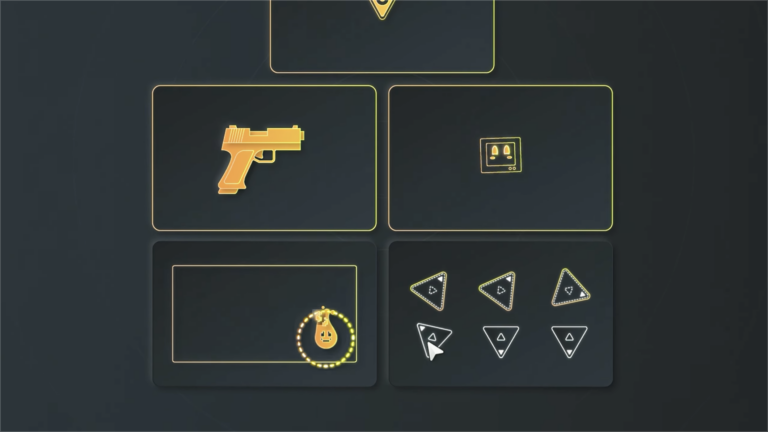
What makes it different from the obvious genre comparison — Nintendo’s WarioWare series, which nailed the micro-game formula in 2003 — is a structural design choice. WarioWare presents its micro-games sequentially: one task at a time, finished, gone, next. Neuron Activation runs simultaneous multitasking. Multiple tasks are active on the same control board at the same moment, requiring the player to split attention and prioritize in real time. That is a meaningfully different cognitive demand, and it is the game’s primary mechanical identity.
The setup is a workplace dystopia in miniature. The player is a new hire at a futuristic control hub, tasked with completing assignments fast enough to satisfy “The Board,” an unnamed corporate entity whose nature is never directly explained. The work begins as satisfying and straightforward — flip switches, drag sliders, shoot targets, push buttons — but the mystery deepens quickly. A second authority figure called The Handler enters the picture, and screenshots visible in the demo reveal messages like “DO NOT TRUST HIM,” suggesting the player is caught between competing corporate forces. As assignments grow stranger and more ethically charged, the central question becomes whether to comply or resist — a choice the game says will affect how events unfold, with multiple endings promised in the full release.
The emotional register shifts as the narrative progresses. What opens as frantic, score-chasing fun where corporate orders become harder to ignore, in the developer’s own description, gradually turns into something more unsettling. The game is not asking players to care about a character in the conventional sense. It is asking them to interrogate why they are pressing the buttons in the first place.
The original demo launched January 16, 2026, and earned a 100% positive Very Positive rating on Steam before the update shipped. The August 18 update adds enough content that prior players have good reason to return.
The most substantial new mode is Gauntlet Mode, which chains all the demo’s available boards in quick succession into a time-attack run. Where individual board sessions can be replayed in isolation, Gauntlet Mode tests consistency across the full demo roster in a single attempt. Global leaderboards accompany it, giving score-chasers a live competitive context for the first time.
The Zen Mode preview lets players explore four of the eventual 30 boards with the timer and score system disabled entirely. Three new interactive elements are exclusive to this mode. For players who find the arcade framing stressful, Zen Mode positions Neuron Activation as something closer to a tactile toy than a competitive game — a different reason to be in the same space.
The cosmetics store is the update’s most structurally interesting addition. Players earn the store’s in-game currency through gameplay and can spend it on panel customizations and lootboxes. Opening a lootbox triggers new dialogue from The Handler — meaning the lootbox mechanic is repurposed as a narrative-delivery mechanism rather than a monetization vector. No real-money purchase path exists anywhere in the demo.
Neuron Activation is built on the same psychological architecture as some of the most aggressively monetized games on the market. Compulsion loops — the feedback cycles that make players feel compelled to do one more task, reach one more score threshold, open one more reward container — are the mechanism behind F2P games that extract hundreds of dollars from players via microtransactions. The lootbox specifically is a format that has drawn regulatory scrutiny in multiple jurisdictions precisely because it combines variable-ratio reward schedules with real-money spending.
Danilo’s design choice to make the cosmetics store entirely in-game-currency-funded is not a small footnote. It is a direct statement about what kind of dopamine game Neuron Activation intends to be: one that borrows the psychological mechanisms of F2P design and then refuses to extract money through them. Whether that holds in the full game’s final economy remains to be seen, but the demo’s architecture gives no indication of a real-money path.
The full release is planned for sometime in Q4 2026 on Windows, macOS, and Linux. System requirements are deliberately low — a GPU from around 2012 will meet minimum spec — which puts the game in reach of a much wider hardware range than most new releases.
The answer is: very little, and that is the design. There is no tutorial gate, no sprawling onboarding sequence, and no skill prerequisite. The Steam tags reflect intentional breadth: Arcade, Casual, Relaxing, Puzzle, Cozy, Colorful, Wholesome sit alongside Action-Adventure and Cyberpunk, signaling a game trying to occupy multiple genre identities simultaneously. With nine languages in the current demo — English as the only full-audio language; French, German, Spanish (Spain and Latin America), Japanese, Portuguese-Brazilian, Russian, and Simplified Chinese with interface and subtitle support — the localization breadth already exceeds many full releases.
The most striking accessibility choice is the dual-mode offering. The same game that punishes inefficiency with lower scores and provides bosses to defeat also offers a completely pressure-free version in the same build. That is not a standard indie design pattern.
Neuron Activation is a frantic micro-challenge puzzle game from solo developer Danilo under the DR Studio label, published by Pretty Soon. Players operate a futuristic control hub filled with switches, sliders, and interactive tasks, completing them as fast as possible to chain score multipliers. The demo is free to download on Steam — no purchase required.
The full release is targeted for Q4 2026 on Windows, macOS, and Linux. No specific date has been announced. The full game will include 60-plus handcrafted levels, procedurally generated content, a complete version of the corporate narrative, multiple endings, and the full 30-board Zen Mode.
The current demo’s cosmetics store is funded entirely by in-game currency earned through gameplay. No real-money purchase option exists in the demo. The cosmetics store and lootbox system — whose lootboxes deliver new narrative dialogue rather than gameplay advantages — are described by the developer as using “only the satisfaction” as the real reward. Whether this model will extend unchanged to the full game has not been confirmed.
Both games use short-duration micro-tasks as their core unit. The key structural difference is that Neuron Activation stacks multiple tasks simultaneously on a single persistent control board, requiring players to divide attention in real time. WarioWare presents one micro-game at a time, each fully resolved before the next begins. Neuron Activation also adds a persistent corporate narrative layer — something WarioWare’s irreverent humor format does not attempt.