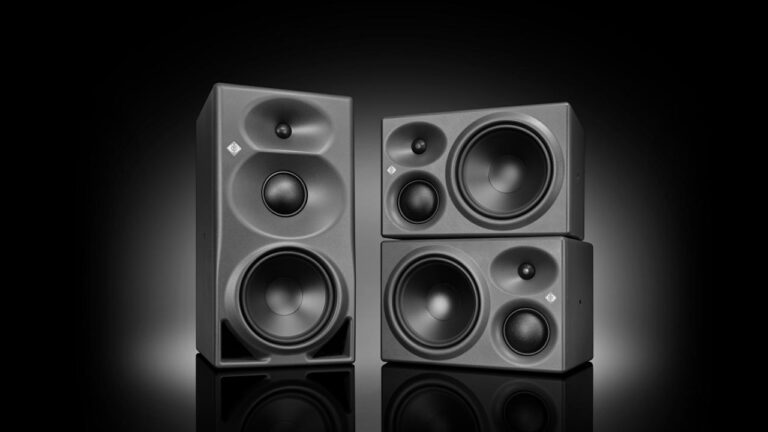
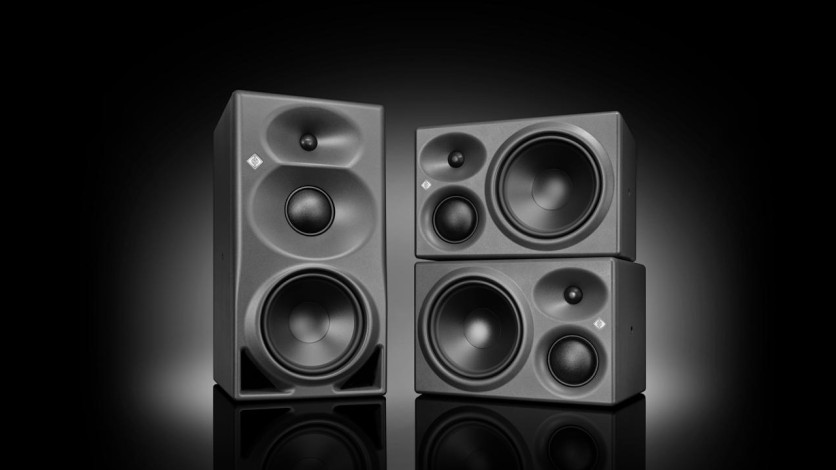
HomeAuto Neumann KH 310 II and KH 350 Three-Way Monitors Arrive in Japan With DSP and AES3 Built In
Neumann KH 310 II and KH 350 Three-Way Monitors Arrive in Japan With DSP and AES3 Built In
October 31, 2026:
Neumann.com
Sennheiser Japan has announced that two new precision three-way active studio monitors from Neumann — the KH 310 II and the KH 350 — will reach Japanese studios beginning November 18, 2026, with the KH 350 entering order intake on that same date. The monitors were globally unveiled in September 2026 and are currently shipping to markets outside Japan; the November 18 date positions both models ahead of Japan’s year-end production season, when studios traditionally evaluate and upgrade equipment before major project runs.
The two monitors share a common 32-bit DSP platform, a 585W tri-amplified Class-D amplifier section, and support for Neumann’s MA 1 Automatic Monitor Alignment room-correction system — but they are architecturally distinct in the way that matters most to engineers evaluating a purchase: one uses a sealed cabinet, the other a bass-reflex port, and that difference cascades through every aspect of how each monitor performs in a real room.
Sealed vs. Bass-Reflex: Why the Architectural Choice Defines Each Monitor
The distinction between a sealed and a ported loudspeaker enclosure is not primarily about how deep the bass goes. It is about the fundamental physics of how the enclosure interacts with the driver below the system’s resonant frequency — and that interaction determines transient accuracy, group delay, and how reliably a mix made on these monitors will translate to other playback systems.
A sealed cabinet acts as a second-order high-pass filter, rolling off at −12 dB per octave below its tuning frequency. The behavior is smooth and predictable; transients in the bass register decay quickly and cleanly, with minimal added group delay. Engineers describe this as “tight” bass — not because there is less of it, but because the timing of bass information arrives at the ear with higher accuracy relative to midrange and treble. This is why sealed monitors have historically been preferred in critical mixing and mastering contexts where low-frequency judgment calls are unforgiving.
A bass-reflex (ported) enclosure adds a tuned port — typically a length of pipe — that resonates at a calculated frequency and augments the driver’s output in the bass. The result is a fourth-order high-pass rolloff (−24 dB/octave below port tuning), deeper extension from a given cabinet size, and higher maximum output at low frequencies. The tradeoff is increased group delay in the bass — a slight blurring of timing relationships — and a resonant port overhang that some engineers find makes aggressive low-frequency decisions harder to assess. Bass-reflex designs also carry a risk of port chuffing at high drive levels, though well-engineered systems push this threshold well beyond typical monitoring levels.
Neumann’s decision to build one monitor each way is not indecision — it is a deliberate product architecture. The KH 310 II’s sealed cabinet makes it the near-field precision reference for critical mixing, mastering, and broadcast monitoring. The KH 350’s bass-reflex design makes it the full-range option for engineers who need deeper low-frequency extension and the headroom to push to mid-field listening distances. Both answers are correct; the right one depends entirely on the application.
KH 310 II: A Decade-Old Reference Upgraded Without Changing Its Footprint
The KH 310 II is the direct successor to the KH 310 A, a monitor that spent more than a decade in professional mixing, mastering, and broadcast rooms worldwide. Neumann redesigned the woofer, amplifier, and DSP while deliberately preserving every external dimension — meaning the KH 310 II can be dropped into existing KH 310 A installations without modifying stands, soffits, or wall mounts.
The headroom improvement is the most immediately striking specification: the KH 310 II delivers 5 dB more maximum SPL than the KH 310 A — a meaningful increase in a monitor class where engineers routinely push levels. The frequency response extends from 29 Hz to 21 kHz (±6 dB), the same characteristic three-inch soft-dome midrange driver is retained (preserving the voicing that KH 310 users know), and crossover points sit at 700 Hz and 1,700 Hz, positioning the soft-dome midrange across the most audibly critical range of instruments and voice.
The sealed cabinet’s second-order rolloff characteristic makes it the appropriate choice for near-field use in rooms where the listening position is close enough that direct sound dominates room reflections — standard critical monitoring conditions.
US pricing for the KH 310 II runs from approximately $2,799 to $2,999 per unit at major retailers, or approximately €2,979 (approximately $3,337 USD) in European markets. Japan-specific pricing was not disclosed in the Sennheiser Japan announcement.
Roman Kramer, Product Manager at Neumann, described the design brief: “With the KH 310 II, we worked long and hard to retain everything users love about the original while elevating performance in virtually every area. At the same time, the KH 350 opens new possibilities for engineers who want superior low-end reproduction and the flexibility to work across environments from near-field to mid-field.”
KH 350: Bass-Reflex Design for Mid-Field and Immersive Rigs
The KH 350 is an entirely new design positioned between the KH 310 II and Neumann’s flagship KH 420 in the product line. It uses a bass-reflex enclosure with a vertically aligned three-way driver layout, pushing the low-frequency extension to 27 Hz (±6 dB) — two hertz deeper than the KH 310 II — and reaching the same 21 kHz upper limit. The cabinet is almost twice the size of the KH 310 II, reflecting requirements of a ported design optimized for lower tuning.
A large MMD (Mathematically Modeled Dispersion) waveguide governs the tweeter’s output. The waveguide geometry is calculated to maintain controlled, consistent directivity across the full high-frequency range — meaning the monitor’s off-axis frequency response remains predictable as a listener moves away from the primary axis. This matters particularly in immersive audio setups where speakers at multiple positions (overhead, sides, surrounds) each contribute to a spatial sound field that a room calibration system must stitch together coherently. If one speaker’s off-axis behavior changes unpredictably with listener angle, the calibration breaks down. The MMD waveguide is Neumann’s engineering answer to that requirement.
The KH 350 is rated for use as a near-field monitor, mid-field monitor, LCR speaker, or surround channel — making it a candidate for music production, film scoring, post-production, broadcast, and immersive audio setups including Dolby Atmos and Sony 360 Reality Audio.
US pricing for the KH 350 runs from approximately $3,333 to $3,599 per unit, or approximately €3,579 (approximately $4,009 USD) in European markets.
Shared Platform: Class-D Power, 32-Bit DSP, and Broadcast-Ready Digital Input
Both monitors use the same custom drivers — an 8.25-inch cone woofer, a 3-inch soft-dome midrange, and a 1-inch tweeter — all designed in-house at Neumann. Amplification totals 585W in a tri-amplified Class-D configuration: 300W to the woofer, 160W to the midrange, and 125W to the tweeter.
The Class-D topology is what makes 585W practical in a compact near-field monitor. Switching amplifiers operate above 90% efficiency — MOSFETs switch fully between supply rails rather than conducting linearly, wasting minimal power as heat. An equivalent Class-AB design running at approximately 60% efficiency would dissipate around 390W as heat, requiring a heat sink and chassis scale incompatible with near-field monitoring distances. Class-D’s thermal efficiency is not an engineering compromise here; it is what makes the power specification physically possible.
The 32-bit DSP signal path handles all crossover management, frequency-response shaping, and phase optimization internally. The significance of 32-bit floating-point processing in this context mirrors the rationale behind 32-bit floating-point recording in DAWs: any intermediate arithmetic operation — no matter how extreme a filter coefficient or how complex a FIR convolution — has sufficient numerical headroom to avoid overflow or truncation artifacts. In a studio monitor, where distortion artifacts in the crossover region or room-correction filters would be audible at reference levels, the absence of DSP-induced artifacts is not a minor refinement — it is the baseline requirement.
Connectivity on both monitors includes AES3id 75Ω coaxial BNC digital inputs alongside analog XLR, plus a BNC output for daisy-chaining additional monitors from a single digital source. The AES3id specification uses the same 75Ω infrastructure as broadcast video cables, BNC connectors, and SDI patch bays. In a broadcast control room or post-production suite that already runs video on BNC infrastructure, the KH monitors can be patched into existing routing hardware without additional conversion. The digital input accepts sampling rates from 32 kHz to 200 kHz, and an RJ45 Ethernet port enables network connection for MA 1 Automatic Monitor Alignment. Manufacturing tolerances on both models have been tightened to minimize unit-to-unit variation — a specification that matters in immersive rigs where multiple speakers must perform identically to maintain imaging coherence.
What Is MA 1 Automatic Monitor Alignment, and How Does It Actually Work?
Neumann’s MA 1 system is consistently cited in the product materials, and its operation deserves a concrete explanation for engineers evaluating whether it changes the monitoring calculus in their room.
MA 1 works by measuring the acoustic response of the listening environment using a calibrated Class I measurement microphone and an audio interface. A swept sine wave plays through each monitor; the system captures the impulse response at the primary listening position, deconvolves the room’s acoustic signature, and computes a set of FIR (Finite Impulse Response) correction filters that counteract the room’s frequency-response irregularities, phase shifts, and arrival-time differences between speakers. Those filters are then uploaded to and stored in each monitor’s own 32-bit DSP via the Ethernet/RJ45 port.
The critical architectural distinction from PC-based room-correction software — Sonarworks SoundID Reference or Dirac Live, for example — is that MA 1 stores the correction in the monitor itself. Once the calibration is written to the DSP, the Ethernet cable can be disconnected. During playback, no software is running, no additional processing load sits on the DAW workstation, and no latency is added by a plug-in insert. The correction is transparent to the signal chain. For engineers routing audio through tight real-time setups, this matters.
The practical limitation of any room correction is that FIR inversion holds precisely at the measured spot. A few centimeters away from the microphone position, the acoustic correction degrades. MA 1 addresses this to a degree with Neumann’s recommendation to measure multiple listening positions and apply a smoothed correction, but the fundamental physics of room correction — accurate at one point, increasingly less so off-axis — applies here as elsewhere.
Stephan Mauer, Product Management Director at Neumann, described the rationale for the shared platform: “The KH 310 II and KH 350 share the same acoustic DNA and commitment to truthful sound reproduction. Today’s engineers work across a wide range of rooms, formats, and production styles. Our goal was to provide two solutions that deliver the same trusted reference standard while allowing users to choose the monitoring concept that best supports their workflow.”
A Heritage That Runs to 1967
The “KH” designation on both monitors carries substantive meaning. It refers to Klein + Hummel, the German acoustic engineering firm widely credited with producing the world’s first active three-way studio monitor — the OY model in 1967. That claim traces through Neumann’s own product history and has been broadly repeated in the professional audio industry, though it originates from Neumann-affiliated sources rather than independent academic attribution. Klein + Hummel’s subsequent early-1980s O 98 compact three-way established the design principles — low distortion, linear frequency response, controlled dispersion, and active crossovers — that continue to define the KH series today.
Sennheiser acquired Klein + Hummel in 2005. The studio monitor business transferred from Sennheiser to Georg Neumann GmbH in 2009, and Neumann entered the monitor market in 2010 with the KH 120 and KH 150. The KH 120 II compact near-field and the KH 310 II and KH 350 now complete what Neumann describes as its full KH family — compact two-way near-field through flagship three-way — available for the first time as an integrated system on the same DSP and MA 1 platform.
Specifications at a Glance
Feature
KH 310 II
KH 350
Cabinet type
Sealed (2nd-order rolloff)
Bass-reflex / ported (4th-order rolloff)
Driver configuration
3-way: 8.25″ woofer, 3″ soft-dome mid, 1″ tweeter
3-way: 8.25″ woofer, 3″ soft-dome mid, 1″ tweeter
Crossover frequencies
700 Hz / 1,700 Hz
700 Hz / 1,700 Hz
Frequency response (±6 dB)
29 Hz – 21 kHz
27 Hz – 21 kHz
Total amplification
585W Class-D (300W / 160W / 125W)
585W Class-D (300W / 160W / 125W)
DSP
32-bit
32-bit
Room correction
MA 1 Automatic Monitor Alignment
MA 1 Automatic Monitor Alignment
Digital input
AES3id, 75Ω BNC coaxial
AES3id, 75Ω BNC coaxial
Analog input
XLR
XLR
Network
RJ45 Ethernet (MA 1)
RJ45 Ethernet (MA 1)
US price (per unit)
$2,799–$2,999
$3,333–$3,599
EU price (per unit)
€2,979 (approx. $3,337 USD)
€3,579 (approx. $4,009 USD)
Primary application
Near-field critical monitoring
Near-field / Mid-field / LCR / Immersive
Japan availability
November 18, 2026
November 18, 2026 (order intake)
Currency conversions from EUR to USD are approximate and reflect exchange rates at time of publication.
Frequently Asked Questions
What is the practical difference between the KH 310 II’s sealed cabinet and the KH 350’s bass-reflex design — and which one should I choose?
The sealed KH 310 II acts as a second-order high-pass filter below its resonant frequency, rolling off at −12 dB per octave with minimal group delay. This means bass information arrives at your ears with high timing accuracy relative to midrange and treble — the characteristic that makes sealed monitors the preference for critical mixing and mastering work where low-frequency judgments are decisive. The bass-reflex KH 350 uses a tuned port to augment bass output and extend the response to 27 Hz (two hertz deeper than the KH 310 II), but at the cost of a fourth-order rolloff and higher group delay in the bass. The KH 350’s greater headroom and deeper extension make it the better choice for mid-field distances, full-range playback at higher levels, and immersive audio setups where speakers serve as LCR or surround channels. If you are doing near-field critical work in a treated room — mixing, mastering, broadcast — the KH 310 II is the intended tool. If you need the monitors to serve a larger room, higher levels, or an immersive rig, the KH 350’s architecture suits that application better.
Can the KH 310 II be dropped directly into an existing KH 310 A installation?
Yes — this was a deliberate engineering decision. Neumann preserved the exact external dimensions of the KH 310 A while redesigning the internal components. A KH 310 II can be installed in existing stands, soffits, or wall mounts without any modification. The upgrade path for studios with established KH 310 A installations is straightforward. The internal improvements — redesigned woofer, amplifier, and DSP, plus 5 dB more maximum SPL and the addition of 32-bit DSP for MA 1 compatibility — are all invisible from the outside.
What does AES3id mean, and why does it matter if a studio monitor has that input?
AES3id is the 75Ω coaxial variant of the professional AES3 digital audio standard — the same standard that underlies the XLR digital connections found on most professional converters and routers. The “id” version uses a BNC connector and 75Ω cable, which is the same physical infrastructure as broadcast video — SDI video cables, BNC patch bays, and video routers. In a broadcast or post-production facility that already runs BNC cabling throughout the studio, the KH monitors can be connected directly to existing digital routing infrastructure without additional conversion hardware. The digital output on both monitors also allows daisy-chaining: a single AES3id source can feed multiple monitors in series, which is relevant in multi-speaker immersive setups.
How does MA 1 Automatic Monitor Alignment differ from software-based room correction like Sonarworks or Dirac Live?
The fundamental difference is where the correction lives during playback. Software-based room correction runs as a plug-in or system-wide process on your workstation — it is active at all times, consuming CPU cycles and adding a measurable amount of latency (typically 15–100ms depending on filter length and buffer size). MA 1 computes FIR correction filters during a measurement session and then writes them directly into the monitor’s own 32-bit DSP via the Ethernet port. Once stored, the calibration is independent of your computer. During playback, no software is running, the workstation adds no processing load, and the latency penalty is zero — the correction is physically embedded in the monitor’s signal path. The trade-off shared by all room-correction approaches is that FIR filter inversion is accurate only at the measured listening position; accuracy degrades as the listener moves off-axis. MA 1 does not solve that limitation, but its on-monitor DSP storage makes it the more transparent implementation for low-latency professional audio workflows.