HomeAuto NATS Grounds Nearly 1,000 Flights in Third Swanwick Failure Since 2023 Reforms
NATS Grounds Nearly 1,000 Flights in Third Swanwick Failure Since 2023 Reforms
September 9, 2026:
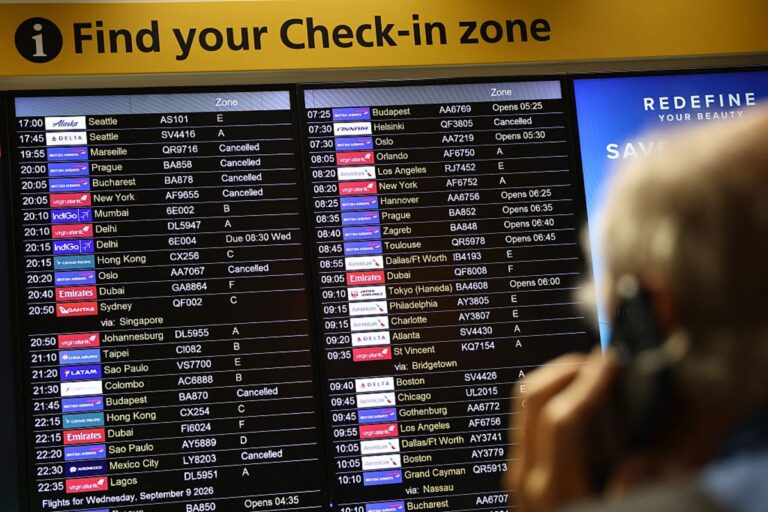
Cancelled flights are pictured on an electronic check-in display board at Terminal 3 of London Heathrow airport, west of London on September 8, 2026, following major disruption due an issue affecting the NATS air traffic control systems. Flights to and from the UK were cancelled on on September 8, due to a “technical issue” affecting UK’s National Air Traffic Services (NATS), which says it is working to resolve the situation. Henry NICHOLLS/AFP via Getty Images
A failure in the UK’s air traffic control flight-data processing system grounded or delayed nearly 1,000 flights on Tuesday, September 8, 2026, disrupting tens of thousands of passengers at Heathrow, Gatwick, and at least ten other airports — and renewing demands from major airlines for the resignation of the NATS chief executive who has overseen three system collapses in three years.
National Air Traffic Services announced a technical fault at its Swanwick control center in Hampshire at 13:46 local time, which was restricting departures across the London control area. The organization said the problem was in its flight-processing system — the automated software that receives and translates flight plan data for air traffic controllers — and confirmed a fix had been implemented at 16:40 local time, with the system in recovery after that point.
Inside the System That Failed Again
The technology at the center of Tuesday’s disruption is a computerized translation layer that airline passengers never see but cannot fly without. When an airline files a flight plan, it passes through Eurocontrol’s central system in Brussels before arriving at NATS as a standardized European data packet. NATS’ flight-processing software must then re-encode that packet into the format used by UK airspace management systems before controllers can act on it. A detailed technical analysis of the 2023 failure documents this architecture in full.
When that conversion software fails, controllers cannot automatically receive and process incoming flight plans. The system does maintain a buffer of approximately four hours’ worth of pre-filed plans, but these degrade quickly as airlines update routes, crew changes happen, and weather patterns shift. When the buffer is exhausted or the plans become stale, the last resort is manual entry — a labor-intensive process that reduces throughput to a fraction of normal capacity and makes large-scale ground stops inevitable.
NATS has not yet disclosed the specific technical trigger for Tuesday’s failure. What is confirmed is that the fault was, once again, in the flight-processing system — the same class of system that caused the August 2023 meltdown, when a software edge case involving two identically named waypoints in different locations caused both the primary system and its backup to simultaneously enter a fail-safe mode. That the September 8, 2026 failure affected the same category of infrastructure raises structural questions about whether the architectural vulnerability — a primary and backup system running identical logic, meaning a single software flaw can disable both — has been adequately addressed.
Scale of Tuesday’s Disruption
FlightAware data showed approximately 490 departures delayed at six airports — Heathrow, Gatwick, London City, Luton, Edinburgh, and Bristol — by mid-afternoon. A further 525 arriving flights at those same airports were canceled or delayed. Separate data from Flightradar24 recorded at least 625 cancellations across all UK airports during the day.
At Heathrow specifically, 38 of 661 scheduled arrivals were canceled or unable to operate, according to aviation analytics company Cirium. British Airways — the airport’s dominant carrier — canceled 16 of its 333 scheduled departures. Ryanair reported that more than 65,000 passengers were affected by delays of up to eight hours, with more than 50 flights canceled outright.
Disruption extended well beyond London. Other affected airports included Manchester, Birmingham, Belfast City, Glasgow, Aberdeen, Southampton, East Midlands, and Jersey, all of which reported cancellations and delays. Flights to and from Dublin were also caught in the slowdown because many transatlantic and European services use UK-controlled airspace. The disruption affected arriving and connecting passengers as well: the imbalance between incoming and outgoing traffic created congestion at gates and stands, triggering missed connections that continued cascading through airline networks long after NATS declared the technical fault resolved.
Airlines Demand Action
The response from carriers was swift and, from some quarters, openly contemptuous. Ryanair Chief Operating Officer Neal McMahon demanded that Martin Rolfe resign as NATS chief executive. “Following the 2023 collapse, we were told lessons would be learned. We were told resilience would improve. We were told the systems had been fixed. Yet here we are again,” McMahon said.
Wizz Air issued a separate statement declaring the organization “not fit for purpose in its current form” and calling for urgent structural reform. “A critical national infrastructure provider should not repeatedly bring the aviation system to a standstill,” the airline said.
Aviation analyst John Strickland offered a more measured but no less stark assessment, noting that even a comparatively brief outage carries enormous systemic impact when the failure touches the control center that coordinates airspace above England, Wales, and Northern Ireland simultaneously.
NATS confirmed the system fix was implemented at 16:40 local time and apologized. The organization stated it was “continuing to work closely with our airline and airport customers on recovery” and that passengers should continue to check with their airlines.
What Three Years of Failures Reveals
Tuesday’s event is the third documented system failure at the Swanwick center in three years. The pattern matters more than any individual incident.
The first came on August 28, 2023 — the English bank holiday and one of the busiest travel days of the year. A flight plan filed by French airline French Bee contained two identically named waypoints in different geographic locations outside UK airspace. The FPRSA-R software, manufactured by Frequentis AG and introduced in 2018, could neither approve the plan nor safely reject it. Both the primary system and its backup entered maintenance mode within 20 seconds. The result: the automated processing of flight plans stopped entirely. Controllers had to enter plans manually, a bottleneck that reduced capacity to a trickle.
The scale of that disruption was enormous. The UK Civil Aviation Authority estimates that over 700,000 passengers were impacted: 300,000 by cancellations, 95,000 by delays of more than three hours, and a further 300,000 by shorter delays. Industry estimates put the cost to the airline sector at close to £100 million (approximately $135 million USD) in additional costs, driven by the legal requirement to provide alternative flights, food, hotel accommodation, and care to affected passengers.
The CAA then commissioned an independent review chaired by Jeff Halliwell, which issued 34 recommendations across NATS, airlines, airports, and government in November 2024. Among the findings was a recommendation that NATS consider stationing a Level 2 engineer on-site during busy periods — NATS engineering staff had been working remotely during the 2023 bank holiday. Halliwell’s panel acknowledged the cost of on-site staffing but concluded it should be weighed against the total cost the industry bore in August 2023.
Then came July 30, 2025: a radar-related technical fault at Swanwick caused over 150 flight cancellations and restrictions on aircraft numbers in UK airspace for more than four hours. UK Transport Secretary Heidi Alexander summoned Martin Rolfe. Ryanair again called for his resignation.
A government reform progress report published on July 1, 2025 — one month before that second failure — confirmed that NATS had delivered on many of the 34 Halliwell recommendations, and that the CAA expected most to be completed and validated by end 2026. The CAA subsequently closed all outstanding recommendations on June 19, 2026. Less than three months later, a third system failure struck the flight-processing infrastructure.
How Are Passengers Affected — and What Are Their Rights?
For the tens of thousands of passengers caught in Tuesday’s disruption, the legal picture is clear but not generous. Because the failure originated with NATS rather than with the airlines themselves, Tuesday’s disruption will almost certainly be classified as “extraordinary circumstances” under UK air passenger rights law.
Under that framework — which the CAA applied identically following the July 2025 NATS failure — airlines are obligated to provide care and assistance to delayed passengers: food and drink vouchers after two hours for short-haul, three hours for medium-haul, or four hours for long-haul; hotel accommodation if passengers are stranded overnight; and transport to the hotel. Airlines must reimburse passengers who make their own care arrangements if the airline fails to provide them directly.
What the extraordinary circumstances classification does not provide is fixed-sum compensation. Under UK law, fixed-sum compensation — which can reach £520 ($705 USD) per passenger for long-haul delays — is only payable when the disruption stems from a cause within the airline’s control. A NATS system failure does not meet that threshold.
Passengers should contact their airline directly for rebooking options, keep receipts for any meals, accommodation, or transport they arrange independently, and file claims through the airline’s customer services process. If an airline refuses to pay reasonable care expenses, the CAA accepts complaints.
CAA Steps In — Again
The UK Civil Aviation Authority said it expects NATS to submit a full incident report covering Tuesday’s failure, and that the regulator will then consider whether further steps are needed to secure the reliability of the country’s air traffic control system.
The CAA’s response echoes an identical pattern from 2023, when the regulator demanded a preliminary report, then an independent review. The difference this time is context: the Halliwell review was formally completed in June 2026 with all recommendations closed, and the most recent progress assessment described NATS as having delivered on “many” recommendations. A third system failure — and again in the flight-processing domain — calls into question whether the reforms have addressed the structural rather than the surface causes of NATS’ repeated failures.
Heathrow remains Europe’s busiest airport, and the UK government holds a 49% stake in NATS — a commercial and political interest that makes full-scale structural reform inherently complex. Whether the calls for Martin Rolfe’s resignation now gain meaningful traction, following two prior rounds of identical demands without consequence, will be a test of the CAA’s willingness to exercise its regulatory authority.
What Tuesday confirmed is that the fundamental question the aviation sector has been asking since August 2023 remains unanswered: is the flight-processing architecture at Swanwick being genuinely rebuilt, or is it being patched?
Frequently Asked Questions
Are passengers entitled to compensation if their flight was disrupted by the NATS failure on September 8, 2026?
Almost certainly not — in terms of fixed-sum compensation. When a disruption is caused by an air traffic control failure rather than by the airline itself, it is typically classified as “extraordinary circumstances” under UK air passenger rights law. That classification removes the airline’s obligation to pay fixed-sum compensation (up to £520/$705 USD per passenger). However, airlines remain legally required to provide care: meals and refreshments after significant delays, hotel accommodation if you are stranded overnight, and transport between the hotel and airport. If your airline fails to provide these directly, you are entitled to arrange them independently and claim reimbursement. Keep all receipts.
What specifically is the flight-data processing system that failed, and why does a software fault cause such widespread disruption?
Before a commercial flight can take off, air traffic controllers must receive a processed version of the aircraft’s filed flight plan — a data file specifying its route, altitude, speed, and call sign. NATS’ flight-processing system at Swanwick translates these plans from a European data standard (ADEXP) into the format used by UK airspace management software. The system has a primary and a backup — but both run the same software logic. If a logical flaw causes the primary to fail, the backup encounters the same flaw and fails too. In the 2023 failure, the specific trigger was two identically named waypoints in different locations; NATS has not yet identified the specific trigger for Tuesday’s event. When this system fails, controllers cannot automatically manage the flow of incoming aircraft, forcing capacity restrictions that rapidly cascade into ground stops.
Why does the same center keep failing, and what has been done since 2023?
After the August 2023 failure, the UK Civil Aviation Authority commissioned an independent review chaired by Jeff Halliwell, which issued 34 recommendations for NATS, airlines, airports, and the government in November 2024. NATS reportedly implemented many of those recommendations, and the CAA formally closed all outstanding recommendations on June 19, 2026 — less than three months before Tuesday’s failure. The July 2025 Swanwick failure — a radar-related issue — and now Tuesday’s flight-processing failure raise serious questions about whether the reforms have addressed the structural roots of NATS’ fragility or focused on the specific mechanisms that caused each individual incident.
Is there any alternative to NATS for UK air traffic control?
No. NATS is the sole provider of en-route air traffic control services for UK airspace. The UK government holds a 49% “golden share” in the organization; seven major airlines hold a further 42%; LHR Airports Ltd holds 4%; and NATS staff hold 5%. There is no competing provider that could step in if NATS fails. This monopoly structure means that any system failure at Swanwick — which handles airspace over England, Wales, and Northern Ireland — is automatically a nationwide crisis with no workaround beyond reducing traffic to whatever the degraded system can safely manage.