November 26, 2026:


An asteroid collision may sound like something humanity can only prepare for, but a groundbreaking NASA experiment has demonstrated that a threatening space rock could potentially be redirected.
Four years after the Double Asteroid Redirection Test (DART) struck an asteroid moonlet, the European Space Agency’s (ESA) Hera mission has arrived to investigate the aftermath. Its early observations reveal a much more dramatic impact than scientists initially understood.
The findings offer valuable insights into asteroid deflection, the behavior of small celestial bodies, and the future of planetary defense.
In September 2022, NASA carried out the DART mission, deliberately sending a spacecraft toward Dimorphos, a small asteroid orbiting a larger companion called Didymos. The experiment aimed to determine whether a spacecraft collision could alter an asteroid’s movement enough to demonstrate a possible method of protecting Earth from future impacts.
Traveling at more than 13,700 miles per hour, or approximately 6.14 kilometers per second, DART slammed into Dimorphos and released roughly 10 billion joules of energy. The collision shortened the asteroid moonlet’s orbital period around Didymos by approximately 33 minutes.
This result exceeded expectations. Scientists had anticipated a much smaller change, making the experiment a significant achievement in planetary defense research.
However, the successful impact left researchers with an important unanswered question: What exactly happened to the asteroid after the collision?
DART was designed to destroy itself upon impact. Although its onboard camera captured images during its final approach, scientists had limited opportunities to examine the resulting crater, debris, and changes to Dimorphos’s physical structure.
The European Space Agency developed the Hera mission to provide a closer examination of the DART experiment. After traveling for approximately two years, the spacecraft reached the Didymos-Dimorphos asteroid system to study the consequences of the collision.
Its initial images revealed an enormous impact scar on Dimorphos, an asteroid measuring approximately 500 feet (151 meters) across. The crater was described as nearly stadium-sized, suggesting that the collision affected a substantial portion of the small celestial body’s structure.
Scientists had initially considered two possible outcomes: DART might have created a conventional impact crater, or the collision might have reshaped the entire asteroid. Hera’s observations indicate that both processes occurred.
The impact was powerful enough to excavate material and significantly alter Dimorphos’s shape. Researchers are still examining how the asteroid’s internal structure and physical properties contributed to such an extensive transformation.
Another notable discovery involved Dimorphos’s rotation. While Didymos maintained its previously observed rotation, Dimorphos appeared to be tumbling unpredictably. This suggests that the collision affected more than its orbital movement, changing its rotational behavior as well.
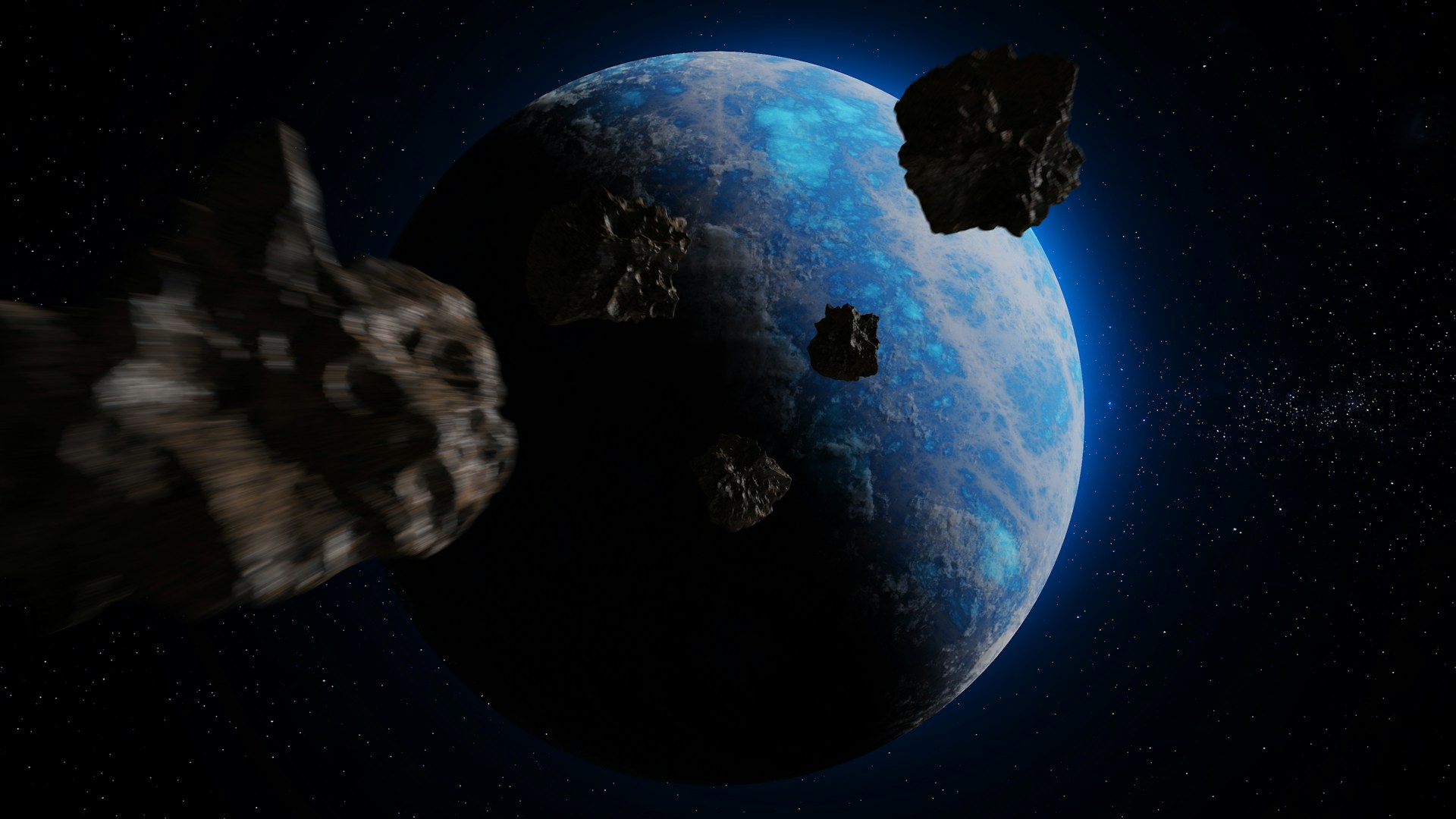
Perhaps one of Hera’s most surprising discoveries was the presence of hundreds of boulders surrounding the asteroid pair.
Images captured by the spacecraft revealed numerous fragments, with estimated sizes ranging from footballs to washing machines. These objects became visible through processed images combining multiple long-exposure frames from Hera’s hyperspectral camera.
According to Ars Technica, scientists suspect that some of these boulders may have been ejected from Dimorphos during the DART collision. However, their origin has not yet been established.
The fragments could also be remnants of earlier geological processes or materials left behind when Dimorphos originally formed. Distinguishing between these possibilities will help researchers understand the history and evolution of binary asteroid systems.
The discovery also introduces a practical challenge for Hera’s mission. The surrounding debris could complicate navigation and increase the risks associated with deploying its two smaller spacecraft, Milani and Juventas.
Both CubeSats are expected to conduct closer investigations of the asteroid system. Their objectives include examining surface composition, internal structure, mass, and gravitational properties. Juventas is also expected to attempt a landing on Dimorphos.
Despite the apparent danger, the spacecraft operate in an environment with extremely weak gravitational forces. Their movements are relatively slow, reducing the likelihood of destructive high-speed collisions with nearby fragments.
The behavior of Dimorphos highlights an important challenge in planetary science: small asteroids do not respond to physical disturbances in the same way familiar objects behave on Earth.
Their extremely weak gravity and loosely bound surface materials can produce unexpectedly large movements when disturbed.
A similar phenomenon occurred during NASA’s OSIRIS-REx mission, which collected samples from asteroid Bennu in 2020. When the spacecraft made contact with the surface, the interaction displaced a considerable amount of rock and dust, demonstrating how easily material can move on a low-gravity asteroid.
These observations matter because scientists cannot simply apply everyday assumptions about solid objects when predicting how an asteroid will respond to an impact.
The effectiveness of an asteroid deflection mission depends on several physical characteristics, including its density, composition, internal structure, and surface cohesion. Two asteroids of similar size could react very differently to the same collision.
Hera’s investigation is expected to provide the measurements needed to reconstruct the DART collision more accurately. By determining Dimorphos’s mass, internal structure, surface characteristics, and impact-related changes, scientists can improve computer models used to predict asteroid deflection outcomes.
These models could eventually help mission planners determine the appropriate spacecraft size, impact speed, and collision strategy for different types of near-Earth asteroids.
Not every asteroid presents the same physical characteristics. A deflection technique that works effectively on a loosely packed asteroid may produce a different result when applied to a denser or more solid object.
The DART experiment established that a spacecraft can measurably change an asteroid’s orbit. Hera’s contribution is to explain the physical processes behind that change and determine how reliably the technique could work elsewhere in the Solar System.
NASA’s Double Asteroid Redirection Test (DART) was the first full-scale demonstration of asteroid deflection technology. In September 2022, a spacecraft deliberately collided with Dimorphos to determine whether an impact could change an asteroid’s orbital movement.
Yes. The DART spacecraft shortened Dimorphos’s orbital period around Didymos by approximately 33 minutes, demonstrating that a spacecraft collision can measurably alter an asteroid’s motion.
Didymos is the larger asteroid, while Dimorphos is its smaller companion, which orbits around it. Together, they form a binary asteroid system located approximately 120 million miles from Earth at the time described in the mission report.
Hera’s initial observations revealed a massive impact crater, changes in Dimorphos’s rotational behavior, and hundreds of surrounding boulders. These findings provide additional information about the effects of the DART collision.
Scientists suspect that some fragments were ejected during the DART collision. However, others may have existed before the impact as remnants of the asteroid’s formation or other geological processes. Further observations are needed to establish their origins.
Asteroid deflection technology could potentially prevent a dangerous collision by changing an asteroid’s trajectory before it reaches Earth. The DART mission demonstrated the feasibility of this approach, although its effectiveness depends on the asteroid’s physical properties and the time available before a potential impact.
The Milani and Juventas CubeSats are designed to conduct closer investigations of the asteroid system. Their scientific objectives include studying surface composition, internal structure, mass, and gravitational properties to improve understanding of asteroid deflection.
No. The two asteroids were selected for the DART experiment because their characteristics make them suitable for testing asteroid deflection. Their system does not pose a known collision threat to Earth.