November 21, 2026:


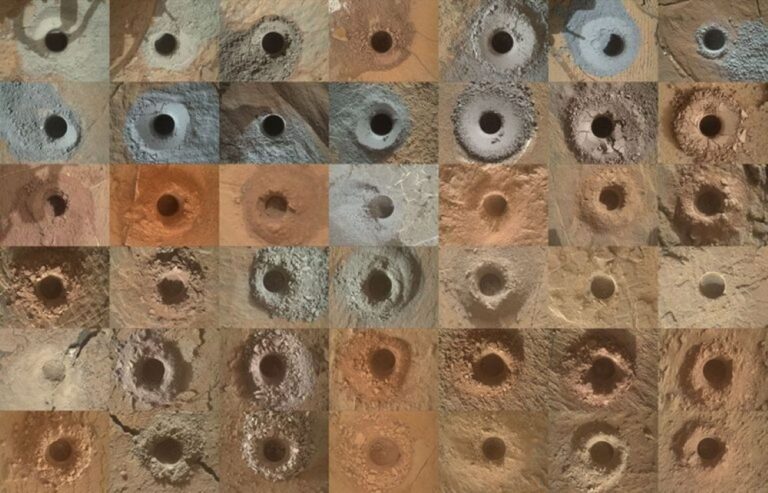
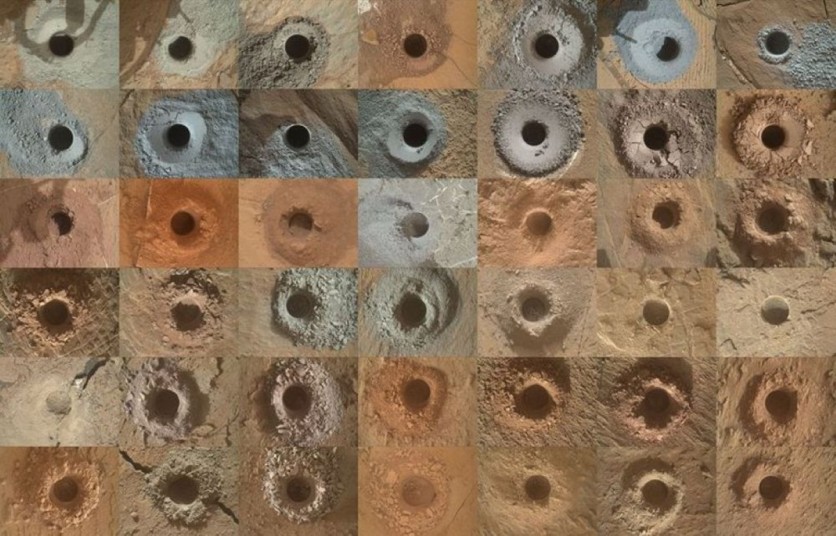
NASA’s Nov. 16 collage of Curiosity’s 49 Mars drill holes spans two eras of drill hardware: JPL says the drill had collected samples 15 times before its motor fault in December 2016, which by subtraction puts 34 holes after it.
Each close-up shows a hole 16 millimeters (0.63 inches) wide, photographed by the Mars Hand Lens Imager, a camera on the rover’s robotic arm. NASA’s website carries an image article dated Nov. 20 that presents the grid. Every hole is a powdered-rock sample delivered to instruments inside the rover, and NASA’s recent mission blogs show that drill targets must pass engineering checks as well as geology checks.
NASA’s collage page does not label individual holes, give their locations, or say which instruments analyzed which samples, so the details below come from the mission’s weekly blog posts.
Curiosity’s drill was designed to work like a drill press. Two stabilizer posts steadied the drill against the rock, and a motor then extended the bit forward between them. The first sample hole went into a flat, veiny rock called John Klein in Yellowknife Bay on Feb. 8, 2013, the rover’s 182nd Martian day, and reached 6.4 centimeters (2.5 inches) deep.
In December 2016, according to NASA’s Jet Propulsion Laboratory (JPL), a faulty motor prevented the drill bit from extending and retracting between the stabilizers. Engineers left the bit in its extended position and drilled freehand, practicing on an Earth replica for months before trying the method on Mars.
The first sample hole after the fault was a rock called Duluth, drilled May 20, 2018, about 2 inches (5 centimeters) deep. Subtracting the pre-fault count of 15 from the collage’s 49 gives 34 holes from Duluth through Nazca, which NASA’s mission blog called the 49th hole in a November post. The Planetary Society’s 16-hole list agrees, placing Duluth as the 16th sampled location.
With the stabilizers unused, the rover’s whole arm pushes the drill forward in place of the motorized extension. A force sensor originally meant to stop the arm after a high-force jolt now helps keep the bit from drifting sideways and sticking in the rock. NASA’s caption likened the approach to someone drilling into a wall at home.
Leaving the bit extended also kept CHIMRA, the device that sieves and delivers powder, out of play, so JPL devised a shaking method to deposit powder into the instruments. A JPL release dated June 4, 2018 said the technique, called feed extended sample transfer, had on May 31 trickled rock powder into the rover.
Before the first drilling in 2013, JPL scheduled an overnight pre-load test with the drill pressed against rock, to check that the large day-to-night temperature change would not overstress the arm. NASA’s recent blogs still describe pre-load tests ahead of drilling. In October 2025, rover planners used a pre-load test to characterize how the arm and rock might behave during drilling, comparing before-and-after images from the arm camera and the mast camera.
A target that fails can end the attempt. In early 2024, the first Mineral King hole fell short of target depth, leaving too little sample for the Sample Analysis at Mars instrument to finish its evolved gas analysis. The replacement spot on the same block failed its pre-load test because it was too close to the rover.
The same screening shaped the 2026 campaigns. On April 25, the rover drilled a rock nicknamed Atacama, an estimated 1.5 feet across and 6 inches thick and weighing roughly 28.6 pounds (13 kilograms), and the whole rock lifted with the arm because it was a detached block. Engineers freed the drill on May 1, and the next target, Campo Marte, was chosen partly because it was substantially thicker than Atacama, which the team hoped would keep it on the ground. Basque Lakes, which NASA called its 48th rock target, went through a pre-load test in September before it was drilled, and Nazca passed stability and pre-load tests in October.
NASA deputy project scientist Abigail Fraeman wrote that the team drilled Campo Marte to only 28 millimeters (1.1 inches), rather than the usual 35 millimeters (1.38 inches). Susanne Schwenzer of The Open University later called it the 47th successful drill.
A shallower hole yields less powder. The team expected to be nearly out of sample after four portions went to the Sample Analysis at Mars instrument, and planned a repeat drop-off test to estimate how many portions remained.
The Sample Analysis at Mars instrument, known as SAM, heats drilled powder and measures the gases that come off. It can also treat powder with a chemical reagent first, using single-use sample cups: 74 in all, with nine reserved for wet chemistry and two of those holding a reagent called TMAH.
In NASA’s February 10 mission blog, planners described applying TMAH to rock powder from a drill hole and called it the second of two vials of the reagent, which makes molecules detectable to SAM that would otherwise be undetectable. A Jan. 31 Mastcam image from the same site shows two side-by-side holes, Nevado Sajama and Nevado Sajama 2. That count implies no unused TMAH vial remains. The first TMAH experiment ran in 2020, and a 2026 report described more than 20 organic molecules from it.
Nazca, the 49th hole, came from a block a few meters from Chiu Chiu, a rock that was itself a poor drilling candidate. After the rover drove to the neighboring block, close-ups showed it packed with disc- and needle-shaped lumps, which the team considers potential crystals.
NASA planetary scientist Lucy Lim cautioned that the minerals now in those shapes may not match the originals, because crystals can later be replaced by other minerals that keep the same shape. The blog calls such replacements pseudomorphs, which keep the original shape but not the original composition.
Before drilling, the rover passed a stability test, which confirms that all wheels are on solid ground before the arm extends, and then a pre-load test, which checks the rock’s stability and the forces on the arm as the bit presses in, according to planetary mineralogist Susanne Schwenzer. Curiosity then drilled Nazca, and NASA’s Mastcam image of the hole is dated Oct. 20.
The powder went to CheMin, the instrument that identifies minerals by X-ray diffraction. NASA’s Nov. 9 post said CheMin’s results were still making their way to Earth, and its Nov. 11 post, which describes samples delivered to SAM, reports no results. A Nov. 17 post said the team learned a lot from the Basque Lakes and Nazca samples but gave no mineral findings.
NASA’s blogs spell out what a target must offer. In April, the team rejected the Antofagasta crater rim as a drill site because the awkward angle would have blocked delivery of a sample to the instruments, and the sandy crater floor risked trapping the rover. The goal, according to Lim, was a representative bedrock sample from the layers just above the boxwork. Power is another limit: the blog on Basque Lakes cited significant power constraints from drilling and its analyses, as well as from an aging rover.
Those criteria suggest the 49 holes record rocks that were both scientifically interesting and mechanically drillable: stable under load, thick enough to stay on the ground, and reachable at an angle that lets the arm deliver powder. For readers who follow claims drawn from Mars rock samples, the number to watch is not only how many holes NASA has drilled but how each target cleared those checks.
The collage’s identical 16-millimeter (0.63-inch) holes therefore tell an engineering story as well as a geology story. Fifteen holes came before the December 2016 fault and 34 after, NASA’s recent blogs describe pre-load tests ahead of drilling, Campo Marte’s shallow hole limited its powder, SAM has used the second of its two TMAH vials, and Nazca’s mineral results had not been reported in NASA’s posts through Nov. 17.
Each hole is 16 millimeters (0.63 inches) wide. NASA’s blog gives 35 millimeters (1.38 inches) as the usual depth in 2026 and 28 millimeters (1.1 inches) for Campo Marte. Older holes ran deeper: John Klein reached 6.4 centimeters (2.5 inches) in 2013. The Mineral King episode in 2024 showed that a hole short of target depth can leave too little sample for SAM.
Rover planners press on the bedrock with the drill to see how the arm and rock behave before drilling, and they compare images taken before and after the test. The test checks stability and drillability, and a spot that fails can be replaced, as when Mineral King 2 failed.
NASA’s published criteria suggest not. The blogs describe targets rejected for awkward sample-delivery angles and chosen for substantially thicker blocks, so the holes cover rocks the arm can drill safely rather than every rock along the route.
Not in the mission posts through Nov. 17. The Nov. 9 post said the results were still on their way to Earth, the Nov. 11 post describes only the delivery of samples to SAM, and the Nov. 17 post gives no findings.