HomeAuto MSC Formally Returns to Suez on Four Services as Carrier Cascade Widens
MSC Formally Returns to Suez on Four Services as Carrier Cascade Widens
August 26, 2026:
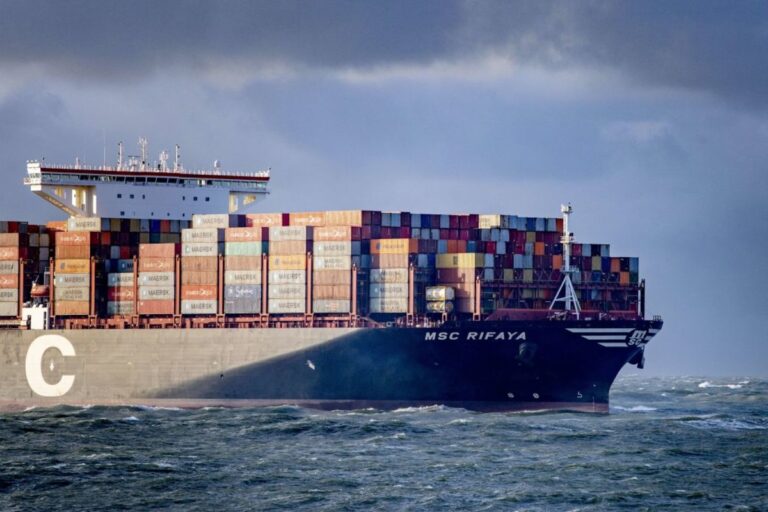
A photograph taken on April 7, 2021 shows the MSC Rifaya container ship arriving at the Rotterdam port, form the Suez Canal, following its blockage. ROBIN UTRECHT/ANP/AFP via Getty Images
The world’s largest container shipping line formally ended two years of Cape of Good Hope diversion for four of its East-West service networks on Monday, issuing a MSC customer advisory August 24 that commits specific sailings on its Jade, Albatros, Himalaya, and Tiger services to Suez Canal routing — and sets a competitive clock running on every shipper still paying Cape-era surcharges.
Mediterranean Shipping Company, which controls approximately 7.33 million TEUs of fleet capacity — a 21.6 percent share of global capacity that no other carrier has ever matched — announced the partial resumption following what it described as “a comprehensive review of the latest security and operational conditions in the Red Sea region.”
The four services span the core Asia-Mediterranean and Asia-North Europe axis — the lanes where the Cape of Good Hope detour has been most economically punishing. MSC stated contingency plans remain active, allowing individual voyages to be rerouted back to the Cape if security conditions require, and that it will continue monitoring the region “in coordination with the relevant authorities and security partners.”
Five Named Sailings, Four Services, One Decisive Signal
MSC’s advisory named five specific sailings commencing the transition:
Jade service (Asia-Mediterranean, eastbound): MSC Michel Cappellini, voyage GJ632E, departed Abu Kir on August 24
Albatros service (Asia-North Europe, eastbound): MSC Josefina, voyage GA630E, departed Jeddah on August 24
Tiger service (Asia-Mediterranean, westbound): MSC Anna, voyage GT629W, departed Singapore on August 24
Tiger service (Asia-Mediterranean, eastbound): MSC Tina, voyage GT632E, departed Mersin on August 20
Himalaya service (India-Mediterranean, westbound): MSC Beryl, voyage IS632A, is scheduled to depart Vizhinjam on August 31
Why This Announcement Carries Outsized Market Weight
Not all Suez return announcements are created equal. When Maersk committed its AE15 service in July, the industry recognized a milestone. When MSC formally commits, the arithmetic changes for the entire market.
MSC’s fleet of approximately 7.33 million TEUs represents 21.6 percent of global container capacity — a record that surpasses the historical peak of any prior carrier. The Geneva-based carrier operates more than 1,000 ships across 155 countries, making it the first carrier in industry history to reach that milestone. At a carrier of this scale, routing decisions are not simply operational announcements — they are market infrastructure events.
The mechanism is straightforward: every TEU MSC moves via the shorter Suez route instead of the longer Cape route compresses effective fleet supply. The Cape route adds 6,000 miles or more to each round trip, plus 10 to 14 additional days of transit time on Asia-Europe lanes — meaning ships that were previously occupied for two extra weeks are now freed to complete another voyage. For shippers, that compression translates directly into shorter lead times and a narrowing of the excess capacity premium that Cape-of-Good-Hope surcharges have been built around.
BIMCO, the Baltic and International Maritime Council, has estimated that a full industry-wide Suez return could produce approximately a 10 percent reduction in ship demand — a figure that, if realized, would put substantial downward pressure on Asia-Europe spot freight rates. MSC’s formal commitment is the most consequential single step toward that scenario since the crisis began in late 2023.
A Two-Year Disruption in Context
The diversion that MSC’s announcement begins to unwind traces to late 2023, when Houthi rebel attacks on commercial vessels in the Bab el-Mandeb Strait — carried out in stated solidarity with Palestinians in Gaza — made the Red Sea corridor effectively impassable for most major shipping lines. By early 2024, every top-tier carrier had diverted Asia-Europe traffic around the Cape.
The commercial cost was steep and measurable. Routing around Africa added up to $1 million in additional fuel costs per voyage, stretched transit times by 10 to 14 days, and absorbed an estimated 5 to 7 percent of global container capacity into the longer voyages — removing the equivalent of 1.3 to 1.8 million TEUs from the active market. Freight premiums on Asia-Europe lanes rose 25 to 40 percent above pre-crisis levels. Schedule reliability on affected corridors fell below 60 percent on-time arrivals, compared with a pre-crisis norm above 75 percent.
The Suez Canal Authority bore its own losses. Canal revenues reached $4.67 billion in fiscal year 2025/26 — roughly half of the record $9.4 billion posted in fiscal year 2022/23 — despite a 23 percent year-over-year improvement as partial recovery began.
A brief reopening window appeared in early 2026, before the United States-Iran conflict escalated in late February, forcing carriers back to the Cape route. That second diversion compressed what had been a tentative recovery into a complete restart.
The Carrier Cascade Is Now in Motion
MSC’s formal announcement on August 24 follows weeks of quiet test transits that industry analytics firm Linerlytica had already been tracking. MSC had sent seven MSC dark transits through the Suez Canal and Bab el-Mandeb in the two weeks prior to the advisory, according to Linerlytica’s weekly market report — all without making any public announcement. The advisory now formalizes what had been an informal evaluation period.
The broader backdrop is an industry that has been rebuilding corridor confidence for several weeks. The Suez Canal recorded 1,090 transits highest since 2024 in the four-week period ending August 20, 2026 — though still 41 percent below pre-crisis baselines. CMA CGM — which maintained some transits even during peak tensions through the European Union’s EUNAVFOR naval escort operation — has completed 199 CMA CGM canal transits since early 2026, carrying 5.2 million tonnes of cargo; its fleet’s aggregate net Suez tonnage in 2026 already exceeds the company’s full-year 2025 total by approximately 34 percent, despite fewer vessel transits, because it is deploying larger ships. Maersk has returned more than 30 percent of its previously Cape-routed Asia-Europe volumes to the trans-Suez corridor, according to Linerlytica’s calculations. COSCO Shipping revived its RES4 service through Bab el-Mandeb from July 28, marking the Chinese carrier’s first return to the strait in more than two years.
What the August 24 advisory now does is complete the top tier of the cascade. For the first time since late 2023, every major carrier in the top five — CMA CGM, Maersk, MSC, and COSCO — has committed services to the Suez corridor. That collective commitment changes the competitive arithmetic in a way that matters directly to cargo owners: a shipper can now choose a Suez-routing service from multiple carriers on the same lane, apply competitive pressure, and demand that Cape-routing-era surcharges be removed from newly-eligible sailings.
What Shippers Can Now Demand
MSC’s commitment creates a specific, actionable window for shippers that did not exist one week ago.
The key mechanism is the EOCR surcharge container shipping 2026 — and its siblings: the Red Sea Diversion Surcharge, War Risk Surcharge, and Emergency Contingency Surcharge. Carriers have applied these charges since 2024 to recover the real additional costs of Cape routing: extra fuel, additional vessel days, extended charter hire, and operational overhead. Those cost bases are specific to Cape routing. When a service formally transitions to Suez routing, the cost basis changes. Shippers contracting with MSC on the four affected services have legitimate commercial grounds — and in US Federal Maritime Commission-regulated trades, regulatory grounds — to demand removal or proportional reduction of Cape-routing-specific surcharges.
The practical steps for shippers are clear. First, confirm whether your specific service and voyage are covered by the August 24 advisory — MSC has committed four services, not its full East-West network, and the transition is being implemented service-by-service. Second, request updated all-in quotes from your MSC representatives that reflect Suez routing and explicitly remove or adjust EOCR and Red Sea diversion surcharge line items. Third, compare those all-in rates against any non-Suez competitors still charging Cape-era surcharges on the same lane — the transit time advantage of 10 to 14 fewer days is itself a working capital and inventory-carrying-cost benefit that can be quantified against the freight rate differential.
For time-sensitive cargo categories — electronics, automotive components, perishables, pharmaceuticals — the transit time compression alone may justify a booking shift even before surcharge adjustments are negotiated.
C.H. Robinson’s August 2026 ocean freight market update noted that in the current environment, shippers may see lower rates and improved booking flexibility before they see improvement in routing options, schedule reliability, or network performance. For lanes where MSC has now committed to Suez routing, the routing options have improved — but shippers should still validate each specific voyage’s routing before changing transportation plans.
Why MSC’s Remaining Services Are Still Cape-Routed
It would be premature to read MSC’s advisory as a full Suez restoration. The carrier has been explicit: the remaining services are being evaluated “on a route-by-route and voyage-by-voyage basis,” and contingency frameworks remain in place for the newly committed services as well.
The industry context supports caution. War risk insurance premiums for Red Sea transits remain elevated relative to pre-crisis baselines, reflecting the residual security uncertainty that underwriters continue to price in, even as the Suez Canal’s transit volume recovers. The precedent of February 2026 — when the US-Iran conflict forced a complete restart of Cape diversions only weeks after an initial reopening — illustrates that the corridor’s stability is structural rather than guaranteed.
CMA CGM CEO Vincent Clerc stated in August 2026 that conditions for a full return during 2026 were in place but that the company was proceeding gradually to avoid adding pressure to already-congested terminals. That same calculation applies to MSC’s announcement. A simultaneous full-network Suez reversion by every major carrier would release a significant slug of vessel capacity into the market at once — compressing spot rates and creating congestion at European port hubs as vessels arrive within compressed time windows.
MSC’s service-by-service approach is the industry’s consensus risk management strategy: commit what you can commit now, retain the ability to revert, and expand as security and commercial conditions permit.
How the Route Mathematics Work
The Bab el-Mandeb Strait — a waterway approximately 18 miles (29 km) wide at its narrowest point connecting the Red Sea to the Gulf of Aden — is the southern chokepoint through which Suez-bound vessels must pass. The Suez Canal itself is approximately 120 miles (193 km) long, connecting the Mediterranean to the Red Sea via the Gulf of Suez.
The geometry of the alternatives is stark. The Asia-Europe shipping lane via Suez and Bab el-Mandeb runs approximately 11,000 to 13,000 nautical miles depending on origin and destination port. The Cape route adds 6,000 miles or more to a round trip — effectively a 45 to 85 percent increase in total voyage distance. At standard commercial steaming speeds, that distance translates directly into 10 to 14 additional days at sea, additional bunker fuel consumption, and additional vessel and crew costs that carriers have been passing through to shippers as surcharges.
A carrier operating a weekly Asia-Europe service at typical fleet utilization takes approximately 12 to 14 vessels to maintain weekly departures on the Suez route. Cape routing requires two to four additional vessels to maintain the same frequency — a fleet expansion that was effectively mandated for every carrier operating Asia-Europe services from late 2023 onward. MSC’s commitment to Suez routing on four services effectively releases those extra vessel-slots back into the active market, contributing to the capacity pool available for booking across its network.
Frequently Asked Questions
Will EOCR and Red Sea diversion surcharges fall now that MSC is returning to Suez?
For the specific services MSC has formally committed to Suez routing — Jade, Albatros, Himalaya, and Tiger — shippers have commercial grounds to demand removal or reduction of Cape-routing-specific surcharges, including EOCR and Red Sea diversion fees, since the operational cost basis those surcharges were designed to recover no longer applies to Suez-transiting voyages. Practically, this happens through individual carrier negotiations and contract review, not automatically. Shippers should request updated all-in quotes explicitly removing these surcharge line items from their MSC representatives. Broader surcharge reduction across the industry will follow as more services transition — but carriers will not proactively reduce charges without shipper engagement.
Why doesn’t every carrier immediately return all services to Suez now that MSC has committed?
MSC’s commitment applies to four specific services, not its full East-West network. The challenge for carriers is that a simultaneous full-network return would flood European ports with vessels arriving in a compressed window — creating severe terminal congestion, demurrage costs, and operational disruption that would negate the transit-time benefit for shippers. MSC’s decision to proceed service-by-service is the industry consensus approach, mirroring what CMA CGM (which has confirmed conditions for a full 2026 return are in place but is proceeding gradually to avoid port congestion), Maersk (30%+ of Cape volumes back on Suez), and COSCO (RES4 service revived July 2026) have all done before it. The competitive pressure MSC’s announcement creates on still-Cape-routing carriers is real — cargo owners can now demand Suez-route delivery from any carrier with a committed service and compare transit times side-by-side — but the transition will be measured in weeks to months, not days.
What does the Suez Canal’s current recovery level mean for the shipping market?
The canal recorded approximately 1,090 transits highest since 2024 in the four weeks ending August 20, 2026 — the highest volume since January 2024, and approximately 14 percent above the January-to-June 2026 average — but still 41 percent below pre-crisis baselines. That gap matters for two reasons. First, it tells shippers that the corridor is functioning but has not yet absorbed its full pre-crisis volume, which means transit slots remain available and schedules are less crowded than peak historical levels. Second, it tells analysts that the rate impact of full restoration — which BIMCO estimates could reduce effective ship demand by approximately 10 percent — has not yet been realized. The four services MSC has committed will add to the recovery trajectory, but a full industry-wide network restoration, if it comes, would produce a more significant rate-compression event.
Is the Red Sea completely safe for shipping again?
No, and MSC’s advisory is explicit on this: contingency plans remain in place, allowing individual voyages to return to Cape routing if conditions deteriorate. War risk insurance premiums for Red Sea transits remain elevated above pre-crisis levels, reflecting ongoing underwriter caution. The February 2026 US-Iran conflict forced a second complete restart of Cape diversions after carriers had only begun tentative test transits — demonstrating that corridor stability depends on geopolitical conditions outside any carrier’s control. What has changed is the collective industry risk assessment: carriers are no longer asking “when is it safe to return?” but “which services are ready to return, in what sequence, and under what contingency conditions?” MSC’s August 24 advisory is the largest single answer to that second question the shipping industry has produced since the crisis began.