Mountain Bike Photo Wins Illume Awards 2026: Lear Miller Shot f/2, ISO 3200, 1/640 Second in Rain

November 15, 2026:

Mountain Bike Photo Wins Illume Awards 2026: Lear Miller Shot f/2, ISO 3200, 1/640 Second in Rain
Illume Awards 2026 Bike Category
The-illume.com

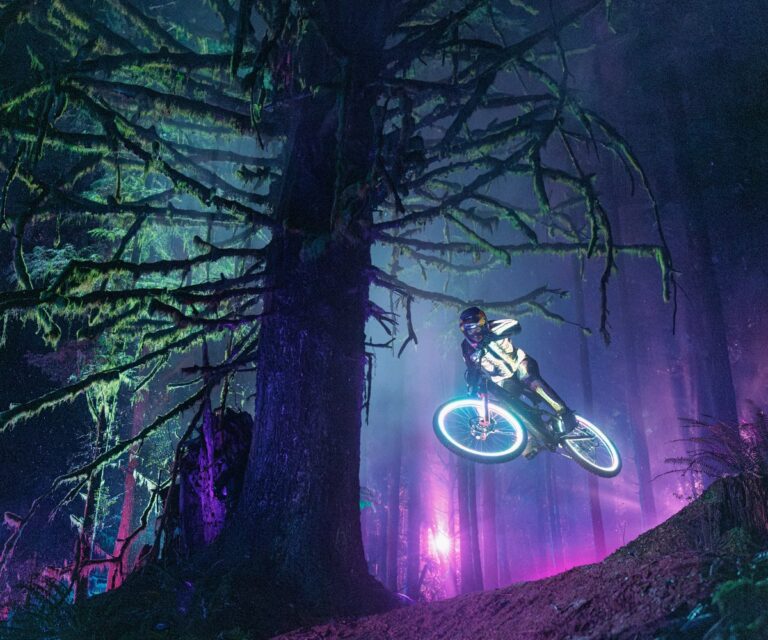
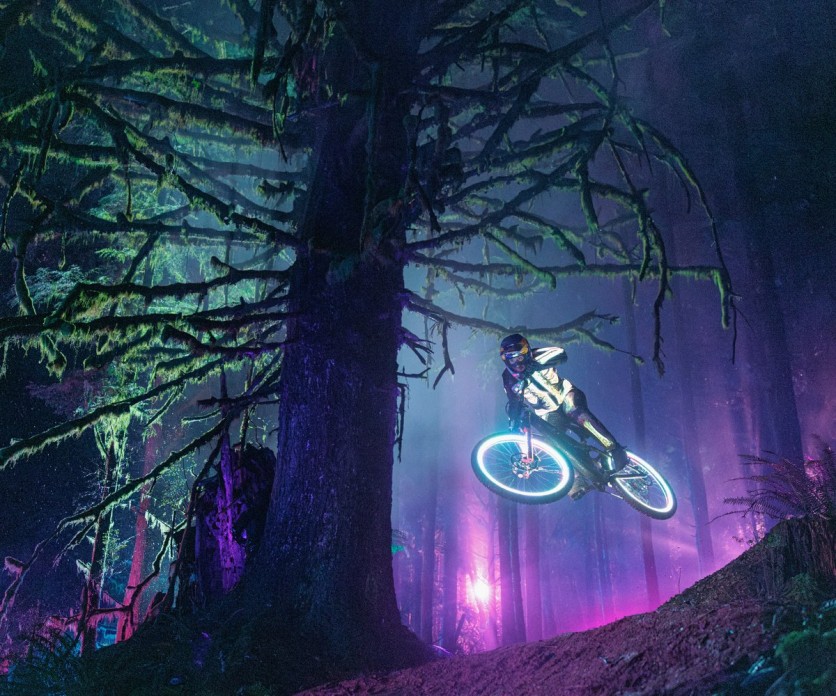
Photographer Lear Miller won the Bike category of the Illume Awards 2026 with a frame of rider Hannah Bergemann launching off a mud jump around 2 a.m. local time in heavy rain. The settings behind it, f/2, ISO 3200 and 1/640 second, work as a template for anyone who shoots action after dark: a fast lens and a high-ISO sensor trade money, weight and noise for a shutter speed fast enough to stop motion.

Digital Camera World published its shoot report Nov. 14, describing a forest lit artificially with fluorescent lighting and a mud jump built under a tree nicknamed Tree of Life. The win itself came earlier: The Illume announced Miller’s win Oct. 20 at an event in Aspen, Colorado, and credits the photo to Chris Benchetler’s Mountains of the Moon project in Pacific City, Oregon. Digital Camera World’s report describes only a forest, without naming a location.

Conditions were harsh: temperatures had fallen to about 40°F (4°C), rain fogged Miller’s viewfinder, and the run-up to the jump was a greasy, wet mud spot. Miller, speaking to the Illume Awards, called it “an extremely difficult shoot, logistically and condition-wise.”

Which Camera Settings Won Illume Awards Bike Category?

Miller used a Canon EOS R5 Mark II with a Canon RF 28-70mm f/2 L USM lens at 1/640 second, f/2 and ISO 3200, according to Digital Camera World. Pinkbike’s Bike announcement lists the same camera, lens and exposure values. Each number answers a different problem: 1/640 second limits motion blur from a rider in the air, f/2 is the widest opening the lens offers, and ISO 3200 raises the sensor’s sensitivity to make up the remaining light.

Canon Europe’s Mike Burnhill describes the main technical challenge of night photography as the gap between what the eye can see and what a camera can capture. The three settings above are how Miller closed that gap on a rainy forest set.

Settings Imply Scene Near EV 6, Within Range of Home Interior Lighting

Photographers can turn any set of exposure settings into an estimate of scene brightness. Exposure value (EV) is the base-2 logarithm of the f-number squared divided by the shutter time in seconds, and EV100 restates that figure at ISO 100 so scenes compare regardless of sensor speed, as Wikipedia’s exposure value entry explains.

TechTimes calculation: f/2 at 1/640 second works out to EV 11.3, and ISO 3200 sits five stops above ISO 100, which puts the scene near EV100 6.3, assuming Miller exposed close to neutral and did not deliberately under- or overexpose. The same reference table lists home interiors at about 5 to 7 EV100 and night street scenes at about 7 to 8. That places the lit forest set near living-room brightness.

The aperture matters just as much. Each full f-stop halves light, and an f-number step of about 1.4 equals one stop. A lens limited to f/2.8 would gather about one stop less (0.97 stops by TechTimes calculation), so holding 1/640 second would call for roughly ISO 6400, one stop noisier. Canon says the lens at f/2 delivers image quality comparable to or better than its EF 24-70mm f/2.8L II zoom at that lens’s widest aperture.

Constant f/2 Zoom Weighs 1,430 g (3.15 lbs) and Has No Built-In Stabilizer

The RF 28-70mm f/2 L USM holds f/2 across its whole zoom range, which Canon says RF mount enabled. It weighs 1,430 g (3.15 lbs), takes a 95 mm (3.74 in) filter and has no image stabilization, according to Sans Mirror’s database.

The body adds 746 g (1.64 lbs) with card and battery, Canon UK’s specifications show, bringing the rig to about 2,176 g (4.8 lbs) before any strap or rain protection. At estimated launch prices of $2,999 for the lens and $4,299 for the body, the pair came to $7,298. Current street prices differ. Front glass that large gives rain more surface to land on, which fits Miller’s account of constantly battling water on the lenses.

The sensor does its part. The EOS R5 Mark II uses a 45-megapixel back-illuminated stacked sensor with a native ISO range of 100 to 51,200 (expandable to 50 to 102,400), Canon UK lists, so ISO 3200 sits four stops below its native ceiling.

Mountains of the Moon Film Sends Athletes Into Darkness in Glowing Skeleton Suits

Miller made the frame during production of Mountains of the Moon, a film by artist and professional skier Chris Benchetler. Its premise: athletes in ski, snowboard, surf, freedive, mountain bike and climbing perform in darkness wearing custom lightsuits Arc’teryx built so they stay visible. The festival synopsis frames the project as exploring unseen connections among sport, life, music and the living earth, with themes of life and death and nature’s resilience, and it reads the glowing skeletons as the shared light within all people. The register is surreal, set to Grateful Dead songs. One concrete detail: Arc’teryx says 1,000 hours went into the suits.

Arc’teryx lists Bergemann among the film’s mountain bike athletes, alongside Carson Storch, Casey Brown and Ryan Howard. The Coast Film & Music Festival listing says the film was shot almost entirely at night, with lasers, animation and projection mapping among its techniques. Projection mapping uses video projection to turn objects, often irregularly shaped, into display surfaces. Freeskier’s trailer announcement set the world premiere for Nov. 15 to 23 in Santa Monica, California, with theatrical screenings from Nov. 14; the article is dated Oct. 30, 2025. The film is a 2026 Official Selection of the Wild & Scenic Film Festival.

Four Nights From 10 p.m. to 4 a.m. Produced Winning Frame

Germany’s BIKE Magazin reported Nov. 8 that Miller spent four nights shooting the bike segment, working from 10 p.m. to 4 a.m. each night. While Bergemann rode through the forest, the lighting and production team built a psychedelic look suited to Benchetler’s Grateful Dead-inspired vision. Digital Camera World places Miller’s frame around 2 a.m., within that window.

Twenty Images, Five Judges and Overall Winner Due in December 2026

BIKE Magazin says the Bike category had 20 images to choose from and a five-member jury picked Miller’s. The Illume lists the panel as Elias Schwärzler, Brian Park, Katie Lozancich, Senad Grosic and Dave Trumpore. Photographer Ale di Lullo had three photos in the Top 20 shortlist and did not win.

Miller’s prizes include a Leica D-Lux 8 camera, and the image will appear in The Illume Photobook 2026. BIKE Magazin says 16 category winners are chosen before an overall winner, and Digital Camera World reported that the overall winner will be announced at a global award ceremony in December 2026. The contest was held for almost 20 years as Red Bull Illume, which was founded in 2006 by Ulrich Grill.

The takeaway for readers who shoot after dark: Miller’s frame needed three things working together, a lens that opens to f/2, a sensor that stays clean at ISO 3200, and a shutter fast enough at 1/640 second to limit blur from a rider in the air. The price was about 4.8 lbs (2,176 g) of rain-exposed gear and roughly $7,298 at launch list prices. The same settings in a brighter scene would overexpose, and in a darker one would need more ISO or a slower shutter, so they describe this set, not a universal recipe.


Frequently Asked Questions

How much more light does f/2 gather than f/2.8?

About one stop, or roughly double, as Wikipedia’s f-number entry explains. By TechTimes calculation, holding 1/640 second at f/2.8 would take roughly ISO 6400 instead of ISO 3200.

How bright was the scene Miller photographed?

By TechTimes calculation, the settings imply about EV100 6.3 if the exposure was near neutral, which falls within Wikipedia’s range for home interiors, about 5 to 7 EV100.

Where was the winning Illume photo taken?

The Illume’s winner announcement credits the photo to Chris Benchetler’s Mountains of the Moon project in Pacific City, Oregon.

What is Mountains of the Moon?

A Chris Benchetler film shot almost entirely at night, with athletes in custom Arc’teryx lightsuits, set to Grateful Dead music and a 2026 Official Selection of the Wild & Scenic Film Festival.

When will the Illume Awards 2026 overall winner be named?

Digital Camera World reported the overall winner will be announced at a global award ceremony in December 2026.

Source link