HomeAuto Moldova’s Railway, Not Russia, Blocks Ukraine’s Only Grain Exit at Kuchurgan
Moldova’s Railway, Not Russia, Blocks Ukraine’s Only Grain Exit at Kuchurgan
September 5, 2026:
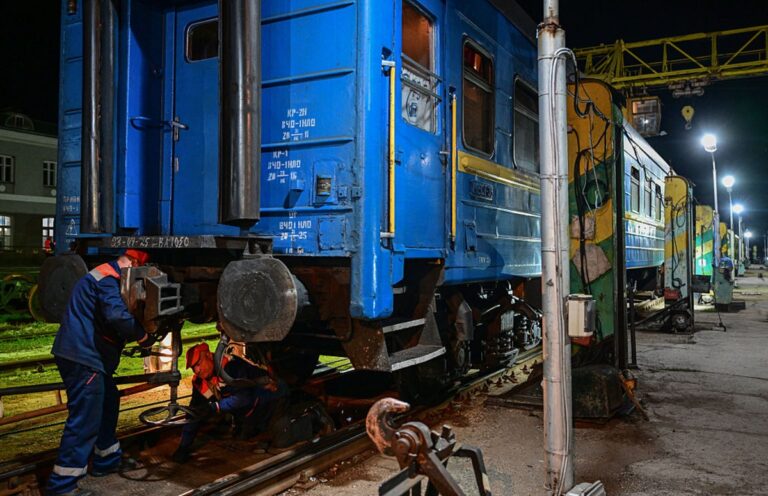
Workers of Moldovan railways change the axles of the passenger cars of a train running between Chisinau and Bucharest (Romania) at Ungheni railway station on September 23, 2025. Moldova still uses the Soviet gauge, wider than the European one, so trains coming from Romania to Moldova or vice versa have to make a stop in Ungheni to change the wheels. (Photo by Daniel MIHAILESCU / AFP) DANIEL MIHAILESCU/AFP via Getty Images
Ukraine’s state railway operator notified freight customers Thursday that Moldova’s national railway company, Calea Ferată din Moldova (CFM), has blocked grain transfers at Kuchurgan — the primary entry point for what was, until today, the only large-scale active corridor for Ukrainian grain exports. Ukrzaliznytsia (UZ) said it is rerouting grain to other Ukraine–Moldova border crossings and will adjust freight charges accordingly. The disruption reveals a structural vulnerability in the EU’s Solidarity Routes framework that political commitments alone cannot fix: when a government endorses an emergency logistics arrangement but its operational railway company faces enough domestic pressure, it can restrict access at the crossing level without abandoning the deal on paper.
Russia’s Strikes Turned a Rail Backup into Ukraine’s Primary Lifeline
Before August, the Moldova corridor was one contingency among several. Russian forces spent the months of summer 2026 systematically targeting Ukraine’s Black Sea port complex in the Odesa region, attacking over 50 ships over the summer season, with 21 sailors killed in July attacks and 28 civilian vessels damaged at Odesa-region ports that month alone. By July 22, shipping through the ports of Greater Odesa had practically stopped.
Those ports normally handle roughly 6 million metric tons of cargo per month and account for roughly 90% of Ukraine’s grain exports — the country’s largest source of foreign currency. Ukraine’s Agriculture Ministry cut forecast to 38–40 million tons for the 2026–27 marketing season, down from 43 million metric tons — a reduction of up to 12%. Agricultural analysts at APK-Inform cut estimate to 39.4 million tons due to export disruptions. An estimated 10 million tons of the prior season’s harvest remained unsold in storage, competing for space with an incoming crop, while sector losses were projected to reach approximately $3 billion by year-end.
Against that backdrop, Ukraine and Moldova formalized a transit arrangement August 10 under the EU’s Solidarity Routes framework — a network of alternative logistics corridors established Solidarity Lanes in May 2022 to route around Russia’s Black Sea blockade. CFM would allow transit of up to 600,000 metric tons of Ukrainian agricultural products through to the Romanian port of Constanța at a 50% discount on standard tariffs — a rate that runs through December 31, 2026. Ukraine and Moldova share the Soviet-era 1,520mm broad-gauge rail standard, meaning Ukrainian grain wagons can travel from loading points in Ukraine directly through Moldova to Constanța without transshipment — a key technical advantage over routes through EU member states that use the narrower 1,435mm standard gauge.
Ukrainian Prime Minister Serhii Koretskyi announced the rail transit arrangement via Telegram, calling it “another practical measure to support Ukrainian exporters amid Russian attacks in the Black Sea.” Ukraine’s Foreign Minister Andriy Sibiga thanked Moldova for joining Solidarity Routes, calling the decision “important and timely.”
Why the Kuchurgan Crossing Is Not Just Any Border Point
The Kuchurgan–Novosavitska crossing sits on the Ukraine–Moldova border northeast of Odesa. Its designation as the corridor’s primary entry point made logistical sense: grain loaded in Ukraine’s southern agricultural heartland could reach the crossing with minimal distance, then transit directly to Constanța without gauge-change delays. When CFM blocked grain transfers there on September 4, it effectively targeted the route’s most efficient link.
The blockage places Ukraine in a difficult position. CFM has said it will allow grain to move through other Ukraine–Moldova crossings, and UZ has committed to using them. But reorganizing rolling stock flows, coordinating new slot reservations at Constanța — a port that Moldovan Prime Minister Vasile Tofan acknowledged Constanța’s heavy load — and adjusting freight charges for new routes takes time that harvest-season logistics windows do not freely give.
Moldovan Farmers Drove the Ground-Level Veto
The pressure behind CFM’s operational decision had been building since the transit agreement was announced. The Forța Fermierilor (Farmers’ Force) association immediately objected that the 50% discount tariff deal was struck without consulting local producers. Farmers warned of wagon shortages and higher logistics costs during harvest months, and — given their experience in 2022–23, when some Moldovan producers were forced to sell below cost — possible market disruption from Ukrainian goods in transit despite transit-only designations. The association set a deadline of August 21, threatening mass protests if the government did not show progress.
A multi-stakeholder meeting on August 20 brought together CFM, the agriculture ministry, and farm associations. CFM attempted to reassure critics, stressing that its own wagons were reserved for locals and that Ukrainian transit cargo traveled in Ukrainian wagons. CFM also noted the network was operating at only about 20% capacity — sufficient, CFM argued, for both Moldovan exports and Ukrainian transit without conflict.
Those assurances did not fully resolve the tension. CFM’s stated operating policy — Moldovan companies get priority over Ukrainian cargoes when shipments compete for the same routes and crossing points — provided the mechanism for Thursday’s blockage. Even with capacity to spare, the priority policy gave CFM grounds to restrict Ukrainian access at Kuchurgan without technically violating the broader transit agreement.
Moldovan President Maia Sandu and Prime Minister Tofan had both backed the arrangement publicly. Sandu argued that “Ukraine ensures our peace today,” and Tofan said he wanted more transit because CFM needed volume to remain financially viable — noting that only about 400 of a planned 1,000 rail cars had moved through the corridor in August. Their political commitment did not translate into operational control over CFM’s crossing-level decisions.
Solidarity Routes’ Unresolved Design Problem
Thursday’s disruption is not the first time domestic agricultural pressure in a partner state has disrupted Ukrainian grain transit along an EU-backed corridor. In early 2024, Polish farmers blockaded border crossings with Ukraine, in some instances opening Ukrainian freight wagons and spilling grain onto tracks. The EU condemned the action but lacked tools to compel Polish authorities to reopen the crossings immediately.
The Solidarity Lanes were established in May 2022 as a rapid-response logistics network — a political coordination mechanism, not an operational one with enforceable service-level commitments. The EC and partner states agreed to facilitate transit; no provision compels a partner railway operator to accept specific cargo at specific crossing points in the face of domestic opposition. That design choice made the framework faster to establish in 2022 but left it dependent on continuous political will from multiple levels of government and from ground-level railway management.
In the Moldovan case, all three levels of political leadership — the president, the prime minister, and Ukraine’s foreign ministry — endorsed the arrangement. The breakdown occurred at the operational level, where CFM’s priority dispatch policy provided a mechanism that farm-sector political pressure could activate without requiring Chisinau to formally withdraw from the Solidarity Routes deal.
The European Commission has invested in crossing infrastructure at Ukraine–Moldova border crossings as part of the Solidarity Lanes initiative. Whether that investment was accompanied by enforceable access guarantees at the crossing level is now a live editorial question for the EU’s logistics diplomacy with Kyiv.
What Losing Kuchurgan Means for Global Grain Supply
As of September 4, the Moldova corridor represented Ukraine’s only meaningfully active large-scale export route. The Black Sea maritime route, which before this year’s escalation handled approximately 6 million tons of cargo per month, remains paralyzed — with Russia having attacked over 50 ships over the summer. Danube ports can supplement exports but are limited in capacity; Ukraine’s agriculture minister has acknowledged Black Sea ports’ essential role for any adequate export volume.
Ukraine is among the world’s largest grain exporters, supplying approximately 10% of global wheat exports, around 15% of corn, and more than 50% of sunflower oil. Countries in North Africa, the Middle East, and South Asia — including Lebanon, Libya, Tunisia, Pakistan, and Somalia — source 36% to 67% of their wheat from Ukraine. Any significant disruption to Ukrainian grain flows has historically transmitted rapidly into global wheat prices; the 2022 blockade was associated with price spikes exceeding 50% on global markets.
APK-Inform had already cut its full-season forecast to 39.4 million metric tons factoring in export disruptions. If the Kuchurgan blockage extends beyond its first day and alternative crossings prove slower to organize than UZ expects, actual exports risk approaching the low end or below the revised range, adding further pressure to a global wheat market already sensitive to Ukrainian supply signals.
What Happens Next at the Crossing
Ukrzaliznytsia has asked affected freight customers to contact its UZ cargo contact center at +465 22 22 to arrange rerouted shipments. Alternative crossing points with Moldova exist along the Ukraine–Moldova border, and UZ has committed to redirecting grain through them with adjusted charges.
The corridor’s broader legal and commercial framework — the 50% tariff discount, the 600,000 metric ton capacity commitment, Moldova’s formal participation in the Solidarity Routes initiative — remains nominally in place. The dispute is operational, not diplomatic. Whether CFM’s Kuchurgan decision can be reversed through government-level engagement between Kyiv and Chisinau, or whether Ukrainian grain must now flow through alternative crossings with reduced efficiency for the remainder of harvest season, is unresolved as of this writing.
What is established is the pattern: emergency logistics corridors assembled under political goodwill but without binding operational-level access guarantees are vulnerable to exactly the kind of ground-level disruption that CFM delivered at Kuchurgan on Thursday. Until the Solidarity Routes framework includes enforceable crossing-access commitments that bind partner railway operators — not only their governments — that vulnerability will remain available to any domestic agricultural constituency with sufficient leverage over its national railway company.
Frequently Asked Questions
Why did Moldova’s railway block Ukrainian grain at Kuchurgan?
CFM cited its standing operating policy that Moldovan companies take priority over Ukrainian transit cargo when shipments compete for the same routes and border crossings. The decision followed sustained political pressure from the Forța Fermierilor (Farmers’ Force) association, which objected to the 50% tariff discount deal signed August 10 without consultation with local producers. The farmers feared wagon shortages, higher logistics costs during harvest season, and possible market disruption from Ukrainian goods in transit. CFM invoked the priority policy as the operational mechanism for the blockage, even though it had separately acknowledged the rail network was operating at only about 20% of its capacity.
Can Ukraine still move grain through Moldova at all?
Yes — Ukrzaliznytsia has said it will redirect grain shipments to other Ukraine–Moldova border crossings, and the broader transit agreement (including the 50% tariff discount through December 31, 2026) remains nominally in place. The practical question is whether alternative crossings can match Kuchurgan’s efficiency and how long reorganizing rolling stock flows and Constanța port slot reservations will take. Harvest-season logistics windows are time-limited, and delays at any crossing compound the financial losses Ukrainian farmers are already absorbing from the loss of Black Sea shipping.
What does the Solidarity Routes framework actually guarantee?
The EU’s Solidarity Lanes, established May 2022, are a political coordination mechanism rather than an enforceable service agreement. Participating states and partner operators agree to facilitate transit — but no provision in the framework legally compels a partner railway company to accept specific cargo at specific crossings when domestic pressure pushes back. The Kuchurgan disruption follows a similar pattern to Polish farmer blockades of Ukrainian grain crossings in 2024, where the EU condemned the action but lacked tools to compel immediate compliance. Whether the framework should be redesigned to include enforceable crossing-access guarantees at the railway operator level is a question Thursday’s events make difficult to avoid.
If this disruption continues, how could it affect global food prices?
Ukraine supplies roughly 10% of global wheat exports, about 15% of corn, and more than half of all traded sunflower oil. Countries like Lebanon, Libya, Tunisia, Pakistan, and Somalia source between one-third and two-thirds of their wheat from Ukraine. Any significant sustained disruption to Ukrainian grain exports tends to move global grain prices: the 2022 blockade was associated with wheat price spikes of more than 50%. With the Black Sea route already paralyzed by Russian attacks, the Moldova corridor was the only large-scale remaining exit. If Kuchurgan stays blocked and alternative crossings prove slower to organize, commodity traders and food-importing governments will be watching Ukrainian export data closely for signs of further supply contraction.