September 5, 2026:


Baltic game developer Estoty — a studio that built its reputation on hyper-casual mobile titles played solo in 30-second bursts — has announced The Missing Tail, a narrative co-op adventure for two players set in a medieval world populated by cats. The game’s most immediately actionable design decision: one copy for two players is all that two players need to get in.
Estoty, headquartered in Riga, Latvia with a second studio in Vilnius, Lithuania, is best known for hyper-casual mobile games — titles like Knife Hit, Johnny Trigger, 2048, and Jelly Shift — that collectively have more than 1.5 billion downloads across the Apple App Store and Google Play Store. In January 2020, Johnny Trigger was the most downloaded game in the world. That catalog represents one end of the game design spectrum: zero-commitment, zero-friction, sessions lasting seconds.
The Missing Tail sits at the opposite end. It requires two players, sustained cooperation, and enough shared investment in two feline characters to carry a journey across a medieval castle and its surrounding village. This is Estoty’s first announced game in the narrative co-op adventure genre — a significant pivot that positions the studio alongside the design philosophy popularized by Hazelight Studios (It Takes Two, Split Fiction), even if at a much smaller scale.
The mechanism behind the one-copy model is Steam Remote Play Together, a feature Valve launched in late 2019. Under this system, the game runs entirely on the host player’s PC. Steam captures the game window, encodes it using GPU hardware encoding (NVIDIA NVENC or AMD’s equivalent), and streams video and audio to the guest’s Steam client over the internet. Per Steam’s developer documentation, only the host needs to own and install the game, while additional players connect through Remote Play streaming technology. The guest’s controller or keyboard input travels back to the host machine and is injected as local input — from the game engine’s perspective, both players are sitting at the same computer.
The tradeoff inherent in this architecture is input latency: everything the guest does must travel to the host, be processed, and come back as rendered video before the guest sees the result. For a fighting game or a precision platformer, that round-trip adds noticeable lag. For a cozy puzzle co-op where the primary challenge is collaboration rather than reaction time, the tradeoff is largely invisible. Estoty appears to have designed The Missing Tail for exactly this constraint — its puzzles prioritize communication and coordination over split-second timing.
Beyond Remote Play Together, the game also supports local split-screen co-op (both players on one screen, in the same room) and Steam Family Sharing. Estoty has confirmed the one-copy model on PlayStation and Xbox as well. Cross-play between platforms has not been confirmed as of publication.
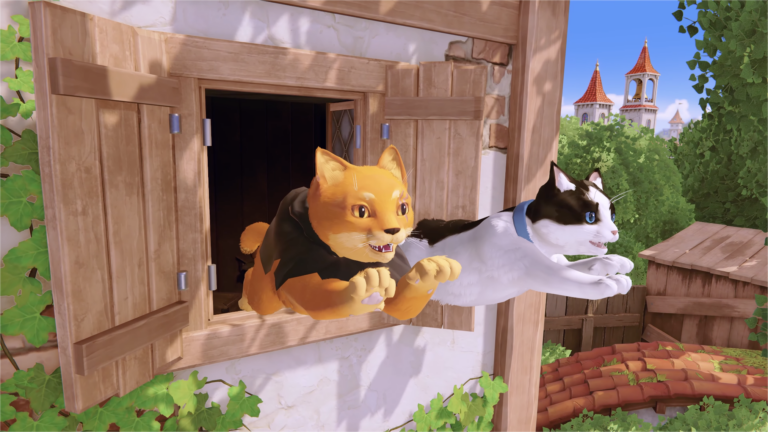
A palace cat and a stray cat do not, in the ordinary course of things, cross paths. In The Missing Tail, an unnamed disaster upends the royal cat’s comfortable life at exactly the moment a stray is losing a losing battle over its food supply with forest creatures. Both cats are suddenly homeless, disoriented, and traveling in the same direction — which is how an unlikely partnership begins.
The central question the game builds toward is whether two cats with opposite temperaments, opposite upbringings, and opposite skill sets can actually get each other home. That question is not merely thematic — it is structural. The stray, shaped by years on the street, relies on speed, climbing, and agility to navigate the world. The royal cat, shaped by a life of comfort and study, approaches obstacles through puzzle-solving finesse. Neither character can substitute for the other. A gate that requires a heavy object to be pushed across a courtyard needs both sets of paws. A rooftop route that calls for precision climbing belongs to the stray; a mechanism hidden inside the castle wall belongs to the royal cat’s domain.
This is what game designers call asymmetric co-op — a structure in which each player’s role is distinct enough that the collaboration is genuinely irreplaceable. Research on asymmetric co-op social connectedness, including work by Harris and Hancock, has found that players report higher social presence and connectedness in asymmetric co-op than in symmetric designs where both players perform equivalent tasks. The tone throughout is cozy and bittersweet: a storybook adventure about a friendship forming between two creatures who would never have chosen each other, set against the warmth of a medieval village at various times of day, from bustling market mornings to rooftop nights where the castle lights reflect in the cobblestones.
The setting is a lively medieval environment — a courtyard, a castle, surrounding streets — designed with the assumption that cats will interact with it in the way cats actually do. Players can explore freely, take on side quests offered by animal NPCs in the world, help other creatures in distress, interact with villagers, and — critically — push things off ledges and knock items into places they do not belong. The tone throughout appears to balance an emotional journey with moments of deliberate, gentle chaos.
Environmental puzzles require both players to work in tandem: shifting heavy objects together, operating multi-stage mechanisms in sequence, and coordinating movement through night missions that use the castle’s shifting shadows as a gameplay element. None of these puzzles are described as timed or reaction-dependent, which is consistent with the Remote Play Together use case.
The Missing Tail has no confirmed release date. The Steam page is live at App ID 4096780 and accepting wishlist additions. Playtest sign-up forms are open at themissingtail.com for players who want early access — submitting the form registers interest but does not guarantee a spot.
Minimum PC system requirements are accessible by 2026 standards: Windows 10 64-bit, an Intel Core i5-4460 or AMD Ryzen 3 1200, 8 GB of RAM, an NVIDIA GTX 960 or AMD RX 570, DirectX 11, a broadband internet connection, and 10 GB of storage. The recommended configuration raises the GPU to a GTX 1660 or RX 5600 XT. The GTX 960 is a GPU released in 2015, meaning machines built a decade ago can meet the minimum bar — a deliberate design choice that expands the addressable audience of co-op pairs who might not have matching modern hardware. Console versions for PlayStation and Xbox have been confirmed but specific platform generations (PS5 vs. PS4, Series X|S vs. Xbox One) have not been detailed.
The game’s language support is expected to be broad based on the official site; specific language confirmations beyond English have not been publicly detailed.
The Missing Tail‘s bet is that the Remote Play Together streaming model — designed for fast-paced couch co-op and retroactively applied to thousands of games — works particularly well when applied to a slow, emotionally driven puzzle adventure designed around it from the start. The distinction matters. A game that retroactively supports Remote Play Together receives the streaming infrastructure as a feature layered over an existing design. A game that builds its puzzle architecture, character abilities, and session pacing around two players who may be playing from different apartments receives the streaming model as a design constraint — and designs around its actual strengths.
Estoty’s hyper-casual catalog suggests a studio that understands what keeps players engaged across distributed, low-commitment sessions. Applying that understanding to a longer, more emotionally invested co-op format is the experiment The Missing Tail represents. Whether a studio that built its reputation on 30-second tap loops can deliver a multi-hour narrative co-op adventure that justifies the genre shift is the question the playtest is meant to answer.
No. Estoty has confirmed that one copy covers both players on Steam, PlayStation, and Xbox. On Steam, this is handled through Remote Play Together: the host runs the game and streams it to the guest, who does not need to own the game. Split-screen local co-op on one machine also requires only one copy. PlayStation and Xbox versions will support the same one-copy model, though the specific sharing mechanism on those platforms (Share Play or equivalent) has not been detailed.
It is more than screen sharing. When a host invites a friend through Remote Play Together, Steam captures the game window using GPU hardware encoding and streams it to the guest’s device as a compressed video feed. The guest’s controller or keyboard input travels back to the host machine in real time and is injected as a local controller input — the game engine itself treats the remote guest as a player sitting at the same PC. The guest can use their own controller, keyboard, or mouse. The tradeoff is that all game logic runs on the host’s hardware, so session quality depends on the host’s PC and internet connection.
Estoty has confirmed that The Missing Tail is in development for Steam (PC), PlayStation, and Xbox. Specific platform generations — whether the console versions target current-generation hardware only or include last-generation — have not been announced. A Nintendo Switch version and cross-platform play between platform families have not been confirmed.
Estoty is a Baltic mobile game studio founded in 2012 in Riga, Latvia. Its catalog spans more than 40 hyper-casual mobile games, including Knife Hit, Johnny Trigger, 2048, and My Little Universe, with a combined total of more than 1.5 billion downloads. The Missing Tail is its first announced narrative co-op adventure for PC and consoles — a significant departure from the studio’s hyper-casual roots and its most ambitious project in terms of design scope and target platform.