HomeAuto Mike Flanagan Uses Carrie to Build Dark Tower Mythology Before Greenlight
Mike Flanagan Uses Carrie to Build Dark Tower Mythology Before Greenlight
September 19, 2026:
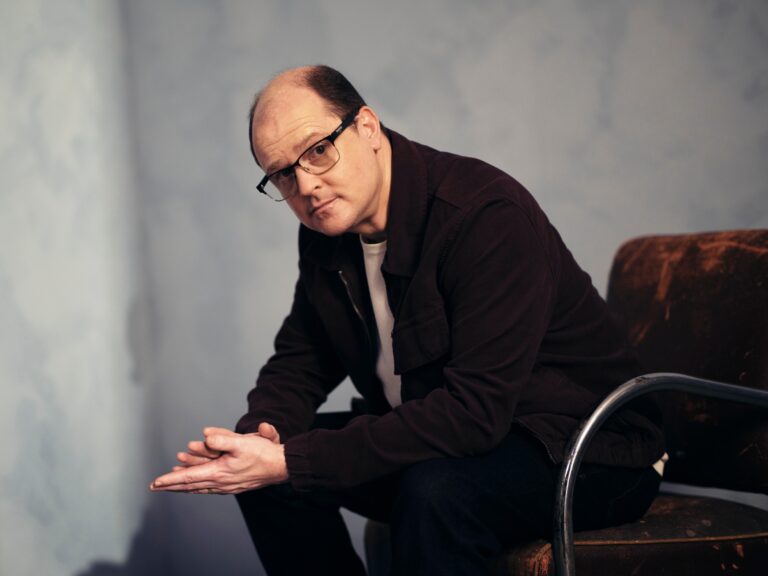
Mike Flanagan of ‘Carrie’ poses in the Getty Images Portrait Studio presented by IMDb and IMDbPro at InterContinental Toronto Centre on September 13, 2026 in Toronto, Ontario, Canada. Gareth Cattermole/Getty Images for IMDb
The most cosmologically rigorous fantasy franchise ever written now has a showrunner who understands why it cannot be made quickly. Mike Flanagan confirmed this month that his adaptation of Stephen King’s eight-novel Dark Tower cycle remains in active development, with completed Season 1 scripts bearing King’s approval and Amazon Prime Video as the most likely destination — but without a greenlight, a cast, or a confirmed production date. Speaking with Entertainment Weekly in September 2026, Flanagan described the process as moving at “oil-tanker pace” — not stalled, but massive — and added that getting the greenlight on Dark Tower is “a much longer and more involved process than anything else I’ve ever approached in my life.” The update came as Flanagan simultaneously teased that his upcoming Prime Video series Carrie — which will premiere October 7, 2026 — may already be building the connective tissue the Tower universe requires.
The reason the project is both so important and so difficult to move is the same reason it is worth understanding before it exists: King spent four decades constructing a cosmological architecture that is not a metaphor. The six Beams that hold his multiverse together, the ka-cycles that govern fate, the Todash void between realities — these are described with engineering precision, and they map onto real physics more precisely than any comparable fictional multiverse. What they require is space to breathe: five seasons and two feature films, minimum, or they collapse into the same 95-minute rubble that buried the 2017 Sony adaptation.
“There are other worlds than these,” Roland tells Jake Chambers in the first novel’s most famous moment. That plurality is not a flourish. The entire plot mechanics of the series depend on the reader accepting that parallel realities are real, that they are nested within the Tower, and that the Tower’s deterioration threatens all of them simultaneously. This cannot be established in 95 minutes. It barely fits into five seasons.
Flanagan’s Latest Statement and What Changed Since 2022
Flanagan’s Red Room Pictures acquired the rights to The Dark Tower in December 2022, separately carving them out of the exclusive television deal he signed with Amazon MGM Studios at the same time. That separation was deliberate — it meant Amazon could eventually come on board, but that Flanagan was not locked into them and could shop the project to any willing studio. Four years later, the project still has no confirmed streaming home, although Flanagan’s hints consistently point toward Prime Video.
The timeline of delays since 2022 is instructive. The project stalled first when Flanagan was transitioning from Netflix to Amazon, and stalled again when the Writers Guild of America struck in May 2023, followed by SAG-AFTRA’s parallel strike, together representing the most significant Hollywood labor action in decades. “It was stalled first by me moving from Netflix to Amazon,” Flanagan has said, “and stalled again by the strikes.” Once those resolved, the project resumed as his stated first priority. In 2024 he founded Red Room Pictures as his independent production company, separating from his longtime producing partner Trevor Macy’s Intrepid Pictures banner.
By September 2026, speaking with Entertainment Weekly ahead of Carrie‘s October premiere, Flanagan confirmed: “To do it the way I wanna do it requires an enormous commitment from a studio.” He added that the project has “never stopped moving” and that rights complexity — not creative stagnation — accounts for the timeline. “The way the Dark Tower universe is connected, you’ve got characters in there that are all over the place when it comes to studio ownership,” he explained to Entertainment Weekly. The Man in Black/Randall Flagg alone has ties to The Stand, which is separately optioned. Pennywise from It shadows the Dark Tower’s mythology. Characters from Insomnia, Black House, and The Talisman exist in King’s Tower-adjacent universe with their own rights situations. Any production faithful to the novels would need to negotiate or navigate around all of them.
Dark Horizons, reporting on the same September 17, 2026 interview round, added a significant new detail: Flanagan revealed he has been asking himself whether his Carrie series contains characters who would serve a specific purpose in the Tower canon. “It’s certainly not impossible,” he said. “There are characters in the ‘Tower’ canon who would serve a very specific purpose in that story, who audiences wouldn’t necessarily recognize because they only exist in certain books.”
How Carrie Is Already Building the Tower’s Foundation
Flanagan’s Carrie — starring Summer H. Howell in the title role alongside Samantha Sloyan as Margaret White, with Matthew Lillard and Amber Midthunder — is not a straightforward retelling of King’s 1974 debut. According to Entertainment Weekly’s coverage of the production, the eight-episode series will introduce multiple women from different time periods who possess telekinetic abilities, dramatically broadening the mythology King established in his first novel.
Flanagan made the Tower connection explicit in the same interview: “Carrie’s abilities aren’t named, really, in the book. He calls it ‘the TK gene’ for telekinesis, but if Steve had written this just a little later, Carrie White would have ‘the Shining.'” This is precisely the logic that governs the Tower universe — the Shining, telekinesis, the Breaker capacity described in the source novels, and Charlie McGee’s pyrokinesis from Firestarter are all versions of the same psychic sensitivity that the Crimson King conscripts into his Breaker program at Algul Siento. By establishing Carrie White within a larger line of telekinetic women across history, Flanagan is laying groundwork for a Breaker mythology that predates the Tower narrative itself.
The precedent exists in his own filmography. In Doctor Sleep (2019), Flanagan embedded explicit Dark Tower references: the number 19 (the Tower’s most significant numerical constant) on a character’s baseball jersey, a bus line called “Tet Transit” after the Tet Corporation from the Tower novels, and an industrial complex bearing the name of LaMerk Industries, also a Tower-universe entity. Dick Hallorann’s ghost delivers the most direct one. Den of Geek’s Doctor Sleep Easter egg guide confirms the line: “Ka is a wheel.” Flanagan was not freelancing — each detail reflected genuine knowledge of King’s meta-textual architecture and laid a bridge to the adaptation he was working toward.
Carrie represents a considerably more structural investment than Easter eggs. If the series works as intended, Flanagan will have produced a complete first chapter in King’s psychic mythology — with an audience of Prime Video subscribers already oriented to the idea that telekinetic sensitivity is a variant of the Shining, not a standalone anomaly — before he asks that same audience to accept the Breakers as cosmological weapons.
Why the Source Material Is Structurally Un-Rushable
The 2017 Sony/MRC adaptation is the most instructive failure in modern fantasy television development. Director Nikolaj Arcel, with a 95-minute runtime, condensed the first book of an eight-volume series into what became effectively a CliffsNotes reimagining, dropping the novels’ opening sequence in Mid-World in favor of a prolonged setup in contemporary New York City before Roland Deschain (Idris Elba) even appeared. The film received a 16 percent Rotten Tomatoes score and underperformed at the box office. An Amazon pilot developed by Glen Mazzara for a subsequent TV series was filmed but never picked up.
These failures all had the same root cause: nobody involved was willing to commit to the actual size of what King built. The series spans eight novels (nine counting the novella The Wind Through the Keyhole), published between 1982 and 2012. It blends Western, horror, high fantasy, science fiction, Arthurian mythology, and metafiction — King himself appears as a character in the sixth and seventh volumes — while embedding connections to dozens of other King novels. To adapt it faithfully is to commit to a decade of production, not a film franchise.
What the Beams Are — and Why They Match Real Physics
The Dark Tower’s most unusual cosmological feature is not the multiverse itself but the structure that maintains it. King describes six magnetic “Beams” running between twelve Guardian portals, arranged as six pairs of opposite poles spanning the full dimensional breadth of his fictional cosmology. Each Beam has orientation, physical extent, and a specific function: they ensure “the proper acceleration and stability of time, space, dimension, and scale” across all parallel realities. You can navigate by them as a compass bearing. They can be eroded. They were built, by a vanished civilization, and they are now unmaintained.
In 20th-century comparative mythology, this structure belongs to the tradition the scholar Mircea Eliade called the axis mundi or world pillar — the cosmic axis, the point of connection between higher and lower realms, the point of connection between higher and lower realms. Eliade documented the concept in The Sacred and the Profane (1957), tracing it across Norse cosmology (Yggdrasil), Hindu cosmology (Mount Meru), Mesoamerican cosmology (the Maya ceiba tree), Babylonian architecture, Dogon cosmology, and Kabbalah. Every major human civilization that left records developed an axis mundi — a vertical structure that the health of the world depends upon.
What King does that is historically unusual is to literalize and mechanize the archetype. The Tower is not a symbol for cosmic order — it is cosmic order, physically instantiated and physically vulnerable. In this sense it invites comparison to a class of hypothetical structures studied in quantum gravity and string theory: cosmic strings, or topological defects. These are one-dimensional mass-energy concentrations predicted to have formed during symmetry-breaking phase transitions in the early universe when the topology of the vacuum manifold changed. The concept was first proposed by Tom Kibble in the 1970s and is consistent with multiple Grand Unified Theories. Cosmic strings have not been confirmed to exist, but they are not forbidden by any current physical theory, and their gravitational signatures — including potential effects on spacetime metric around them — are being searched for in gravitational wave data.
The Beams behave differently from mass concentrations — they are organizing forces rather than mass structures — but the structural logic is closely analogous. They define a coordinate system, a set of orientations, within which space, time, and dimension cohere. Without them, the seriality of cause and effect, the distinction between scales of size, and the separation of parallel realities into non-interfering strata all lose their anchoring. This is precisely what Mid-World’s increasing geographic instability represents: a universe whose coordinate system is being actively degraded.
This is the Dark Tower’s most important property as a fictional cosmology: it is the only major fantasy multiverse designed as an engineering specification rather than a myth. Tolkien’s world tree, the MCU’s multiverse, the Force — all of these are mythological figures. King’s Beams are infrastructure. They were built by specific people, with specific tools, to serve specific functions, and they are failing because the civilization that built them is dead and no one has maintenance protocols. That specificity is what makes the adaptation so difficult and so essential to get right: the series will either honor the engineering or it will fail.
Ka and the Physics of Cyclic Cosmology
Ka — the Beams’ philosophical counterpart in the series — is described throughout the novels as an active, agentive force of destiny that “moves in a wheel.” Characters use the word for fate, for the will of the creator-figure Gan, and for the forward pressure that moves Roland’s ka-tet toward necessary ends regardless of their individual choices. The series opens with Roland already deep into his quest. It ends — in the seventh and final volume — with the revelation that Roland has completed this journey before, an uncountable number of times, and that the Tower returns him to the starting desert each time he reaches its top. On this iteration, for the first time, he carries the Horn of Eld: a small but decisive piece of information that did not survive the previous cycle.
This cycle structure maps onto Roger Penrose’s Conformal Cyclic Cosmology (CCC), proposed formally in his 2010 book Cycles of Time: An Extraordinary New View of the Universe. In CCC, the universe iterates through an infinite sequence of aeons; the conformally rescaled geometry of one aeon’s end is identified with the Big Bang of the next. The model predicts that information — specifically, gravitational wave imprints from the previous aeon — can leak through across the transition. This inter-aeon information leakage is structurally identical to the Horn of Eld: a single piece of data that carries across the cosmic reset, incrementally altering the next iteration, incrementally steering the cycle toward a different conclusion.
CCC has not been accepted by the wider cosmological community and lacks generally confirmed observational evidence — Penrose and colleagues have reported candidate CMB signatures consistent with it, but these remain contested. Penrose was awarded the 2020 Nobel Prize in Physics for his earlier work on black holes and general relativity, establishing his credibility as a theoretical physicist while leaving CCC as a speculative but coherent framework. Nietzsche’s Eternal Recurrence — the hypothesis that time is infinite and matter finite, forcing all configurations eventually to repeat — anticipates the same structure philosophically, though CCC gives it a specific physical mechanism (conformal rescaling) that Nietzsche’s version lacked.
King’s ka-cycle predates Penrose’s formal CCC proposal by decades and was almost certainly not derived from it. The parallel is structural, not causal. Both propose that reality iterates through cycles, that cycles are not identical repetitions but convergent spirals approaching some final state, and that small pieces of information can carry across the transition. The Horn of Eld is, in this sense, a fictional Hawking Point.
The Breakers, Consciousness, and the Quantum Measurement Problem
The mechanism by which the Beams are being destroyed deserves examination on its own terms. The Breakers are individuals with anomalously high psychic potential — described as Shining-sensitive or TK-gene-positive — who are held captive at Algul Siento and directed to focus their consciousness cooperatively against the Beams’ structural integrity. The Beams erode under sustained psychic concentration. This is not instantaneous. Two of the six Beams are already gone before Roland’s story begins. The remaining four are degrading.
The implicit physics here is that consciousness is not epiphenomenal but causally potent at a fundamental level — that mind, in sufficient concentration, can alter the structural parameters that govern reality. This is not a mainstream scientific position. The majority of physicists treat consciousness as a product of physical processes rather than a cause at the fundamental level. However, the measurement problem in quantum mechanics — the question of why superposed quantum states yield definite outcomes upon observation — has never been fully resolved, and a minority tradition in quantum interpretation has explored observer-dependent or consciousness-dependent formulations. The most extreme version, the von Neumann-Wigner interpretation, holds that consciousness itself plays a role in wavefunction collapse. Hugh Everett III’s many-worlds interpretation (1957) addresses the same measurement problem by eliminating collapse entirely: all quantum measurement outcomes occur simultaneously in branching non-interacting worlds, and observer experience selects which branch is perceived rather than causing collapse. Both interpretations implicitly assign some significance to the observer — and King’s Breakers can be read as an amplification of exactly this question: if consciousness plays any role in quantum state transitions, what would a sufficient concentration of cooperative psychic attention accomplish at a cosmological scale?
King does not need this reading to work as fiction. The Breakers are frightening and narratively compelling regardless of their physics. But the reading is available, and it is consistent with the rest of the series’ engineering-specification cosmology.
Mid-World as Civilizational Collapse: The Institutional Failure Behind the Apocalypse
The reason the Beams are being successfully attacked is not simply that the Crimson King is powerful. It is that the civilization responsible for maintaining them has collapsed. Roland is the last gunslinger, the last member of a knightly order whose function was to protect the Tower and its infrastructure. The machines are rusting. The robots have gone insane — the cyborg bear Shardik, one of the twelve Guardian entities, is malfunctioning catastrophically at the start of the second novel. The knowledge of how to repair a Beam, if that were even possible, died with the civilization that knew it.
Shardik is the series’ most quietly devastating cosmological detail: the Guardian is a machine. Not a supernatural entity, not a divine being, but an engineered construct built by “the Great Old Ones,” Mid-World’s lost advanced civilization. The universe’s load-bearing support system was built by people, is currently unmaintained, and is being actively attacked. The apocalypse in King’s universe is not an event — it is a long administrative failure. Gilead fell, the gunslingers were eliminated, the maintenance protocols were lost, and the Crimson King moved into the vacuum.
This is what Flanagan’s filmography has been about all along. The Haunting of Hill House is about what happens when a family cannot maintain the boundaries between grief and the present. Midnight Mass is about what happens when a community’s institutional failure allows something monstrous to take root inside its structure of care. The Fall of the House of Usher is about what happens when a dynasty’s corruption propagates forward in time as physical decay. In each case, the horror is not an external attack but the consequence of a system that was maintained — barely, badly, inadequately — and then stopped being maintained. Mid-World is the same story at cosmological scale.
This thematic correspondence is probably not coincidental. Flanagan has been preparing for The Dark Tower throughout his career, embedding its concepts into every King adaptation he has made. The “oil tanker” metaphor he returns to repeatedly is precise: the project cannot be redirected once it moves, because its narrative logic, its character arcs, and its cosmological mechanics are interdependent in a way that no individual scene or episode can summarize. The series has to be built the way the Tower was built — as infrastructure, not as spectacle.
Why No Studio Has Committed Yet
The obstacle Flanagan describes is not creative but structural and financial. The Dark Tower’s characters are distributed across multiple studio intellectual property portfolios. Any faithful adaptation of the novels requires either licensing agreements with competing rights-holders or creative workarounds that dilute the source material in exactly the ways the 2017 film did. Studio ownership of King’s characters is not consolidated. Sony retained elements from the 2017 film. Amazon separately licensed The Stand (which features Randall Flagg/Walter Padick, the Tower’s primary human antagonist). It and its character Pennywise have their own rights structure entirely.
“The way the Dark Tower universe is connected,” Flanagan told Bloody Disgusting in September 2026, “you’ve got characters in there that are all over the place when it comes to studio ownership.” The development process is consequently “epic” — his word — even though the creative work on the project has been continuous.
There is a further financial reality beyond rights. Any adaptation faithful to five seasons of the Dark Tower’s narrative scope will be among the most expensive television productions ever attempted. Mid-World’s post-apocalyptic landscape, the Beam architecture, the period flashback sequences from Gilead’s fall, the multiple parallel-reality settings that appear across the eight novels — these are not CGI shortcuts. They require sustained location work, production design, and the kind of long-horizon financial commitment that a major streamer makes only when it has a high degree of confidence in return.
Flanagan’s credentials are as strong as any showrunner’s could be for this particular project. He has completed Season 1 scripts, has King’s explicit approval of his approach, and has an exclusive deal with Amazon that makes them the natural home. The obstacle is the willingness to make an irreversible multi-year commitment to the largest piece of King’s literary universe — one that cannot be tested in a pilot and cannot be extracted from its context.
What Comes Next in Flanagan’s Production Sequence
Based on confirmed public information as of September 2026:
Carrie is set to premiere on Prime Video on October 7, 2026, with Summer H. Howell as Carrie White, Samantha Sloyan as Margaret White, Amber Midthunder, and Matthew Lillard. The series will run for eight episodes and has already been positioned by Flanagan as an expansion of King’s psychic mythology rather than a straightforward retelling.
The Exorcist: Martyrs — with Scarlett Johansson and Chiwetel Ejiofor starring — is scheduled for theatrical release on March 12, 2027, through Universal and Blumhouse.
The Mist adaptation, separately at Warner Bros., is in development. Flanagan said in September 2026 that his version departs from Frank Darabont’s 2007 film “starting page one.”
The Dark Tower remains in development at Red Room Pictures with no confirmed greenlight, no announced cast, and no production start date.
Is There a Universe in Which a Worse Version Gets Made First?
The Warhammer 40,000 series Flanagan is also attached to at Amazon represents the other major property-rights complexity on his current slate — another franchise with existing studio relationships and a passionate global fanbase. He confirmed in September 2026 that both it and The Dark Tower “will take their own time and set their own schedule.”
Flanagan’s Amazon overall deal, signed in 2026, covers his television projects exclusively. It makes Prime Video structurally the most likely home for The Dark Tower if and when a greenlight happens — but the deal does not include The Dark Tower by default; the rights remain carved out. A separate negotiation would be required.
The historical record suggests the risk of a lesser version is real. Flanagan has invested years in this project and holds the rights independently. But if he does not secure a studio commitment within his rights window, the property could revert to King or enter another development cycle with a different creative team. The history of previous attempts — J.J. Abrams (2007-2009), Ron Howard/Universal (2010-2014), the Arcel film (2017), the Mazzara pilot (2018) — shows that rights complexity and production cost have consistently combined to produce either a no-production outcome or a rushed, diminished version.
A TechTimes reader deciding whether to invest emotional and financial energy in following this property should understand that Flanagan’s adaptation is the most credible attempt since King handed over the rights in 2022, that it has more completed creative work attached than any previous attempt, and that the obstacles are financial and legal rather than creative. It is the most likely path to a faithful adaptation. It is not yet a certain one.
What King built over four decades — an axis mundi with engineering specifications, a cyclic cosmology with a CCC-precise information-leakage mechanism, a multiverse maintained by unmaintained infrastructure collapsing under the weight of institutional failure — requires a production that treats it as what it is: an engineering problem, not a spectacle. Flanagan’s track record suggests he understands this. The question is whether a studio will too.
Frequently Asked Questions
Where does Mike Flanagan’s Dark Tower adaptation currently stand as of September 2026?
Season 1 scripts are complete and have Stephen King’s approval. Flanagan has confirmed the project is in active development and “never stopped moving,” with Amazon Prime Video as the most likely streaming destination given his exclusive overall TV deal with Amazon MGM Studios. However, no greenlight, cast announcement, or production start date has been confirmed. The primary obstacles are the rights complexity — characters from the Tower universe are scattered across multiple studio portfolios — and the scale of financial commitment required to produce the series faithfully. Flanagan described the greenlight process as uniquely difficult: “a much longer and more involved process than anything else I’ve ever approached in my life.”
How does Flanagan’s Carrie series connect to The Dark Tower?
Flanagan made the connection explicit in September 2026 interviews. His Carrie — premiering October 7 on Prime Video — expands King’s 1974 novel to include multiple women from different historical periods who possess telekinetic abilities, a creative choice Flanagan framed as building toward King’s larger psychic mythology. In King’s wider universe, the Shining, telekinesis, and related psychic abilities are all variations of the same genetic sensitivity; in the Dark Tower novels, individuals with this sensitivity are called Breakers and are conscripted as weapons against the multiverse’s structural support system. Flanagan has also raised the possibility that Tower canon characters might appear in Carrie — ones audiences wouldn’t recognize because they only exist in certain books.
What is the Dark Tower’s connection to real physics and cosmology?
King’s six “Beams” — the structural supports that maintain his fictional multiverse — have no precise analogue in confirmed physics but share functional logic with cosmic strings, hypothetical one-dimensional topological defects predicted to have formed during symmetry-breaking phase transitions in the early universe, first theorized by Tom Kibble in the 1970s. More striking is the similarity between the Tower’s ka-cycle — in which Roland is iteratively returned to the starting desert with incremental information from the previous cycle — and Roger Penrose’s Conformal Cyclic Cosmology (CCC), which models the universe passing through infinite aeons with small gravitational-wave imprints crossing the transition between them. King built the only major fantasy cosmology designed as an engineering specification rather than a mythological figure — which is why adapting it faithfully is so structurally demanding and why Flanagan, whose body of work consistently concerns the consequences of failed institutional maintenance, is an unusually natural fit.
Why has The Dark Tower been so difficult to adapt?
Three structural problems have defeated every previous attempt. First, the novels span eight volumes published over four decades and embed connections to dozens of other King properties, requiring either licensing agreements with competing studios or creative workarounds that inevitably damage the source material. Second, the narrative demands multi-season investment before its full cosmological stakes become legible — a 95-minute film cannot establish a functional multiverse. Third, the production scale required to represent Mid-World, the Beams, the Guardians, and the multiple parallel realities faithfully is comparable to the most expensive prestige television ever produced. The 2017 film failed on all three counts: it collapsed eight volumes into 95 minutes, ignored the cosmological architecture, and produced a product that King fans found unrecognizable. Flanagan’s approach addresses each problem — scripts written, cosmology intact, Amazon relationship in place — but the studio commitment remains unconfirmed.