HomeAuto Meta Data Center Robots Expose Two-Stage Automation Squeeze on Skilled Technicians
Meta Data Center Robots Expose Two-Stage Automation Squeeze on Skilled Technicians
August 31, 2026:
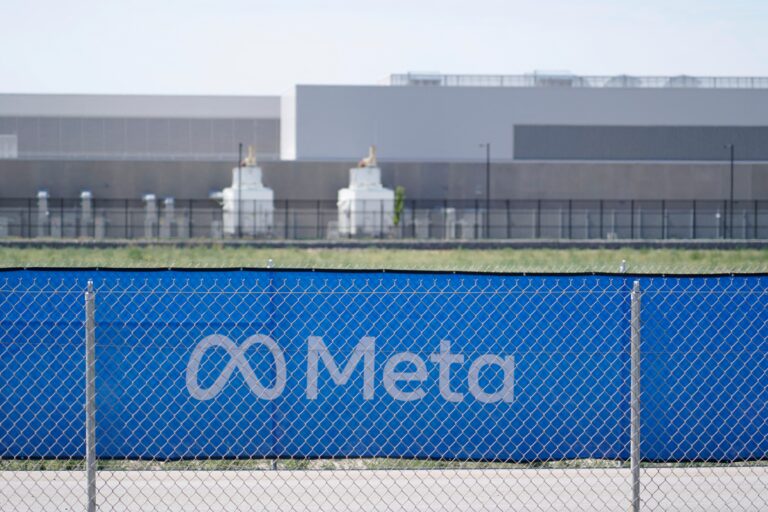
Outside view of the newly completed Meta’s Facebook data center in Eagle Mountain, Utah on July 18, 2024. GEORGE FREY/AFP via Getty Images
The robots Meta is testing inside its AI data centers cannot yet match a human technician’s speed — but economists have a name for what happens when machines take the easy tasks first, and AI-generated instructions absorb what remains at lower wages. Harry Braverman called it deskilling. His 1974 book Labor and Monopoly Capital documented the pattern across a century of industrialization: first, routine tasks are mechanized; then, the residual work is restructured downward, handled by less-skilled, lower-paid workers following procedural instructions they didn’t design. Now the same structural squeeze, documented in factories and offices for fifty years, is arriving in the physical layer of the AI economy itself.
Meta is running active pilot programs in its data centers in Altoona, Iowa and at the Prometheus campus in New Albany, Ohio, testing whether robots can take over the repetitive physical maintenance tasks that have long been performed by on-site technicians. According to a detailed account published by Wired on August 28, 2026, three vendors are under evaluation: San Francisco infrastructure-robotics startup Watney Robotics, Canadian arm-specialist Kinova, and Swiss industrial automation conglomerate ABB. The tasks the robots are being trained to perform — swapping networking cables, power-cycling frozen servers, reseating hardware components, inspecting equipment, and moving server racks — are unglamorous but essential: the daily physical work that keeps hyperscale computing facilities running.
Bill Gates published an essay on August 26 proposing that governments tax robots and AI tokens to offset the payroll revenue they displace, arguing that current tax law already tilts the playing field against human workers. Two days later, Wired published its detailed account of Meta’s data center trials — timing that makes the two stories impossible to read separately. Gates’ argument is precisely the policy frame that Meta’s employees are living out in their internal chat groups.
Robots in the Server Room: What Each Machine Is Doing
Meta is not deploying a single robot fleet. Three different robots, from three different vendors at different stages of technical maturity, are being evaluated against specific tasks where human labor is both expensive and time-consuming.
At the Altoona, Iowa campus, Meta is testing Watney dual-arm robots for cable replacement. The dual-arm design is not incidental: cable insertion requires bimanual coordination — one arm holds the cable body while the other guides the connector into the correct port. Single-arm robots consistently fail at this task. Watney Robotics startup, whose $21 million seed round was backed by Conviction, Abstract, and A*, has described its mission as enabling “autonomous physical infrastructure” and is actively partnering with major hyperscalers.
At the Prometheus campus in New Albany, Ohio, ABB robots mounted on four-wheeled mobile platforms are being tested for component reseating, per reporting on the pilots — the process of re-securing a hardware component that has partially disconnected from its slot. ABB, headquartered in Zurich, Switzerland, is one of the world’s largest industrial automation companies, known for decades of factory-floor robotics deployment in automotive and manufacturing contexts. Its robotics division is the subject of a $5.375 billion SoftBank deal pending regulatory approval, with the European Union clearing the deal in March 2026 and US and China regulatory approvals still pending.
A Kinova Gen3 arm is separately being evaluated for power-cycling servers — pressing the physical power button to reboot frozen equipment. Kinova Robotics company, founded in 2006 and headquartered in Boisbriand, Quebec (approximately 23 miles, or 37 kilometers, north of Montreal), originally developed its six-axis manipulator arms for wheelchair-mounted assistive use; the same dexterity profile that makes the Gen3 useful for helping people with disabilities makes it a candidate for precise, low-force physical interactions with server hardware.
Simpler automation is already deployed at multiple Meta campuses: self-driving tugger robots that transport heavy server racks between locations, and wheeled inventory robots that scan equipment and assist with inspections. At some facilities, a remotely controlled device resembling a mechanical finger is already in use for pressing power buttons — essentially a hardwired precursor to the articulated arm approach. Meta’s robotics manager Eric Xu stated at a 2025 industry conference that the long-term goal is deploying robots in data centers to accelerate incident response, enable continuous environmental monitoring, and perform preventive maintenance.
Why These Tasks and Not Others: The Embodied AI Bottleneck
Data centers are unusual targets for early physical AI deployment — not because they are simple environments, but because they are structured ones. The central technical challenge in embodied AI (the field covering robots that perceive and act in the physical world, as distinct from software-only AI) is the sim-to-real gap — described in coverage of physical AI — where training a robot in simulation produces behavior that often fails in the real world because simulated and real environments are never identical. A construction excavator faces radically changing terrain with every bucket strike. A data center aisle, by contrast, has the same cable types in the same rack configurations repeating for thousands of rows. The repetitive structure makes it far easier to train and validate robot behavior in simulation before deployment.
Current systems nonetheless face four documented engineering constraints that prevent them from replacing human technicians entirely. Battery life limits operational windows: server hall aisles have no charging infrastructure designed for mobile robots, forcing machines offline to recharge. Visual inspection remains difficult: identifying a hardware failure by visual appearance — a discolored capacitor, a partially seated connector, a burned trace on a circuit board — requires extremely high-resolution imaging and AI vision systems that are not yet reliable in the variable lighting of dense server environments. Dense cable arrangements confuse robot perception systems: a fully cabled rack presents hundreds of flexible cables, each capable of obstructing the machine’s sensors and arm path. And aisle navigation is harder than it looks: server halls are narrow (typically 24 to 48 inches, or 61 to 122 centimeters, wide), filled with non-standard equipment, and occasionally occupied by human technicians.
The robots are slower than skilled human technicians at every evaluated task. One unnamed Meta employee told Wired that a robot capable of reliably swapping cables could eventually displace as much as 80 percent of certain technician workloads — but was careful to note this was personal speculation, not a Meta projection, and that current machines cannot yet match a person’s speed.
What Employees Are Worried About: Braverman’s Two-Stage Model, Arriving in Real Time
The labor fear among Meta’s data center workers is not simply “robots will take my job.” It is more structurally specific than that, and it follows a pattern that the labor economist Harry Braverman identified in 1974 and that subsequent scholars have continued to document as automation spreads into new sectors. Harry Braverman, Labor and Monopoly Capital (Monthly Review Press, 1974).
Braverman’s core argument was that industrialization does not just replace workers — it restructures work in a specific direction. Complex, skilled tasks are first broken into their component parts. The most repetitive components are mechanized. The remaining tasks — still requiring some physical presence but no longer requiring craft knowledge — are handed to lower-skilled, lower-paid workers who follow procedural instructions. The “conception” of the work (the expertise, the architecture, the system knowledge) is retained by a small managerial or engineering class; the “execution” is distributed downward. This process is documented in the academic literature on deskilling. Scholars Fabiane Santana Previtali and Cílson César Fagiani, writing in the peer-reviewed journal Work Organisation, Labour & Globalisation in 2015, confirmed the ongoing relevance of Braverman’s framework to contemporary automation. Previtali & Fagiani, “Deskilling and degradation of labour in contemporary capitalism,” Work Organisation, Labour & Globalisation, Vol. 9, No. 1, Spring 2015.
The two-stage model Meta’s workers fear maps precisely onto this historical pattern. Stage one: robots handle the most repetitive tasks — cable swapping, power cycling, component reseating. Stage two: Meta simultaneously develops AI-generated instruction tools that would allow lower-skilled workers — sometimes called “smart hands” in the industry — to carry out more complex maintenance by following step-by-step guidance generated in real time by an AI system. The experienced technician who currently performs both sets of tasks is then caught between two simultaneous pressures: machines for the routine work, and AI-coached novice workers for the remainder, at a fraction of experienced technicians’ pay, according to reporting on Meta’s internal workforce concerns.
The fear is internally documented. Meta employees voiced concerns in internal chat groups about routine maintenance jobs vanishing within a few years, according to reporting by Decrypt.
What Will Data Center Workers Actually Need?
Meta pushed back on the displacement framing in a statement to Decrypt. A spokesperson said: “America is in the middle of its biggest infrastructure boom since World War II, and there’s a major shortage of skilled workers to fill the roles; we need more workers, not fewer.”
The labor shortage argument has genuine force in the context of construction: the Associated Builders and Contractors trade group estimated the US construction industry needs to attract approximately 349,000 net new workers in 2026 alone — primarily electricians, mechanical trades workers, and other specialists needed to physically build data centers — rising to 456,000 in 2027 as AI infrastructure spending continues to expand. A separate analysis from the Information Technology and Innovation Foundation documented that data center construction labor shortages stood at roughly 439,000 positions as of late 2025, with over 400 data centers then under development by major tech companies.
Nvidia CEO Jensen Huang has repeatedly argued that robots are best understood as filling roles that cannot be staffed by humans, calling AI-driven machines “AI immigrants” at CES 2026 and predicting they will create rather than eliminate employment. Huang envisions data centers as “AI factories” operated by people, software agents, and robots working in parallel.
But labor economists note that the construction-era shortage and the operations-era threat are different populations facing different dynamics. Workers building AI data centers (electricians, mechanical trades) face genuine labor-shortage conditions that robots might usefully supplement. Workers operating and maintaining existing data centers — the group whose jobs Meta’s pilots target — face a different trajectory: not a shortage of roles, but a structural renegotiation of what those roles pay and require.
Bill Gates made the tax asymmetry concrete in his August 26 essay. When employers hire humans, they pay payroll taxes on those workers’ earnings. When they purchase robots or AI systems, those costs are typically written off as business expenses. “The tax system nudges you toward replacing people with machines,” Gates wrote. He called for taxing robots and AI tokens, with the revenue earmarked for retraining displaced workers — a proposal the critics of his 2017 version of the same idea once called strange but that has gained traction as the 2026 job displacement numbers have climbed. Employers have cited AI and automation in 184,538 job cut announcements since 2023, according to Challenger, Gray and Christmas, cited in the same piece.
Infrastructure Robotics: A New Category, Not a Single Company’s Experiment
Meta’s pilots are not an isolated initiative. They represent the early visible phase of a new market category — infrastructure robotics — aimed specifically at the physical maintenance layer of large-scale compute facilities.
Y Combinator-backed Boost Robotics is building autonomous mobile manipulation robots for data center inspection and remote-hands interventions — the same core use case Meta is piloting. Microsoft, Google, and Amazon have all explored robotics for data center operations, according to reporting by Wired, though none has publicly detailed pilot programs at the scale Meta’s are now documented to be.
Alibaba unveiled its Qwen-Robot Suite in June 2026, covering navigation, object handling, and physical simulation — foundational capabilities relevant to data center deployment. Nvidia researchers have introduced AI agent frameworks for training robot fleets; the same GPU infrastructure Meta is spending $130 billion to $145 billion building in 2026 will itself generate the training data and compute for the robots being trained to maintain it. ACE Robotics chairman Wang Xiaogang predicted that embodied AI — the capability class that lets robots perceive and act in physical environments — could reach a “ChatGPT moment” of sudden capability advance — Decrypt reports ACE Robotics predicts this by end of 2027 by the end of 2027.
The global data center robotics market was estimated at $13.7 billion in 2024 and is projected to reach $44.2 billion by 2030, growing at a compound annual growth rate of 21.6 percent, according to a ResearchAndMarkets report published via Business Wire in November 2025. The economics Meta is responding to are real: a robot can operate continuously in temperatures and environments inhospitable to human workers, requires no benefits, and produces no overtime costs.
For now, Meta’s robots remain supervised prototypes, unable to match the speed or adaptability of a skilled human technician. But the trajectory is clear. The data centers being built to run AI at scale are themselves becoming a test bed for the automation wave they were built to power.
Frequently Asked Questions
Will data center robots actually eliminate technician jobs, or is Meta right that more workers are needed?
Both things can be true simultaneously, and that is precisely what makes this moment structurally significant. The construction labor shortage is real: the US construction industry needs an estimated 349,000 net new workers in 2026, primarily to build the data centers that AI companies are commissioning. But construction workers (the ones running conduit and pulling cable to build new facilities) are a different population from operations and maintenance technicians (the ones inside running facilities who power-cycle servers and swap networking cables). Meta’s robot pilots target the second group. Their labor shortage argument addresses the first. A technician watching robots practice cable replacement in their data center is not reassured by knowing that electricians are hard to hire at construction sites two states away.
What is the two-stage deskilling squeeze that employees fear?
The pattern Meta’s workers are worried about follows a documented economic model first described by labor economist Harry Braverman in 1974: machines first take the most routine physical tasks; then AI-generated instruction systems allow lower-skilled, lower-paid workers to absorb the residual tasks that robots cannot yet handle reliably. The experienced technician who previously performed both sets of tasks is displaced not by a single robot but by the combination — machines above, cheaper guided labor below. The critical insight from Braverman’s framework is that this process does not require any individual act of bad faith: it is the natural economic outcome of breaking complex work into components, automating the easiest ones, and restructuring the remainder downward.
What tasks can data center robots reliably perform today, and where do they still fall short?
Current robots in Meta’s pilots can perform or are being evaluated for: moving server racks (already deployed, using self-driving tugger robots), scanning equipment (wheeled inventory robots already deployed), pressing power buttons to reboot servers (mechanical finger device, already deployed), power-cycling servers via robotic arm (Kinova Gen3, under evaluation), reseating hardware components (ABB wheeled platform, under evaluation), and cable replacement (Watney dual-arm, under evaluation in Altoona, Iowa). Robots still cannot reliably perform: visual diagnosis of hardware faults, navigation through densely cabled racks without damaging cables, complex repair tasks requiring fine dexterity, and any task requiring judgment about non-standard or unexpected equipment states. All current systems require human supervision and are slower than skilled technicians.
What would Bill Gates’ robot tax actually do?
Under current US tax law, employers pay payroll taxes when they hire workers but can write off robot and automation purchases as business expenses — an asymmetry that Gates argues makes machines artificially cheap to deploy relative to human employees. His August 26 essay proposed taxing robots and AI tokens at a rate that would roughly equalize the cost advantage, with the revenue earmarked for worker retraining, job placement programs, and education investments. Critics of a similar proposal Gates made in 2017 argued it would slow productivity growth; its proponents argue that absent such a correction, the transition costs of automation will be borne entirely by displaced workers rather than shared across the firms and shareholders who capture the productivity gains.