HomeAuto Melty Blood: Twi-Lumina Confirms April 22 Launch, Debuts White Len at TGS
Melty Blood: Twi-Lumina Confirms April 22 Launch, Debuts White Len at TGS
September 12, 2026:
Unknown-corp.co.jp
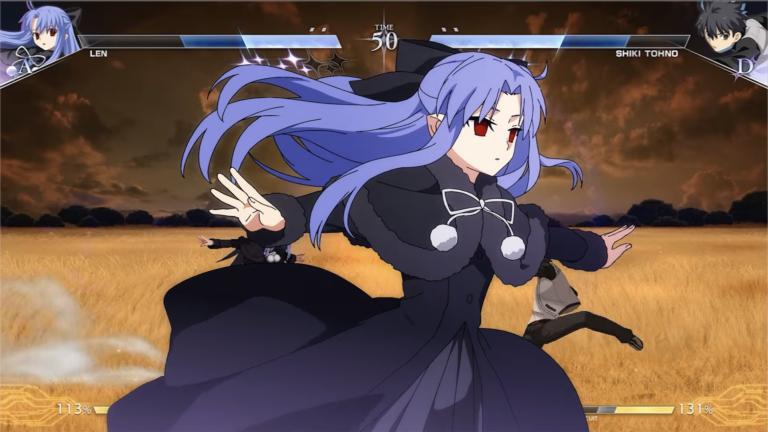
After nearly four years of silence following Melty Blood: Type Lumina‘s final DLC, Aniplex and developer French-Bread have confirmed that the sequel Melty Blood: Twi-Lumina will arrive on April 22, 2027 — giving fans of the long-running TYPE-MOON fighting game franchise a concrete window to plan around for the first time since the title’s surprise reveal at EVO Japan 2026 in May. The release date announcement arrived alongside the game’s first full gameplay April 22, 2027 release trailer, which debuted a new character — White Len, illustrated by TYPE-MOON co-founder and character designer Takashi Takeuchi — while providing the clearest look yet at the upgraded battle system, new control options, and a story mode authored by visual novel legend Kinoko Nasu.
Platforms and Languages
Twi-Lumina will launch on six platforms simultaneously on PlayStation 5, PlayStation 4, Xbox One, Nintendo Switch, Nintendo Switch 2, and PC via Steam. Store pages on the PlayStation Store and Steam are already live for wishlisting. The Xbox One page coming soon was confirmed in the official Japanese tweet from the @MB_LUMINA account on September 12, 2026.
Eight supported launch languages will be available at launch: English, French, Spanish, Portuguese, Japanese, Korean, Traditional Chinese, and Simplified Chinese. Voice acting will be Japanese only. The multilingual rollout marks a continued commitment to global accessibility — Type Lumina launched with only Japanese, English, and Chinese at release.
White Len Returns — and What Her Appearance Signals
The trailer’s headline reveal is White Len, a dream-world doppelganger of fan-favorite character Len who first appeared in Melty Blood Re-ACT in 2004 and became fully playable in Melty Blood Act Cadenza Ver. B in 2006 as part of the Melty Blood franchise history. Her return carries more significance than a simple roster addition. Type Lumina, released in 2021, was explicitly rebuilt around the continuity of Tsukihime -A Piece of Blue Glass Moon-, the 2021 remake of TYPE-MOON’s original visual novel — a design choice that the Type Lumina development history reveals left the older cast of Len and White Len, both of whom originate from the 2001 fan disc Kagetsu Tohya, off the initial roster entirely.
Kagetsu Tohya is a standalone story set one year after Tsukihime‘s events, in which protagonist Shiki Tohno is trapped in an endlessly repeating dream constructed by Len — a succubus dream familiar who can shift between the form of a black cat and a young girl. White Len, lore-wise, is Len’s dark counterpart, assembled from the magical remnants of a ritual overseen by the sorceress Aoko Aozaki. Together, the two characters are inseparable from Kagetsu Tohya‘s dreamworld mythology. Their presence in Twi-Lumina — combined with the game’s subtitle (which combines “Twilight” with “Lumina” to evoke a liminal between-worlds state) and its official English site tagline “A tale of conflict stirs once again within a dream” — signals that Twi-Lumina is drawing directly from Kagetsu Tohya‘s source material as its narrative foundation.
For longtime fans, this matters beyond nostalgia: Melty Blood Actress Again Current Code, the last pre-reboot entry in the series, featured 31 playable characters, many of whom came from Kagetsu Tohya and the older Tsukihime routes. Type Lumina trimmed the roster to 22 fighters, all tied to the remake’s narrower “Near Side” storyline. White Len’s appearance suggests Twi-Lumina may restore access to characters from that wider original pool — though the full roster has not been announced.
What Is Different Under the Hood
Twi-Lumina is not a sequel in the traditional sense. Every character from Type Lumina‘s 22-strong roster returns — including Len, who had been conspicuously absent from Type Lumina‘s playable launch lineup despite her silhouette appearing in a post-credits scene. The game functions as a major update to Type Lumina built on the same HD sprite engine shared with French-Bread’s Under Night In-Birth series, with substantially reworked systems layered on top.
Act and Duel: Two Paths Into the Game
The most significant mechanical addition is a dual control scheme. Act mode replaces traditional quarter-circle and half-circle motion inputs with single-button special moves and a forward-direction dash input — a design that mirrors Street Fighter 6‘s “Modern” controls. Crucially, the August 2026 TYPE-MOON TIMES broadcast confirmed that Act mode no damage penalty applies — unlike some fighting games that punish simplified inputs with reduced output. This is a deliberate commitment to competitive parity regardless of input style, and it positions Twi-Lumina for the broadest possible audience without creating a second-class tier of players.
Duel mode preserves the traditional command-input system that veterans of the series and the fighting game community (FGC) at large expect. Players will select their control style at character select, and both modes access the same characters, mechanics, and online modes.
How Rollback Netcode Keeps It Competitive Online
Twi-Lumina retains the rollback netcode from Type Lumina, which is the technical foundation that made Type Lumina viable as a competitive online game and a staple of EVO Japan — the game was featured in Type Lumina at EVO 2022’s main lineup, the first time a Melty Blood entry appeared at EVO in over a decade.
Rollback netcode works by treating each player’s inputs as locally immediate and predicting what the opponent will do next frame rather than waiting for the remote player’s data to arrive. When the prediction proves correct, the match plays smoothly; when wrong, the game rolls back to the correct state — a correction that is typically imperceptible for small frame discrepancies. The alternative, delay-based netcode, inserts artificial lag frames to keep both machines synchronized, producing the stutters and input-delay that have frustrated competitive players for years. Twi-Lumina‘s preservation of rollback confirms it will remain a viable tournament entry when it launches.
New Gauge Systems and the Gauntlet
The Magic Circuit gauge — Melty Blood‘s equivalent of a super-meter — has been revised for Twi-Lumina. Per the Twi-Lumina gauge mechanics overview, it reverts to a two-bar system capping at 200%, pulling back from Type Lumina‘s Moon Drive/Moon Skill mechanic structure. A new rule adds a comeback layer: a player who loses a round gains access to MAX State-based Rapid Heat once their gauge is full and a third sub-gauge depletes. This creates a structured means for trailing players to access powerful states, reducing the frustration of runbacks where a losing player has no escalation path.
A brand-new mechanic called Gauntlet spends the Lumina gauge to launch a rushing attack capable of overpowering incoming moves and sending opponents airborne. Gauntlet appears to function as an armor/momentum mechanic — spending resources to push through an opponent’s pressure rather than absorbing or dodging it. Full frame data and mechanical specifics have not been released ahead of TGS.
The Rapid Beat autocombо system — which allows players to execute multi-hit combos by pressing an attack button repeatedly — returns in reworked form supporting more varied combo routes, according to the Grand Scenario Mode details in Aniplex’s official press overview.
Grand Scenario Mode: Kinoko Nasu Returns to Shiki’s Story
The centerpiece of Twi-Lumina‘s single-player offering is the Grand Scenario Mode, an entirely original story written by Kinoko Nasu — co-founder of TYPE-MOON, author of Tsukihime, Fate/stay night, and every prior Melty Blood scenario. According to Aniplex’s official overview, the mode centers on Shiki Tohno navigating Souya City through a series of battles, with a substantial volume of recorded dialogue expanding the narrative well beyond the per-character story modes that defined Type Lumina.
Nasu’s involvement in Type Lumina‘s story was collaborative but circumscribed — he contributed planning and drafts, with portions of the Arcueid and Ciel scenarios written by a credited writer named “acpi” based on Nasu’s outline. The Grand Scenario Mode in Twi-Lumina, described as “a new tale centered around Shiki Tohno” and tied to the dreamworld imagery in the game’s subtitle and tagline, appears to be a more direct authorial statement. Nasu has described Kagetsu Tohya as centering on the familiar Len — and the thematic connective tissue between that 2001 fan disc and Twi-Lumina‘s promised narrative is substantial.
The mode’s dialogue volume is described as “substantial” in press materials, raising expectations for something meaningfully larger than what Type Lumina offered — which featured brief visual novel segments accompanying each character’s individual story path, without a unified narrative through-line.
Hands-On at Tokyo Game Show 2026
Players in Japan will be able to try Twi-Lumina before its launch. The game will be playable at the Aniplex booth at Tokyo Game Show 2026, which will run September 17–21, 2026, at the Tokyo Game Show 2026 official venue — Makuhari Messe in Chiba, Japan, approximately 22 miles (35 km) from central Tokyo.
TGS 2026 is a milestone edition of the show — its 30th anniversary, and the longest in its history at five days, with TGS 2026 record exhibitor count confirmed at 1,138 exhibitors from 53 countries across 3,999 booths. Business days run September 17–18 (industry only); public days open September 19–21. Standard single-day public tickets cost ¥3,000 (approximately $19 USD). The Twi-Lumina demo will give attendees their first direct experience with the new mechanics and the Act/Duel control options before any wider public demo is released.
What Type Lumina Built — and What Twi-Lumina Inherits
Understanding Twi-Lumina‘s position requires knowing what Type Lumina achieved. Released September 30, 2021, Type Lumina was the first major Melty Blood game since Actress Again Current Code in 2010, rebuilt from scratch on a high-definition engine with rollback netcode, a streamlined battle system, and 14 launch fighters expanding to 22 through free DLC per the Type Lumina release and DLC record. Worldwide sales passed the mark of Type Lumina sold 330,000 units by September 2022, and the game received wide critical praise, earning a nomination from the Academy of Interactive Arts & Sciences for Fighting Game of the Year at the 25th Annual DICE Awards, documented in the Type Lumina critical reception record.
The original Melty Blood Comiket release stretches back to December 2002, when TYPE-MOON and French-Bread co-developed a doujin PC release distributed at Comiket — making Twi-Lumina‘s 2027 launch a point roughly 25 years into one of the longest-running anime fighter lineages in the medium.
Seven Months of Reveals Still to Come
With the April 22, 2027 date confirmed and White Len as the first declared new addition, the reveal cadence is only beginning. Type Lumina featured 22 fighters at launch, several of them Fate franchise crossovers (including Saber, Mash Kyrielight, Ushiwakamaru, and the Count of Monte Cristo). Whether Twi-Lumina expands the roster with further Fate additions, deeper Kagetsu Tohya representation, or characters from Tsukihime‘s still-unreleased “Far Side” routes remains the dominant community debate.
What is established: the game will launch on six platforms simultaneously with eight language options, include a Nasu-authored story mode, offer newcomer-accessible controls without competitive penalty, and be playable on the TGS 2026 show floor five days from now. For a franchise whose fans waited eleven years between Actress Again Current Code and Type Lumina, seven more months is a short runway.
Frequently Asked Questions
What platforms will Melty Blood: Twi-Lumina support at launch?
Twi-Lumina will launch simultaneously on PlayStation 5, PlayStation 4, Xbox One, Nintendo Switch, Nintendo Switch 2, and PC via Steam on April 22, 2027. Store pages on PlayStation Store and Steam are already live. All six platforms will support eight languages, though voice acting is Japanese only.
Who is White Len, and why does her inclusion matter?
White Len is a dream-world counterpart to Len — a fan-favorite character who originates in the 2001 TYPE-MOON fan disc Kagetsu Tohya and made her first fighting game appearance in 2004. Both Len and White Len were absent from Melty Blood: Type Lumina‘s roster because that game was tied to the 2021 Tsukihime remake’s narrower character pool. White Len’s inclusion in Twi-Lumina, combined with the game’s dream-themed subtitle and tagline, signals that the sequel is drawing from Kagetsu Tohya‘s mythology — and possibly reopening the roster to characters from the broader original Tsukihime universe that Type Lumina could not include.
What is different about Twi-Lumina’s control system compared to Type Lumina?
Twi-Lumina introduces a second control type called Act, which replaces complex motion inputs (quarter-circles, half-circles) with single-button special moves and a simplified dash input. Act mode carries no damage penalty, unlike similar “simplified” modes in other fighting games that reduce output power. The traditional input style from Type Lumina — called Duel in Twi-Lumina — remains available for veterans. Both modes access the same characters, mechanics, online features, and competitive modes.
Can I try Twi-Lumina before it launches?
A playable demo will be available at the Aniplex booth at Tokyo Game Show 2026 (September 17–21, Makuhari Messe, Chiba, Japan). Public days run September 19–21; standard tickets cost ¥3,000 (approximately $19 USD). No wider public demo outside Japan has been announced yet.