November 18, 2026:


Medtronic said on Nov. 17 that the FDA cleared its Hugo robotic-assisted surgery system for general surgery, listing cholecystectomy, Roux-en-Y gastric bypass, ventral hernia repair, small bowel resection, inguinal hernia repair and appendectomy. Enable Hernia Repair enrolled 193 patients and is the only US general-surgery trial Medtronic has disclosed, and it covers just the two hernia procedures, so a six-procedure label is not a six-procedure outcomes record. Hospital buyers, surgeons and patients weighing Hugo against da Vinci should ask which data backs each procedure, because Medtronic has not said.
Medtronic estimates, without citing a source, that the cleared procedures account for about 3.5 million US surgeries a year, more than half of soft-tissue procedures. The announcement cites no clinical data, no launch date and no count of US hospitals beyond a “growing number.”
Medtronic calls Enable Hernia Repair the first completed US investigational device exemption study of robotic hernia repair, a claim the company made when it announced results on Sept. 4, 2025. The study was prospective, multicenter and single-arm. Results were published in Annals of Surgery in May 2026, which lists 97 inguinal and 96 ventral patients treated; Medtronic’s release counted 92 and 94 repairs available for analysis.
Surgical success was 100% against a performance goal of 85%. Surgical-site events occurred in 0.0% of inguinal repairs and 2.1% of ventral repairs (two events), both measured against a 30% goal, according to Medtronic. The journal abstract reports success in 193 of 193 patients, with surgical-site events in 0 of 97 inguinal and 2 of 96 ventral patients. Medtronic’s publication summary lists one inguinal and four ventral readmissions and one reoperation, in the ventral group.
The trial compared Hugo with preset performance goals, not with laparoscopic or da Vinci arms, so it cannot show whether outcomes beat or match either alternative. Dr. Francesco Bianco, a UI Health surgeon quoted in Medtronic’s Nov. 17 release, is among authors who were Medtronic consultants, according to the disclosures Medtronic lists for the paper. Two other authors were Medtronic employees.
FDA’s review practice for broadly labeled general-surgery robots lets a manufacturer support some procedures with data from others, and lets published literature stand in for investigational device exemption studies, according to a Hogan Lovells Cadwalader analysis dated Oct. 16. The authors, partners Kristin Zielinski Duggan, Lina Kontos and Randy Prebula, wrote that the approach reflects long-standing review practice that the draft guidance now formalizes.
FDA’s draft guidance on robotic surgical devices, issued Sept. 25 under docket FDA-2026-N-9505, is non-binding. It says nine clinical endpoints may warrant use: length of stay, intraoperative adverse events, transfusion rate, conversion rate, post-operative adverse events, readmission, reoperation, mortality and operative time. The law firm noted that clinical data for broadly indicated systems have historically centered on conversion rate. The draft also expects training plans that cover bedside assistants and scrub nurses, not only the operating surgeon.
Comments on the draft close Nov. 24, and FDA will hold a public workshop on robotic devices on Dec. 2 and 3 covering autonomous and remote teleoperation capabilities. Hogan Lovells reported that FDA expects to finalize the guidance within the current fiscal year. Medtronic’s June 3 filings also included a gynecologic 510(k) submission that Medtronic has not announced as cleared, and its Embrace Gynecology study has completed enrollment of 70 patients at five US hospitals.
Medtronic’s announcement does not name the predicate device or the data behind the Nov. 17 clearance. The December 2025 urology clearance K250725 is documented: its only listed predicate is CMR Surgical’s Versius system, authorized through De Novo order DEN230078 dated Oct. 11, 2024.
Medtronic’s Expand URO study enrolled 137 patients at six US sites and reported 98.5% surgical success (134 of 136) against an 85% goal. The urology letter also carries postmarket study requirements tied to the Versius De Novo order, including a study protocol, enrollment milestones at 12, 24, 36 and 48 months and progress reports every six months.
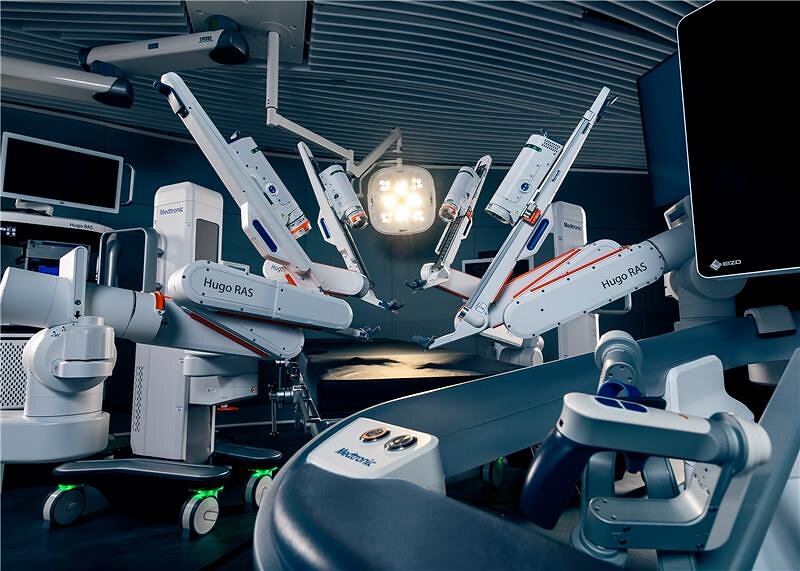
Hugo consists of a surgeon console, a system tower and four independent arm carts, each positioned separately beside the patient. The console is open, with an HD 3D passive display viewed through 3D glasses and a head-tracking system that checks the glasses’ alignment with the monitor and enables robotic control. Its instruments are wristed, and reported studies used 8 mm (0.31 in) robotic trocars with an 11 to 12 mm (0.43 to 0.47 in) endoscope port.
Da Vinci, the market incumbent, puts the surgeon at a console, typically in the same room, and uses a cart carrying three or four arms. J&J’s Ottava, authorized in July, integrates its arms into the table, and J&J says that design uses 30% to 50% less space than traditional boom- and cart-mounted systems, based on a September 2025 evaluation.
Independent carts allow flexible arm placement, but a published review found docking “more challenging and demands training,” with times from about 3 to 19 minutes across studies, arm collisions, and one partial nephrectomy converted to laparoscopy. The same review found only three general-surgery reports at the time and called for more clinical data. Later non-US studies exist: a 70-patient series at one German center, a retrospective Rome gastric bypass comparison of 45 Hugo and 45 da Vinci patients that found comparable early complication rates, and a Korean single-center cholecystectomy study co-authored by Medtronic staff.
A January 2025 field safety notice described one complaint of a portion of an arm cart detaching during a procedure before docking. A follow-up recall letter dated March 2025 counted one detachment and four loose-connection complaints as of Feb. 4, 2025, attributing the cause to a single batch of fasteners and reporting no adverse events for the four loose connections. The notices do not say whether US units were affected.
In February 2026, Health Canada posted a Type II recall of Hugo bipolar Maryland forceps and bipolar fenestrated graspers, saying manufacturing variations in a drive-cable pulley raised the likelihood of component failure and that a small plastic piece could come loose in the body cavity. The recall states the system is designed to detect the failure and halt control of that instrument. Medtronic announced the first US commercial Hugo case, a prostatectomy at Cleveland Clinic, on Feb. 17, 2026, so US field history is short.
A study in Surgery covering 1,258 robotic and 13,548 laparoscopic cholecystectomies from 2017 to 2024 found median disposable costs of $1,309 for robotic cases and $534 for laparoscopic cases, with no significant difference in complications or readmissions. The study examined robotic platforms generally, not Hugo, but cholecystectomy is the first procedure on Hugo’s new list.
Intuitive is also adjusting prices. Its da Vinci procedures rose about 14% worldwide in the third quarter, with US growth near 10% against about 16% a year earlier, and the installed base reached 12,094 systems. Intuitive attributed US general surgery growth to cholecystectomy, hernia repair and appendectomy, while US bariatric procedures fell by a low double-digit percentage and made up about 2% of worldwide da Vinci procedures. Roux-en-Y gastric bypass, a bariatric procedure, is on Hugo’s list.
Intuitive also disclosed pricing actions that it expects to lower instrument and accessory revenue per procedure by about 3% to 5% once fully implemented, excluding mix effects, with China changes beginning in the fourth quarter of 2026 and instrument pricing changes in the first half of 2027.
J&J received De Novo authorization for Ottava on July 22 with ten procedures in its label and plans to launch with select US customers; its 30-patient FORTE study tested Roux-en-Y gastric bypass at six US sites. Stryker agreed on Oct. 12 to invest about $400 million in CMR Surgical and become its exclusive US distributor, with an option to buy the remaining shares; Versius is authorized in the US only for gallbladder procedures.
Medtronic announced on Sept. 1 an investment of about $700 million in Hong Kong-based Cornerstone Robotics, with distribution rights for its Sentire system in select markets outside the US. Cornerstone has a 30,000 square meter manufacturing facility (322,917 sq ft) in China. Asked on Medtronic’s fiscal first-quarter earnings call whether the deal signals doubt about Hugo, CEO Geoff Martha said, “We are doubling down here.” Sentire is not part of this clearance and is not covered by US rights under the deal.
Medtronic’s Nov. 17 release names no launch date, no US install count and no Hugo per-procedure pricing. It says Hugo is used at a growing number of US health systems and that Hugo procedure growth is on track to surpass 50,000 procedures worldwide by the end of its fiscal year, which ends in spring 2027; both are company claims. Medtronic is scheduled to report second-quarter fiscal 2027 results at 6:45 a.m. ET on Tuesday, Nov. 24, with a webcast at 7:30 a.m. ET.
Medtronic announced FDA clearance of its LigaSure RAS Maryland jaw instrument for Hugo on Sept. 16.
For a hospital deciding on Hugo, the clearance settles that the device may be marketed for the listed procedures, not what outcomes to expect from each. The disclosed US evidence covers hernia repair; FDA’s framework allows other data to fill gaps; the predicate and supporting data for the new label are undisclosed; independent carts bring docking and training demands; two foreign field-safety notices describe hardware failures, with no stated US impact; and Intuitive’s planned 3% to 5% per-procedure revenue reduction and rival launches will shape cost comparisons.
Medtronic said Nov. 17 that FDA cleared Hugo for general surgery. Medtronic’s June 3 510(k) filings sought that expansion, and a 510(k) outcome is a clearance, not an approval.
The only US general-surgery trial Medtronic has disclosed is Enable Hernia Repair, with 193 patients; Medtronic has not said which data supported the other procedures. Smaller non-US Hugo studies exist, including a Korean cholecystectomy study and a Rome gastric bypass comparison.
No. Under FDA’s review practice, data from some procedures, along with literature and real-world evidence, can support others in the same specialty, so a label is not a per-procedure outcomes file.
Hugo uses four independent arm carts and an open console with 3D glasses, while da Vinci uses a surgeon console and patient-side cart.