MCU VFX Veterans Launch Box Knight: Office Roguelike Built Like Film Sets

August 24, 2026:

MCU VFX Veterans Launch Box Knight: Office Roguelike Built Like Film Sets
Box. Knight
Wemat.com.au

The people who helped bring Iron Man’s armor to life on screen have spent the last six years building a game where your most dangerous enemies are your coworkers β€” and it launches on Steam on August 25, 2026.

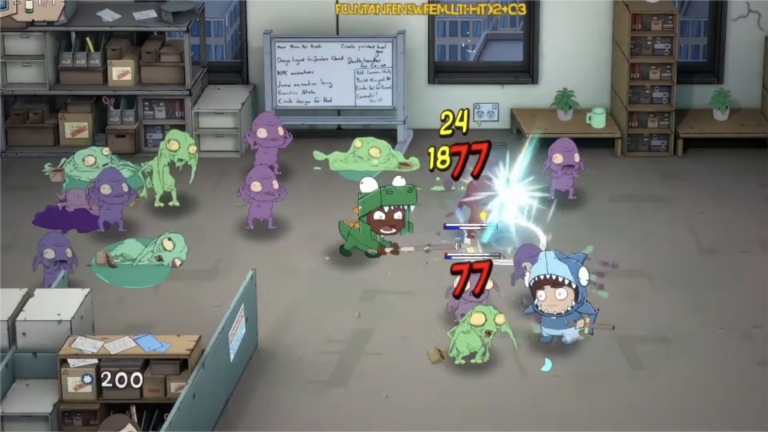
Box Knight, the debut game from Adelaide-based We Made A Thing Studios, is a side-scrolling action roguelike that transforms the office into a monster-infested dungeon, floor by floor, until you punch your way to the CEO. What makes it unusual is not the premise β€” satirical workplaces are common enough in indie games β€” but who built it and how. Co-founders Tom Phillips and Jeremy Kelly-Bakker arrived in game development from careers in film visual effects and production, with MCU and franchise film credits spanning Harry Potter and the Half-Blood Prince, Prometheus, Iron Man 3, and Captain America: The Winter Soldier. Their studio used a COVID-era production shutdown in 2020 as the opening it needed to make a game it had always wanted to build, as a ScreenHub interview with the founders details.

The result is a game that carries the visual philosophy of film and theater into a format where very few developers have tried to apply it.

A free demo is available now on Steam. The full release launches August 25, 2026.

When Film Shuts Down, Build a Dungeon

We Made A Thing Studios was established in Adelaide, South Australia, in 2017 as a multi-platform production company β€” working across film, television, and digital series. Phillips handled writing, creative direction, and production; Kelly-Bakker brought the visual effects experience he had accumulated on major franchise films, as their studio’s about page confirms. They had been working together since around 2009, when Kelly-Bakker β€” a self-described film school dropout who taught himself VFX by watching The Lord of the Rings behind-the-scenes footage β€” agreed to help Phillips finish a short film and never entirely stopped.

The COVID-19 pandemic’s 2020 shutdown of live-action film production forced a decision. The studio had already been building a rough prototype of Box Knight during spare hours. With film work paused, that prototype became the full project.

“COVID forced our hand in 2020, but we always had a few of those ideas we liked to noodle with,” Phillips said in the ScreenHub developer interview. Kelly-Bakker added that the studio had the technical foundation to pivot: visual effects work and game development share substantial overlap in the skills required β€” modeling, animation, texturing, lighting β€” even when the industries themselves operate very differently.

Box Knight received funding from the South Australian Film Corporation, the same body that had supported the studio’s earlier film projects. Development ran through the Game Plus co-working space in South Australia, where Phillips and Kelly-Bakker were surrounded by game developers and able to build the cross-disciplinary knowledge their film backgrounds hadn’t supplied.

The game won Best in Exhibition at the South Australian Game Exhibition 2024, one of the most competitive showcases for Australian indie developers, as the ScreenHub developer interview notes.

How the Game Actually Works

Box Knight is a roguelite brawler: a side-scrolling beat-’em-up layered with two tiers of progression that distinguish it from traditional arcade brawlers.

The first tier operates within each run. As players fight through the office tower room by room, strong performance unlocks additional upgrade choices between levels β€” new cardboard weapons, abilities, and enhancements that shape the current attempt. The Steam store page details this system: better performance unlocks more upgrade options, creating distinct build paths between aggressive damage-focused styles and fast hit-and-run approaches.

The second tier persists between runs. When players die β€” and roguelites are designed to ensure they do β€” resources earned during the failed attempt carry over. These fuel permanent upgrades available through the in-game Council of Janitors, the upgrade hub between attempts. As the Box Knight Steam page explains, a character becomes meaningfully stronger regardless of any single run’s outcome, reducing frustration while preserving the tension that makes the format compelling.

What separates Box Knight’s combat from straightforward arcade brawlers is an enemy weakness system that adds a tactical layer most games in this lineage do not include. Different enemy types require different approaches: some cannot be attacked from above, others require piercing weapons, and some explode if the player jumps on them. The Steam page describes this as a “rock-paper-scissors-like mechanic” layered into real-time action combat β€” easier to enter than traditional roguelikes, but demanding to master once the full enemy roster appears.

The enemy roster is explicitly designed as “fantastical abstractions of your least favorite coworkers,” giving the game its satirical backbone. The Drone Goblin is among the named enemy types. The endgame target is the CEO.

What Film and Theater Taught a Game Developer

The visual design of Box Knight is where We Made A Thing Studios’ film background is most apparent β€” and where Kelly-Bakker’s specific techniques are most transferable.

“We had the visual effects knowledge, which has a huge amount of overlap with games, you know, in modeling and animation, and texturing and lighting,” Kelly-Bakker said. But beyond those shared fundamentals, the studio brought in techniques specific to theater and film set design that are rarely applied in 2D games, as the ScreenHub developer interview details.

Kelly-Bakker described using forced-perspective geometry borrowed from stage design β€” placing geometry outside the camera’s visible frame to cast shaped shadows and break up incoming light, creating the illusion of depth and atmosphere without the geometry itself ever appearing on screen. The approach draws on the same principles as an old Georges MΓ©liΓ¨s forced-perspective matte painting β€” a reference to the French filmmaker who pioneered in-camera visual trickery in the early 20th century, per the ScreenHub developer interview.

The result is a deliberately imperfect visual style. Box Knight’s comic-book art aesthetic has no straight lines or symmetry by design, contributing to what Kelly-Bakker described as a sense of “off-Broadway” handmade quality. Color palettes, set design, and in-game props are all treated as narrative elements rather than background decoration β€” a priority that reflects how both founders think about screen environments rather than game levels.

“One of the things that rolls into game production is a sort of cohesion to what we’re doing,” Kelly-Bakker said. “We are thinking about set design, we’re thinking about our color palettes. We’re thinking about our narrative, and the lore that runs through the objects and props,” as he explained in the ScreenHub developer interview.

The game is built in Unreal Engine, which the studio also used for its Lucy and DiC live-action series β€” a virtual production project enabled by an Epic Games MegaGrant and a natural extension of the same engine expertise developed during Box Knight’s production.

Play Solo or With a Friend

Box Knight supports both single-player and local couch co-op, with two players able to fight through the office tower together. Steam’s Remote Play Together feature extends the co-op to players who are not in the same room, effectively making the local co-op option available online, as confirmed on the Box Knight Steam page.

Cosmetic customization β€” helmets, uniforms, weapons, and cosmetics β€” lets players personalize their Box Knight before or between runs.

The game also includes Steam Achievements and is playable with a controller or keyboard.

The story premise: every Friday at 5 PM, a regular office worker transforms into the Box Knight β€” a cardboard-armor-wearing defender armed with improvised weapons, the only person standing between the rest of the company and the corrupt creatures their colleagues have become. The tone is consciously irreverent β€” the studio describes its approach as “Hades meets The Office with a splash of South Park’s attitude.” The humor is physical and absurd, the stakes are deliberately low, and the combat is what the developer calls “bloody and silly.”

A demo made available during Steam Next Fest in February 2026 covered the opening floors of the office tower, and remains available as a free download on Steam for players who want to try before buying, as BleedingCool’s Next Fest coverage confirmed.

Does It Deliver What It Promises?

At launch, Box Knight has no aggregate review score β€” the game is new and user reviews are still accumulating. What can be evaluated is what the studio built toward. A game that wins Best in Exhibition at a regional showcase, survives a multi-year development that started as a COVID contingency plan, and arrives at launch with a public demo that has already given players a preview of the first several floors of the office tower has cleared meaningful pre-market hurdles.

The combat system’s enemy weakness mechanic is the design risk worth watching. Traditional brawlers succeed through feel β€” the snap of a hit connecting, the momentum of clearing a room. Adding a weakness-typing layer introduces the possibility of rewarding tactical play, but also the possibility of interrupting combat flow if the required attack type isn’t immediately readable. Early coverage describes the combat as fast-paced and rewarding with attention to positioning and timing, and the roguelite structure means death is always a learning opportunity rather than a frustrating setback.

For the Australian indie development community specifically, Box Knight represents something relatively uncommon: a debut from a team whose professional backgrounds come from outside the game industry entirely, arriving in games with Hollywood-scale production experience and applying it to an indie scope. The precedent is interesting regardless of how the launch performs.


Frequently Asked Questions

What is Box Knight about, and who made it?

Box Knight is a comedic action roguelike set inside a corporate office tower that has been taken over by monster versions of ordinary employees. You play as an office worker who becomes the Box Knight every Friday at 5 PM and must fight floor by floor to defeat the company’s monstrous CEO. The game was developed by We Made A Thing Studios, an Adelaide, Australia-based studio co-founded by Tom Phillips and Jeremy Kelly-Bakker β€” two film professionals whose previous credits include VFX work on Iron Man 3 and Captain America: The Winter Soldier. Box Knight is the studio’s debut game, developed during and after the COVID-19 pandemic’s shutdown of live-action film production, as the ScreenHub developer interview documents.

Is Box Knight free, and does it have co-op?

The game is not free to play, but a free demo is available on Steam and can be downloaded before purchasing the full release. The full game includes local couch co-op for two players and extends that co-op to remote players through Steam’s Remote Play Together feature, as detailed on the Box Knight Steam page.

How is Box Knight different from other roguelike brawlers?

Most side-scrolling beat-’em-ups treat combat as a rhythm problem: clear the room, advance to the next. Box Knight adds an enemy weakness system β€” certain enemies cannot be attacked from above, others require specific attack types, and some respond to jumps by exploding β€” creating a tactical layer on top of the real-time brawler structure. The other major differentiator is the studio’s background: the visual environment is designed using forced-perspective and set-design techniques drawn from film and theater, not game development conventions, producing a comic-book art style that the developers deliberately made asymmetrical and slightly imperfect, as Kelly-Bakker explained in the ScreenHub developer interview.

Can a film career actually prepare someone to build a video game?

More than most people expect. Visual effects and game development share significant technical overlap: modeling, animation, rigging, texturing, lighting, and real-time rendering pipelines are common to both industries. What differs is the workflow. Film production is a linear pipeline β€” concept, pre-production, production, post, release. Game development is iterative at every stage, requiring constant revision in response to playtest feedback, and a shipped game is rarely considered finished. We Made A Thing Studios co-founder Jeremy Kelly-Bakker described the shift as the hardest part of the transition, and one that ultimately also fed back into how the studio approaches its film projects, as he detailed in the ScreenHub developer interview.

Source link