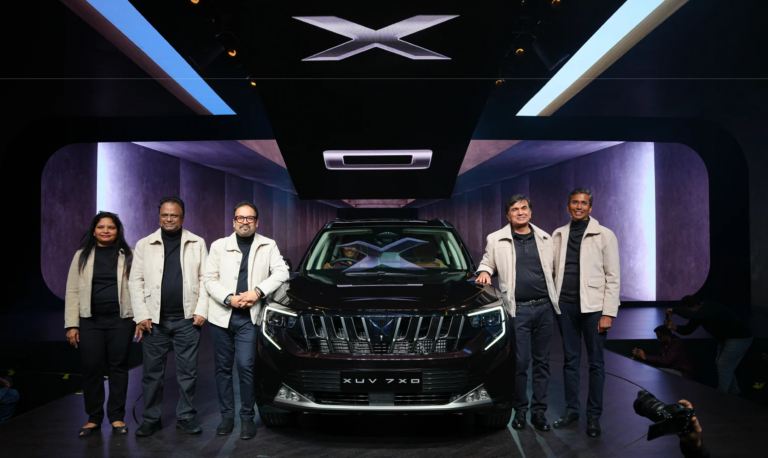
Mahindra’s XUV 7XO — the three-row flagship that replaced the XUV700 when it went on sale in January 2026 — earned a five-star rating today from Bharat NCAP, India’s government-backed crash-assessment program, scoring 30.76 out of 32 in adult occupant protection and 44.97 out of 49 in child occupant protection across both front-wheel-drive and all-wheel-drive configurations of its AX7 diesel-automatic variant (per Autocar Professional’s September 15, 2026 report on the result). The result gives buyers of a vehicle priced from ₹13.66 lakh (approximately $14,155) an independently verified crash-safety benchmark to stack against a class whose other leading models have not yet submitted to the same test.
What Bharat NCAP Actually Measures
Before the numbers carry full weight, the program behind them is worth understanding. Bharat NCAP — formally the Bharat New Car Assessment Programme — is India’s own crash-test authority, the 10th crash-assessment program worldwide, launched by the Ministry of Road Transport and Highways on August 22, 2023 and operational from October 1 of that year. It was built in partnership with Global NCAP, the international safety body, and evaluates M1-category passenger vehicles — those with up to eight seats and a gross weight under 3,500 kilograms (7,716 lbs).
The program is voluntary. Manufacturers pay to submit their vehicles and choose which variants are tested. The test protocol in use when the XUV 7XO was assessed — valid through September 30, 2027, after which a Bharat NCAP 2.0 framework expected to take effect — runs three main crash scenarios. A frontal offset deformable barrier test at 64 km/h (39.8 mph) at a 40% overlap stress-tests the driver-side structure in the most common real-world crash geometry. A mobile deformable barrier side-impact test at 50 km/h (31.1 mph) simulates a T-bone collision at moderate speed. A side pole test at 20 km/h (12.4 mph) evaluates protection against a narrow rigid object — a tree or lamp post — where energy concentrates in a small area and curtain airbag geometry is decisive.
It matters how this differs from minimum legal requirements. Bharat NCAP is explicitly designed to sit above India’s regulatory floor — its purpose is to show buyers which vehicles provide more than what Indian law requires, not which ones are legal to sell. A five-star result signals that a vehicle has been engineered with a deliberate safety margin above the minimum standard, and that an independent body rather than the manufacturer has verified it.
Numbers: What the XUV 7XO Scored
Bharat NCAP tested the XUV 7XO in its AX7 diesel-automatic configuration in both front-wheel-drive and all-wheel-drive configurations. Mahindra confirmed the rating covers the full range (per Autocar Professional, September 15, 2026).
Assessment
Score
Adult Occupant Protection (AOP)
30.76 / 32
Child Occupant Protection (COP)
44.97 / 49
Overall
⭐⭐⭐⭐⭐
In the frontal offset barrier test, the driver’s head, neck, pelvis, thighs, and feet all received “good” ratings; the chest and tibia were rated “adequate.” The co-driver matched those results, with tibiae also rated “adequate” (per Autocar Professional, September 15, 2026).
The standout result was the side movable deformable barrier test, where the XUV 7XO scored a perfect 16 out of 16 — every occupant zone, head through pelvis, rated “good.” The vehicle also received an “OK” rating in the side pole test. A perfect MDB score is meaningful: the mobile barrier scenario is among the most demanding in the protocol precisely because it replicates the physics of a car-to-car broadside impact, where energy transfer is high and door structure, B-pillar reinforcement, and curtain airbag coverage must all perform together (per Autocar Professional, September 15, 2026).
In child occupant protection, the XUV 7XO scored 23.97 out of 24 in the dynamic assessment, losing a negligible 0.03 points on the 18-month-old dummy’s frontal result. Rearward-facing child restraint systems for an 18-month-old dummy and a three-year-old dummy were both tested; the three-year-old dummy achieved a full 8 out of 8. Both dummies scored 4 out of 4 in the side crash. The vehicle earned full marks — 12 out of 12 — for child restraint system installation, losing four points in the vehicle assessment portion for a total COP of 44.97 out of 49 (per Autocar Professional, September 15, 2026).
What Is Level 2 ADAS — and What It Is Not
The XUV 7XO ships with a driver-assistance suite Mahindra markets as “Sense+” under its ADRENOX+ platform, incorporating 17 functions including adaptive cruise control, lane-keeping assist, automatic emergency braking, forward collision warning, lane departure warning, blind-spot monitoring, and driver drowsiness detection.
Mahindra classifies this as Level 2 per the SAE J3016 standard and taxonomy. That classification has a precise meaning that is frequently misunderstood: at SAE Level 2, the system can control both steering and speed simultaneously, but the human driver remains fully responsible for monitoring the environment and must be ready to take control immediately. Level 2 is not partial autonomy that relieves driver workload in traffic — it is partial automation that handles two mechanical sub-tasks at once while the driver’s attention obligation remains unchanged.
That distinction matters more in India than in most markets. A 2026 SAE Technical Paper — “Adapting ADAS to Indian Driving and User Needs” (SAE 2026-26-0045, Sankpal et al.) — examined ADAS performance on Indian roads and found a documented gap between how these systems are designed (largely based on structured Western traffic environments with consistent lane markings) and the conditions they encounter in India: lane ambiguity, unpredictable pedestrian movement, informal road practices, and a mix of vehicle types that no training dataset calibrated for European or American highways was built to handle. Qualcomm’s group general manager for automotive, Nakul Duggal, put the challenge plainly in a Qualcomm Snapdragon Auto Day interview: “Where traffic rules are not followed, you can’t train an AI model to figure out what to actually do.” Mahindra has acknowledged these limits directly — in July 2025, the company released a dedicated video series instructing owners of its BE6 and XEV 9e models not to rely on ADAS completely, citing the complexity of Indian road conditions.
The practical implication is not that Level 2 ADAS is worthless on Indian roads — automatic emergency braking, forward collision warning, and adaptive cruise control on well-marked highways are genuinely useful — but that a buyer should understand what the feature designation means before treating it as a meaningful reduction in the attention burden of Indian city driving. The Sense+ suite’s Dynamic Visualization feature, which Mahindra claims is a first in India for an ADAS Level 2 system, renders a real-time graphic of the system’s active decisions on the instrument cluster; that transparency about what the system is and is not doing is arguably more valuable for safety than the automation itself in mixed-traffic conditions.
The ADRENOX+ platform runs on a Qualcomm SA8155P chipset specification, which Mahindra says is the first deployment of this specific processor in an internal-combustion vehicle in India. The SA8155P is a third-generation automotive system-on-chip integrating an octa-core Kryo CPU, an Adreno 640 GPU, and a Hexagon 696 digital signal processor optimized for AI inference — the unit that handles real-time sensor fusion for the ADAS functions. The platform simultaneously drives three 12.3-inch high-definition screens spanning 31.24 inches (79.4 cm) coast-to-coast across the dashboard. Mahindra has since moved to the newer SA8295P chipset for its pure-electric BE6 and XEV 9e models.
How Does This Stack Against Rivals?
The XUV 7XO competes in the three-row mid-size segment primarily against the Tata Safari, the MG Hector Plus, and the Hyundai Alcazar.
The Tata Safari also holds Tata Safari’s five-star Bharat NCAP rating, making it the XUV 7XO’s nearest safety-certified rival in the segment. The Hyundai Alcazar and MG Hector Plus, as of this writing, have not published Bharat NCAP results — buyers comparing those models against the XUV 7XO cannot make a like-for-like safety comparison based on India’s domestic benchmark. That is not necessarily a negative verdict on those vehicles’ structural quality; it reflects that Bharat NCAP remains voluntary and manufacturers must choose to submit. But for buyers who weight independently verified crash data in their decision, the certification gap is real.
The XUV 7XO’s price range runs from ₹13.66 lakh (approximately $14,155) for the petrol base variant to ₹24.92 lakh (approximately $25,824) for the range-topping diesel automatic all-wheel-drive AX7L. It is available in six variants — AX, AX3, AX5, AX7, AX7T, and AX7L — with a 2.0-litre turbo-petrol producing 200 HP (148 kW) and a 2.2-litre diesel producing up to 185 HP (138 kW), both paired with six-speed manual or torque-converter automatic gearboxes. The diesel-automatic combination also offers all-wheel drive on higher trims — a capability not available on the Tata Safari, which is front-wheel-drive only.
Why This Rating Matters on Indian Roads
India recorded 1,77,175 road accident deaths in 2024 — approximately 485 people per day — according to the Ministry of Road Transport and Highways’ annual Road Accidents in India report. That rate, among the highest in the world by absolute numbers, makes vehicle crash safety a public health matter rather than purely a consumer specification.
Bharat NCAP was created specifically to raise the engineering standard for vehicles sold in India above the legal minimum, in a market where that gap has historically been significant. The program’s decision to remain voluntary rather than mandatory — unlike in some developed markets where regulatory bodies require independent crash assessment — means the value of a result like the XUV 7XO’s is partly in its signal value: a manufacturer that pays to submit its vehicle and publishes the result is revealing a level of structural confidence that the absence of testing cannot replicate.
The XUV700 Global NCAP five-star result, the predecessor model whose 2021 adult occupant result put Mahindra on the Indian safety map, built the benchmark that the XUV 7XO was explicitly engineered to meet or exceed under India’s own framework. With the result now confirmed, Mahindra has a lineage of independent verification running from the XUV700 to the Thar ROXX, XUV 3XO, and XUV400 EV — all five-star Bharat NCAP models per Mahindra’s Bharat NCAP safety milestone — through to the XUV 7XO.
The XUV 7XO crosses 70,000 units since its January 2026 launch — a monthly average of approximately 9,285 units that outpaces the XUV700’s best full calendar year. The breadth of that customer base means the safety margin confirmed today is not a niche premium outcome — it is a specification that tens of thousands of families bought, in a country where those margins materially determine survival outcomes in a crash.
Is There a Safety Floor Across the Range?
One of the notable aspects of the XUV 7XO’s specification is that Mahindra claims 75 safety features on base variant — not held back for higher trims. The variant tested by Bharat NCAP (AX7 diesel-automatic) is a mid-to-upper range configuration; Mahindra has stated the five-star rating applies across the entire range, implying the structural and passive safety architecture that drove the score is consistent regardless of trim.
The seven-airbag count — including a driver knee airbag — is present on higher variants. The base and lower trims carry six airbags as standard. Electronic Stability Control, ABS with EBD, and a 360-degree camera system (with an under-vehicle feed from the 540-degree array) are available across the range.
Currency conversions are approximate based on exchange rates at time of publication.
Frequently Asked Questions
What makes a perfect side-impact score in Bharat NCAP so hard to achieve?
The mobile deformable barrier side-impact test replicates a scenario where a car is struck broadside by another vehicle, concentrating a large amount of energy into the door structure, B-pillar, and side sill in a very short time. A perfect 16 out of 16 requires that head, chest, abdomen, and pelvis all receive “good” ratings — meaning the door structure held, the curtain airbag deployed correctly and maintained coverage, and the seat and restraint geometry kept the occupant away from the intruding structure. Vehicles that do not invest in B-pillar reinforcement or curtain airbag calibration often lose points on chest or abdomen because the torso absorbs door intrusion load that the structure should have absorbed first.
Does the five-star Bharat NCAP rating mean the XUV 7XO is safer than unrated rivals like the Hyundai Alcazar?
Not necessarily — it means the XUV 7XO has independently verified crash performance, while the Alcazar and Hector Plus have not published Bharat NCAP results. A vehicle that has not been tested is not the same as a vehicle that has been tested and failed. The absence of a rating is a gap in information for buyers, not a verdict on the vehicle’s engineering. That said, for buyers who require objective third-party crash data to compare two vehicles, the XUV 7XO offers a data point that its immediate rivals currently do not.
Does Level 2 ADAS on the XUV 7XO make driving meaningfully safer in Indian cities?
In structured highway conditions with clear lane markings, the Sense+ system’s adaptive cruise control, lane-keeping assist, and automatic emergency braking provide real safety benefit. In dense urban traffic, mixed-vehicle environments, and roads without consistent lane markings — which is the majority of the driving experience for most XUV 7XO owners — the Level 2 designation means the driver remains fully responsible for monitoring the environment. A 2026 SAE study confirmed the gap between how these systems are designed and how Indian roads actually behave. Mahindra has issued guidance to its ADAS vehicle owners not to over-rely on the system. Treat the Sense+ suite as a driver aid that helps on good roads rather than a hands-free capability.
Will this rating still apply after Bharat NCAP 2.0 launches?
The current Bharat NCAP framework is valid through September 30, 2027. The XUV 7XO’s five-star result was earned under that protocol. Bharat NCAP 2.0 — currently in draft — proposes a significantly expanded 100-point system adding vulnerable road user protection, post-crash safety, and additional crash test scenarios including female and child dummies. Under that new protocol, the XUV 7XO would need to be retested to carry an updated star rating; the current result would remain valid as a historical benchmark but may not reflect performance under the new, more demanding criteria.