HomeAuto Magnetic Filtering in Birth Cloud May Explain Sun’s Rocky-Element Deficit vs Solar Twins
Magnetic Filtering in Birth Cloud May Explain Sun’s Rocky-Element Deficit vs Solar Twins
November 1, 2026:
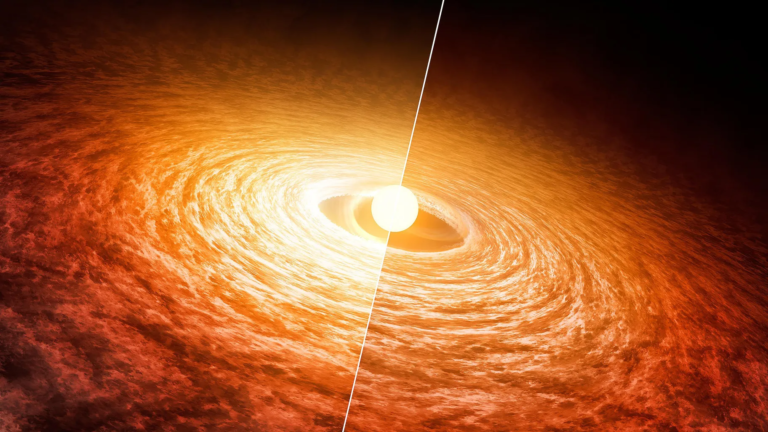
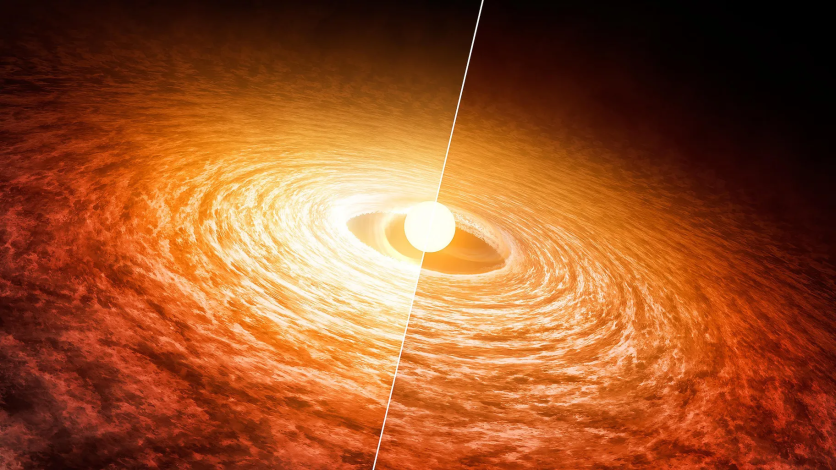
This two-toned image shows an illustration of the protoplanetary disk around the young star FU Orionis, which was imaged multiple times by infrared observatories such as Spitzer and SOFIA, but years apart. The disk has changed, indicating that it’s entering a more advanced stage of evolution, as planets form and the material available for forming and growing them evaporates, sublimates, and is otherwise blown away. Planets and the central star are all expected to orbit and rotate in the same direction; only collisions and interactions should change that story. Our own Solar System likely had a similar history to the protoplanetary system illustrated here. Nasa.gov
For nearly two decades, astronomers comparing the Sun against its closest stellar cousins have found the same quiet discrepancy: the Sun is systematically depleted in rock-forming elements — calcium, aluminum, titanium, chromium, manganese, scandium — relative to roughly 80 to 85 percent of the stars that most closely resemble it, a pattern first documented by Meléndez and collaborators in a landmark 2009 study. The depletion is small in absolute terms, roughly 10 to 20 percent for the most refractory species, but it is systematic, it correlates precisely with how high a temperature each element condenses from a gas, and it has resisted every planet-formation explanation thrown at it for nearly seventeen years.
A new hypothesis presented this past week at the 58th Annual Meeting of the Division for Planetary Sciences in Spokane, Washington may finally explain it — and the explanation does not involve planets at all. According to the model, the Sun is depleted in rocky materials because magnetic fields in the molecular cloud where the Sun was born held those materials back before they ever had a chance to fall onto the forming star. The same mechanism, if confirmed, would imply that the Sun formed considerably closer to the center of the Milky Way than its current position — and that every other star formed in a magnetized cloud carries an equally biased chemical record.
Rocky Elements, Condensation Temperature, and a Puzzle That Has Outlasted Multiple Explanations
The category of elements at issue — refractories — is defined by condensation temperature (Tc), the temperature below which a given element transitions from gas to solid in cooling protostellar material. Elements with Tc above roughly 900 Kelvin (1,160°F), such as calcium, aluminum, titanium, chromium, manganese, scandium, and vanadium, remain solid at high temperatures; volatile elements with lower Tc, such as carbon, nitrogen, oxygen, sulfur, and zinc, more readily stay gaseous.
The key observation, carefully documented by Meléndez and collaborators in 2009, is that the Sun’s deficit tracks the condensation temperature of each element — the higher the Tc, the more depleted the Sun is relative to its twins. That specific correlation is what the community has been calling a “fingerprint,” and it is what demands a physical explanation rather than statistical noise.
The most intuitive early explanation was also the most appealing: terrestrial planets and asteroids sequestered the refractory material, locking it away from the Sun’s convective envelope before the disk cleared. The math was roughly compatible — adding back a few Earth-masses of rocky material to the Sun would bring its composition into alignment with the typical solar twin. But the hypothesis ran into trouble. If terrestrial planet formation depleted the Sun, solar twins that host their own rocky planets should show similar depletions — and they mostly do not.
Booth and Owen proposed a more sophisticated planetary mechanism in 2020: a forming giant planet could trap refractory-rich dust exterior to its orbit, starving the inner disk and the growing protostar of rocky material. That model achieved a better statistical match to the prevalence of refractory-depleted solar twins, which roughly tracks the occurrence rate of Jupiter-analog planets. But it too has faced challenges — and a separate line of research has complicated the picture further.
Rampalli and colleagues found in a 2024 analysis that galactic chemical evolution — the systematic enrichment of interstellar gas in heavy elements across cosmic time and galactic location — accounts for the vast majority of the variation seen in refractory depletion trends among solar analogs, leaving the residual anomaly considerably smaller than raw comparisons suggest. A 2025 follow-up by Rampalli extended this work further. The debate over how much of the Sun’s depletion is genuinely anomalous — versus an artifact of not correcting for where each star formed in the galaxy — has continued.
Magnetic Braking in the Birth Cloud: How Charged Dust Grains Get Left Behind
At DPS 58, Steven Desch, a planetary scientist at Arizona State University’s School of Earth and Space Exploration, proposed a mechanism that operates at a step earlier than any of the planet-formation hypotheses — not in the protoplanetary disk, but in the molecular cloud itself, before disk or protostar had formed.
The mechanism turns on a well-characterized property of magnetized molecular clouds called the mass-to-magnetic-flux ratio. When this ratio falls below a critical threshold — when the magnetic field is strong enough relative to the cloud’s self-gravity — the field resists gravitational collapse. This is the state known as a magnetically subcritical cloud: the cloud cannot freely collapse inward along the magnetic field lines, and material must instead slowly diffuse across them through a process called ambipolar diffusion, in which neutral gas gradually decouples from the ions and charged grains that remain locked to the field, as Price and Bate demonstrated for magnetized star-forming regions.
The refractory-chemistry consequence of this setup is a size-dependent filtration effect. Small, electrically charged dust grains — which are the primary solid-phase carriers of refractory elements like calcium, aluminum, and titanium — are tightly coupled to the magnetic field lines via gyration forces. In a collapsing subcritical cloud, they are preferentially held back as the denser neutral gas falls inward. Larger dust grains are less tightly coupled, less impeded by the magnetic field, and can fall inward more readily along with the neutral material.
Because refractories are preferentially concentrated in the small charged-grain fraction, their selective magnetic retention means the star that forms from the collapsing cloud accretes a mix that has been systematically shorted on rocky material — not because planets stole it, but because magnetic field lines acted as a filter at the cloud level before any planet existed.
Desch’s team modeled this effect across a range of cloud mass-to-flux ratios and compared the predicted distribution of refractory depletions against the observed spread among solar twins. Kerry Hensley’s AAS Nova summary of the DPS 58 conference reported that the model produced refractory depletion values spanning the full range observed among solar twins, including a value consistent with the Sun’s own observed deficit.
Does Magnetic Filtering Point the Sun’s Birthplace Deep in the Milky Way?
The shift from a planet-formation explanation to a magnetic-accretion one reopens a question about the Sun’s galactic birthplace that had seemed partly settled.
The Milky Way carries a well-characterized negative metallicity gradient, with stars and gas in the inner galaxy being systematically more metal-rich than those in the outer disk. The gradient runs approximately −0.07 to −0.08 dex per kiloparsec in iron abundance. If researchers try to infer the Sun’s birth location from its photospheric metallicity — essentially asking “where in the disk would we expect to find a cloud with the Sun’s chemical composition?” — they get an estimate that assumes the Sun’s surface composition faithfully records what its birth cloud contained.
But Desch’s mechanism suggests it does not. If magnetic fields suppressed refractory accretion, the Sun’s birth cloud was richer in rocky elements than the Sun’s photosphere now shows. A more metal-rich cloud implies a location further inward in the galaxy, where higher metallicity is the norm under the galactic gradient. As the AAS Nova DPS recap explained, if most stars are depleted in refractories relative to their birth clouds, the Sun could have originated considerably closer to the galactic center than standard photospheric estimates imply.
This aligns with a growing independent body of evidence that has been building apart from the refractory-depletion debate. A 2022 study led by Yuxi Lucy Lu and collaborators, using stellar ages and metallicities from a large sample of Milky Way disk subgiants, estimated that the Sun was born at approximately 4.5 kiloparsecs (about 14,700 light-years) from the galactic center — considerably closer than the Sun’s current orbit of about 8 kiloparsecs (roughly 26,100 light-years) from the center. Earlier work by Ivan Minchev and colleagues at the Leibniz Institute for Astrophysics Potsdam produced an estimate of around 7.3 kiloparsecs (about 23,800 light-years).
In March 2026, Daisuke Taniguchi’s team at Tokyo Metropolitan University published two papers in Astronomy & Astrophysics arguing, based on a Gaia-derived catalog of solar twins, that the Sun originally formed more than 10,000 light-years closer to the galactic center and migrated outward with a cohort of thousands of stellar lookalikes roughly 4 to 6 billion years ago — possibly swept outward by the formation of the Milky Way’s central bar structure. That bar, which formed 4 to 6 billion years ago, now constitutes a gravitational barrier that prevents inner-galaxy stars from migrating outward — which is consistent with the timing of the proposed migration.
Desch’s magnetic-field mechanism provides a new physical basis for these inward-origin calculations. If photospheric compositions systematically understate parent-cloud metallicities, then the galactic metallicity gradient points birth locations further inward than stellar spectra alone would imply.
If Magnetic Filtering Is Universal, Stellar Birth-Radius Models Need Revision Across the Galaxy
The broadest implication of the result, if confirmed, extends well beyond the Sun’s biography. The magnetic accretion suppression mechanism would apply to any star forming in a magnetized molecular cloud — and most star formation in the Milky Way occurs in environments where magnetic fields play central roles in cluster and protostellar dynamics.
That would mean photospheric metallicities across the disk are systematically biased downward relative to the clouds that produced them, with the magnitude of the bias depending on local magnetic field strength at the time of formation. The consequence for galactic chemical evolution models is significant: these models typically assume that stellar surface compositions faithfully record birth-cloud metallicities. If magnetic filtering is common, every birth-radius estimate derived from stellar metallicity and the galactic gradient needs a systematic inward correction — not just for the Sun, but across the stellar census.
The AAS Nova conference summary noted that this result “has not yet been incorporated into models of star formation” and that if stars broadly do not match the metallicity of their parent molecular clouds, the implications for how the field understands the relationship between interstellar chemistry and stellar composition would be substantial.
The hypothesis also adds a new physical layer to the ongoing debate about whether the Sun’s refractory depletion is genuinely anomalous. If magnetic field strength varies across the galaxy — and it does, with inner-galaxy molecular clouds generally exhibiting stronger fields than outer-disk counterparts — then the prevalence of refractory-depleted solar twins in the solar neighborhood could partially reflect the magnetic environments in which those stars formed, not just their planet formation histories or uncorrected galactic chemical evolution effects.
Waiting for Peer Review: A Conference Hypothesis Still Needs Testing
The refractory-depletion question is seventeen years old by Desch’s own accounting, and the magnetic field proposal does not immediately close it. The DPS 58 presentation was a conference talk, not a peer-reviewed publication; the mechanism will need to be tested against a broader observational base and evaluated by the stellar physics and star formation communities.
What the model does change is the framing of the question. Instead of asking what happened to the Sun’s missing refractory material after the solar system formed — planets, giant planet dust traps, galactic chemistry — Desch’s hypothesis asks whether that material ever arrived in the first place. The answer, the model suggests, is that magnetic fields in the parent molecular cloud filtered out the fine refractory dust before it could fall onto the forming protostar.
If the filtering was real, then what the Sun’s photosphere carries is not a complete inventory of what its birth cloud contained. It is a receipt for what arrived after magnetic gates had already done their sorting. And those gates, the evidence increasingly suggests, were set somewhere considerably closer to the center of the Milky Way than the address the Sun holds today.
Frequently Asked Questions
Why does the Sun have less calcium, titanium, and other rocky elements than similar stars?
That has been one of the quieter unsolved questions in solar science since 2009. The short answer is that nobody has confirmed the cause — but the leading new hypothesis, presented at the 58th Division for Planetary Sciences meeting in Spokane this week, is that magnetic fields in the Sun’s birth cloud selectively held back the small electrically charged dust grains that carry those elements. The grains were tightly coupled to the cloud’s magnetic field lines and were preferentially filtered out as the cloud collapsed to form the Sun. The result: the Sun accreted a mix already depleted in rock-forming materials, with no planet required to explain the missing inventory.
Where in the Milky Way was the Sun born?
Current estimates point to the inner disk, considerably closer to the galactic center than the Sun’s current position at about 8 kiloparsecs (roughly 26,100 light-years). A 2022 study by Lu and colleagues estimated the Sun’s birth radius at about 4.5 kiloparsecs (about 14,700 light-years); a 2026 study by Taniguchi and colleagues at Tokyo Metropolitan University concluded the Sun migrated more than 10,000 light-years outward from the inner disk roughly 4 to 6 billion years ago, possibly when the Milky Way’s central bar formed. The magnetic filtering hypothesis strengthens these inward estimates: if the Sun’s surface composition understates its birth cloud’s metallicity, the galactic metallicity gradient points its birthplace even further inward than photospheric data alone suggest.
If stellar surface chemistry doesn’t faithfully record birth-cloud composition, what does that mean for galactic evolution models?
It could mean significant revision across the field. Galactic chemical evolution models, which track how heavy elements built up across the Milky Way over time, typically assume that a star’s photospheric metallicity faithfully records the composition of the cloud that formed it. If magnetic filtering systematically biases that record downward — and the degree of bias depends on local magnetic field strength — then all birth-radius estimates derived from stellar metallicity and the galactic radial gradient carry a systematic inward error. The Sun would be one data point in a galaxy-wide set of mislabeled chemical histories. According to the AAS Nova summary of the DPS 58 presentation, this finding had not yet been reflected in existing models of star formation.
Is this hypothesis confirmed?
Not yet. The magnetic filtering model was presented as a conference talk at DPS 58, not as a peer-reviewed paper. The model reproduced the observed spread in refractory depletions among solar twins, including a value matching the Sun, but it will need to be tested against the broader stellar physics and star formation literature before the community can assess it. The coincidence between the magnetic-filtering prediction and the independently derived estimates for the Sun’s inner-galaxy birth radius is striking — but striking coincidences in science require more than a conference poster to become established fact.