HomeAuto Magical Girl Refuses Her Destiny: Mercury Filmworks Animated Ep Now Free on YouTube
Magical Girl Refuses Her Destiny: Mercury Filmworks Animated Ep Now Free on YouTube
September 6, 2026:
Mercuryfilmworks.com
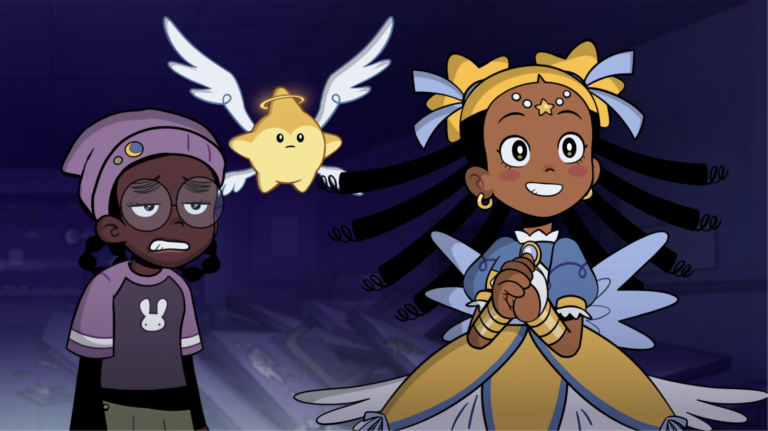
Aika is fifteen years old, Black and Japanese, and exhausted in a way most magical girl heroines are never permitted to be. She did not choose her cosmic obligations. She was assigned them at an age when meaningful consent was impossible, and she has been carrying them ever since — not with sparkle and purpose, but with the flat, mechanical efficiency of someone clocking in at a job she cannot quit. That premise, which creator Kiana Khansmith has said draws directly from her own experience as a storyboard artist in the professional animation industry — including time at Disney, a company whose brand is literally built on the promise that wishing upon a star is enough — is what makes Pretty Pretty Please I Don’t Want to Be a Magical Girl the most precise portrait of occupational burnout in animation history. And as of September 4, 2026, that portrait is available free on YouTube, fully animated and produced by Mercury Filmworks — the Emmy Award-winning Canadian studio behind Hilda, The Ghost and Molly McGee, and Centaurworld.
The World Health Organization formally classified burnout as an occupational phenomenon in 2019, placing it in the eleventh revision of the International Classification of Diseases. The WHO was careful to specify that burnout is an organizational problem, not an individual one — the result of chronic workplace stress that the system failed to manage, not a personal weakness of the person experiencing it. Aika’s case maps onto this framework with uncomfortable precision: she was not given a choice, she was not provided an exit, and the magical girl apparatus around her — represented most directly by her earnest, star-shaped sidekick Hoshi — consistently treats her reluctance as a logistical inconvenience rather than a legitimate claim on her own time and selfhood.
The Fully Animated Episode Is Out: And It Is Free Right Now
The fully animated version of Episode 1, titled “I Don’t Want to Be a Magical Girl,” arrived on Khansmith’s YouTube channel on September 4, 2026. The episode runs approximately 11 minutes and carries a TV-14 rating. No subscription is required. The episode is the product of a partnership announced at the end of the Episode 2 animatic in January 2026, in which Mercury Filmworks committed to bringing Khansmith’s original storyboard-based animatic to full professional animation.
The original animatic — a cleaned-up storyboard sequence with voice acting and timing but without full motion animation — premiered on February 28, 2025, and accumulated 4.9 million views by December of that year. That figure is remarkable for an independently produced 11-minute animation with no network backing, no theatrical release, and no streaming platform deal. The series originated as experimental portfolio work — character concepts posted to Tumblr in August 2024 that attracted a committed community of fans who made art, posted theories, and lobbied for more.
Mercury Filmworks’ decision to fully animate the pilot was announced, characteristically, not through a press release but at the end of the Episode 2 animatic’s credits — a detail that an 11 million-subscriber studio would not do, and that an indie creator-community relationship makes entirely natural. Emily Brundige, creator of Goldie on Apple TV+ and head writer on Hilda — the series that established Mercury Filmworks’ reputation for emotionally sophisticated 2D character animation — described it in a piece spotlighting Khansmith as something that would “blow your minds.”
What the Magical Girl Genre Is, and Why This Series Subverts It
The magical girl genre — known in Japanese as mahou shoujo (魔法少女, “magic girl”) — dates to 1962 with the manga Himitsu no Akko-chan and the 1966 anime Sally the Witch, which established the template of a young girl with magical powers and a hidden heroic identity. Sailor Moon (1992) gave that template its most influential form: the elaborate transformation sequence, the team of guardians, the cosmic mandate, and romance as the reward for sacrifice. Every element of Pretty Pretty Please I Don’t Want to Be a Magical Girl is a response to Sailor Moon’s conventions — built by someone who loves the genre enough to tell it an uncomfortable truth about itself.
The most important element of any mahou shoujo narrative is the henshin (変身) — the transformation sequence in which the heroine transitions from her civilian identity to her heroic alter ego. In canonical series from Sailor Moon to the Precure franchise, this is a slow, elaborate, often sexually coded visual ritual. The anthropologist Arnold van Gennep described rites of passage as a three-phase structure — separation, liminality, and incorporation — in which the liminal moment is where genuine transformation occurs: the individual is “betwixt and between,” neither who they were nor who they will become. Victor Turner extended the model in The Ritual Process (1969) and observed that liminality is where new possibilities are invited. In the mahou shoujo henshin, that liminal space — elaborated visually and temporally — is how the audience witnesses a young woman choosing her heroic identity.
Pretty Pretty Please I Don’t Want to Be a Magical Girl abolishes the liminal moment entirely. Aika’s transformation is instantaneous: she pops into her magical girl outfit with the emotional register of someone putting on a coat to go outside. There is no threshold experience. There are no new possibilities being invited. The sociologist Erving Goffman, in Encounters (1961), coined the term “role distance in social performance” — the performative gap between the self and the role being enacted, communicated through flat affect and mechanical execution. Aika’s flat, bored transformation is textbook Goffman: she is performing the role of magical girl while every element of her performance signals that she has not identified with it for a long time.
The episode’s most striking formal choice follows from this logic. The one extended, visually elaborate sequence in the episode — the one that gets the temporal and aesthetic treatment that Sailor Moon devotes to transformation — is Aika’s de-transformation back into civilian clothes. The message is unambiguous: her authentic self is the ordinary girl, not the guardian. The magic is the costume. The girl underneath is the one who matters.
Aika’s World, Aika’s Opponents, and the Lead Pipe
For readers encountering the series for the first time through the fully animated episode: here is what you need to know about who Aika is and why she is worth an hour of your attention.
Aika is a 15-year-old girl whose family background is Black and Japanese, with Japanese as her first language. She narrates her first day at a new high school with the gleeful optimism of someone trying very hard to manifest a normal life. She is, she insists, “a normal girl of average talent and zero secrets.” This is obviously untrue. Her star-shaped sidekick Hoshi — an angelic being who can phase through solid matter and grants her access to magical weapons by “wishing upon a star” — appears outside her classroom window almost immediately. Aika has, in fact, imprisoned Hoshi inside a magical containment box, and an argument about this in the school bathroom forms the episode’s first major comic setpiece.
The containment box does not hold. It never does. Aika’s self-proclaimed “rival” villain Eclipse — armed with a moon staff and a confidence that outpaces his current skill level — bursts through a cafeteria wall looking for the Star Guardian. Aika’s new friend Zira, an awkward self-described loser whose entire personality is organized around her devotion to an in-universe manga called Moon Sailor (an obvious Sailor Moon parallel that generates quiet dramatic irony throughout the episode), attempts to shield Aika from Eclipse’s attack.
This forces Aika’s hand. She transforms — instantaneously, joylessly. She invokes Hoshi’s wish-granting power. The weapon that manifests is a lead pipe. Aika efficiently kneecaps Eclipse and sends him limping away. The episode closes with Eclipse reporting to the enigmatic Lady DeVoid, who is pleased that Aika has been located.
The tonal register is dark comedy built on deep genre affection. The show is not making fun of magical girls — it is taking their emotional reality seriously in a way the genre rarely permits itself to do. Zira, who has dedicated her identity to loving magical girl fiction, does not know she is best friends with a real one. That is not played for laughs so much as for the specific bittersweet ache of loving something that does not love itself back the way you need it to.
Khansmith has confirmed that the series’ core question — “how hard do you fight for an old passion, or at what point do you just let it go?” — is unresolved by design. That question is what makes the show genuinely interesting rather than merely clever.
What Self-Determination Theory Says About Why Aika Feels This Way
Research on intrinsic motivation — engagement in an activity for its own inherent satisfaction — consistently shows that tasks begun from genuine internal desire become burdens when external pressure, repetition, and consequences calcify around them. Edward Deci and Richard Ryan at the University of Rochester developed Self-Determination Theory over decades of research, establishing that the shift from autonomous to controlled motivation (I do this because I have to) is the primary mechanism through which burnout occurs. The 2017 neuroscience research by Di Domenico and Ryan confirmed that intrinsically motivated behaviors are underpinned by dopaminergic systems — making the loss of intrinsic motivation a measurable biological as well as psychological state.
Aika exhibits what the Maslach Burnout Inventory dimensions — the field’s standard clinical instrument, developed by Christina Maslach and Susan Jackson in 1981 — define as all three burnout dimensions: emotional exhaustion (she is visibly drained by the expectation that she will continue), depersonalization (she treats Eclipse’s attacks with flat affect and mechanical efficiency, like a problem to be processed rather than a battle to be won), and reduced personal accomplishment (defeating Eclipse produces nothing in her — no satisfaction, no pride, no sense of purpose). Her genuine delight at befriending Zira — someone with no expectations of her, who loves her before knowing what she is — reads in this framework as a clinically recognizable hunger for unconditional regard: human connection that is not contingent on performance.
The specific shape of Aika’s burnout matters. She was not allowed to choose this role. She was assigned it, at fifteen, without consultation. Research on what psychologists call “early selection” — the phenomenon of identifying and training individuals for demanding vocations before they can meaningfully consent — shows consistent patterns: exceptional competence coexisting with motivational hollowness, and the erosion of the capacity to want anything except the removal of obligation. Elite athletes selected for intensive training in childhood, child prodigies groomed for specific performance careers — the literature is consistent. You can be very good at something you no longer wish you had ever been asked to be good at.
Aika’s cry of “I’m fifteen! Unless it’s a minimum-wage cashier job, I should not be working!” is the series’ thesis statement disguised as a joke.
Why Blasian Representation Matters in This Specific Genre
Khansmith has made the representational argument her casting enacts explicit. Making Aika Black and Japanese — blasian — with Japanese as her first language, and casting Eclipse as a Black character explicitly described as a “Black love interest,” is a deliberate intervention in a genre whose racial politics are overdue for examination.
The mahou shoujo genre, despite its Japanese origins, has historically centered heroines whose racial presentation is ambiguous, often coded in Western localizations as effectively white. American adaptations of Sailor Moon, for instance, removed much of the Japanese cultural specificity that grounded the original. A genre built around themes of hidden power, cosmic obligation, and the tension between ordinary girlhood and exceptional destiny has no inherent reason to restrict those themes to any particular cultural presentation. Khansmith’s argument, enacted by the casting itself, is that the genre’s symbolic architecture is available to any girl who has ever been asked to be more than she wanted to be — and that a Black and Japanese American girl navigating both cultural inheritances while refusing a cosmic mandate is not a departure from the magical girl tradition. She is its rightful heir.
The genre has been moving in this direction. The academic literature on blasian identity in media notes that blasian representation has grown substantially since the mid-2010s, and that the most significant development is the shift from blasian characters as peripheral figures to blasian characters as protagonists whose identity is treated as simply who they are, not as a plot point requiring explanation. Aika’s ethnicity is never a plot point. It is just who she is. That is the more radical choice.
How Mercury Filmworks Changed What Indie Animation Can Become
The production history of Pretty Pretty Please I Don’t Want to Be a Magical Girl is itself a story about what the creator economy has made possible — and what professional studio partnerships now look like when the power dynamic has been reversed.
The traditional animation pipeline runs from institutional top to individual bottom: a network or streaming platform funds a concept, a studio produces it, the creator is hired into a structure that already exists. What happened with PPPIDWTBAMG inverted that structure entirely. Khansmith built a community first — on Tumblr, then on YouTube, accumulating 4.9 million views on a proof-of-concept animatic with no institutional backing. Mercury Filmworks, one of the most acclaimed 2D animation studios in North America, came to her. The studio did not fund the concept; it joined a creator who had already demonstrated the concept was viable.
YouTube’s 2026 Animation Trends report, published in April 2026, confirmed this as a broader structural shift: 61% of animation fans between the ages of 14 and 24 prefer content from independent creators over major studio output, and 57% of that demographic watches animatics on a weekly basis. The animatic — once an internal production tool, a rough sketch that preceded the real work — has become a complete entertainment format in its own right. PPPIDWTBAMG is the most prominent case study in that transition.
Mercury Filmworks brings to this partnership a specific kind of expertise: Mercury Filmworks Emmy Award history in expressive character animation, fluid motion, and tonal sophistication honed on projects like Hilda — a series praised precisely for its ability to communicate complex emotional states through character performance. For a show whose comedy depends entirely on the precision of Aika’s body language — the specific degree of her boredom, the exact flatness of her transformation — that expertise is not just an upgrade. It is the technical foundation that allows the series’ central joke to land.
Does This Mean Aika Will Get More Episodes?
The third episode is currently listed as in development, with no release date announced. Justin Carter writing in Gizmodo, in February 2026 after the Episode 2 animatic aired, observed that the Mercury Filmworks partnership could be “a soft launch for a full series or…little one-and-done” — suggesting even the studio relationship does not resolve the question of whether this becomes a conventional series.
That uncertainty is, in a way, appropriate. The show is about a girl who does not know whether to fight for a vocation that once meant everything to her or to let it go. Its creator built it out of the experience of doing exactly that. Whether it becomes a full series or remains a beautiful, compact thing — the answer is still in development.
What is settled is that the fully animated Episode 1 is available now, for free, with no account required. It runs 11 minutes.
Frequently Asked Questions
Where can I watch the fully animated Pretty Pretty Please I Don’t Want to Be a Magical Girl?
The fully animated Episode 1 is available free on YouTube on Kiana Khansmith’s channel. No subscription, account, or payment is required. The episode premiered on September 4, 2026, and runs approximately 11 minutes with a TV-14 rating. The original animatic and Episode 2 animatic are also available free on the same channel.
The show is described as a deconstruction of the magical girl genre; what does that mean in practice?
In genre terms, a deconstruction takes the conventions of an established form and interrogates what those conventions actually mean, or what they cost. Pretty Pretty Please I Don’t Want to Be a Magical Girl does this by taking the most iconic element of magical girl anime — the henshin, or transformation sequence — and draining it of all ceremony. Where Sailor Moon’s transformation into her heroic identity is a slow, elaborate ritual signaling a chosen identity, Aika’s is instantaneous and joyless. The WHO’s 2019 ICD-11 classification of occupational burnout maps almost precisely onto Aika’s situation: she is exhausted, cynical about her duties, and derives no sense of accomplishment from performing them. The show’s argument is that the magical girl genre’s conventions — chosen destiny, cosmic obligation, the transformation as identity embrace — have always been an idealized version of something that, in real life, looks like being assigned a demanding job without being asked. Self-Determination Theory research by Ryan and Deci establishes that this shift from intrinsic to controlled motivation is precisely the mechanism by which burnout occurs.
Why does the show make Aika a blasian protagonist specifically?
Creator Kiana Khansmith has been direct about this choice: it is a correction to the magical girl genre’s historical centering of light-skinned, ambiguously East Asian heroines, and a deliberate expansion of whose story the genre’s symbolic structure can hold. Aika is Black and Japanese, with Japanese as her first language, and that identity is never treated as unusual or in need of explanation within the series. Academic scholarship on blasian identity in media notes that the most significant recent shift is exactly this — from blasian characters as peripheral or explained figures to blasian characters as simply protagonists. Khansmith has also confirmed the importance of this representational choice in interviews, noting that Eclipse is explicitly described as a “Black love interest” — a pairing that remains rare in anime-influenced animation.
What framework does the show use to think about burnout, and is it accurate?
The show uses what psychologists would recognize as the framework of Self-Determination Theory: Aika’s problem is the shift from intrinsic motivation (she once loved being a magical girl) to controlled motivation (she does it now because she has no legitimate exit). Ryan and Deci’s research established that this shift is the primary mechanism of burnout, and the WHO’s ICD-11 classification placed the responsibility on the organization — the system that creates and maintains the obligation — rather than the individual experiencing it. In Aika’s case, that organization is the magical girl apparatus itself: the one that assigned her a cosmic mandate at fifteen without consulting her. The show’s accuracy lies not in the stellar physics of Hoshi’s wish-granting but in the emotional logic of what happens to someone who was selected for an extraordinary role before they could choose whether they wanted it.