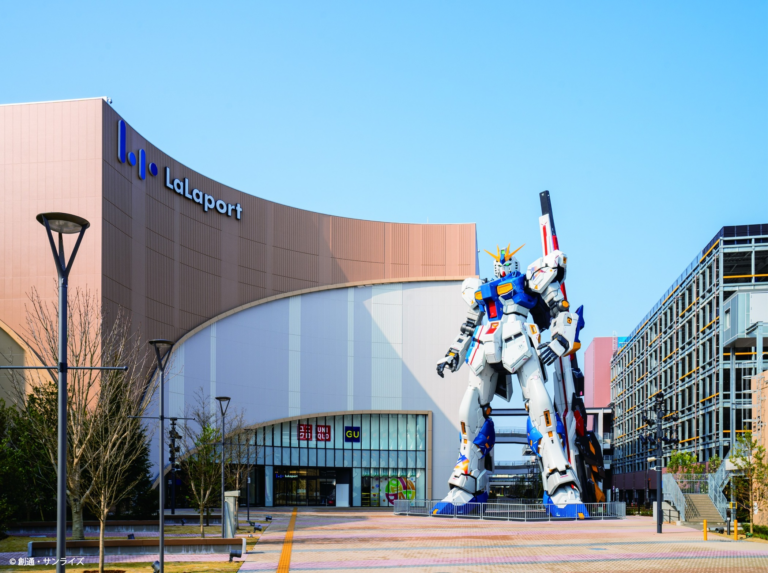
August 31, 2026:


Today, August 31, 2026, marks the final day of public display for the RX-0 Unicorn Gundam statue at DiverCity Tokyo Plaza in Odaiba — closing an unbroken 17-year chapter of life-sized Gundam presence in one of Tokyo’s most distinctive waterfront districts. For fans of Mobile Suit Gundam worldwide, today is less an ending than a stage-clearing: Bandai Namco spent the same May 2026 conference that announced the Unicorn’s retirement unveiling the most ambitious franchise roadmap in years, building toward the series’ 50th anniversary in 2029.
To understand what closes today, it helps to start with what came before it. A life-sized Gundam has stood on Odaiba’s waterfront continuously since 2009 — first the original RX-78-2, then the Unicorn.
The RX-78-2 arrived at Shiokaze Park in July 2009 to mark the franchise’s 30th anniversary. It proved an immediate cultural event, drawing more than four million visitors in just 52 days. After a stint in Shizuoka, it relocated to DiverCity Tokyo Plaza in 2012. When contractors dismantled it in March 2017 — beginning by removing the head and left arm in deliberate homage to the “Last Shooting” pose from the original anime — the act was widely recognized as a tribute rather than a mere demolition.
The Unicorn Gundam was announced as its successor at the same time — chosen, in Bandai Namco’s own framing at the time, partly because the Unicorn recognized more internationally than the original RX-78-2. The Unicorn debuted at DiverCity’s Festival Plaza on September 24, 2017, with a formal public unveiling ceremony the following day.
The Unicorn Gundam statue is not simply a large sculpture. Standing 19.7 meters (64.6 feet) tall and weighing 49 tons, it is assembled from 230 separate parts, with its exterior panels constructed from glass fiber reinforced plastic (GFRP) — a material chosen for its combination of structural strength and relative lightness. The lower section was manufactured in Bangkok, Thailand; the upper section was molded in Tokyo.
What distinguished it from the earlier RX-78-2 was theatrical ambition. The statue mechanically transforms between “Unicorn Mode” — its default white silhouette — and “Destroy Mode,” in which 50 illuminated components light up to reveal the red psycho-frame elements that the anime character activates in combat. The transformation runs four times daily at 11:00, 13:00, 15:00, and 17:00 Japan Standard Time, with evening projection shows from 19:30 to 21:30 JST casting Gundam anime footage across the facade of DiverCity itself.
The mechanism behind those movements has an unexpectedly traditional lineage. According to Masaki Kawahara, the production director who oversaw the statue’s construction, the bunraku puppet theater techniques behind the transformation systems — the same mechanical principles his company developed in the Meiji period for automaton mechanics in stage productions and cuckoo clocks. “If you think about it, the Unicorn statue is just a modern day Cuckoo clock,” Kawahara said in a 2018 interview. “When the clock strikes a specific time, the whole statue moves.” Guinness World Records recognized the statue as the world’s largest animated statue globally on the basis of its transforming capability.
The statue’s final months have carried a quietly elegiac quality. A mechanical malfunction in June 2025 forced a temporary suspension of transformation shows; operations resumed partially on June 9, 2025, but with limitations on shoulder movements that have remained in place since. A 49-ton mech going out not at its peak but slightly weathered and constrained is, somehow, appropriate for the send-off of something that had become, over nine years, genuinely lived-in.
The Unicorn Gundam occupied an unusual position among major pop-culture attractions: it was free, permanently visible, and accessible at any hour. Where franchise theme parks and ticketed venues draw fans willing to pay for proximity, the Unicorn asked nothing of anyone who wanted to stand beneath it. That structural characteristic — more civic monument than commercial attraction — gradually transformed it into what academics studying Japanese urban culture would recognize as a seichi junrei site: an anime pilgrimage destination.
The Japan Tourism Agency formally recognized anime pilgrimage tourism as a national infrastructure priority in its 2012 “Basic Plan for the Promotion of a Tourism Nation,” and the Development Bank of Japan highlighted it as a rural revitalization lever in 2017. The Unicorn Gundam, as a free permanent installation, represented the publicly funded end of that spectrum — a pilgrimage site that charged nothing. Academics studying Tokyo’s creative economy have noted it specifically. The 2020 book “Creativity in Tokyo: Revitalizing a Mature City” (Ursic and Imai, Springer Nature) cited the statue as an example of “mixing popular culture and consumption” in Odaiba’s identity.
Anime tourism across Asia is now growing at extraordinary speed. Trip.com data released in 2026 recorded a 195 percent year-over-year surge in searches for anime-related travel experiences across Asia. The Unicorn Gundam’s retirement lands at precisely the moment demand for anime landmark travel is at its highest recorded level.
The statue’s final months have included a series of deliberate farewell gestures. From June 20, 2026 through today, the statue has worn newly designed “finale version” decal decorations created by Hajime Katoki, the mechanical designer behind the Unicorn Gundam. A Gundam Stamp Rally 2026 ran across six spots in the Odaiba waterfront district, giving fans a structured farewell pilgrimage across the neighborhood that has hosted Gundam’s physical presence since 2009.
For anyone who can reach DiverCity Tokyo Plaza today, the Gundam Base Tokyo store in the same mall remains an independent destination. The statue stands in Festival Plaza on DiverCity’s second floor at 1-1-10 Aomi, Koto City, Tokyo. Daiba Station on the Yurikamome line and Tokyo Teleport Station on the Rinkai line are both approximately a five-minute walk away.
When Bandai Namco announced the Unicorn’s retirement at Gundam Conference SPRING 2026 on May 15, 2026, the company offered no reason for the removal beyond the end of its planned display run and confirmed no successor statue for the Odaiba site. But the conference framed the retirement as part of a larger restructuring rather than a conclusion: the same session announced the most extensive build-up project in the franchise’s history.
The 50th anniversary roadmap, targeting 2029 — the year the original Mobile Suit Gundam first broadcast on April 7, 1979 — includes: A full remaster of the 1979 Mobile Suit Gundam series, planned for global release in 2029. A dedicated Yoshiyuki Tomino exhibition at the Tokyo National Museum in 2029. “Gundam-Con,” a new annual convention event, beginning January 9–11, 2027 at Makuhari Messe in Chiba. April 7, 2029 officially designated as “Gundam Day” — recognized by the Japan Anniversary Association. And the Gundam Landmark Project: described as “a new big project, a facility that is planned to be built in Japan for fans from all over the world.”
The Landmark Project has no confirmed location, format, or opening date. But the Yokohama precedent is instructive: when Gundam Factory Yokohama closed on March 31, 2024, after three years of operation as home to the world’s first large-scale moving Gundam — which briefly held two Guinness World Records — its physical components were repurposed and rebuilt as an approximately 17-meter statue at the Gundam Next Future Pavilion during Osaka Kansai Expo 2025, which ran April 13 through October 13, 2025. What Bandai Namco retires tends to reappear.
The scale of what surrounds the Unicorn’s departure clarifies why Bandai Namco chose this moment for a reset. Since the franchise’s debut on April 7, 1979, Gundam has produced more than 90 titles across anime, manga, games, and music. Gunpla — the plastic model kit line that has defined Gundam’s commercial ecosystem since the early 1980s — has surpassed 800 million cumulative shipments globally. The mobile game SD Gundam G Generation Eternal, released in 2025, exceeded eight million downloads worldwide in its first year.
The 50th anniversary tagline Bandai Namco chose — “Your FIRST Starts Here” — signals that its primary goal for 2029 is not congratulating existing fans but bringing new ones into a franchise that now spans nearly five decades. The physical landmark has always served that function alongside its emotional one: the original RX-78-2 at Shiokaze Park drew more than four million visitors in its first 52 days, many of whom had no prior relationship with Gundam. The Gundam Landmark Project, whatever form it takes, will need to replicate that conversion capacity.
There is a specific category of Japanese landmark that is difficult to translate: free, slightly oversized for its context, and more meaningful than its premise reasonably allows. The Tetsujin 28-go statue in Kobe belongs to this category. So did the walking Gundam at Gundam Factory Yokohama. These are pop-culture monuments that the cities around them gradually treated as actual civic infrastructure rather than temporary marketing exercises.
The Unicorn Gundam spent nine years becoming that. Anime tourists planned international trips around it. Office workers from Koto Ward took lunch breaks near it. Fans who had seen it dozens of times returned for one more visit this August. Every night, a 49-ton mecha unfolded armor panels in front of crowds who had often arrived hours early. That quality — fandom made physical and communal, free to anyone who walked over — is not easily manufactured on commission.
Odaiba will be without a life-sized Gundam for the first time since 2009 once today’s final show concludes. Whatever Bandai Namco plants here next will have enormous footprints to fill.
Bandai Namco has not confirmed any replacement statue for the DiverCity Tokyo Plaza site. The company announced the Gundam Landmark Project at Gundam Conference SPRING 2026 — described as a new permanent facility in Japan designed for fans from around the world — but no location, format, or opening date has been disclosed. The Yokohama precedent, in which the moving Gundam’s components were repurposed for Osaka Expo 2025, suggests Bandai Namco tends to find new homes for its retired physical installations rather than retiring them permanently.
The Gundam Landmark Project is a new facility announced by Bandai Namco at Gundam Conference SPRING 2026 in May 2026, as part of the franchise’s build-up to its 50th anniversary in 2029. Bandai Namco described it as a permanent facility in Japan intended to attract international visitors. As of today, no specific location, design details, or opening timeline have been confirmed publicly. The Landmark Project sits alongside several other announced anniversary initiatives: a 1979 series remaster, a Yoshiyuki Tomino exhibition at the Tokyo National Museum, and the inaugural Gundam-Con event in January 2027.
The Unicorn Gundam’s signature shift from “Unicorn Mode” to “Destroy Mode” was achieved through mechanical actuators controlling 50 separately illuminated armor panel components. The transformation sequence — which expands the head horn, reconfigures the face panels, and opens the shoulder, waist, and knee armor to reveal red psycho-frame elements — was engineered by Masaki Kawahara’s production company using techniques drawn from traditional Japanese bunraku puppet theater. The same mechanical lineage that produced Meiji-era automaton clockwork powered the horn extension. A malfunction in June 2025 permanently limited the shoulder movement range in the statue’s final year of operation.
Bandai Namco has not announced specific plans for the Unicorn Gundam statue’s physical components after its retirement from DiverCity Tokyo Plaza. When Gundam Factory Yokohama closed in March 2024, the moving Gundam’s structural elements were repurposed and rebuilt as a new static installation at the Gundam Next Future Pavilion at Osaka Kansai Expo 2025. Whether a similar reuse applies to the Unicorn’s components has not been confirmed.