HomeAuto Kyrgyzstan Launched First Satellite for $130,000: SpaceX Rideshare Rewrites National Space Economics
Kyrgyzstan Launched First Satellite for $130,000: SpaceX Rideshare Rewrites National Space Economics
October 4, 2026:
PATRICK T. FALLON/AFP via Getty Images
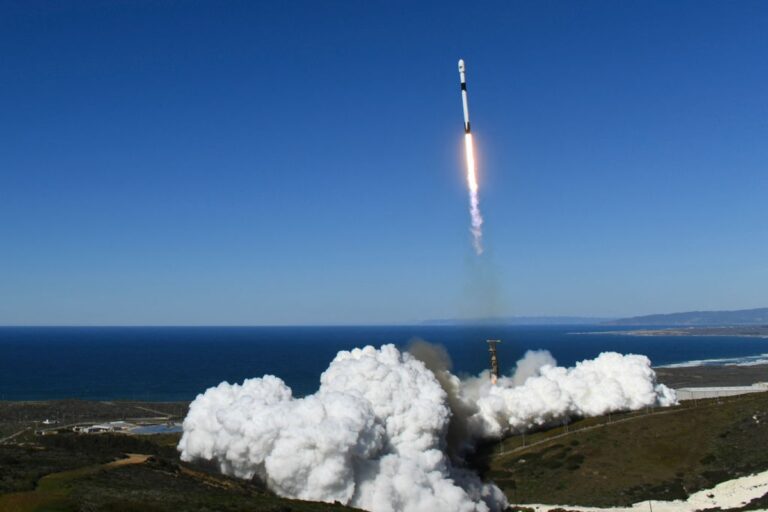
On October 1, 2026, at 2:32 p.m. ET (18:32 UTC), a SpaceX Falcon 9 rocket lifted off from Space Launch Complex 4 East at Vandenberg Space Force Base in California, carrying 130 payloads into sun-synchronous low Earth orbit. Tucked among that crowded manifest was a 5-kilogram (11-pound) spacecraft assembled by roughly ten engineers at a state-connected technology company in Bishkek — Kyrgyzstan’s first satellite, and the country’s entry into the short list of nations that have put their own hardware in orbit.
The launch, the 18th in SpaceX’s Transporter dedicated rideshare series, made Kyrgyzstan a spacefaring nation for the first time in its history. The satellite was built for between 10 and 12 million Kyrgyz som — approximately $114,000 to $137,000 USD — over two and a half years. That price tag, remarkable for a piece of national space infrastructure, is a direct consequence of how the commercial rideshare market has transformed the economics of orbit.
A Bread-Loaf-Sized Spacecraft With National Significance
The satellite is a nanosatellite — by international classification, a spacecraft massing 1 to 10 kilograms — and was built and assembled at Kyrgyz Electronics JSC, a state-connected manufacturer at the historic Lenin Plant in Bishkek that previously made computers and cash registers. A team of approximately ten engineers spent about two and a half years on the project, according to reporting from Times of Central Asia and regional sources citing the Kyrgyz Agriculture Ministry.
Ilya Cherny, the director of Kyrgyz Electronics, acknowledged that “most of the technologies” incorporated into the spacecraft are of Russian origin — a pragmatic choice, he said, because developing satellite systems entirely from scratch would take five to ten years and far more resources. The project also involved cooperation with the United Arab Emirates, though the specific nature of that partnership — technical, financial, or both — has not been detailed publicly by either government.
The satellite carries high-resolution cameras and sensors for Earth observation. Its primary stated mission is agricultural: imagery collected from orbit will help monitor crop conditions, detect early signs of drought and frost risk, track water distribution, and assess the health of Kyrgyzstan’s pastures and forests. Given the country’s geography — landlocked and heavily mountainous, with rivers and irrigation systems directly dependent on Tian Shan glacier melt — monitoring glacial retreat is a second major stated priority. The satellite data is also intended to flag illegal mining operations, unauthorized waste sites, and other environmental violations that are difficult to document from the ground. It will be operated from a ground control center in Bishkek, keeping day-to-day mission management under Kyrgyz control.
The satellite has an estimated operational lifespan of 15 years. Details on the satellite’s specifications, including build cost and technical parameters, have been confirmed by Kyrgyz state sources and regional media.
Deputy Prime Minister Erlist Akunbekov, who presented the spacecraft publicly in Bishkek on September 24, framed the mission as a generational shift: “Previously, Kyrgyz Electronics used to assemble regular computers and cash registers. But today we are reaching a fundamentally new level.”
President Sadyr Japarov — who has also led Kyrgyzstan’s parallel effort to bring Starlink satellite internet into the country’s mountainous regions, signing a decree authorizing a Starlink pilot project for non-geostationary satellite internet — attended the launch ceremony at Vandenberg in person as part of a working visit to the United States.
How the Machine That Made This Possible Works
The Transporter program, which launched its inaugural mission in January 2021 by deploying a then-record 143 satellites on a single Falcon 9, has fundamentally restructured who can access orbit. SpaceX’s published entry price for the program is $350,000 for up to 50 kilograms (110 pounds) to sun-synchronous orbit, with additional mass priced at $7,000 per kilogram ($3,175 per pound), according to Exolaunch’s mission documentation. For the Kyrgyz satellite — which massed approximately 5 kilograms — the launch slot would represent a small fraction of the satellite’s total build cost, not the dominant expense.
The engineering mechanism behind that price is the Falcon 9 Block 5’s reusable first stage. The booster that flew Transporter-18, designated B1082, completed its 25th flight on the mission before returning to land at Vandenberg’s Landing Zone 4 — its seventh-minute controlled descent audible as sonic booms across the Central Coast. Reusing the most expensive part of the vehicle up to 25 or more times is what enables the Transporter entry price to exist. Without that economics, a comparable dedicated launch would list at roughly $70 million.
The “sun-synchronous” in how sun-synchronous orbit works is the other technical element that makes Earth observation nanosatellites practical. The orbit — at approximately 500 kilometers (310 miles) altitude, with an inclination of about 97 degrees — precesses at the same rate as Earth’s annual orbit around the Sun, so the satellite crosses any given point on the surface at the same local solar time every pass. Consistent solar illumination is essential for repeatable optical imaging: a satellite that passes over Kyrgyzstan’s Tian Shan range at 10 a.m. local time on every orbit will find the same shadow geometry in each image, making multi-temporal change detection — tracking glacier retreat across months, monitoring crop stress through the growing season — meaningfully accurate.
Research published in Scientific Reports has shown that nanosatellite-based multispectral imagers can produce near-daily, approximately 3-meter-resolution (10-foot) crop evaporation estimates — sufficient to support precision irrigation and yield forecasting. The Kyrgyz satellite’s camera payload will operate within that proven technical envelope.
Transporter-18 itself was a particularly active day for SpaceX. The launch was the second of three Falcon missions that day, following the Crew-13 crewed mission to the International Space Station at 11:10 a.m. ET and preceding a Falcon Heavy carrying the classified NROL-97 payload for the National Reconnaissance Office, which lifted off from the Kennedy Space Center later that night. Other notable payloads on Transporter-18 included Google’s Project Suncatcher prototype — designed to test tensor processing units in the space radiation environment — and Starfish Space’s first Otter satellite servicing vehicle.
Data Sovereignty: Why Central Asian States Want Their Own Orbital Infrastructure
The agricultural and environmental rationale is genuine, but it is not the complete picture. Dr. Nelly Bekus, a Central Asia specialist at the University of Exeter, told RFE/RL that “in recent years, as geopolitical tensions have increased worldwide, independent access to satellite data operated by national teams has also become increasingly important for state security.” She added that “spacefaring capabilities have long been associated with ideas of progressive nationhood, providing highly visible evidence of a nation’s technological prowess and its standing on the world stage.”
The security dimension runs deeper than imagery. When Central Asian governments operate their own satellites, they control their own data pipeline — they do not need to purchase access from a foreign commercial provider who could, in principle, restrict it. Analysts studying the region have noted that some authoritarian governments explicitly value satellite infrastructure as insurance against dependence on foreign communications systems during periods of civil unrest.
Uzbekistan’s government has stated explicitly that its planned domestic satellite — under development for a 2028 launch — will ensure “a sovereign and objective source of information.” Kazakhstan shut off the country’s internet nationwide during mass protests in early 2022 and, when it later negotiated with SpaceX over Starlink access for rural populations, reached an impasse over a Kazakh requirement that all ground stations be built inside the country — allowing Astana to maintain physical control over the signal infrastructure. That standoff illustrates exactly what owning domestic satellite infrastructure avoids: a negotiating position where the foreign provider holds the off switch.
Kyrgyzstan’s satellite, built with Russian technology components and deployed through a UAE partnership, sits within this same regional dynamic — a small state acquiring a data-collection capability that it owns, operates, and cannot have withdrawn by a foreign government or corporation.
A Region Reaching for Orbit
Kazakhstan, the region’s largest economy, has operated its own satellites for years and is home to the Baikonur Cosmodrome — the world’s first and largest operational launch facility, leased from Russia — and in September 2026 announced plans to build an international constellation of up to nine Earth observation satellites involving Mongolia, the Republic of the Congo, and Nigeria. Uzbekistan launched the Samarkand-2028 hyperspectral Earth observation satellite in August 2026 — a Chinese-built Samarkand-2028 satellite carrying an artificial intelligence module developed by specialists from the Uzbekcosmos agency. Uzbekistan’s own domestically developed scientific satellite, Mirzo Ulugbek, is being built with engineering support from Japan’s Kyushu Institute of Technology, according to regional reporting.
For Kyrgyzstan — a landlocked nation of roughly seven million people whose GDP places it among lower-middle-income post-Soviet economies — the ability to field a functional Earth observation satellite for approximately $114,000 to $137,000 in total build cost would have been implausible even a decade ago. That it is now achievable is a direct consequence of the commercial rideshare market SpaceX created, which has lowered the price of a kilogram to sun-synchronous orbit to a level that nation-states with modest budgets can realistically afford.
Whether the satellite fulfills its agricultural and environmental promises remains to be seen. But as a demonstration that national orbital Earth observation is no longer the exclusive domain of large economies and their military contractors, Kyrgyzstan’s first satellite is a concrete and specific data point.
Frequently Asked Questions
What will Kyrgyzstan’s satellite actually do in orbit?
The satellite carries cameras and sensors for multispectral Earth observation from a sun-synchronous orbit at approximately 500 kilometers (310 miles) altitude. It is designed to pass over the same ground locations at the same local solar time on each orbit, producing consistent imagery for change detection. Its stated missions include monitoring crop health and water stress, tracking glacier retreat in the Tian Shan range (which feeds Kyrgyzstan’s irrigation systems), assessing pasture and forest conditions, and helping authorities identify illegal mining operations and unauthorized waste sites. Data will be processed at a ground control center in Bishkek.
How much does it actually cost to launch a satellite on SpaceX’s Transporter rideshare?
SpaceX’s published 2026 entry price for its Transporter rideshare program to sun-synchronous orbit is $350,000 for up to 50 kilograms (110 pounds), with additional mass priced at $7,000 per kilogram. For a 5-kilogram nanosatellite like Kyrgyzstan’s, the launch slot itself represents a fraction of the satellite’s reported total build cost of approximately 10 to 12 million Kyrgyz som ($114,000 to $137,000 USD at current exchange rates). The hardware cost was the dominant expense — not the rocket ride. Full pricing details are available through SpaceX rideshare program documentation.
Why do Central Asian governments want their own satellites rather than buying data from commercial providers?
Independent satellite infrastructure gives a government control over its own data pipeline — it cannot be cut off by a foreign provider, restricted during a geopolitical crisis, or made conditional on accepting ground-station arrangements dictated by an outside party. Analysts studying the region note that Central Asian governments view satellite independence as a sovereignty tool, not just an agricultural efficiency measure. Uzbekistan has explicitly stated that its planned domestic satellite will ensure “a sovereign and objective source of information,” and Kazakhstan’s Starlink negotiations broke down over a requirement to maintain domestic physical control of ground stations.
What makes a nanosatellite useful for agriculture if its cameras are smaller than commercial satellites?
Sun-synchronous nanosatellites compensate for smaller optics with frequent revisit and consistent lighting. Because the orbit’s geometry guarantees the same local solar time on every pass, multispectral imagery from successive orbits can be compared directly — the lighting is controlled, the only variable is what changed on the ground. Research using CubeSat-class satellites has demonstrated near-daily, approximately 3-meter (10-foot) resolution estimates of crop water use sufficient to inform precision irrigation. For a country the size of Kyrgyzstan, a single satellite in this orbit provides sufficient coverage frequency for the agricultural and glacier monitoring applications described.