HomeAuto Korea Antitrust Hits Crossroads: KFTC Escalates Coupang Probe as Courts Overturn Platform Fines
Korea Antitrust Hits Crossroads: KFTC Escalates Coupang Probe as Courts Overturn Platform Fines
September 5, 2026:
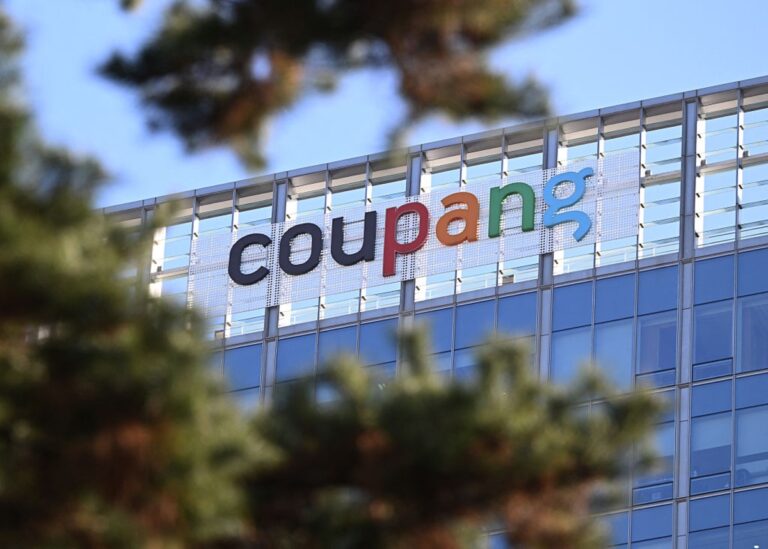
A general view shows the logo of South Korean online delivery service Coupang, at a building housing the headquarters of Coupang in Seoul on December 9, 2025. Jung Yeon-je/AFP via Getty Images
South Korea’s competition watchdog launched yet another investigation into e-commerce giant Coupang on September 1, 2026 — the latest escalation in a regulatory campaign that a joint academic seminar, convened the following day in Seoul, argued is structurally misconceived. The central charge from scholars and legal experts: the Korea Fair Trade Commission is punishing platform companies for how they behave rather than for what that behavior actually does to markets, and Korea’s own highest court has already said, in a landmark ruling last October, that it agrees.
The “Platform Company Regulation: Assessment and Alternatives” seminar, co-hosted by the Korea Center for Free Enterprise and Citizens for Good Regulation at Pureun Hall in Seoul, used Coupang’s mounting legal exposure as the clearest illustration of a systemic problem: enforcement that can pile sanction upon sanction without being required to demonstrate, in any individual case, that competition was actually restricted or that consumers were actually harmed.
Coupang’s Regulatory Pile-Up: What the Numbers Look Like
The scale of Coupang’s regulatory exposure illustrates the problem the seminar was convened to address. The company simultaneously faces a KRW 140 billion (approximately $103 million) fine and criminal referral from the KFTC over allegations that it manipulated in-app search rankings to favor its own private-label products — the largest fine ever imposed on a single Korean retailer. It also faces a separate KRW 642.6 billion (approximately $473 million) penalty from the Personal Information Protection Commission related to a data breach affecting 33.7 million customers. On September 1, a new KFTC investigation was opened into alleged abuse of market dominance and interference with rival businesses — the third major probe in less than two months, following the company’s extraordinary refusal to allow a separate KFTC onsite inspection in August.
KAIST Business School emeritus professor Lee Byung-tae, who delivered the keynote, argued that this accumulation of overlapping sanctions should be read not as evidence of Coupang’s guilt but as a symptom of a regulatory framework that has lost coherence. The question, he said, is not whether any individual agency has legal authority to act — most do — but whether the aggregate of their actions represents proportionate enforcement grounded in evidence of competitive harm.
Conduct vs. Effects: The Evidentiary Standard at Stake
The seminar’s central reform proposal would reorient Korean platform enforcement from a conduct-based approach — where regulators can sanction specific categories of behavior once they have established that the behavior occurred — to an effects-based standard, requiring authorities to demonstrate that the conduct actually restricted competition or reduced consumer welfare before penalties are applied.
The distinction has significant practical consequences. Under the existing regime, an algorithm that surfaces a retailer’s own products can be treated as illegal self-preferencing the moment it is documented. Under an effects-based standard, the same algorithm would only be actionable if regulators could show it meaningfully foreclosed rivals from the market or left consumers with fewer choices and higher prices. The Information Technology and Innovation Foundation has analyzed self-preferencing’s ambiguous competitive effects, finding the practice often benefits consumers rather than harming them.
Professor Lee drew a pointed comparison with offline retail: placing high-margin private-label products in premium shelf positions is standard practice in brick-and-mortar supermarkets globally, and it is not presumed anticompetitive in the absence of evidence that shoppers are worse off. He criticized the KFTC’s enforcement as having imposed sanctions “based on the conduct itself, without sufficient basis for concluding that consumer welfare was negatively affected.”
He also identified structural concerns about the KFTC: the commission combines investigative and adjudicative functions in a single body, an arrangement that critics have long argued creates due-process risks. Sungkyunkwan University Law School emeritus professor Choi June-sun had made a similar argument publicly in June 2024, calling the record fine “hasty and unfair” and noting that the commission had yet to prove the alleged conduct had harmed consumer benefits.
Korean Courts Have Already Moved
The seminar’s reform call lands at an unusual moment: Korea’s judiciary appears to be independently reaching the same destination, through case law, faster than legislators or the KFTC.
In October 2025, the Supreme Court of Korea fully reversed and remanded a Seoul High Court ruling that had upheld the KFTC’s KRW 26.6 billion (approximately $19.6 million) fine against Naver for alleged search self-preferencing. The court found no violation of Korean competition law, overturning both the agency’s 2020 decision and the lower court. Its reasoning was explicitly effects-based: the KFTC had not demonstrated that Naver’s ranking algorithm actually restricted market competition or harmed competitors in a causally documented way. Competition law scholar Sangyun Lee described the ruling as a resounding KFTC defeat and wrote that it represented “one of the most significant pushbacks against the government’s recent pursuit of the EU’s regulatory approach.”
In February 2025, the Supreme Court acquitted Yogiyo of criminal charges related to its minimum-price guarantee policy, finding the company lacked the requisite intent to violate antitrust law — another case where demonstrated harm, not mere conduct, was the threshold the prosecution failed to clear.
Most recently, on July 14, 2026, the Seoul High Court suspended the KFTC’s designation of Coupang founder Bom Kim as the company’s “same person” — the dongil-in mechanism used to trace ultimate control of Korean conglomerates — pending a ruling in the main case. It was the first time such a designation had been suspended by a Korean court. The court found no evidence that suspension would harm public welfare, an implicit judgment that the designation’s legal basis was, at minimum, contestable.
The pattern across these three cases is the same: courts applying traditional Korean competition law principles have found the KFTC’s evidence of harm insufficient. The seminar’s reform proposal would codify that standard legislatively.
Four Behaviors, Ambiguous Effects
Kangwon National University economics professor Jeong Hoe-sang analyzed the four categories of platform conduct that Korea’s proposed Online Platform Act seeks to prohibit. His finding was that none produces uniformly negative effects on consumer welfare.
Self-preferencing, he argued, can in some circumstances reduce prices when it allows a platform to internalize distribution costs. Tying and bundling, commonly associated with exclusionary practices, can equally deliver consumers cheaper package deals and lower barriers for new entrants. He pointed to Coupang Eats’ entry into the food delivery market — then divided between incumbent platforms Baemin and Yogiyo — as an example of a new platform challenger successfully competing against established players, complicating any blanket narrative about platform dominance foreclosing competition.
The appropriate response to these behaviors, Jeong concluded, is case-by-case assessment requiring proof of restriction — not categorical prohibition.
Does Korea Need Korea’s Version of Europe’s Rules?
Dongguk University economics professor Ji In-yeop presented empirical findings on the Digital Markets Act’s impact in the European Union, analyzing data from 1,034 startup investment transactions across 27 member states. His research found that the introduction of the DMA was associated with a decline in new company formation and investment volumes in Europe, with revenues in the EU services sector estimated to have contracted by between 0.05 and 0.64 percent over the period studied.
Ji also cited analysis showing that when Apple reduced fees in response to DMA compliance requirements, more than 86 percent of the resulting financial benefit flowed to app developers located outside the EU — raising questions about whose competitive interests the regulation ultimately served.
The EU enacted its Digital Markets Act in 2022, imposing a set of ex ante behavioral obligations on designated “gatekeeper” platforms — large companies that function as essential intermediaries between businesses and consumers — without requiring regulators to demonstrate harm in each individual case. Korea’s regulatory debate has long been framed around whether to adopt a similar approach or to rely on case-by-case effects analysis.
Ji’s argument was directed at Korean policymakers: the competitive dynamics of Korea’s platform market differ materially from those of the EU, where the absence of domestic tech giants prompted a more interventionist stance. Applying European architecture to a market with strong domestic platforms like Naver, Kakao, and Coupang could generate similar distortions without the same justification.
Does How It Feels Inside the Regulator Matter?
Beyond the evidentiary standard debate, several panelists called for institutional changes to the KFTC itself. Professor Lee recommended formally separating the commission’s investigative and adjudicative arms — a structural reform that would make the KFTC’s process more consistent with due-process standards applied in courts. He also called for codifying attorney-client privilege rights during KFTC investigations and unwinding the dongil-in designation system for companies structured as U.S.-listed public corporations, where the original chaebol-era rationale — tracing private benefits within a family-controlled group — does not straightforwardly apply.
Lee further proposed a broader rethink of corporate criminal liability in Korea, noting that more than 2,200 criminal penalty provisions are currently applicable to corporate managers under Korean law. He argued that the overwhelming majority should be converted from criminal to administrative or civil liability, reserving criminal prosecution for the most egregious cases. The KFTC’s June 2024 criminal referral of Coupang executives illustrates why critics see this as urgent: it has created friction with the United States, where members of Congress described the referrals as “discriminatory attacks on American technology companies.”
Kwangwoon University public administration professor Kim Joo-chan, who co-chairs Citizens for Good Regulation, framed the reform agenda through what he called “13 conditions for good regulation,” among which he emphasized that rules should maximize net public benefit, be grounded in scientific evidence, avoid redundancy with existing enforcement, impose the minimum interference necessary, and not hinder innovation.
Applying those criteria to platform enforcement, Kim argued that algorithmic regulation should target demonstrably deceptive practices and genuine competitive exclusion — not self-preferencing as a category.
What It Means for Naver, Kakao, and Coupang
The seminar’s conclusions carry direct implications for Korea’s three largest platform companies, all of which have faced KFTC scrutiny and all of which would benefit from a legal standard that places the burden of demonstrating competitive harm on regulators rather than presuming it from conduct. Naver’s self-preferencing case is back at the Seoul High Court for a re-hearing following the Supreme Court’s October 2025 reversal; the new proceedings began April 30, 2026.
The KFTC has historically defended its conduct-based approach as necessary given the speed with which digital markets can tip irreversibly toward monopoly — and the difficulty of proving downstream harm before it becomes entrenched. By the time an effects test can be satisfied, regulators argue, market power may already be permanent.
The academic counter is that this logic proves too much: it authorizes sanctions on the mere possibility of harm, which is indistinguishable from authorizing sanctions on innovation itself. A court willing to reverse a record fine because the KFTC failed to prove harm is, in effect, telling the regulator that speed and precaution are not substitutes for evidence.
How Should the Question About Consumer Harm Be Answered?
The debate will not be resolved by a single seminar. But the accumulation of judicial defeats — Naver’s Supreme Court reversal, Yogiyo’s criminal acquittal, and the dongil-in suspension — has given the effects-based reform movement something it previously lacked: proof that Korean courts, operating under existing competition law, are already applying its standard.
Whether the KFTC adjusts its enforcement posture, and whether the National Assembly codifies an effects-based standard in the proposed Online Platform Act, will determine whether Korea’s platform regulation converges toward the U.S. rule-of-reason model or holds to a version of the EU’s pre-emptive gatekeeper approach. That choice will be watched closely across Asia and in Washington, where the treatment of U.S.-listed Coupang has already become a trade-policy flashpoint.
Frequently Asked Questions
What is the effects-based antitrust standard, and how does it differ from Korea’s current approach?
The effects-based standard requires regulators to demonstrate that a specific business practice actually restricted competition or reduced consumer welfare before they can impose penalties. Korea’s current enforcement approach has generally been conduct-based: regulators document that a prohibited behavior occurred — such as self-preferencing an algorithm — and that documentation is largely sufficient to justify sanctions without a separate showing of harm. The U.S. antitrust system has long applied an effects-based “rule of reason” in most cases; the EU’s Digital Markets Act takes the opposite approach, imposing categorical obligations on designated gatekeeper platforms without case-by-case harm analysis. The seminar argued, and Korea’s Supreme Court suggested in the Naver Shopping ruling of October 2025, that effects-based reasoning better protects both innovation and consumer welfare.
What did Korea’s Supreme Court actually rule in the Naver Shopping self-preferencing case?
In October 2025, the Supreme Court of Korea fully reversed a Seoul High Court ruling that had upheld the KFTC’s fine against Naver for allegedly manipulating its shopping-search algorithm to favor its own marketplace. The court found no violation of Korean competition law, overturning both the agency’s 2020 decision and the lower court’s 2022 affirmation. The ruling explicitly rejected a general obligation of “equal treatment” for platform operators and held that the KFTC had not established the causal connection between the ranking design and anticompetitive intent or measurable market harm that Korean competition law requires. The case returned to the Seoul High Court for re-hearing, which opened April 30, 2026.
What is the “same person” designation and why did a court freeze it for Coupang?
The dongil-in (same person or “same natural person”) rule is a Korean fair trade mechanism designed to identify the individual who ultimately controls a large business group, subjecting that person to enhanced disclosure and governance requirements. It was originally designed for family-controlled conglomerates. The KFTC applied it to Coupang founder Bom Kim in April 2026, following a finding that his younger brother’s management role at the company’s Korean operations meant Coupang no longer qualified for the corporate-entity exemption. The Seoul High Court suspended the designation in July 2026 — the first time such a designation had been suspended by a Korean court — finding an urgent need to prevent irreparable harm to the applicants and no evidence that suspension would harm public welfare. Critics at the seminar argued the rule was not designed for a U.S.-listed public company with transparent ownership and should not be applied to one.
Could the EU Digital Markets Act model work in Korea?
The seminar’s evidence suggests serious caution is warranted. Professor Ji In-yeop’s research on 1,034 startup investment transactions across the EU’s 27 member states found that DMA-linked regulation correlated with declining new company formation and a contraction in services-sector revenues of between 0.05 and 0.64 percent. Additional analysis of Apple’s DMA-driven fee reductions showed that more than 86 percent of the financial benefit accrued to developers outside the EU. The argument for adapting rather than transplanting European rules is partly structural: unlike the EU, where regulatory intervention was partly motivated by the absence of strong domestic platforms, Korea already has competitive domestic incumbents in search, commerce, and logistics whose responses to pre-emptive regulation may be more complex than a simple leveling-of-the-playing-field story suggests.