HomeAuto Knight of the Seven Kingdoms Season 2 Survived Real Floods Filming Fictional Drought
Knight of the Seven Kingdoms Season 2 Survived Real Floods Filming Fictional Drought
September 15, 2026:
Hbo.com
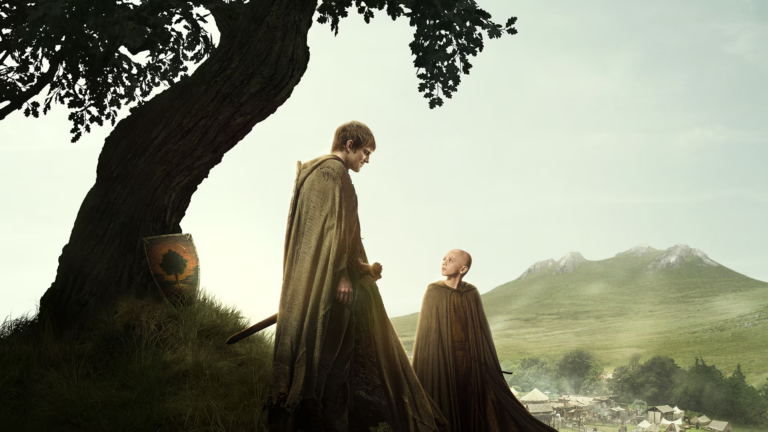
At the 78th Emmy Awards on Sunday night, the stars of HBO’s most surprisingly resonant fantasy series walked the red carpet with a production war story that could have come straight from the novella they were adapting. Peter Claffey, who plays hedge knight Ser Duncan “Dunk” the Tall, and Dexter Sol Ansell, 11, who plays the secretly royal squire Egg, both confirmed that filming for A Knight of the Seven Kingdoms Season 2 has wrapped — and that what they shot is the most demanding work of their careers. According to Entertainment Tonight, Claffey described the experience as “the trickiest second album,” while Ansell called it the most challenging and rewarding project of his life.
Showrunner Ira Parker put it more plainly, telling James Hibberd in a July interview on Season 2 filming challenges: “This has been a brutal, brutal season.”
Season 2, which is expected to premiere in the first half of 2027 on HBO and Max, adapts The Sworn Sword — the second of George R.R. Martin’s three Tales of Dunk and Egg novellas, originally published in 2003. What it is about, and why it is as timely as any episode of television scheduled for next year, turns out to be inseparable from what nearly derailed its production.
What The Sworn Sword Is Actually About
The Sworn Sword is a story about a drought.
Set approximately a year and a half after the events of Season 1’s Hedge Knight adaptation, it follows Dunk and Egg after they take employment under Ser Eustace Osgrey (played in Season 2 by veteran actor Peter Mullan), an aging, cash-poor landed knight whose modest tower in the Reach sits in the middle of a years-long dry spell. Among the cast of The Sworn Sword adaptation, Lucy Boynton plays Lady Rohanne Webber — the “Red Widow” — on whose estate a stream that both lords depend on has shrunk to a contested trickle. Ser Bennis of the Brown Shield, played by Babou Ceesay, arrives to complicate matters further.
What begins as a provincial property squabble quickly becomes something more: a collision between feudal obligations and personal conscience, played out over who controls a body of water that everyone needs to survive.
Claffey told The Playlist that the tone shift in Season 2 is radical. “It’s totally different,” he said. “It’s a tragic love story. It’s a completely different job for Dunk to navigate.”
Dunk’s specific situation — he is now a “sworn sword,” a knight who has pledged service to Ser Eustace in exchange for employment — is both the title’s literal meaning and its central moral dilemma. As Dunk’s loyalty to his lord collides with the interests of Rohanne’s smallfolk and with his own sense of justice, the show forces a question that medieval moral philosophy actually grappled with: what does a sworn oath oblige you to do when the person you swore it to turns out to be wrong?
Chivalry’s Impossible Arithmetic
The chivalric code’s overlapping demands — combining the warrior ethos of loyalty to one’s lord with the religious obligation to protect the weak and the courtly tradition of honor and right conduct — developed in Western Europe between roughly 1170 and 1220. Historians have long noted that these three legs of the chivalric stool could rarely all be satisfied at once.
When a knight’s lord commanded him to do something that violated the religious or protective dimensions of the code, the feudal hierarchy generally won in practice — even if the idealized literature of the era suggested it should not. What distinguishes Martin’s Dunk from the standard medieval knight, in the novellas and in the series, is that he consistently refuses that resolution. His loyalty is genuine; his moral discomfort when that loyalty demands complicity is equally genuine. The novella refuses to resolve this contradiction cleanly.
This is the thematic territory Season 2 will have to dramatize without dragons, throne rooms, or continent-spanning wars. It is, by any measure, harder to pull off than a tournament spectacle. Claffey noted in a Gold Derby FYC interview that the Season 2 script placed Dunk “on his own” for much of the season, creating an isolating experience on set that mirrors the character’s moral isolation in the text. Parker and Claffey discussed Season 2 at length during that FYC event.
Who Controls the Stream: Medieval Water Law and Its Modern Echoes
The dispute at the center of The Sworn Sword has deep roots in real legal history. Under the riparian rights doctrine rooted in English common law — itself derived from Roman law and shaping water regulation across much of the English-speaking world — a landowner whose property bordered a watercourse was entitled to the “natural flow” of that water, undiminished in quantity or quality by upstream neighbors. Any diversion that materially reduced that flow was legally actionable.
The critical complication: during drought, when total flow dropped, the doctrine required all riparian owners to share the reduced supply proportionally. There was no clean mechanism for adjudicating whose survival need was greater. As historian Joshua Getzler documents in his study of English water rights conflicts in A History of Water Rights at Common Law (Oxford University Press, 2004), each period of economic stress in England’s history produced a surge of legal conflict over water access — and legal conflict frequently escalated into physical conflict when courts were slow or the stakes were immediate.
Martin does not need to have read Getzler to have reproduced the dynamic faithfully. He built it into the story because it is true: scarce water is one of the oldest documented catalysts of human conflict, from ancient Mesopotamia to the American West, where the legal aphorism “whiskey is for drinking; water is for fighting” emerged from an era of genuine violence over irrigation rights.
The Reach, where the story is set, is Westeros’s agricultural heartland — the equivalent of medieval Europe’s most fertile grain-producing region. A drought in the Reach is not just a local hardship; it is a civilizational stress event. Martin chose the setting deliberately to maximize the stakes of what is, structurally, a dispute between two minor nobles over a property boundary.
When the Fictional Drought Met a Real One: Climate Whiplash on Location
Here is where the production story becomes genuinely strange, and genuinely significant.
To film a story about a drought, the AKotSK crew needed to leave their home base in Belfast — where, as Parker noted drily during a Gold Derby FYC event, “it rains every day” — and find a location that looked authentically parched. They chose the Canary Islands, a Spanish archipelago off the coast of northwestern Africa, historically one of the most arid territories in Europe.
Then the Canary Islands flooded.
“The place we chose to shoot our drought in got a once-in-a-100-year storm,” Parker told The Hollywood Reporter in July. “It kept getting water, and we got rained out of locations. We got flooded. There were national emergencies. We had to put the crew on hiatus. We were going to go back — and then it happened again.” The production ultimately relocated portions of the shoot to Gran Canaria. GDACS records confirm March 2026 flooding in the Canary Islands, with storms bringing some locations twice their average annual rainfall in a matter of days.
This is not merely an ironic production anecdote. It is an instance of a documented and accelerating climate phenomenon.
Scientists call it weather whiplash, or hydroclimate whiplash: the rapid oscillation between opposite extremes — prolonged drought followed by sudden intense flooding — that becomes more frequent as the planet warms. A July 2026 commentary in Nature Water by Ricardo Sánchez-Murillo and colleagues at the University of Texas at Arlington, titled “Rapid drought-to-flood weather whiplash amplifies climate change governance failure,” concluded that these events are “not isolated anomalies, but rather emerging manifestations of a more volatile hydroclimate under climate change.” The July 2026 Nature Water commentary studied drought-to-flood episodes in Texas, Mexico, Brazil, and Valencia, Spain.
The mechanism driving whiplash is straightforward: hydroclimate whiplash accelerating globally because warmer air holds approximately 7% more water for every degree Celsius of warming, enabling longer drought periods while simultaneously accumulating more water to dump when precipitation finally arrives. Arid ground, compacted by drought, cannot absorb sudden heavy rainfall — it sheds it as flash flooding. The Canary Islands’ volcanic rock geology makes them particularly susceptible to exactly this pattern.
George R.R. Martin wrote The Sworn Sword in 2003, placing its water-scarcity conflict in an arid feudal landscape to maximize narrative pressure. In 2026, a production crew attempting to film that story found themselves experiencing the 21st-century version of the same dynamic: a landscape chosen for its dryness transformed without warning into a flood emergency. Martin wrote a story about how drought drives human conflict. The production discovered, involuntarily, that the climate science confirms the premise.
Emmy Recognition and What Season 2 Inherits
Season 1 of A Knight of the Seven Kingdoms earned nine Emmy nominations at the 78th Primetime Emmy Awards — including, notably, a nomination for Outstanding Drama Series on its first attempt, something the broader Game of Thrones franchise had not achieved with House of the Dragon. It also won Outstanding Stunt Performance at the Creative Arts Emmy Awards earlier this month. Season 1 averaged 14 million US viewers across platforms and 26 million worldwide, per HBO, with series-high ratings for the finale.
Season 2 inherits this audience with a significantly more demanding source text and, as Parker confirmed, a production history that tested every member of the crew. What it also inherits — somewhat unusually for a fantasy series — is a story whose central conflict has become more topically urgent since it was written, not less.
Parker confirmed to The Hollywood Reporter that George Martin provided unpublished pages from his own files to Season 2 — material he considers canonical — meaning viewers will see story elements that have never appeared in print. For the deeply invested, that alone makes Season 2 worth watching on its own terms.
What the Blackfyre Shadow Adds
There is a political dimension to The Sworn Sword that Season 2 will have to navigate carefully, and that adds a layer beyond the water dispute. The backstory documented in the Sworn Sword’s political context reveals that Ser Eustace Osgrey’s past includes loyalty to House Blackfyre — the legitimized-bastard claimants who challenged Targaryen rule in a civil war that preceded the story’s present — making his relationship to the Crown legally and morally murky. Egg’s true identity, as a Targaryen prince traveling incognito as a squire, makes Dunk’s service to a former Blackfyre loyalist a latent act of treason — not just a moral complication, but a potentially fatal one.
What looks like a dispute over a stream in the Reach is also, in Martin’s hands, a dispute about who has the right to govern and whose allegiances are legitimate. The personal, the political, and the environmental are never separate. They are the same conflict at different scales.
How to Watch, and What to Read First
A Knight of the Seven Kingdoms Season 2 is expected to premiere in the first half of 2027 on HBO and Max. No specific premiere date has been announced. Season 1 — which adapts The Hedge Knight and covers the Tournament at Ashford Meadow — is currently available in full on Max, with six episodes running approximately 35 minutes each.
Viewers who want to read ahead can find The Sworn Sword in the collected volume A Knight of the Seven Kingdoms (Bantam Books, 2015), which also includes The Hedge Knight and The Mystery Knight. The prose novella provides the full text of the story Season 2 will adapt; the experience is approximately two hours of reading and pairs well with a rewatch of Season 1.
Frequently Asked Questions
When will A Knight of the Seven Kingdoms Season 2 premiere?
No specific premiere date has been confirmed. Showrunner Ira Parker confirmed first-half 2027 premiere plans to The Hollywood Reporter in July 2026, stating he still expected the show to return in the first half of 2027, despite the delays caused by flooding in the Canary Islands. Filming has wrapped.
What does The Sworn Sword have to do with real-world climate change?
More than Martin may have intended when he wrote it in 2003. The novella depicts a years-long drought in Westeros’s most fertile region driving two neighboring lords into a potentially violent dispute over water access — a scenario that maps directly onto the historical and legal reality of riparian rights during drought, which governed exactly these conflicts in medieval and early modern England. The production’s experience — trying to film a drought story in the Canary Islands and being stopped by a once-in-a-century flood — is a real-world instance of what climate scientists call weather whiplash: the accelerating pattern of arid landscapes suddenly inundated by extreme precipitation. A July 2026 Nature Water commentary found this pattern to be “not isolated anomalies, but rather emerging manifestations of a more volatile hydroclimate.” The weather whiplash study covered multiple regions. The fictional story and the production disaster are expressing the same underlying dynamic.
Is Season 2 darker than Season 1, and should viewers who loved the lighter tone worry?
Claffey has described The Sworn Sword as “a tragic love story” and “totally different” from Season 1 in his interview with The Playlist, while Parker called the shoot “a brutal, brutal season.” But the darkness is not gratuitous — it reflects what the source novella is doing philosophically. Season 1’s lightness came from Dunk’s naivety and the tournament setting’s bounded, game-like structure. Season 2’s weight comes from Dunk being forced to choose between his oath and his conscience, in a drought that gives nobody an easy out. Viewers who loved Season 1 for its emotional honesty rather than its lightness specifically will likely find Season 2 more rewarding, not less.
What is a “sworn sword” and why does it matter to the story?
A sworn sword is a knight who pledges his blade and service to a lord or lady in exchange for food, shelter, and wages — the lowest formal rung of knightly employment. Dunk enters this arrangement with Ser Eustace Osgrey, raising the central moral question of Season 2: what does a sworn oath obligate you to do when your lord’s cause is wrong? Historians document that the chivalric code’s contradictory demands — between loyalty to one’s lord and protection of the weak — were never cleanly resolved in the medieval period. Dunk’s predicament in The Sworn Sword is not a fantasy invention — it is a dilemma that medieval philosophy and ethics genuinely grappled with, and that the Nuremberg trials eventually resolved in one direction (institutional loyalty does not override moral duty) centuries later.