September 10, 2026:


Nintendo closed the September 9 Nintendo Direct by revealing Kirby and the World Beyond, a new Switch 2 title that reinvents how the franchise’s signature copy abilities work — redesigning them not as level-specific power keys but as tools for traversing a continuously explorable world. This is the first Kirby game in which those abilities function in an open or free-exploration environment, a shift that requires HAL Laboratory to solve a design problem the series has not previously faced: how do copy abilities retain their purpose when players can acquire them in any order rather than in a sequence a level designer controls?
The announcement, from Direct host Yoshiaki Koizumi, confirmed a spring 2027 Switch 2 launch timed to the Kirby series’ 35th anniversary.
Kirby starts in what appears to be a lush, sunlit version of Dream Land — familiar enemies, wide grasslands, an early showdown with King Dedede. Then something goes wrong. A fight with Dedede sends him flying into the sky with enough force to shatter it, revealing that the horizon was not open air but a constructed wall. The effect is unmistakably Truman Show-esque: the paradise Kirby has been exploring turns out to be a shell.
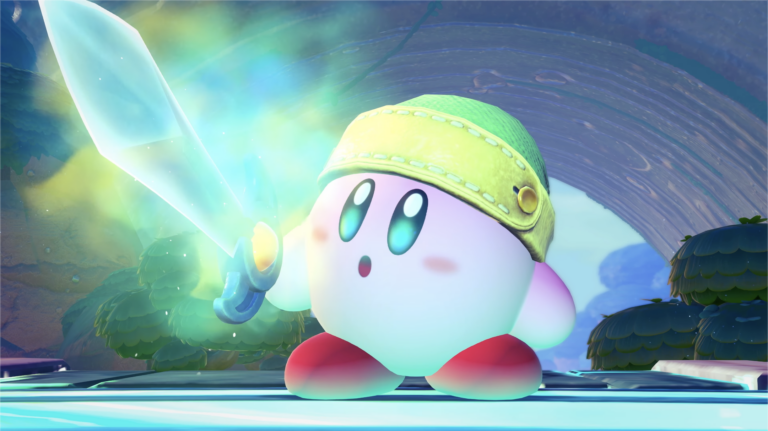
A mysterious floating companion appears — identity unknown, purpose unclear, almost certainly significant — and together they use a vast crystalline sword ability to widen the crack and push through to the other side. The landscape glimpsed beyond the wall is expansive and strange, with at least one distant structure that appears to be a mechanical serpent visible in the far distance.
The game’s emotional register is the dissonance the franchise has always done best: bright pink and cheerful on the surface, quietly unsettling underneath. The central dramatic question going in is not “will Kirby win” but “what is this world actually made of” — and the answer, the trailer suggests, is something far larger and stranger than Dream Land has ever implied.
Koizumi confirmed free exploration with copy abilities as the game’s central design premise, and the trailer makes the specific implications of that design choice visible. The classic Cutter, Bomb, and Umbrella (Parasol) abilities all appear, but with new mechanics that reframe them as movement tools rather than obstacle solutions.
The Bomb ability in particular has been expanded. Where prior Kirby games used Bomb primarily as a combat and puzzle-solving tool, the World Beyond trailer shows Kirby running on top of his own bomb to accelerate across the ground, then using the explosion to propel himself vertically — a Bomb ability rocket-jump mechanic that turns the ability into a traversal option. Umbrella/Parasol now appears to enable sustained aerial gliding over large distances. The new Giant Sword ability, crystalline and oversized, can cut through objects in the environment, including, ultimately, the sky itself.
This is the design question that defines World Beyond‘s ambition: the copy ability system has been part of the series since Masahiro Sakurai introduced it in Kirby’s Adventure on NES in 1993, conceived to add replay value after the first game’s simplicity drew criticism. In every mainline Kirby game since, copy abilities have been positioned by level designers who know exactly when players will encounter them. An open-world structure removes that certainty — players might find the Bomb ability before Cutter, or reach the giant sword section without having crossed a particular terrain type. HAL Laboratory has not yet explained how it is solving the non-deterministic acquisition problem, and that explanation will likely be one of the most significant design details in a future Nintendo Treehouse presentation.
The scale of the design shift is visible in context. Kirby and the Forgotten Land (March 25, 2022), the franchise’s previous 3D entry, used a “semi-open corridor” approach: wide linear levels with pockets of exploration, but a clear path and stage structure. The game sold 7.52 million copies by March 2024, making it the best-selling title in series history. World Beyond appears to break that structure entirely, placing Kirby in an open field from the opening sequence. The Forgotten Land proved HAL could execute a 3D Kirby game with commercial and critical success; World Beyond is the follow-on question of whether HAL can scale that design to a genuinely exploration-first architecture.
The Kirby reveal also fits a pattern Nintendo has developed deliberately on Switch 2. The platform already has a flagship 3D open-level platformer in Donkey Kong Bananza (July 17, 2025), which sold 4.52 million units and was widely credited as the Switch 2’s standout launch-window title. It has The Legend of Zelda: Ocarina of Time arriving November 5, 2026 on Switch 2, adding to a lineup that already includes Zelda: Tears of the Kingdom and Mario Kart World.
The pattern: Nintendo is bringing each of its major platformer franchises into full 3D, open-design territory on Switch 2. Mario has been there since Odyssey. Link’s Breath of the Wild and Tears of the Kingdom defined the open-world ambition. Donkey Kong arrived at Switch 2 launch. Now Kirby completes the cohort. The franchise is the only one of Nintendo’s major platformer properties that, as of the September 9 Direct, had not yet committed to open-world territory — and World Beyond changes that.
The spring 2027 window also carries specific significance. Kirby’s Dream Land, the franchise’s first game, released in Japan on April 27, 1992, making 2027 the series’ 35th anniversary year. The Kirby franchise has sold over 62 million copies across all titles as of September 2025 — a commercial base that justifies the increased development scope World Beyond implies.
This is the specific design question the September 9 trailer leaves unresolved, and it matters for how readers should think about the game. Nintendo’s biggest open-world title, Breath of the Wild, is a fully seamless world with no zone transitions — players can go anywhere from the start, and the only gates are the player’s own skill. Donkey Kong Bananza on Switch 2 uses a different model: large, open-feeling individual levels with substantial freedom within them, but discrete transitions between areas.
The World Beyond trailer does not confirm which model HAL is using. Koizumi’s announcement language about free exploration is consistent with either approach. What is clear is that the game’s world is significantly larger in scope than Forgotten Land‘s stages. The “World Beyond” itself, revealed when Kirby cracks the sky, appears to be a second major region distinct from the opening Dream Land area, suggesting at minimum a two-region structure.
The full picture — world scale, region count, whether a hub area exists, how large individual explorable areas are — will emerge as Nintendo approaches the spring 2027 window and shares more detail.
Kirby and the World Beyond closed a Direct that filled out the Switch 2’s early-2027 software picture substantially. The penultimate segment covered the Persona franchise: Atlus confirmed Persona 4: Revival (Switch 2, May 20, 2027) and announced that Persona 6 will also come to Switch 2, joining its previously announced PlayStation 5, Xbox Series X/S, and PC versions. Metroid Ravenous, a new 2D Metroid developed for Switch 2, was also announced at the same Direct and will launch January 28, 2027.
HAL Laboratory, the longtime developer behind the Kirby franchise, is the expected developer for World Beyond, though Nintendo has not yet officially confirmed the studio. HAL directed the Forgotten Land under series general director Shinya Kumazaki, who has been with the series for more than two decades. Nintendo has not announced a specific release date within the spring 2027 window, a price, or whether the game will support co-op play — a series staple that has been a standard feature of mainline Kirby games since Return to Dream Land in 2011.
Nintendo confirmed the title, spring 2027 window, Switch 2 exclusivity, and 35th anniversary context. Everything else is unconfirmed: world size, how many copy abilities the full game will feature, how HAL is handling ability acquisition in an open environment, whether the mysterious floating companion is an ally or an eventual antagonist (Kotaku and TV Tropes both note the character’s appearance is consistent with prior Kirby antagonists who debut as mysterious helpers), and what the “World Beyond” actually is narratively. Nintendo will share more details in the months ahead.
Nintendo confirmed the game features “free exploration” using Kirby’s copy abilities, and the trailer shows Kirby traversing a large, open environment without visible level gates. However, Nintendo has not confirmed whether the world is seamless and continuous like The Legend of Zelda: Breath of the Wild or structured as discrete open regions like Donkey Kong Bananza. The specific scope — how many regions, whether there’s a hub, how large the world is — will not be clear until Nintendo provides additional gameplay details ahead of the spring 2027 launch.
This is the central design question HAL Laboratory has not yet answered publicly. In every prior Kirby game, copy abilities were placed by level designers who controlled when and in what order players encountered them. An open-world structure means players may acquire abilities in any sequence, which removes the level designer’s ability to use specific ability gates as progression anchors. The World Beyond trailer shows abilities being redesigned as traversal tools — Bomb’s rocket-jump, Umbrella’s gliding, and a Giant Sword that cuts through the environment itself — suggesting HAL is solving the problem by making abilities useful for movement regardless of when they’re acquired. The full system won’t be clear until a Nintendo Treehouse demonstration or gameplay reveal.
The spring 2027 window currently includes Kirby and the World Beyond, Final Fantasy VII Revelation (April 8, 2027), and Persona 4: Revival (May 20, 2027). Earlier in 2027, Metroid Ravenous launches January 28 and Hyrule Warriors: Age of Calamity Definitive Edition arrives February 25. The full Switch 2 holiday 2026 lineup — including Zelda: Ocarina of Time (November 5), Pikmin 4 Switch 2 Edition (November 12), Monster Hunter Wilds (December 4), and Professor Layton and the New World of Steam (December 10) — was confirmed at the September 9 Direct.
Kirby and the World Beyond is scheduled for spring 2027 on Nintendo Switch 2. Nintendo has not announced a specific release date within that window, a price, or whether the game will include co-op. Co-op has been a feature of mainline Kirby titles since Kirby’s Return to Dream Land (2011), but HAL Laboratory has not confirmed it for World Beyond.