HomeAuto Kennedy Samoa Letter Contradicts Congressional Testimony on Vaccines, DOJ Probe Demanded
Kennedy Samoa Letter Contradicts Congressional Testimony on Vaccines, DOJ Probe Demanded
August 28, 2026:
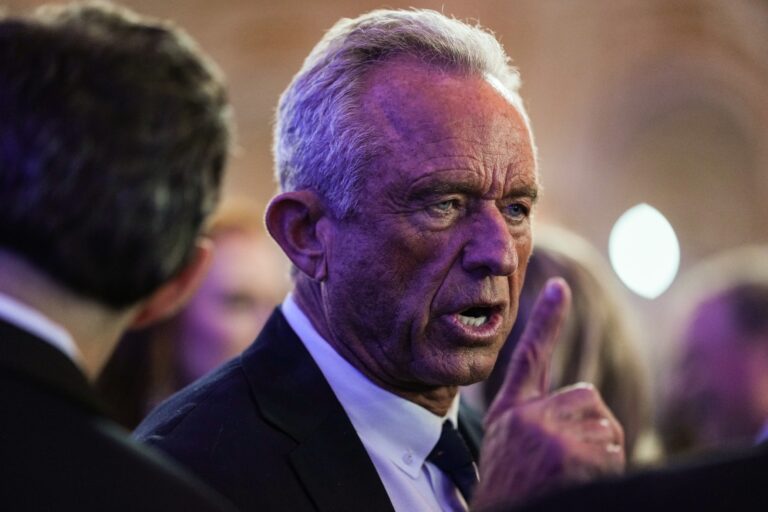
U.S. Health and Human Services Secretary Robert F. Kennedy Jr. attends the re-scheduled White House Correspondents Dinner in the Presidential Ballroom at the Waldorf Astoria on July 24, 2026 in Washington, DC. Eric Lee/Getty Images
A signed letter that Health and Human Services Secretary Robert F. Kennedy Jr. sent to a Pacific island nation’s prime minister in January 2019 — using the word “vaccine” or “vaccination” eight times — directly contradicts the sworn testimony Kennedy gave Congress during the confirmation hearings that put him in charge of the country’s entire public health system. The revelation, published Thursday by The Guardian and The Associated Press following an AP and Guardian investigation brought through a Freedom of Information Act lawsuit against the State Department, prompted a formal criminal referral to the Department of Justice and a call for a federal investigation by senior Democratic senators — all aimed at an administration whose own attorney general is almost certainly not going to act on them.
The letter’s existence matters beyond its legal implications. Kennedy’s false testimony was not a minor omission: it was the predicate for his confirmation, which in turn gave him the authority to cancel $500 million in mRNA research, dismantle vaccine advisory committees, and help engineer the conditions under which the United States is now at risk of losing measles elimination status it first achieved in 2000 — a 25-year public health achievement. The man who dismantled that infrastructure got his job by telling senators his 2019 Samoa trip had nothing to do with vaccines.
Kennedy’s Letter vs. Kennedy’s Oath
The January 20, 2019 letter, addressed to then-Samoan Prime Minister Tuilaepa Sailele Malielegaoi, described Kennedy’s desire to study the Pacific island nation’s use of the MMR — measles, mumps, and rubella — vaccine following the deaths of two children who had received it. In the letter, Kennedy, then serving as chair and chief legal counsel of the anti-vaccine nonprofit Children’s Health Defense (CHD), speculated that manufacturing problems with different vaccine lots may have caused the infants’ deaths. Experts and investigators later confirmed that the deaths were caused by a tragic preparation error — two nurses had accidentally mixed the vaccine with a muscle relaxant, vecuronium bromide, rather than the correct diluent — and that the vaccine itself was not defective. Both nurses were charged with manslaughter and pleaded guilty to manslaughter charges.
The letter was released through a Reporters Committee FOIA lawsuit brought against the State Department by attorneys at the Reporters Committee for Freedom of the Press on behalf of AP reporter Michelle Smith, who had filed the original request in 2023 and waited nearly two years without a substantive response before her organization sued. It represents the most direct documentary evidence yet of what Kennedy actually intended when he organized the Samoa trip.
That evidence stands in direct contrast to what Kennedy told senators over two days of Kennedy confirmation hearing transcripts in January 2025. When Sen. Edward Markey (D-Mass.) asked whether his purpose in going to Samoa had anything to do with vaccines, Kennedy replied: “My purpose in going down there had nothing to do with vaccines.” The next day, Markey pressed again: “Did the trip have nothing to do with vaccines as you told my colleagues in Senate Finance yesterday?” Kennedy’s answer was the same: “Nothing to do with vaccines.”
Kennedy has also claimed in various public statements that his purpose was to introduce a medical data digitization system, and that he never advised anyone in Samoa against vaccination.
Senators Call for Criminal Investigation
The political response to Thursday’s disclosures was swift, though legal experts cautioned that accountability faces structural barriers that are, in the current environment, essentially impassable.
Sen. Ron Wyden (D-Ore.), the ranking Democrat on the Senate Finance Committee and one of the senators who questioned Kennedy most aggressively during the hearings, called for a criminal investigation. “Kennedy’s anti-vaccine agenda is directly responsible for the deaths of innocent children,” Wyden said in a statement. “Lying to Congress about his role in the deadly measles outbreak in Samoa only underscores the danger he now poses to families across America. He and his allies will be held responsible.” His spokesman Taylor Harvey separately confirmed it is a federal crime to make false statements to Congress and that “casual, false denials to Congress will not be swept under the rug.”
The watchdog organization American Oversight sent a formal letter to Attorney General Pam Bondi on Thursday requesting that the Department of Justice immediately open an investigation into whether Kennedy knowingly made materially false statements during his 2025 Senate confirmation hearings. Sen. Ed Markey, who took Kennedy’s direct denials on the record, called the letter “proof of what we already knew” in a statement released the same day.
Lying to Congress is a federal crime under two overlapping statutes. Under 18 U.S.C. §1621 — the general perjury statute — making a willfully false statement before a legislative body under oath carries a maximum sentence of five years. Under 18 U.S.C. §1001, the False Statements Accountability Act of 1996 extended liability to any materially false statement made to Congress even without an oath requirement. Kennedy testified under oath, which means both statutes potentially apply.
“Lying to Congress is a crime, whether or not the witness is under oath,” Georgetown University Law Center professor Josh Chafetz told The Guardian. “But this would require the executive branch to prosecute, and Trump’s Justice Department is unlikely to do so.” The observation reflects a broader pattern: Democrats referred DHS Secretary Kristi Noem to the DOJ for potential perjury in March 2026, also to no known result, citing the same statutes in their Noem DOJ referral. The statute of limitations for false statements to Congress is five years — meaning the clock on any Kennedy prosecution runs through January 2030.
What Kennedy’s Samoa Trip Actually Led To
The importance of the Samoa episode is not merely historical. The sequence of events that followed Kennedy’s January 2019 letter established the pattern that now governs federal health policy.
Kennedy and his wife, actress Cheryl Hines, traveled to Samoa in May and June 2019 along with a colleague from Children’s Health Defense. During the visit, newly disclosed Embassy emails and documents show that a US Embassy staffer, Benjamin Harding, helped arrange access to Samoan government officials — including the country’s health minister — on Kennedy’s behalf, despite this being in a personal rather than official capacity. A senior embassy official, Antone Greubel, told Harding to “cease and desist from any further involvement” after learning of the arrangement, according to the documents. Kennedy also met with Taylor Winterstein, a prominent Samoan anti-vaccine activist, who posted that she was “deeply honoured to have been in the presence of a man I believe is, can and will change the course of history.”
A measles outbreak erupted in Samoa in late 2019, months after Kennedy’s visit. The epidemic sickened thousands and killed 83 deaths in Samoa outbreak; 72 of the dead were children under the age of five. Samoan officials later said Kennedy’s trip had bolstered the credibility of anti-vaccine activists ahead of the outbreak. Kennedy subsequently wrote to the Samoan prime minister during the outbreak, suggesting — without evidence — that the measles infections might have been caused by a defective vaccine rather than low vaccination coverage.
Is This the Legal Dead End It Looks Like?
The structural obstacle to accountability is significant. In the American constitutional system, federal criminal prosecution is entirely within the executive branch’s authority. The DOJ under Attorney General Pam Bondi would have to initiate charges against a cabinet secretary appointed by the same president who appointed Bondi — an outcome that legal analysts consider remote to the point of hypothetical.
Democrats lack the votes in the current congressional composition to compel a special counsel, force binding oversight hearings, or remove Kennedy through formal legislative mechanisms without Republican support that has not been forthcoming. Efforts to censure Kennedy or pass resolutions of disapproval have attracted substantial Democratic backing but have not cleared the threshold required for removal.
What Congress can do — and what senators like Wyden have signaled they intend to pursue — is make the documented false testimony the basis for ongoing oversight efforts, impeachment inquiries, and sustained public pressure on Republican members who voted to confirm Kennedy on the basis of his sworn denials. Whether any of that converts into institutional accountability before January 2030, when the statute of limitations on the false statements charge expires, remains to be seen.
The DOJ referral from American Oversight joins a growing queue of similar requests that have gone unanswered. The question of whether institutional norms against Cabinet-level perjury will eventually reassert themselves — or whether they require a change in the political composition of the executive branch to matter — is one this article cannot answer.
A Cabinet Built on Health Technology — and Built on This
For TechTimes readers, the Kennedy story intersects with federal technology policy in at least two specific ways that tend to get lost in the political coverage.
First, the HHS that Kennedy now leads is a significant actor in health technology. In December 2025, the department released a HHS AI strategy release — a 21-page artificial intelligence strategy “positioning Artificial Intelligence as the Core of Health Innovation” — governing how AI is used in FDA drug reviews, inspection processes, and post-market surveillance, as well as broader health data infrastructure decisions. Kennedy’s agency is, simultaneously, the agency deploying AI tools across the federal health system.
Second, Kennedy’s August 2025 cancellation of $500 million in mRNA research contracts — covering 22 projects at institutions including Emory University, Pfizer, Sanofi, and others — represents the largest single federal retreat from a specific biotechnology platform in recent memory. mRNA technology, which enables faster vaccine development against novel pathogens than conventional approaches, was the platform that produced the COVID-19 vaccines credited with saving millions of lives. Kennedy canceled those contracts on the stated grounds that mRNA vaccines “pose more risk than benefits against these respiratory viruses” — a claim disputed by public health experts including Dr. Peter Hotez, dean of Baylor College of Medicine’s National School of Tropical Medicine, who called Kennedy’s characterization of the science “backwards” in response to the mRNA contract cancellations. The Department of Defense, notably, has continued funding mRNA research and has stepped in to support some projects affected by the HHS cuts.
The person who made those technology policy decisions obtained the authority to make them through sworn testimony that a newly released letter suggests was false.
How Was Kennedy Confirmed?
Kennedy’s confirmation on February 13, 2025, by a Kennedy confirmation vote of 52–48, largely along party lines, was never comfortable. Republican Sen. Bill Cassidy of Louisiana — a physician — extracted explicit commitments from Kennedy about maintaining vaccine advisory infrastructure before voting yes. Kennedy told Cassidy he would not take away vaccines from Americans and that he would “base vaccine recommendations on data-driven, evidence-based, and medically sound research.”
The senators who queried Kennedy most aggressively about Samoa — Wyden and Markey — did not receive answers they could independently verify, because the documentary record Kennedy had generated was still trapped in a State Department FOIA queue that wouldn’t be cleared until the Reporters Committee sued. By the time the Embassy emails surfaced in February 2026, Kennedy was already HHS secretary. By the time his own letter surfaced this week, he had already canceled $500 million in mRNA contracts, reconstituted the vaccine advisory committees he had promised to preserve, and overseen the conditions that have put the United States within months of losing a measles elimination status it took decades to achieve.
Where Measles Stands Now
The US measles situation, as of August 2026, is the direct context in which these disclosures land. After 2025 produced 2,255 to 2,276 confirmed measles cases — the highest total since 1991, including three deaths — a new outbreak centered in South Carolina’s Spartanburg County has grown to more than 920 cases in Spartanburg County, with approximately 95 percent in unvaccinated or vaccination-status-unknown patients. Nearly 90 percent of cases involve children.
The Pan American Health Organization had originally scheduled a formal review of the United States’ measles elimination status — which it first achieved in 2000 — for April 2026. That review was postponed to November 2026 after HHS asked for more time to prepare data. Infectious disease experts have been unsparing about what they expect. Dr. Demetre Daskalakis, a former top CDC official and infectious disease specialist, said in January 2026 that “we do not have the capability to actually control measles, whether or not this is demonstrated through continuous measles transmission for 12 months. So I’m going to say that elimination is already lost.”
Measles has a basic reproduction number — the average number of people each infected person goes on to infect in an unvaccinated population — of between 12 and 18, making it one of the most contagious pathogens known. Interrupting transmission requires approximately 95 percent population immunity. Vaccination rates in the US have declined in 77 percent of counties since 2019, according to a monthslong NBC News investigation.
Kennedy has continued to issue contradictory vaccine messaging. In May 2025, testifying before the House Appropriations Subcommittee, he told committee members: “I don’t think people should be taking advice, medical advice from me.”
What Comes Next
Short of a change in the political composition of the Justice Department or Congress, the most realistic near-term consequences are the ones that have already materialized: documentary evidence now part of the permanent public record, senators on record demanding prosecution, a watchdog referral that will sit unanswered, and a sitting HHS secretary whose confirmation is demonstrably predicated on false statements.
The formal legal question — whether Kennedy knowingly lied to Congress — has a statute of limitations of five years from January 2025. The broader question of what it means for public health when the nation’s top health official obtained that office through false testimony about a vaccine trip that preceded a measles epidemic is not subject to any statute of limitations at all.
Frequently Asked Questions
Did Kennedy actually lie to Congress under oath, and what would prosecution require?
Kennedy’s January 2019 letter to the Samoan prime minister, which used the word “vaccine” or “vaccination” eight times and proposed a vaccine-focused assessment, directly contradicts his sworn testimony in January 2025 that his trip had “nothing to do with vaccines.” Under 18 U.S.C. §1621, making a willfully false statement under oath before a legislative body is punishable by up to five years in prison. Prosecutors would need to establish that the false statement was made willfully — that Kennedy knew it was false when he said it — and that it was material to the inquiry. Legal experts broadly agree both elements appear to be present. The practical obstacle is that under current law, prosecution requires the executive branch’s DOJ to act, and the Trump administration’s DOJ is almost certainly not going to investigate a Trump cabinet secretary.
How did Kennedy’s confirmation testimony enable the HHS policy rollbacks that followed?
Kennedy’s repeated denials about the Samoa trip were a central element in his confirmation strategy — he needed to neutralize the Samoa episode to secure confirmation, because it was the most direct evidence of his active anti-vaccine advocacy. Once confirmed 52–48 in February 2025, he used his HHS authority to cancel $500 million in mRNA research contracts, dissolve and reconstitute the CDC’s vaccine advisory committees, and oversee an HHS restructuring that cut 20,000 staff positions and eliminated the Office of Infectious Disease and HIV/AIDS Policy. Each of those actions required the confirmation his sworn testimony helped secure. A secretary who had not obtained confirmation cannot make those decisions.
What is measles elimination status, and when will the US lose it?
Measles “elimination status,” as defined by the Pan American Health Organization, means no continuous chain of measles transmission for 12 or more months within a country. The US achieved that designation in 2000, after coordinated vaccination efforts reduced domestic transmission. The same measles strain has been spreading in the US since January 2025, when the Texas outbreak began; scientists confirmed the strain in Texas, New Mexico, Utah, Arizona, South Carolina, Canada, and Mexico. PAHO postponed its formal review of US status from April to November 2026 after HHS asked for more time. Multiple infectious disease experts have said elimination is functionally already lost, regardless of the formal ruling.
What can readers do with this information?
Readers who are concerned about the measles outbreak should verify their own MMR vaccination status — adults born after 1957 who received only one dose, or who have no documentation of vaccination, may benefit from a second dose. Readers who want to pursue accountability for Kennedy’s testimony can contact their senators — particularly those who voted to confirm Kennedy based on his sworn denials — and reference the January 20, 2019 letter and Kennedy’s confirmation testimony as documented evidence of contradiction. Watchdog group American Oversight’s DOJ referral is public and can be shared with congressional offices directly.