HomeAuto JWST Detects Dusty Water Ice in Interstellar Comet 3I/ATLAS: Mirrors Kuiper Belt, Not Solar Comets
JWST Detects Dusty Water Ice in Interstellar Comet 3I/ATLAS: Mirrors Kuiper Belt, Not Solar Comets
October 27, 2026:
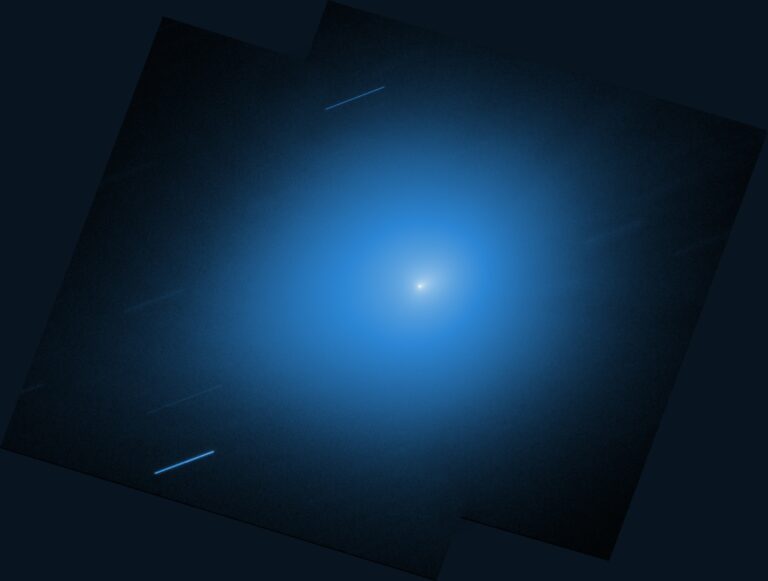
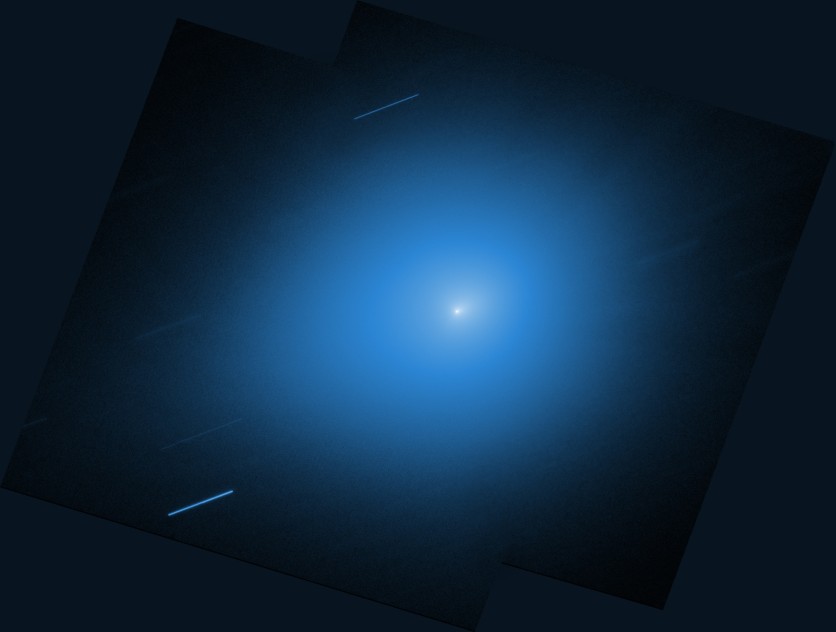
Interstellar comet 3I/ATLAS on Nov. 30, 2025, as observed by the Wide Field Camera 3 instrument on NASA’s Hubble Space Telescope. NASA missions all across the solar system have collected data about the comet to be shared in public archives. D. Jewitt UCLA), M.-T. Hui (Shanghai Astronomical Observatory. Image Processing: J. DePasquale/Nasa.gov
A study published today in the Astrophysical Journal Letters reveals that the James Webb Space Telescope found water ice in interstellar comet 3I/ATLAS — but not the kind seen in typical solar system comets. The ice forms tiny, submicron-scale grains intimately mixed with rocky dust, producing a spectral fingerprint that closely matches the frozen outer worlds of the Kuiper Belt rather than the larger, dust-free ice grains of ordinary comets.
That match carries an implication that extends far beyond one comet’s composition. If a body formed around another star billions of years ago arrives in our solar system with ice grains spectrally indistinguishable from the most ancient icy worlds at the edge of our own system, it suggests that the physical recipe for building icy planetary building blocks — the size and dust content of the grains that eventually clump into planetesimals and then into planets — may be governed by universal physics rather than by the specific conditions of any one stellar system.
“This suggests that the icy building blocks of planets, here and around other stars, may share ice in the form of tiny, micron-scale grains, ranging from relatively pure ice to ice mixed with dust, with 3I/ATLAS toward the dusty end,” said Dr. Silvia Protopapa of SwRI, the study’s lead author.
How a Visitor from Another Star Arrived at the Right Moment
3I/ATLAS was discovered on July 1, 2025, by the NASA-funded ATLAS telescope at an observatory in Río Hurtado, Chile. Formally designated C/2025 N1, the comet arrived from the direction of the constellation Sagittarius at up to roughly 138,000 mph (about 222,500 km/h) — a velocity far above the Sun’s escape speed, an unmistakable signature of interstellar origin. It was the third confirmed interstellar object ever detected, following the rocky body 1I/’Oumuamua in 2017 and the cometary 2I/Borisov in 2019.
Unlike its predecessors, 3I/ATLAS arrived into the sights of the most powerful infrared space observatory ever built while researchers still had months to prepare. ‘Oumuamua had departed before any close-up study was possible; Borisov arrived before JWST’s December 2021 launch. 3I was the field’s first chance to apply JWST’s full spectroscopic toolkit to an active interstellar comet.
“We designed this program to be ready the moment an active interstellar comet was found and to follow it over time,” said Dr. Martin Cordiner of Goddard and the Catholic University of America, the principal investigator of the Webb program and a co-author of the paper. “Our goal was to characterize the ice, dust and gas that the comet releases, and so learn about the chemistry and formation of planetesimals — the building blocks of planets — around other stars.”
How JWST Reads Dust Mixed Into Ice
The instrument at the center of this study is JWST’s Near-Infrared Spectrograph NIRSpec, operating in its PRISM mode. This configuration splits incoming light across a wavelength range from 0.6 to 5.3 microns — far into the infrared, well beyond what the human eye or optical telescopes can detect — at a resolving power that separates the overlapping spectral signals of different molecules in a comet’s coma.
Water ice absorbs infrared light at three characteristic wavelengths. The strongest absorption occurs near 3.0 microns, driven by the fundamental vibration of the oxygen-hydrogen bond in water molecules — a deep, powerful signature that survives even when ice is mixed with dust or formed in tiny grains. Two additional, weaker absorptions occur near 1.5 and 2.0 microns, representing overtone and combination vibrations of the same bond. In large-grained, relatively pure ice — the kind found in typical solar system comets — all three bands appear prominently together.
In 3I/ATLAS, the 3.0-micron band appeared strongly. The 1.5- and 2.0-micron bands were either very weak or entirely absent.
The reason lies in how light travels through dust-mixed ice. In a dust-mixed ice grain roughly one micron across (about the width of a typical bacterium) that is packed with refractory — rocky, non-volatile — dust particles, photons traveling through the ice encounter a dust grain after covering only a tiny distance. That short optical path is long enough for the strong 3.0-micron absorption to leave a clear fingerprint, but not long enough for the weaker 1.5- and 2.0-micron absorptions to accumulate a detectable signal. The result is a telltale spectral mismatch: one band present, two absent.
Spectral modeling by the Protopapa team confirmed that grains of approximately one micron or smaller, intimately mixed with refractory material, reproduce the 3I/ATLAS data best.
Three Observations, One Evolving Puzzle
The SwRI team observed 3I/ATLAS with JWST’s NIRSpec at three points across its solar encounter:
August 6, 2025 — at 3.3 AU from the Sun (1 AU is approximately the distance between Earth and the Sun), while the comet was still inbound and heating up
December 22, 2025 — at 2.4 AU, during its post-perihelion retreat; 3I/ATLAS had passed closest to the Sun (perihelion at 1.36 AU) on October 29, 2025
April 1, 2026 — at 5.7 AU, as the comet receded toward the outer solar system
All three spectra showed the dominant 3.0-micron water ice band with weak or absent shorter-wavelength features. But the third observation, taken five months after perihelion, added new details. A subtle “Fresnel-like” structure emerged near 3.1 microns — a spectral signature consistent with crystalline water ice, in which the molecules have settled into an ordered lattice rather than the disordered amorphous arrangement that forms when ice condenses at very low temperatures in space. A second, slightly larger and more ice-rich grain population also appeared, absent or weaker in the earlier data.
“The strong 3-micron band points to water ice in the coma,” said lead author Silvia Protopapa. “But the weak or absent shorter-wavelength bands suggest the ice is not in the form we usually see in solar system comets.”
What drove the change over time remains an open question.
“We can’t yet tell whether the changes over time are the result of the Sun heating the grains differently at each observation, or of new material exposed as the comet’s surface eroded near the Sun,” said study co-author Michael Kelley of the University of Maryland. “Both are possible, and telling them apart is one of the open questions we aim to address.”
Why Does 3I/ATLAS Ice Look More Like Kuiper Belt Objects Than Solar System Comets?
The paper’s most striking finding emerged when the team placed 3I/ATLAS’s spectra alongside not just active solar system comets, but trans-Neptunian objects (TNOs) — the ancient, frozen Kuiper Belt worlds that orbit the Sun at distances greater than 30 AU and preserve ices largely unchanged since the early solar system.
JWST’s DiSCo survey of trans-Neptunian objects has recently identified several spectral classes among these distant bodies. A subset of them displays exactly the pattern seen in 3I/ATLAS: a prominent 3.0-micron water ice band, with the 1.5- and 2.0-micron bands subdued or absent — the fingerprint of small, refractory-rich ice grains.
“At first glance, 3I/ATLAS looks different from the icy comets we know,” said Silvia Protopapa of SwRI. “But when we placed it alongside distant icy worlds in our own solar system, it no longer looked out of place.”
The interpretation the paper advances is that 3I/ATLAS occupies the “refractory-rich” end of a continuum of grain compositions — a spectrum running from relatively pure ice at one extreme to ice thoroughly mixed with dust at the other. Solar system bodies populate different points on this continuum: typical active comets toward the ice-rich end, Kuiper Belt objects toward the dust-mixed end. What the Protopapa study argues is that this continuum is not unique to our solar system. Icy bodies that formed around a completely different star, in a protoplanetary disk with different chemistry and metallicity, ended up populating the same continuum.
The paper, Protopapa et al. 2026, makes the implication explicit in its title: Evidence for a Continuum of Grain Properties across Protoplanetary Disks.
A Comet 11 Billion Years in the Making
The Protopapa ice study adds to a rapidly growing portrait of 3I/ATLAS assembled across dozens of JWST and ground-based programs since its discovery.
Earlier JWST observations found that the comet’s coma is dominated by carbon dioxide rather than water — a CO₂-to-water ratio among the highest ever recorded for any comet. This suggested the object formed in a cold outer region of its home protoplanetary disk, near or beyond the CO₂ ice line, where CO₂ ice was as abundant as water ice.
JWST’s mid-infrared MIRI instrument also detected methane directly in 3I/ATLAS’s coma — the first confirmed methane detection in any interstellar object. The delayed release of the methane relative to water outgassing pointed toward subsurface material shielded from prior radiation damage, implying that parts of the comet’s interior have remained unprocessed since its formation.
That formation may have been extraordinarily long ago. Isotopic measurements of the comet’s water reveal a heavy-water D/H ratio significantly higher than any solar system comet — a chemical signature pointing toward formation in an environment low in heavier elements. Some analyses place the comet’s origin between 11 and 12 billion years ago, potentially predating the formation of our Sun.
No crystalline silicate minerals were detected — consistent with formation in the cold outer regions of a protoplanetary disk, far from the high-temperature processing that would have crystallized such minerals closer to the host star.
3I/ATLAS came from the direction of the constellation Sagittarius, passed perihelion in October 2025, and by April 2026 was at 5.7 AU and fading rapidly. It will not return.
What Three Interstellar Visitors Have Taught Astronomers So Far
Each of the three known interstellar objects has pushed science in a different direction.
‘Oumuamua, detected in 2017, showed no detectable coma despite traveling through the inner solar system, and exhibited an anomalous non-gravitational acceleration — a departure from the purely gravitational trajectory that was consistent with outgassing but produced no detectable outgassing signature. The leading mainstream explanations invoke hydrogen ice, a very low-density structure, or enhanced radiation pressure on an unusually flat geometry. The mystery remains unresolved.
2I/Borisov, discovered in 2019, behaved like a recognizable solar system comet — water outgassing, a clear cometary morphology, composition broadly consistent with carbon-chain-depleted comets. It was the first interstellar object confirmed to carry volatile ices actively sublimating. But the telescopes available before JWST’s launch could not perform the kind of deep ice-grain spectroscopy now possible with NIRSpec. An earlier search for water ice in 2I/Borisov’s coma had returned inconclusive results, limited by instrument sensitivity at the time.
3I/ATLAS closed that loop. It arrived into the sights of JWST with months of lead time, traveled close enough to the Sun to produce a bright coma, and turned out to carry a compositional puzzle — dusty ice matching the Kuiper Belt — that required exactly the spectroscopic power JWST brings.
The broader scientific community has already submitted dozens of papers across JWST programs, ground-based spectroscopy campaigns, and monitoring initiatives covering 3I/ATLAS’s passage. The Vera Rubin Observatory’s LSST survey, which captured serendipitous pre-discovery images of 3I/ATLAS during its commissioning phase, is expected to dramatically increase the rate of interstellar object detection as its full-sky Legacy Survey of Space and Time matures.
Whether 3I/ATLAS represents the typical composition of interstellar comets, or sits toward one extreme of a wider distribution, will only be answered when the fourth interstellar object passes through. Astronomers, by now, know exactly what to do when it does.
Frequently Asked Questions
What did JWST actually detect in 3I/ATLAS’s coma?
JWST NIRSpec observations of 3I/ATLAS spanning August 2025 through April 2026 detected water ice in the comet’s coma at all three measurement points. The ice signature was unusual: a strong absorption band near 3 microns, typical of water ice, paired with very weak or absent bands near 1.5 and 2.0 microns that are present in most solar system comets. Spectral modeling showed the best fit is water ice grains roughly one micron (about the width of a bacterium) or smaller, thoroughly mixed with refractory (rocky, non-volatile) dust particles.
Why do 3I/ATLAS’s ice grains look more like Kuiper Belt objects than like comets?
The shape of a water ice spectrum — which bands are present and how deep they are — depends on grain size and how much dust is mixed into the ice. Small, dust-mixed grains limit how far light can travel through the ice, suppressing the weaker 1.5- and 2.0-micron absorptions while the stronger 3-micron band survives. This is the same spectral pattern seen in several Kuiper Belt TNO spectral classes, which are thought to preserve ice in small, refractory-rich grains because they formed in cold outer disk regions and have never been strongly processed by solar heat. The implication is that 3I/ATLAS formed in analogous conditions in another stellar system — cold, distant from its host star — and carries the same grain-composition signature as a result.
Does this mean all planetary systems build icy worlds the same way?
Not definitively — one interstellar comet is a sample of one. But the Protopapa study argues the match is not a coincidence: it suggests a “continuum” of ice grain compositions spanning from nearly pure ice to heavily dust-mixed ice, and that this continuum appears to characterize icy bodies across protoplanetary disks from different stellar systems. The underlying physics of grain growth — dust grains acting as nuclei for ice deposition, grain-grain collisions, and the role of radiation processing — may produce similar outcomes regardless of the host star’s chemistry. Confirming whether this holds will require spectroscopic analysis of future interstellar comets, which the Vera Rubin Observatory’s LSST is expected to begin delivering at significantly higher rates.
How many interstellar objects have been detected, and when will astronomers find more?
Three confirmed interstellar objects have been detected as of 2026: 1I/’Oumuamua (2017), 2I/Borisov (2019), and 3I/ATLAS (2025). The low detection rate reflects the limits of earlier survey telescopes rather than a scarcity of interstellar visitors — models based on Oort Cloud formation suggest that vast numbers of planetesimals were ejected from planetary systems across the galaxy and travel through interstellar space. The Vera Rubin Observatory’s wide survey, with its high-cadence Legacy Survey of Space and Time, is expected to detect multiple interstellar objects per year once fully operational, giving astronomers far more objects to compare and dramatically expanding the sample size available for studies like the Protopapa team’s spectroscopic analysis.