HomeAuto Japan’s H3 Rocket Lands First Commercial SAR Constellation Customer in Government-Backed Deal
Japan’s H3 Rocket Lands First Commercial SAR Constellation Customer in Government-Backed Deal
September 16, 2026:
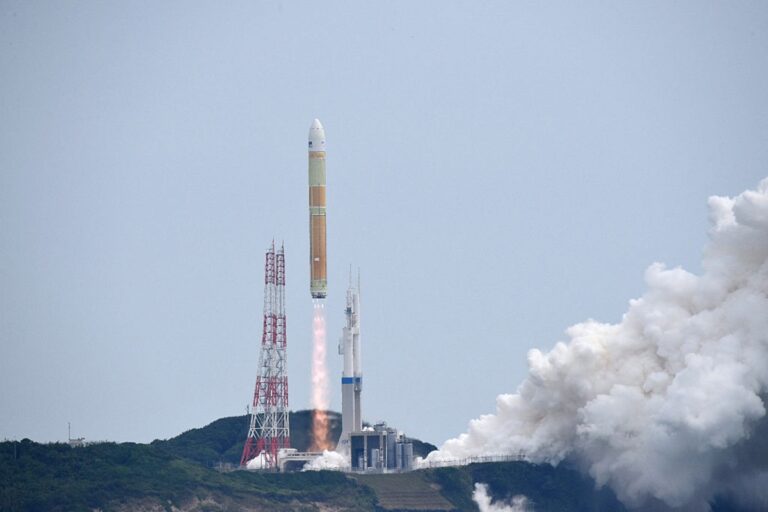
The H3 rocket No. 6 is launched at Tanegashima Space Center in Kagoshima Prefecture on June 12, 2026. JIJI PRESS/AFP via Getty Images
Japan’s commercial radar-imaging startup iQPS signed a rideshare launch services agreement with Mitsubishi Heavy Industries (MHI) on September 14, 2026, booking three of its QPS-SAR satellites on Japan’s H3 rocket — a deal backed by Japan’s Space Strategy Fund and one that completes a deliberate, three-provider diversification strategy designed to insulate the company against the single biggest threat to any satellite constellation: a rocket that won’t fly on schedule.
What the H3 Rideshare Deal Actually Does
Under the contract, iQPS will fly as a primary rideshare customer on an upcoming H3 mission, co-manifesting three QPS-SAR satellites into low Earth orbit in a single flight. That batch-deployment model is a meaningful departure from how iQPS has built its constellation so far. The company’s main small-launch partner, Rocket Lab, deploys one satellite per Electron flight — precision and orbital flexibility in exchange for one satellite at a time. The H3 rideshare lets iQPS place three satellites in a single rocket’s fairing, trading the orbital customization of a dedicated small-launch for the throughput efficiency of a medium-lift vehicle.
No launch date has been announced. iQPS says it will disclose details once confirmed.
The H3 is Japan’s flagship next-generation medium-lift rocket, developed jointly by MHI and the Japan Aerospace Exploration Agency (JAXA) as a cost-competitive successor to the H-IIA. The rocket’s heaviest configuration can lift approximately 16,000 kg to orbit (35,300 lbs to low Earth orbit). Its H3-30 variant — three LE-9 liquid-fuel engines, no solid rocket boosters — is designed specifically for the commercial and sun-synchronous-orbit markets where rideshare demand from small-satellite constellation operators is strongest.
How SAR Satellites See Through Clouds and Darkness
A QPS-SAR satellite is, at its core, a microwave flashlight. The spacecraft transmits pulses of X-band radio waves (at approximately 9.6 GHz) toward the Earth’s surface, then records the signals that bounce back. By processing the slight differences in timing and phase of those returning echoes — captured from many positions as the satellite moves along its orbit — the onboard and ground systems reconstruct a high-resolution two-dimensional image of the surface below. The technique is called synthetic aperture radar because the satellite’s forward motion creates a “synthetic” antenna aperture far larger than the physical antenna itself.
The practical result: a QPS-SAR satellite can image through cloud cover, smoke, and darkness, conditions that render optical cameras useless. It cannot, however, penetrate dense vegetation canopy or soil — limitations shared with other X-band systems and the reason lower-frequency SAR (L-band, P-band) remains important for forestry and subsurface applications. For the disaster response, maritime surveillance, infrastructure monitoring, and security markets iQPS targets, X-band’s cloud-penetrating, day-night capability is well matched.
The engineering challenge iQPS solved was packaging a 3.6 m (11.8 ft) X-band SAR antenna into a 100 kg (220 lb) satellite. Conventional wisdom held that sub-meter SAR resolution required much larger, heavier platforms. iQPS developed a lightweight stowable parabolic antenna — the core of its patent portfolio — that deploys from a compact form factor after launch and enables the company’s claimed 46 cm spotlight imaging resolution (18 in) in spotlight imaging mode, and 1.8 m (5.9 ft) in the wider-swath stripmap mode. That resolution claim is drawn from company materials; no independent third-party audit of the figure has been publicly published.
A Constellation on a Deadline
iQPS’s goal is a “Near Real-Time Data Provision Service” — the ability to revisit virtually any point on Earth at an average interval of approximately 10 minutes. To achieve that cadence, the roadmap calls for 24 operational satellites by 2028 (by the end of May), with the full 36-satellite constellation completed by 2030.
The company has been building toward that deadline at a pace few commercial SAR startups have matched. As of mid-2026, iQPS had conducted more than a dozen successful satellite launches across multiple providers, with operations continuing from a growing in-orbit fleet. In April 2026, the company confirmed nine satellites in active operation. An August 21, 2026 Rocket Lab launch — confirmed by Via Satellite — added another to the constellation, marking iQPS’s 14th successful SAR launch, followed by the sharing of first-light imagery from the newest satellite on September 11.
The financial backstop for that build-out is Japan’s Space Strategy Fund (宇宙戦略基金), a ¥1 trillion government space program (approximately $6.5 billion USD) administered by JAXA over ten years to support private companies and universities developing commercial space technology. iQPS was selected for Space Strategy Fund support of up to ¥21.2 billion (approximately $138 million USD), with an initial confirmed grant of ¥8.4 billion (approximately $55 million USD) reported in March 2025. The MHI rideshare contract was concluded under that subsidy program.
iQPS Runs Three Launch Providers at Once — and Why That’s Smart
The H3 deal adds a third distinct launch vehicle to a manifest already covering two others.
Rocket Lab’s Electron rocket has been iQPS’s workhorse, carrying out the majority of its constellation deployments on dedicated single-satellite missions to a 575 km (357 mile) mid-inclined orbit. The relationship has been unusually active: iQPS signed its third multi-launch booking on Electron in less than a year in July 2026, bringing total launches booked to 18, with Electron having deployed seven QPS-SAR satellites with 100% mission success since 2023. The operational cost of each Electron mission is approximately $7.5 million, giving iQPS orbital precision and scheduling flexibility at the expense of launching one satellite at a time.
Just days before the H3 announcement, on September 9, 2026, iQPS signed a memorandum of understanding with MaiaSpace — the launch arm of ArianeGroup — making iQPS MaiaSpace’s first long-term Asia-Pacific customer, with QPS-SAR launches starting in 2029.
The logic of running three providers at once is straightforward: launching a satellite constellation is only as reliable as the rocket that carries it. A delay or grounding at a single provider can halt months of deployment cadence, slipping the revisit-time improvements that constellation operators sell to data customers. By spreading launches across Rocket Lab (high-frequency, single-satellite precision), H3 (batch throughput, domestic Japanese option), and MaiaSpace from 2029 (European option with its own rideshare kick-stage flexibility), iQPS reduces the chance that any one vehicle’s schedule problems block the path to 24 satellites by May 2028.
That risk is not hypothetical. The H3 itself lost its eighth mission on December 22, 2025, when the H3 Flight 8 failure report documented a payload fairing separation anomaly that damaged the satellite mounting structure, causing the second-stage engine to shut down prematurely and losing Japan’s Michibiki-5 navigation satellite. The program was grounded for nearly six months. JAXA and MHI resumed flights with the H3-30 maiden flight June 2026 — successfully placing six small satellites into orbit on June 12 — the first-ever successful flight of the boosterless H3-30 configuration, the variant most relevant to commercial rideshare. iQPS signed on as a commercial rideshare customer approximately three months later.
The H3 thus has two failures in its eight completed flights and only one successful H3-30 test flight to its name. For an iQPS constellation racing a hard deadline, that context matters: the H3 rideshare carries real schedule risk, which is precisely why the three-provider strategy is not a luxury but a hedge. If H3 schedules slip again, Electron and MaiaSpace continue filling the constellation. If an Electron anomaly grounds Rocket Lab, H3 and MaiaSpace cover the gap.
Why This Deal Matters for Japan’s Space Industrial Policy
For Mitsubishi Heavy Industries, the iQPS contract is a meaningful commercial milestone for a rocket that has historically carried primarily government and institutional payloads. Japan’s H-IIA, the H3’s predecessor, carried a small number of commercial secondary payloads over its 45-flight career. The H3 was designed from the outset to compete commercially — JAXA and MHI targeted a launch cost substantially below the H-IIA, with the LE-9 engine engineered to reduce manufacturing complexity. At approximately ¥5 billion per H3 launch (approximately $33 million USD), the rocket is priced to attract commercial business that has previously flowed to SpaceX’s Falcon 9 Transporter rideshare series and Rocket Lab’s Electron.
Landing iQPS as a rideshare customer proves — for the first time — that H3 can function as a multi-customer commercial constellation deployment vehicle, not just a government payload carrier. Whether MHI can sustain a commercial rideshare business will depend on launch cadence and pricing competitiveness. But as a proof of concept, iQPS’s three satellites provide exactly the signal MHI needs to pitch other commercial operators.
The deal also completes the picture of how Japan’s Space Strategy Fund is functioning as industrial policy: it subsidizes iQPS to build a SAR constellation, and that subsidized constellation business flows in part back to MHI’s H3 rocket, strengthening the domestic supply chain linkage between Japan’s commercial Earth observation startups and its national launch infrastructure.
What Comes Next
The manufacturing pipeline is the next constraint. iQPS has estimated per-satellite production costs at approximately ¥1.5 billion to ¥2 billion (approximately $10 million to $13 million USD) each according to company estimates, and the path from the current in-orbit fleet to 36 satellites by 2030 requires sustaining a parallel drumbeat of fabrication and flight bookings. With three launch providers now in the manifest, the launch capacity exists. The question is whether the factory floor can fill it.
For Japan’s broader space industrial ecosystem, the timing is significant. The MHI/iQPS deal lands as JAXA and MHI are still validating the post-failure H3 program’s commercial reliability, and as competing Japanese Earth observation players — including the ICEYE partnership for 24 satellites with IHI Corporation announced in May 2025 — add pressure from within Japan’s own market.
iQPS’s move to leverage all three options — Japan’s domestic rocket, the world’s leading small-launch dedicated provider, and a rising European entrant — positions it to pursue the 2028 deadline regardless of which vehicle the launch market delivers on schedule.
Currency conversions are approximate, based on exchange rates as of September 15, 2026.
Frequently Asked Questions
What is synthetic aperture radar, and how is iQPS using it?
Synthetic aperture radar (SAR) is a radar technique in which a satellite transmits microwave pulses toward Earth’s surface and records the reflected signals. By processing those echoes from many orbital positions, it produces high-resolution images regardless of cloud cover, darkness, or weather — unlike optical cameras. iQPS’s QPS-SAR satellites use X-band SAR (around 9.6 GHz) with a lightweight deployable 3.6 m (11.8 ft) antenna to achieve a claimed resolution of 46 cm (18 in) in spotlight mode from a 100 kg (220 lb) satellite. The company aims to build a 36-satellite constellation capable of revisiting any point on Earth approximately every 10 minutes, making near-real-time monitoring of disaster zones, infrastructure, shipping, and agriculture commercially viable.
How does Japan’s Space Strategy Fund work, and why is it backing iQPS?
Japan’s Space Strategy Fund (宇宙戦略基金) is a roughly ¥1 trillion (approximately $6.5 billion USD) government initiative administered by JAXA, designed to accelerate private-sector and university space technology development over 10 years. The fund awards multi-year subsidies to selected companies to cover the development, demonstration, and commercialization of advanced space technology. iQPS was selected for support of up to approximately ¥21.2 billion (approximately $138 million USD), with an initial grant of approximately ¥8.4 billion (approximately $55 million USD) confirmed in early 2025. The MHI H3 rideshare contract was concluded under this program, making it a case where Japanese government policy is directly accelerating the domestic commercial SAR launch supply chain.
What happened to the H3 rocket before this deal, and does that affect the timeline?
The H3’s eighth flight ended in failure on December 22, 2025, when a payload fairing separation anomaly caused the loss of Japan’s Michibiki-5 navigation satellite. JAXA grounded the H3 program for nearly six months and conducted an investigation that identified a manufacturing defect in the satellite payload adapter. The program returned to flight on June 12, 2026, with a successful test of the H3-30 configuration — the boosterless variant most relevant to commercial rideshare. That was the H3-30’s first-ever flight. iQPS signed its rideshare contract roughly three months later. The reliability risk is real, which is precisely why iQPS’s strategy of maintaining Rocket Lab and MaiaSpace as parallel launch providers is designed to absorb an H3 delay without missing the May 2028 constellation deadline.
Why does iQPS need three different launch providers?
A satellite constellation operator’s revenue depends on how many satellites are in orbit and how often they can revisit a target area. Any launch vehicle that gets delayed or grounded — as the H3 was for six months in 2025-2026 — stops the deployment cadence and slips the revisit-rate improvements the operator sells to customers. By contracting across Rocket Lab Electron (single-satellite precision, high cadence, starting from 2023), MHI’s H3 (batch three-at-once rideshare, Japan option), and MaiaSpace (European option, from 2029), iQPS ensures that no single provider’s schedule can halt the path to 24 operational satellites by May 2028. Each provider also serves a different deployment function: Electron for orbital precision and scheduling flexibility, H3 for throughput efficiency, MaiaSpace for post-2028 replenishment and expansion.