HomeAuto Ireland Sets Third Straight ESA Record at €25.3M, Enters Space Safety Program
Ireland Sets Third Straight ESA Record at €25.3M, Enters Space Safety Program
November 6, 2026:
Enterprise-ireland.com
Irish space technology companies have posted another record year of European Space Agency contract wins, with the newly published Space Activities in Ireland 2025 report showing that Irish industry secured €25.3 million (approximately $28.3M USD) in ESA contracts last year — a fresh high-water mark that narrowly surpasses the previous record of €24 million (approximately $26.8M USD) set only twelve months earlier. Research organizations contributed a further €1.3 million (approximately $1.5M USD), bringing the combined total to approximately €26.6 million ($29.8M USD). Alongside those figures, Minister of State for Employment, Small Businesses and Retail Alan Dillon TD announced that Ireland has formally approved participation in ESA’s Space Safety Programme — the agency’s initiative to protect Europe from threats ranging from solar storms and asteroid impacts to space debris and human-made hazards in orbit.
The report, published today by Enterprise Ireland and the Department of Enterprise, Tourism and Employment, provides the fifth annual snapshot of Ireland’s engagement with ESA since the National Space Strategy for Enterprise was launched in late 2019. The trajectory across that period — from €9.9 million ($11.1M) in 2023 to €24 million ($26.8M) in 2024 to €25.3 million ($28.3M) in 2025 — reflects a compounding investment that shows no sign of plateauing.
A Record Built on Consecutive Records
The speed of Ireland’s ascent in the ESA contract league is striking even by its own recent history. In 2023, Irish companies secured €9.9 million ($11.1M) in ESA work. The following year more than doubled that figure to €24 million ($26.8M) — a milestone celebrated at the ESA Ministerial Council in Bremen in November 2025, where Ireland’s 50th year as an ESA founding member was also marked. The 2025 figure of €25.3 million ($28.3M) builds on that base with a further 5.4 percent increase in industry contracts, while the total addressable market for Irish researchers simultaneously widened through dedicated calls for research institutions.
The number of Irish companies actively engaging with the agency also continued to grow, reaching 126 by the close of 2025 — up from 116 at the end of 2024, and from the original 2019 target of 100 that the National Space Strategy set as an ambitious benchmark for the full six-year period. That target was exceeded years ahead of schedule.
The acceleration is not simply a headline trend: it reflects a structural shift in the relationship between Ireland’s subscription contributions to ESA and the contracts that membership unlocks. ESA’s founding convention is built around the geo return principle — member states receive back in industrial contracts a proportion broadly reflecting their financial contributions to optional programs. Ireland’s ESA allocations reached €32.17 million ($36.0M) in 2024, a 43 percent increase since the Strategy launched in 2019. As that subscription base grows, so does the competitive entitlement to bid on the contract work those programs generate. The 2025 contract figure of €25.3 million ($28.3M), taken alongside Ireland’s rising subscription level, suggests that Ireland is approaching — and may be achieving — a positive industrial return ratio, earning back in contracts what it is investing in participation fees.
“By strengthening our engagement with the ESA, we are helping Irish companies access new markets, develop innovative technologies and seize the opportunities emerging from the global space economy,” Dillon said, speaking at the report launch.
The Companies Behind the Contracts
The 2025 report spotlights a cohort of Irish companies that are winning increasingly ambitious mandates rather than peripheral line items in larger European programs.
Mbryonics, the Galway-based maker of satellite optical communications hardware, was one of the year’s most prominent performers. Last year the company opened a new manufacturing facility creating 125 jobs over two years in deep-tech engineering and advanced manufacturing. It followed that move with a second 40,000-square-foot facility in Shannon, responding to growing demand for its products. The expansion was driven in part by Mbryonics being selected as a strategic partner in the European consortium delivering a component of ESA’s HydRON all-optical network — the world’s first entirely optical multi-orbit transport network targeting terabit-per-second data capacity across low, medium, and geostationary orbital shells.
The technical distinction matters: conventional satellite communications use radio-frequency links that top out in the tens of gigabits per second range. HydRON uses free-space optical laser links — the same fundamental physics that moves data through fiber-optic cables on the ground, but pointed across the vacuum between satellites and toward Earth-based optical terminals. Maintaining a terabit-per-second laser link between fast-moving satellites at different altitudes requires pointing precision measured in sub-microradians, with photonic integrated circuits that can modulate light at the required speeds while surviving the radiation environment and thermal extremes of orbit. That is Mbryonics’ engineering domain, and the company’s selection as a strategic HydRON partner places Irish photonics manufacturing inside what will become Europe’s sovereign high-bandwidth connectivity backbone.
Réaltra, the Dublin flight systems specialist, secured two notable milestones in 2025. The company delivered the payload interface unit for ESA’s PLATO exoplanet mission — the agency’s planetary transits and oscillations of stars telescope, designed to search for Earth-like planets in habitable zones around Sun-like stars using 26 cameras with 12 cm (4.7 in) apertures — and also supplied camera systems for Ariane 6’s fourth commercial flight of the year. Those camera systems broadcast the launch live from the rocket’s exterior, continuing a role Réaltra first played in Ariane 6’s inaugural flight in July 2024.
The PLATO payload interface unit (PLIU) is a Class A flight hardware component — the highest qualification level in ESA’s classification system, reserved for instruments where failure means mission loss. Meeting Class A qualification requires a component to survive vibration, thermal-vacuum, and radiation test campaigns far more stringent than any commercial electronics standard. Delivering such hardware represents one of the most exacting flight heritage milestones in the recent history of Irish space manufacturing.
Ubotica Technologies, the Dublin company whose orbital AI processing platform is used in maritime security monitoring and climate change detection, reached a significant technical milestone in 2025: a world-first demonstration of autonomous Dynamic Targeting in collaboration with NASA’s Jet Propulsion Laboratory, achieving full autonomous object lock in approximately 60 seconds entirely on board the satellite. The company has built its platform around the thesis that moving computing onto satellites — rather than downlinking raw data for processing on the ground — reduces latency from the roughly 90–180 minutes typical of a full ground-processing cycle to near-real-time, enabling time-critical applications that centralized ground architectures cannot serve. That capability attracted an $11 million Series A announced in June 2026, led by Act Venture Capital and Greencode Ventures with Atlantic Bridge participation.
Beyond those three marquee names, the 2025 report highlights several companies that represent the emerging generation of Irish space ventures. Proveye, based at the NovaUCD university incubator in Dublin, announced a partnership during the year to bring its AI-driven, satellite-based precision fertilizer application technology to more than 1,000 dairy and beef farmers — an application that positions space data as an agricultural productivity tool directly relevant to Ireland’s farming economy. Celtonn, also based at NovaUCD, was awarded an ESA ARTES contract to develop a 130 GHz amplifier for next-generation 6G-capable satellite ground systems. At 130 GHz — in the D-band, well into the sub-terahertz range — conventional silicon-based transistors approach their physical frequency limits; Celtonn’s work operates at the boundary of what is currently manufacturable in semiconductor technology. The company was simultaneously selected for the European space-tech business accelerator CASSINI. Lios, a Dublin-based maker of advanced acoustic material with an ESA relationship in spacecraft noise management, secured €6.25 million (approximately $7.0M USD) from the European Innovation Council Accelerator to scale its technology; co-founder Rhona Togher won the EIC Women Innovators Prize during the year.
Space Safety: A New Programme Participation
The report launch also carried a policy announcement with longer-term strategic significance. Minister Dillon confirmed that he has approved Ireland’s formal participation in the ESA Space Safety Programme — a step Ireland had not previously taken.
The Space Safety Programme received €955 million (approximately $1.07B USD) at the November 2025 ESA Ministerial Council — 30 percent more than the original request, reflecting member states’ consensus that the program’s scope had expanded beyond its founding budget. The program is organized around three “Cornerstone” missions addressing distinct threat categories.
The Space Weather Cornerstone centers on the Vigil mission: a spacecraft to be positioned at the Sun-Earth L5 Lagrange point, roughly 150 million kilometers (93 million miles) from Earth at a 60-degree lag behind Earth in its orbit around the Sun. From that vantage point, Vigil can observe coronal mass ejections — eruptions of magnetized plasma from the Sun’s surface — as they form and travel, providing 1 to 4 days of advance warning before they reach Earth. The practical stakes are significant: a storm comparable to the 1989 Quebec event (which collapsed the province’s entire power grid in 90 seconds and caused transformer damage across North America) or the even larger Carrington Event of 1859, estimated at $1 to $2 trillion in damage in today’s infrastructure terms, would affect satellite operations, GPS accuracy, power grids, and high-frequency radio communications simultaneously and globally. The existing L1 Lagrange point solar monitors (SOHO, DSCOVR) provide approximately 15 to 60 minutes of warning. Vigil’s L5 position extends warning time to days, giving critical infrastructure operators far more preparation time than current L1-based monitors provide.
The Planetary Defense Cornerstone now encompasses two active missions. ESA’s Hera spacecraft arrived at the Didymos binary asteroid system in November 2026, beginning a two-year close-range survey of the system that NASA’s 2022 DART mission struck. Hera will characterize the deflection outcome at a level of precision that DART’s Earth-based observations could not provide. The forthcoming Ramses mission will intercept asteroid Apophis — a 370-meter (1,200-foot) near-Earth object — before its April 13, 2029 close approach, when it will pass approximately 31,600 kilometers (19,600 miles) from Earth’s surface, well inside geostationary orbit altitude. While the 2029 flyby carries no collision probability, Apophis will come close enough to have its orbit measurably perturbed by Earth’s gravity, making post-flyby trajectory prediction the critical scientific and safety task. Ramses is planned for launch in early 2028.
The Active Debris Removal and In-Orbit Servicing Cornerstone addresses the growing orbital debris crisis — a challenge posed by the growing population of defunct satellites and rocket bodies in low Earth orbit. The Kessler Syndrome — a chain-reaction scenario in which collisions generate debris that triggers further collisions — represents an existential risk to the most commercially valuable orbital shells. The ClearSpace-1 mission, operated by Swiss startup ClearSpace SA under ESA contract, will demonstrate capture of a defunct ESA payload (a Vespa launch adapter) and de-orbit it. The technologies validated in that mission — proximity rendezvous, robotic capture, controlled disposal — are the same fundamental capabilities needed for in-orbit servicing of active satellites and eventual large-scale debris remediation.
By joining the Space Safety Programme, Ireland gains access to the competitive calls for spacecraft components, sensor systems, software tools, and service development contracts that all three cornerstones will generate through 2028 and beyond. The Space Safety Industry Day held at ESA’s ESTEC facility in the Netherlands in June 2026 outlined the range of near-term industrial opportunities, covering space weather sensors, planetary defense instrumentation, and debris mitigation technologies — areas where Irish expertise in photonics, RF systems, and AI-driven Earth observation software have demonstrated competitive credentials.
The Infrastructure Behind the Contracts
The contract performance figures do not arise in a vacuum. Two new institutional capabilities established during 2025 are actively extending the pipeline of Irish companies and researchers capable of winning ESA work.
ESA Phi-Lab Ireland, part of the ESA Phi-Lab global network, the first of its kind in the country, opened at the Irish Manufacturing Research facility in Mullingar. Operated in collaboration with the AMBER research center based at Trinity College Dublin, with joint funding from ESA and Enterprise Ireland, the Phi-Lab runs a competitive seed funding program for Irish companies developing next-generation materials and hardware for space — with awards of up to €400,000 (approximately $447,440 USD) per project. Mbryonics and Ubotica were among the winners of the first competitive call; a second call has been issued. The Phi-Lab model is designed to shorten the path from laboratory demonstrator to flight-qualified component, addressing a bottleneck — the transition from prototype to space-qualified hardware — that has historically slowed European companies’ progress through ESA’s technology readiness level ladder.
The ESA Business Incubation Centre Ireland had an active year, securing 15 new incubation contracts and one Spark Funding contract in 2025. The BIC model provides early-stage space companies with structured ESA support — technical access, business development assistance, and in some cases small seed grants — in exchange for developing technologies with application both in space and in adjacent commercial markets. The 2025 cohort adds to a cumulative portfolio of Irish space start-ups that have used the incubation pathway as an on-ramp to the broader ESA supply chain.
The Funding Backstory: €170 Million Through 2030
The contract numbers that the annual Space Activities reports track are the return on a government investment in ESA subscriptions that Ireland has been steadily increasing. At the November 2025 ESA Ministerial Council in Bremen, Minister Dillon confirmed that Ireland would increase its ESA program subscriptions by €40 million ($44.7M), bringing the total commitment to more than €170 million ($190.2M) across ESA programs between 2026 and 2030. That investment spans Earth observation, telecommunications, the General Support Technology Programme, and — following today’s announcement — the Space Safety Programme.
The logic of that investment is the geo return mechanism described earlier: each euro committed to an ESA optional program creates a proportional entitlement to bid on the contracts that program generates. When the contracts won exceed the subscription outlay, Ireland achieves a positive industrial return coefficient — meaning the country earns back more in engineering contracts than it pays in program fees. The 2025 figure of €25.3 million ($28.3M) in company contracts against a subscription base still being built toward the €170 million ($190.2M) total suggests that Ireland’s return performance is favorable, particularly given how rapidly the contract total has scaled since 2019.
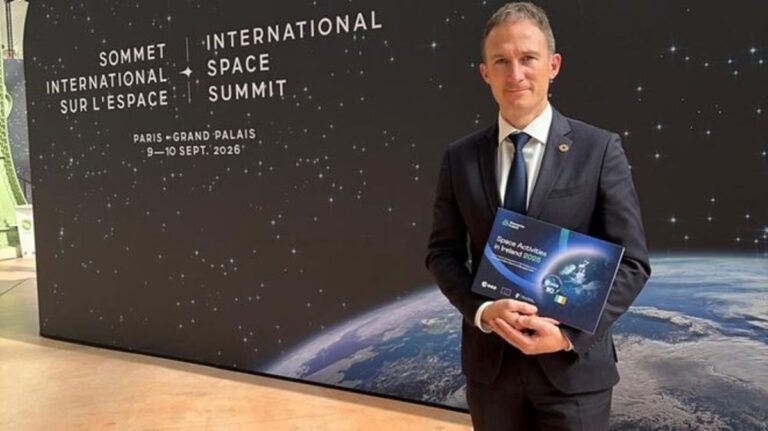
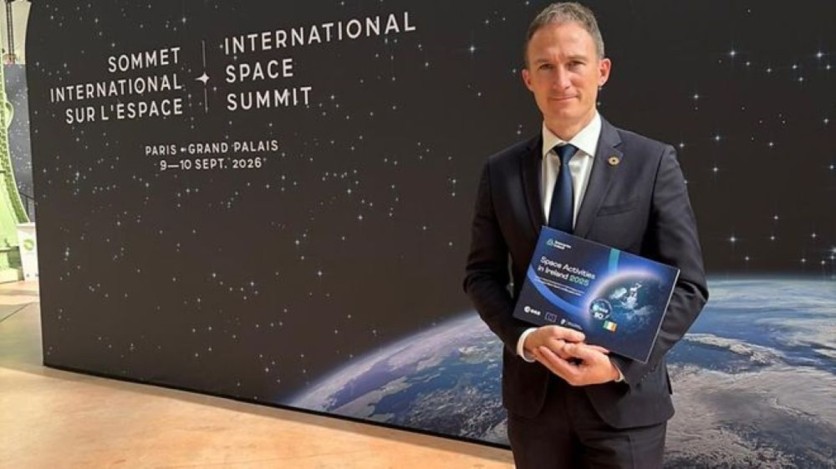
That momentum attracted further investment in 2026. Data released at the International Space Summit in Paris in September 2026 showed that Irish companies had already secured €12.9 million ($14.4M) in ESA contracts in the first half of 2026 alone, with 130 companies now engaged with the agency — four more than at the end of 2025, and four of them winning their first-ever ESA contracts.
From Niche to Infrastructure
The arc of Ireland’s ESA contract performance over six years — from €9.9 million ($11.1M) in 2023 to a run rate that, if the first half of 2026 is indicative, is on course to remain above €25 million ($28M) again this year — reflects something broader than a well-managed government support program finding its stride. It reflects the emergence of Irish companies in categories of space infrastructure that ESA needs and that Ireland was not, until recently, known to supply.
Optical communications hardware from Mbryonics now sits inside ESA’s most ambitious connectivity program. Réaltra’s flight systems have twice been aboard Europe’s primary heavy-lift rocket at the moment of launch, and the company has qualified hardware for a deep-space science flagship. Ubotica’s on-orbit AI processors have demonstrated real-time Earth observation analysis in space — a capability the entire satellite industry is architecturally moving toward. And a generation of university spinouts from NovaUCD and other incubation programs is adding bandwidth in components, frequencies, and agricultural applications that expand the surface area over which Irish companies can compete.
Ireland’s formal entry into ESA’s Space Safety Programme adds one more dimension to that surface area. The program’s cornerstones — space weather forecasting, planetary defense, and debris removal — will produce a decade of industrial contracts. Ireland now has a seat at the table from which to bid for them, backed by a subscription commitment, an institutional pipeline, and a track record of delivering hardware that flies.
(Exchange rate as of November 6, 2026; conversions are approximate.)