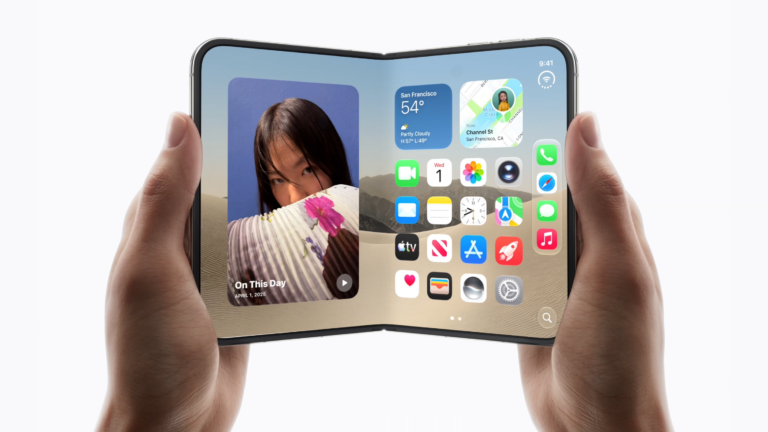
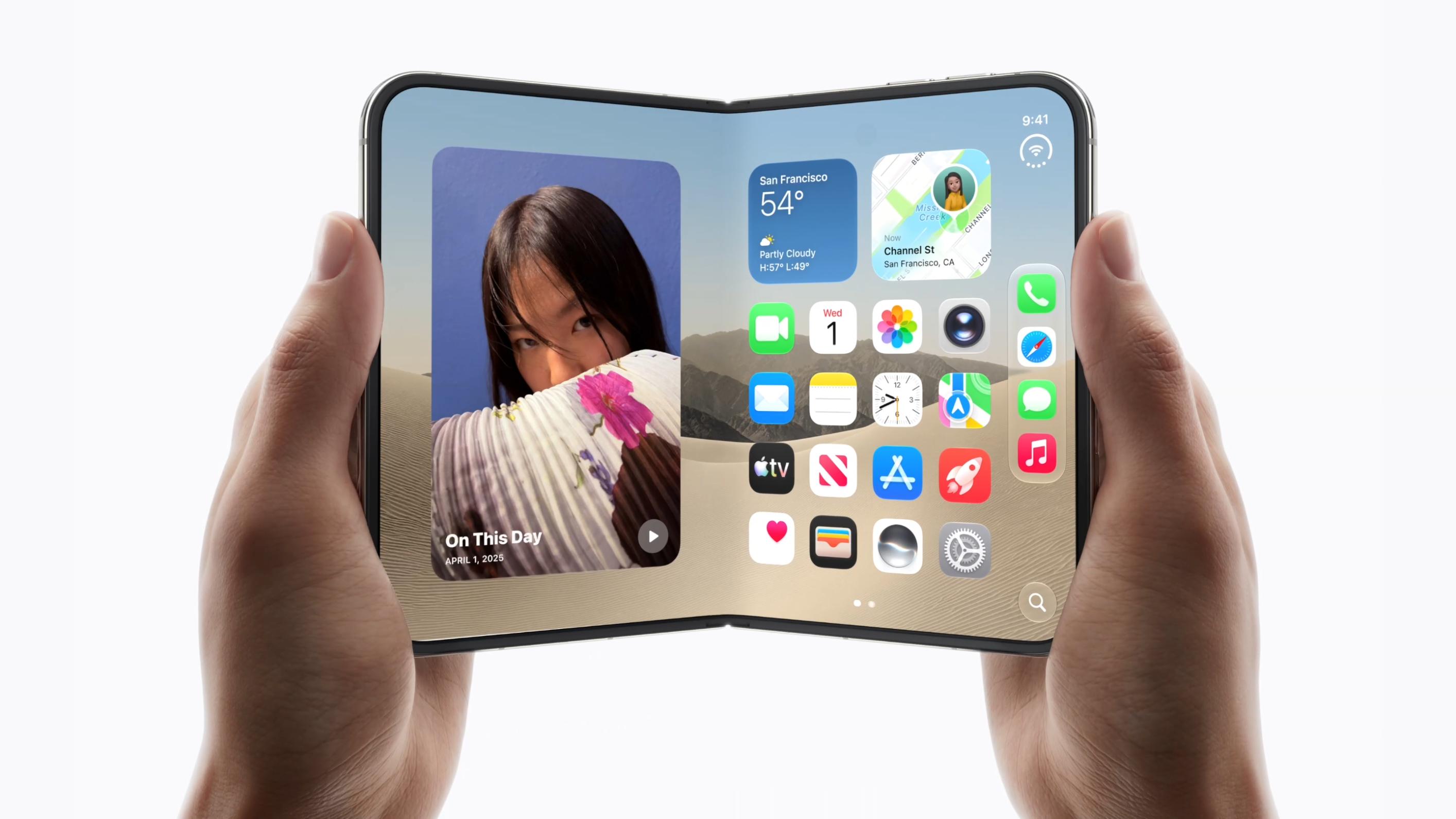
Apple’s “Surprise and Shine” event on Wednesday delivered the company’s first foldable iPhone — named the iPhone Duo, not the “iPhone Ultra” that months of leaks anticipated — at a $1,999 starting price, alongside an iPhone 18 Pro lineup whose variable aperture camera turned out to be available on both the Pro and Pro Max, reversing pre-event predictions that the feature was exclusive to the larger model. New CEO John Ternus, eight days into the job, opened the keynote at Steve Jobs Theater at Apple Park with a privacy-first AI pitch before unveiling a slate of products that included a genuinely unexpected addition: Apple Reference Image, a photo-authentication tool that allows the iPhone 18 Pro to generate a signed, unalterable “digital negative” of every shot taken in Reference mode — aimed squarely at photojournalists and documentary photographers in an era of AI image manipulation.
Ternus Takes the Stage
For 15 years, every Apple fall event opened with Tim Cook walking to center stage at Steve Jobs Theater. On Wednesday afternoon, it was John Ternus who stepped out — and he opened not with a product, but with a position. He told the audience that others see personal data as something to collect and store, and that Apple Intelligence runs on device whenever it can, with Private Cloud Compute extending the same level of privacy protection when greater capability is needed — ensuring that nobody, not even Apple, can access what is yours. That framing came from the TechCrunch event account of the keynote.
The statement was the clearest technology-policy signal Ternus has made since becoming Apple’s CEO on September 1, and it defined the frame for everything that followed: Apple positions its AI ecosystem as the choice for people who want capability without surveillance, staking out territory against Google and Meta’s data-collection models. Cook, now executive chairman, retains responsibility for Apple’s regulatory and diplomatic relationships in the EU and China — the geopolitical dimensions of the CEO role that Ternus has no prior public record on — but the product and AI strategy decisions are now formally Ternus’s, as detailed in TechTimes’s Day One analysis.
iPhone Duo: Apple’s First Foldable
Apple saved the Duo for last. The product is a book-style foldable — similar in form to Samsung’s Galaxy Z Fold series — opening to a 7.6-inch Super Retina XDR inner display with a nano-texture anti-crease coating and ProMotion adaptive refresh. Folded, it presents a 5.4-inch outer screen that delivers 90% of the viewing area of an iPhone 18 Pro, and both panels are rated for outdoor brightness at 3,000 nits per the Apple newsroom iPhone Duo announcement.
The enclosure is grade-5 titanium with a 3D-printed titanium hinge cover. The inner display uses a polymer cover layer with a scratch-resistant coating; Ceramic Shield 2 protects the outer screen. The entire phone carries an IP68 water-resistance rating — a harder certification on a hinged device than on a traditional slab, and a first for a production-volume book-style foldable, as the Creative Bloq event recap noted.
Under the hood, the Duo runs Apple’s A20 Pro chip — the same 2nm silicon as the iPhone 18 Pro — with Apple’s in-house C2 modem. The dual 48MP Fusion camera system supports fast charging to 50% in approximately 20 minutes. Battery life, per Apple’s usage model, is 24 hours running both displays in equal rotation, 31 hours on the inner display alone, and 44 hours using the outer display only.
The Duo also introduced three camera experiences unique to its second screen. Duo Preview turns the outer display into a live viewfinder for the subject being photographed. Kid Cue plays animations on the outer panel to draw a child’s gaze toward the lens, while Smart Take watches the frame automatically and fires the shutter when it detects everyone in position. Duo FaceTime lets a person standing next to the user join a call on the outer panel.
Storage runs from 256GB to 2TB. Colors are Night Sky (deep blue) and Star White. Apple also confirmed that Apple Pencil USB-C support will be available via a software update later in the year, which positions the Duo as a potential iPad mini replacement for Apple ecosystem users willing to accept the $1,999 starting price.
Preorders open October 16; the Duo will be available October 23. Apple has not confirmed a specific preorder time.
For context: the Samsung Galaxy Z Fold 8 Ultra starts at $2,099, and Google’s Pixel 11 Pro Fold starts at $1,899. Apple’s Duo enters the foldable market below Samsung’s flagship and above Google’s, positioning it as the most affordable large-screen book-style foldable from a Western manufacturer.
A20 Pro Chip: Why the 2nm Architecture Is the Real Story
Both the iPhone Duo and the iPhone 18 Pro series ship with the A20 Pro — the first high-volume smartphone processor manufactured on TSMC’s 2-nanometer N2 node. That transition is architecturally significant in a way the version number understates.
Every iPhone chip from the A7 through the A19 Pro used FinFET transistors: the fundamental switch controlling current flow inside the chip was shaped like a three-dimensional fin, with the gate electrode contacting the silicon channel on three sides. At 3nm, the fin is narrow enough that the gate can no longer fully prevent electrical leakage when the transistor should be off — a degradation mode called drain-induced barrier lowering. The 2nm GAA nanosheet architecture replaces the fin with horizontally stacked silicon sheets, each only a few atoms thick, with the gate wrapping around all four sides of each sheet. The additional contact surface eliminates the leakage problem and enables tighter packing of transistors at feature sizes that FinFET physically cannot support. Prior TechTimes coverage of the A20 Pro architecture explains the transistor-level shift in detail.
TSMC’s published specifications for the N2 node target approximately 10 to 15 percent faster CPU performance at equal power consumption, or 25 to 30 percent better energy efficiency at equal performance, compared with the 3nm N3E process used in the A19 Pro. For Siri AI inference — which continuously exchanges data between the Neural Engine and the model weights stored in memory — the efficiency gain matters as much as the raw speed improvement. Battery life reflects this: the iPhone 18 Pro is rated at up to 36 hours of video playback, and the Pro Max at up to 45 hours, the longest ever for an iPhone.
The A20 Pro also uses Wafer-Level Multi-Chip Module packaging, which places the processor and its 12 gigabytes of LPDDR5X memory in closer physical proximity on the same package substrate — reducing the distance data must travel between compute and memory. The practical benefit for on-device AI is that inference latency, which is bounded partly by memory access speed, improves beyond what the transistor shrink alone would produce. TechTimes covered how 12GB RAM gates Siri AI on the iPhone 18 Pro tier.
Apple has also announced its second-generation in-house C2 modem, shipping across the entire iPhone 18 lineup, which enables 5G connectivity over satellite for the first time — not just the emergency-SOS and iMessage satellite features of prior models, but standard mobile data over satellite links. Chip analyst Ben Bajarin told CNBC that Apple will likely eliminate Qualcomm modems altogether with the iPhone 19 generation.
Variable Aperture: On Both Pros — Not Just the Max
A correction to this publication’s pre-event coverage: TechTimes reported on August 27 and September 4 that the variable aperture camera would be exclusive to the iPhone 18 Pro Max. Apple confirmed at the event that both Pro models carry variable aperture.
The mechanism uses six laser-cut blades, each thinner than a human hair, made from a polymer composite engineered for flexibility and durability. The aperture adjusts automatically based on scene conditions — opening wider to capture approximately 50 percent more light in low-light conditions than the fixed aperture on every prior iPhone. Four aperture settings are available manually, and Apple has opened a developer API that exposes the full aperture range to third-party applications. That last detail is significant: professional video and photo apps will be able to control the iPhone’s aperture hardware directly for the first time, replacing years of software-simulated depth of field with genuine optical control.
Apple’s implementation goes substantially further than Samsung’s two-position variable aperture on the 2018 Galaxy S9 — which Samsung discontinued at the Galaxy S20 in 2020. Huawei has continued to offer variable aperture across recent models; Apple arrives last but with continuous adjustment and an open API rather than a fixed-position switch.
The iPhone 18 Pro also introduces Apple Reference Image (see below) alongside the variable aperture, positioning the Pro camera system as a professional tool for documentation and authentication, not only creative photography.
Additional iPhone 18 Pro camera hardware: a new 6-core GPU delivers 40% better graphics performance than the A19 Pro’s. The Dynamic Island is slimmer but now displays up to three Live Activities simultaneously. New colors are Glacier and Burgundy, alongside returning Black and Silver.
The iPhone 18 Pro starts at $1,199 (256GB) and the Pro Max at $1,299 — each $100 more than their predecessors. That increase reflects an industry-wide DRAM shortage driven by AI data center demand: the 12GB of LPDDR5X memory required for on-device Siri AI inference now costs Apple approximately $145 per device, compared with approximately $39 for the equivalent 8GB package in the iPhone 17 Pro — a 272% increase per TechInsights component analysis. TrendForce calculates that memory now accounts for roughly 34% of the iPhone 18 Pro’s total component cost — according to TrendForce iPhone 18 Pro analysis, the first time in iPhone history that memory costs have exceeded processor costs.
iPhone 18 Pro and Pro Max preorders open Saturday, September 12 at midnight PT (3 a.m. ET). Availability is September 18 in more than 65 countries.
Apple Reference Image: What It Proves — and What It Does Not
Apple Reference Image is an opt-in feature for the iPhone 18 Pro and iPhone 18 Pro Max. When enabled, the phone’s new main camera sensor captures signed sensor data at the pixel level alongside the normal shot. Apple’s Private Cloud Compute service processes that signed data into an unalterable file — the “digital negative” — which lands in the Photos app next to the corresponding photograph. Hold the two side by side, digitally, and every change made between the reference and any later version of the image is visible, as MacRumors Reference Image coverage detailed.
Apple has also announced support for the SynthID standard — Google DeepMind’s cryptographic watermarking system, already deployed across Google’s generative AI tools and adopted by OpenAI for ChatGPT-generated images — arriving in iOS 27 via a software update later in 2026. SynthID markers will be embedded in images generated or edited using Apple Intelligence tools, including Image Playgrounds and the new Extend and Spatial Reframe editing features, as reported by 9to5Mac on SynthID support. Together, the two systems address different halves of the AI-image problem: Reference Image says a real-world scene was captured by a real sensor without subsequent editing; SynthID marks content that AI generated or altered.
One limitation matters for photojournalism applications, as the TechCrunch Reference Image explainer notes: Apple Reference Image establishes that a photo was taken by an iPhone 18 Pro sensor and was not edited after capture. It does not — and cannot — establish that the scene depicted was real, unstaged, or accurately described by its caption. A perfectly authenticated Reference Image can still accompany a misleading caption or depict a staged event. The technology is a meaningful layer of provenance, not a complete solution to photographic deception.
Reference Image will not be available at launch in China (regulatory requirements) or for capture in the EU, though EU users on iOS/iPadOS/macOS 27 will be able to develop and view Reference Images captured elsewhere.
Apple Watch Series 12 and Ultra 4
Apple Watch Series 12 (from $399) ships with a new Health Sensing System that samples heart rate every five seconds throughout the day and measures heart rate variability approximately every five minutes — up to 24 times more often than the previous generation. Those readings feed a daily readiness score displayed as one of four states: Recover, Pace Yourself, Ready, or Go For It. Aluminum models now include Ceramic Shield 2, which Apple rates 60% tougher than the Ion-X glass it replaces. A 15-minute charge delivers up to 12 hours of use per the Apple Watch announcement.
Apple Watch Ultra 4 (from $799 — unchanged from Ultra 3) extends battery life significantly: rated at up to 50 hours in standard use, 84 hours in Low Power Mode, and 45 hours during continuous Max Extended Workout tracking. The case is 3D-printed from 100% recycled titanium per the Apple Watch Ultra 4 announcement. Both watches are available for preorder now and ship September 18.
AirPods 5: ANC at $129
AirPods 5 bring active noise cancellation to Apple’s entry-level earbuds for the first time, at $129 — down from $179 for ANC AirPods a year ago, the sharpest price drop for ANC in the AirPods lineup’s history. Apple says the AirPods 5 offer 50% better noise reduction than the previous AirPods 4, along with automatic switching between ANC and Transparency modes based on the surrounding environment. A second model at $149 includes a touch-sensitive stem for volume control. Preorders are open; both ship September 18.
iOS 27 and Siri AI: Who Gets What
iOS 27 will be available as a free update on September 14. The rebuilt Siri AI — which requires a minimum of 12GB of unified memory and is thus limited to iPhone Air, iPhone 17 Pro/Max, and the new iPhone 18 Pro tier — launches in English beta that day, with French, Japanese, Korean, Portuguese, and Spanish support following in October, per TechTimes’s Siri AI compatibility guide.
Apple confirmed at the event that Siri AI features running on its server-side models will be subject to daily usage limits with expanded access available for a fee in the future — the most direct signal yet that Apple Intelligence will eventually carry a subscription component. The EU will not receive Siri AI at launch. China will also not receive it at launch. Cook retains responsibility for the regulatory negotiations in both jurisdictions.
Frequently Asked Questions
Does the iPhone 18 Pro have the variable aperture camera, or is it only on the Pro Max?
Both models. Apple confirmed at the “Surprise and Shine” event that both the iPhone 18 Pro and iPhone 18 Pro Max include a variable aperture main camera — a six-blade mechanism that adjusts the lens opening from a wide position (approximately 50% more light than the fixed aperture on prior iPhones) to a narrow position for brighter conditions. Pre-event leaks, including reporting in this publication, had suggested the feature would be exclusive to the Pro Max. Apple’s announcement made it available on both, as confirmed in the official iPhone 18 Pro press release.
What does Apple Reference Image actually prove — and what doesn’t it prove?
Apple Reference Image proves that a specific photo was captured by an iPhone 18 Pro sensor and was not edited after capture. The sensor signs the pixel-level data at the moment of capture; Private Cloud Compute develops it into an unalterable reference file. Any post-capture editing — cropping, color adjustment, compositing, AI manipulation — will show up when the edited image is compared against the reference. What it cannot prove is that the scene depicted was real, that the subject was accurately described, or that the photograph is not staged. Provenance authentication is a meaningful tool for verifying photographic integrity; it is not a complete solution to photographic deception, as MacRumors’s Reference Image explainer noted.
Why does the iPhone 18 Pro cost $100 more than the iPhone 17 Pro did?
The primary cause is an AI-driven shortage in the global memory chip supply. Apple equipped the iPhone 18 Pro with 12GB of LPDDR5X memory — the minimum required to run on-device Siri AI inference — at a time when Samsung, SK Hynix, and Micron have diverted fabrication capacity toward high-bandwidth memory for AI data centers. TechInsights estimates the 12GB LPDDR5X package costs Apple approximately $145, compared with approximately $39 for the 8GB package in the iPhone 17 Pro — a 272% increase for the same quantity of chip type. TrendForce calculates that memory now represents roughly 34% of the iPhone 18 Pro’s total component cost, the first time in iPhone history that memory costs have exceeded processor costs.
When does the iPhone Duo go on sale, and what are the trade-offs worth knowing before preordering?
iPhone Duo preorders open October 16; availability is October 23, at $1,999 for the 256GB model. The engineering trade-offs of the current foldable form factor apply to the Duo as they have to every book-style foldable before it: Face ID cannot fit in a chassis approximately 4.5mm thin when unfolded (the Duo uses Touch ID in the power button), and the lack of a periscope telephoto assembly means the Duo’s camera system is less capable than the iPhone 18 Pro Max on zoom. Initial supply is expected to be limited — analysts have projected initial quarterly volumes below 1 million units, echoing the iPhone X’s delayed availability in 2017. The second and third generation of any Apple foldable will likely close the capability gaps the first cannot.