Inter BEE Demo: RME ADI-2/4 Pro EX Lists 127 dBA Noise Spec Only at +24 dBu Input Setting

November 19, 2026:

Inter BEE Demo: RME ADI-2/4 Pro EX Lists 127 dBA Noise Spec Only at +24 dBu Input Setting
RME ADI-2/4 Pro EX
Rme-audio.de

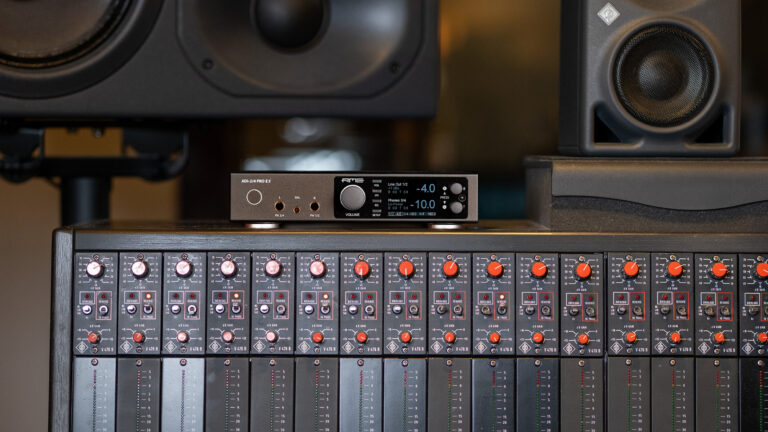
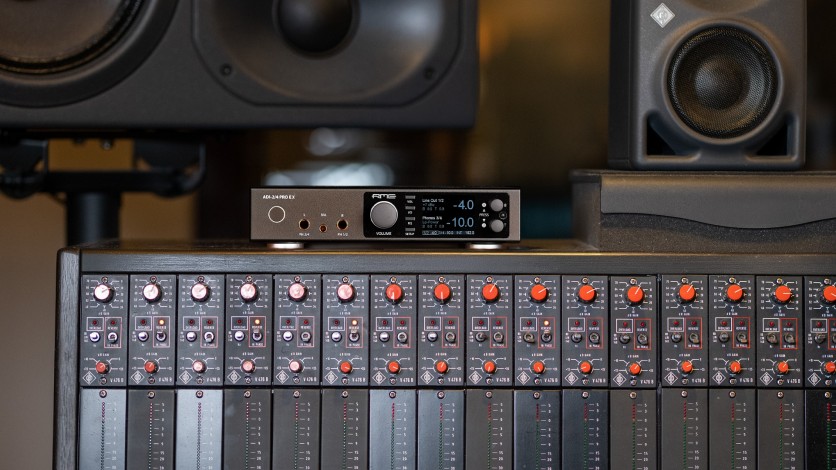
RME’s flagship ADI-2/4 Pro EX converter reaches its headline 127 dBA noise figure only at its highest input setting, +24 dBu, and RME’s own table drops to 123.5 dBA at +1 dBu. Genelec Japan is demonstrating the converter, which US dealers list at $2,999, with its 8380A monitor at Inter BEE 2026 in Makuhari Messe, Chiba, through Friday, Nov. 20, according to PHILE WEB.

Genelec Japan Runs Reservation-Only 8380A Room in Hall 2, Booth 2602

Inter BEE, billed as the 62nd edition, opened Wednesday at 10 a.m. Japan time (8 p.m. ET Tuesday) at Makuhari Messe and runs through Friday. Admission is free, but visitors must register. Hours are 10 a.m. to 5:30 p.m. Japan time on Thursday, Nov. 19 (8 p.m. Wednesday to 3:30 a.m. Thursday ET), and 10 a.m. to 5 p.m. on Friday, Nov. 20 (8 p.m. Thursday to 3 a.m. Friday ET), according to the exhibition guide.

Genelec Japan’s own exhibit notice lists Hall 2, booth 2602, with a reservation-only two-channel listening room for the 8380A. Sessions run 15 minutes for up to three people, and visitors sign up in person at booth reception from 10 a.m. each day. The notice also lists an immersive-sound corner built on The Ones monitors and the 9402A network audio interface, which its heading calls 11.1-channel while the body text describes a 7.1.4 layout. The notice does not mention the converter. The pairing, and the claim that this is the ADI-2/4 Pro EX’s first public showing in Japan, come from PHILE WEB’s on-site report, which does not mention a Japanese price or release date. Genelec Japan is the Japanese distributor of RME.

The 8380A was not audible on the show floor a year ago. PHILE WEB reported in 2025 that Genelec offered no live 8380A demonstration at Inter BEE and sent visitors to its Genelec Experience Center Tokyo in Akasaka instead.

Does RME’s 127 dBA Figure Apply to Every Input Setting?

No. RME’s specification table gives a different analog-to-digital signal-to-noise ratio for each analog input sensitivity setting, and the best value belongs to +24 dBu, the setting that leaves the most headroom for loud analog signals.

Input sensitivity (0 dBFS equals) SNR, unweighted (AES17) SNR, A-weighted

+24 dBu

125 dB

127 dBA

+13 or +19 dBu

124 dB

126 dBA

+7 dBu

123 dB

125 dBA

+1 dBu

121.5 dB

123.5 dBA

Phono (RIAA), +14 or +20 dB gain

88 dB

92 dBA

Phono (RIAA), +38 dB gain

68 dB

73 dBA

RME manufacturer specifications; phono rows measured from 20 Hz to 20 kHz.

RME’s table continues with digital gain steps that accept lower-level sources: 119.5 dBA at -5 dBu and 89 dBA at -35 dBu. The phono input, which RME pairs with RIAA equalization and a ground screw for turntables, tops out at 92 dBA, about 35 dBA below the line-level headline.

The weighting matters as much as the level. The A-weighted figure runs 2 dB above RME’s unweighted AES17 number in every line-level row, because A-weighting reduces the weight of low-frequency noise that hearing picks up less well. Signal-to-noise ratio requires a reference signal, and weighting filters are often applied to the noise. A competitor’s “up to” figure measured at a different level or with different weighting is therefore not the same measurement.

Against the predecessor, the gain is narrower than the headline suggests. RME lists the ADI-2/4 Pro SE at 123 dBA or better on its analog inputs. That makes the EX up to 4 dBA higher at the top setting and 0.5 dBA higher at +1 dBu, by RME’s own tables.

ESS Chips Rate +128 dB and +130 dB, but Board Design Sets Final Figures

RME’s product page names an ESS ES9823Pro as the A/D converter and an ESS ES9039Q2M as the D/A converter, handling 32-bit audio up to 768 kHz. ESS rates the ES9823PRO at +128 dB dynamic range and -117 dB THD+N, and the ES9039Q2M at +130 dB dynamic range and -120 dB THD+N. RME’s 127 dBA A/D figure therefore sits about 1 dB under the chip’s rating, and its balanced-output figure of 126 dBA sits 4 dB under the D/A chip’s. The metrics differ, since RME quotes signal-to-noise at a reference level and the ES9039Q2M datasheet measures dynamic range at -60 dBFS, so the comparison is indicative only. It still shows that the chip sets a ceiling and the analog circuitry around it decides how much of that ceiling reaches the output jack.

ESS says the ES9823PRO line reaches +130 dB in mono mode and more than 136 dB when two devices run in its multi-chip configuration. RME’s product page, as reviewed, does not say whether the EX uses either scheme.

Converters in this class generally rely on oversampling and noise shaping, which move quantization noise above the audio band, where a digital filter removes it. The same overview cautions that theoretical figures ignore other circuit noise, which limits what a real design delivers. At 768 kHz sampling, RME lists the A/D response within 1 dB from 0.15 Hz to 290 kHz.

SteadyClock EX is the other headline change. RME says the internal clock is factory calibrated to ±1 ppm and can be trimmed by ±50 ppm in 0.1 ppm steps, and Recording magazine reports it uses a hand-selected quartz oscillator. Parts per million describe how far the average clock frequency may sit from its nominal value. Jitter, a deviation from true periodicity that can add clicks to audio, is a separate measure. RME’s product page, as reviewed, lists jitter suppression above 50 dB for external clock inputs but no internal-clock jitter figure. A calibrated oscillator matters most when several devices must share one sample rate, and RME says the unit can synchronize to outside equipment without a word clock connection, a feature it calls Sync without Sync.

8380A Claims 0 dB SPL Self-Noise, A-Weighted at 1 m in Free Space

Genelec lists the 8380A’s self-generated noise at 0 dB SPL or less, A-weighted and measured at 1 m (3.3 ft) on axis in free space. The monitor pairs a 15-inch woofer with Genelec’s MDC coaxial driver, a 25 mm (1 in) metal dome tweeter at the center of a midrange cone whose profile forms an integrated directivity control waveguide. Amplification is 500 W Class D for bass, 250 W Class D for midrange and 200 W Class AB for treble, in a silently cooled RAM-L2 amplifier. Genelec lists 29 Hz to 43 kHz (-6 dB), a short-term maximum of 122 dB SPL, and a weight of 54 kg (119 lb) in a cabinet 810 by 480 by 420 mm (31.9 by 18.9 by 16.5 in), height by width by depth. Genelec announced the 8380A on Sept. 30, 2025, and it shares its dimensions with the 1038 and 1238 monitors. It is sold in black or white.

Booth staff told PHILE WEB the monitor holds a consistent, uncolored sound with precise imaging at distances as short as 1.3 m (4.3 ft), and that it produces no noise even with the volume at maximum. Those are demonstrator claims made in a show-floor room, not the free-field condition in Genelec’s specification. Pat Brown writes in SVC that even the quietest listening rooms carry ambient noise at least 20 dB above the threshold of hearing, which suggests room noise, not speaker self-noise, sets the floor a listener hears.

Two design caveats apply. Wikipedia’s overview of coaxial loudspeakers lists woofer diffraction and intermodulation distortion as known drawbacks of the design class that grow with output level, while Genelec says its MDC design has no acoustic discontinuity between tweeter and midrange. Staff also told PHILE WEB that no speaker sounds good simply by being placed in a room, a remark tied to Genelec’s GLM room correction software. Digital room correction cannot hold a perfect inverse away from the measurement point, so designers favor robustness over peak accuracy.

US Dealers List ADI-2/4 Pro EX at $2,999; Japan Price and Date Not Reported

Two US dealers list the converter at $2,999: Pro Audio Design’s product page and Vintage King’s product page. Neither shows a ship date, and Vintage King says the unit ships directly from RME and offers an ETA request. PHILE WEB’s report does not mention a Japanese price or release date.

A sibling model offers a precedent, not a forecast. Genelec Japan showed the ADI-2 Pro EX at a Tokyo headphone show on July 18 and put it on sale Oct. 2 at an open price, 76 days later.

The 8380A is priced separately. UK retailer KMR Audio lists a white pair at £16,499 including VAT (approximately $21,726), or £13,749.17 before VAT (approximately $18,105).

Independent Measurements Will Decide Whether 127 dBA Matters

No independent measurement of the ADI-2/4 Pro EX had surfaced in searches as of Nov. 18, so every converter figure above is RME’s own specification.

Sound On Sound’s Hugh Robjohns wrote in his imersiv D-1 review that the best converter he had measured before it reached a dynamic range of around 125 dB, and that the top seven converters he had tested all exceeded 124.5 dB AES17 dynamic range. The D-1 itself measured 140.8 dB A-weighted, a figure he says largely reflects the limits of his test equipment. RME’s published numbers sit in or near the 125 dB tier, with the caveat that RME’s and Robjohns’s measurement conditions differ. At that level, noise floor alone rarely separates products, and the practical test is whether a real room and real source material reveal anything above it.

For readers weighing the converter, four checks decide the question: which input sensitivity your sources need, whether the 127 dBA figure applies at that setting, how the unit measures once independent labs test it, and what Genelec Japan, which handles RME in Japan, will charge and when. For readers at Inter BEE, free registration and a same-day booth sign-up for the 8380A room in Hall 2 are the two requirements for hearing the demo PHILE WEB describes before the show closes at 5 p.m. Japan time Friday (3 a.m. ET Friday).

Currency conversions use the Nov. 18, 2026 exchange rate (£1 = $1.3168) and are approximate.


Frequently Asked Questions

Is a 127 dBA noise figure the same as a 127 dB signal-to-noise ratio?

Not exactly. The A-weighted figure applies a filter that discounts low-frequency noise the ear hears less well, so it reads higher than an unweighted figure. In RME’s published specification table the A-weighted number is 2 dB above the AES17 number in every line-level row, and both depend on the input setting. A-weighting is defined in IEC 61672.

Can I hear the Genelec 8380A with the ADI-2/4 Pro EX at Inter BEE?

Genelec Japan lists a reservation-only two-channel room with the 8380A at Hall 2, booth 2602, according to Genelec Japan’s booth notice. PHILE WEB reports that the room uses the converter as its playback source, while the notice itself does not mention it. Per the notice, visitors write their name in a time slot at booth reception from 10 a.m. each day, and sessions last 15 minutes for up to three people. Inter BEE also requires free advance registration.

What changed from the ADI-2/4 Pro SE?

RME’s launch materials cite upgraded ESS conversion technology, SteadyClock EX with factory-calibrated clock precision, a USB-C connection and a ground screw for turntables. By RME’s tables, the top-setting analog input noise figure rises by up to 4 dBA.

Does a ±1 ppm clock reduce jitter?

Not by itself. Parts per million measure frequency accuracy, while jitter is timing variation from cycle to cycle. RME lists ±1 ppm factory calibration, and its product page, as reviewed, shows no internal-clock jitter figure.

Source link