HomeAuto InnoTrans 2026 Sets Record 3,170 Exhibitors; AI Earns First-Ever Dedicated Hall
InnoTrans 2026 Sets Record 3,170 Exhibitors; AI Earns First-Ever Dedicated Hall
September 25, 2026:
Innotrans.de
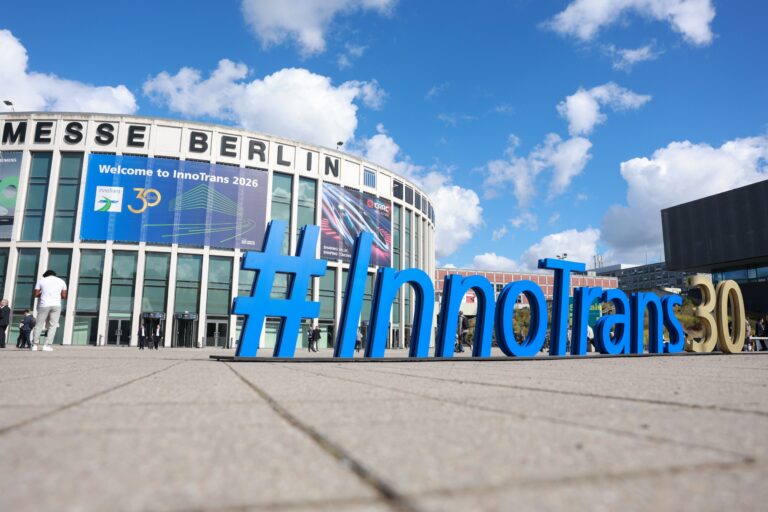
The world’s largest transport technology trade fair will close its doors today at 4:00 p.m. local time at the Berlin Exhibition Grounds (ExpoCenter City, Messe Berlin), on track to wrap a four-day run that exhibitors, officials, and industry observers have called the most consequential edition in the event’s 30-year history. For the first time, InnoTrans gave artificial intelligence its own dedicated hall — a structural signal that AI has moved from rail’s R&D margins into its operational core. More details on the AI Mobility Lab expansion are available on the official InnoTrans site.
From 172 Exhibitors to 3,170: Three Decades of Scale
When InnoTrans held its premiere in Berlin in October 1996, 172 companies showed up — 21 of them from outside Germany — and the event occupied just 4,524 square meters (about 48,700 sq ft) of exhibition space. The Wikipedia entry tracking InnoTrans editions documents this growth in detail. Thirty years later, the 15th edition sold out all 42 halls of the Berlin Exhibition Center, covering a gross exhibition area of 200,000 square meters (approximately 2.15 million sq ft), a completely different category of event. Per the official InnoTrans press release, the final exhibitor count reached 3,170 companies from 59 countries.
The scale of the 2026 edition broke every prior InnoTrans record. The show drew 3,170 exhibitors from 59 countries — roughly 200 more companies than attended InnoTrans 2024, which had itself set a record at 2,946. Around 700 of those companies were attending InnoTrans for the first time, according to Kerstin Schulz, director of InnoTrans — a figure she described as sending “a strong signal from the industry.” Thirty-two national pavilions from 25 countries were represented, including Japan, Brazil, Zimbabwe, and Argentina, alongside 14 official delegation tours from Finland, the United States, Canada, and India.
“Thirty years after the first InnoTrans, we’ve set a new record with 3,170 exhibitors,” said Dirk Hoffmann, COO of Messe Berlin. “InnoTrans is where the global rail industry comes together — to initiate business deals, strengthen partnerships, and collaborate on the major mobility projects of the coming years.”
Visitors are expected to top 175,000 across the four days — up from the 169,214 who attended in 2024. Final figures will be published by Messe Berlin after today’s closing.
Day 1: “Mobility on a Global Scale”
InnoTrans 2026 opened Tuesday, September 22, with a high-profile ceremony at palais.Berlin before more than 1,800 invited industry representatives. The gathering brought together Germany’s Federal Minister of Transport Steffen Bilger, EU Commissioner for Sustainable Transport and Tourism Apostolos Tzitzikostas, and the chief executives of Alstom, Siemens Mobility, Škoda Group, and the California High Speed Rail Authority, among others.
The ceremony title — “Mobility on a Global Scale: Shaping Projects and Growth Opportunities” — set the week’s tone.
“Rail is one of the most important projects for the future of modern mobility,” Bilger told the audience. “No other system transports so many people and so much freight in such an energy-efficient and climate-friendly way. InnoTrans shows us what modern mobility will look like tomorrow.”
Tzitzikostas framed Europe’s ambition in commercial terms. “InnoTrans is an opportunity to strengthen partnerships and assess global markets,” he said. “We are convinced that Europe’s railway technology, open standards, and regulatory expertise make us an attractive international partner and a promising option for connectivity.”
Also on Tuesday, the UNIFE World Rail Market Study findings were presented at the UNIFE stand in Hall 4.2 — an annual barometer of global rail investment that shapes procurement decisions across dozens of networks.
What 180 World Premieres Looked Like on the Track
The show’s 3,500 meters (approximately 11,484 feet, or about 2.2 miles) of outdoor track hosted 113 vehicles from 17 countries — the largest rolling stock display in InnoTrans history. Among the 180 world premieres announced across all segments, the technical headliners drew immediate attention.
CRRC — China’s state-owned rolling stock conglomerate and the world’s largest railway manufacturer by revenue — unveiled a 2,000-kilowatt hydrogen fuel cell hybrid locomotive for the first time. The design pairs fuel cells with batteries, handling peak-demand loads during acceleration via battery and using fuel cells for sustained running power, maximizing hydrogen efficiency. The locomotive also incorporates an intelligent driving platform built on deep learning, with 360-degree environmental detection and multi-sensor data fusion combining cameras, radar, and LiDAR.
Siemens Mobility showcased its new Vectron X platform, and Alstom brought three vehicles to the track display along with three night train concept mock-ups — reflecting a broader industry revival of interest in overnight rail travel.
What ERTMS Is, and Why Europe Spent Four Days Talking About It
To understand why ERTMS dominated the InnoTrans Convention agenda, it helps to know what problem it solves. Europe’s rail network was historically built nation by nation, each country deploying its own train control system — how a locomotive’s cab receives speed instructions, how the trackside infrastructure communicates stop and go. By the early 1990s, at least 20 incompatible national systems existed, meaning a cross-border train could not simply roll from Germany into France without a driver switching systems, or without the locomotive being equipped with multiple onboard units — a costly, operationally complex burden.
The European Rail Traffic Management System (ERTMS) was mandated by EU Council Directive 96/48/EC precisely to end that fragmentation. ERTMS has two core technical components: ETCS (the European Train Control System), a cab-signalling architecture that continuously supervises train speed and applies automatic braking if a safe limit is exceeded, and GSM-R (now transitioning to its successor, FRMCS — the Future Railway Mobile Communication System), which handles voice and data transmission between trains and control centers. A train equipped with ERTMS can in principle operate on any ERTMS-equipped line regardless of which supplier built the trackside equipment or the onboard unit — because the specification is vendor-neutral by design. More than 100,000 kilometers (about 62,100 miles) of track have been contracted for ERTMS deployment globally, and more than half of that is outside Europe.
The UNIFE Dialogue Forum on Thursday, September 24 — “Shaping the Future of ERTMS: Success Stories and Future Outlook” — was the centerpiece of the week’s convention programming. A Political Focus session at UNIFE drew infrastructure managers and senior EU officials, while a Technical Focus track examined deployment challenges from Asia to the Alpine regional lines. The Rail Industry Association’s final-day session on Friday addressed ERTMS deployment alongside cybersecurity — the two transformation priorities that organizations from the VDB to ZVEI spent the week debating.
AI Gets Its Own Hall: What That Means for the Industry
The single most structurally significant development at InnoTrans 2026 — the one that will be cited in industry assessments of this edition for years — is that artificial intelligence received a dedicated hall for the first time.
This was not a rebrand of an existing technology corner. The AI Mobility Lab, which debuted at InnoTrans 2024 as a specialized sub-area within the Public Transport segment, returned in 2026 as a stand-alone hall — Hall 7.1a — with 47 exhibitors focused on AI-based solutions, cybersecurity, data protection, and robotics. Twenty-eight of those 47 companies were attending InnoTrans for the first time, bringing a supply chain that did not exist at the previous edition. The AI Mobility Lab Hall 7.1a is the first dedicated AI exhibition space in InnoTrans history.
What that supply chain actually offers tells the story. OTIV — a Belgian company — demonstrated AI systems that allow rail vehicles to operate autonomously and automate train operation without requiring dedicated infrastructure modifications. Scout Robotics showed autonomous rail inspection systems designed to survey track and vehicle condition without human operators on-site. Downer, the Australian infrastructure company, demonstrated an end-to-end automated inspection pipeline: drones plus LiDAR, laser, and optical sensors collect condition data, machine learning flags anomalies, and a fully automated workflow produces a maintenance report with no human in the loop until the decision stage.
Knorr-Bremse’s LEADER Flow system illustrated AI operating at a different scale — not on a single vehicle, but across a network. The driver assistance platform integrates real-time traffic data from ahead on the same corridor, enabling a driver to anticipate stops and adjust speed proactively rather than braking reactively. The company says average energy savings exceeded 10 percent in testing — a figure that, if replicated at scale, represents a substantial operating cost reduction for high-frequency corridors.
“The 180 world premieres impressively demonstrate the pace at which the rail industry is driving innovation,” said InnoTrans director Kerstin Schulz. “It is particularly exciting to see that artificial intelligence is increasingly being applied in very specific ways — from inspection and energy-efficient operation to the passenger experience.”
Two AI-guided tours ran each day of the show, taking attendees through the halls to AI exhibitors across all five segments. Robotics tours — a first for InnoTrans — also ran all four days.
Days 2 and 3: Convention Deep-Dives, Cybersecurity, and a Night Focused on Asia
Wednesday and Thursday packed the InnoTrans Convention with parallel tracks. Wednesday sessions at the UNIFE stand included a Global Gateway panel on EU rail connectivity, a dedicated cybersecurity session involving Siemens Mobility, Alstom, and the Kombud Group, and the UNIFE SMEs Award ceremony — which recognized Finnish signals company Mipro among others.
Wednesday also launched the “AI on Track” Hackathon, bringing more than 50 programmers from around the world to work on specific rail industry challenges in real time, with awards scheduled for today’s closing.
Thursday’s UNIFE Dialogue Forum on ERTMS drew the week’s highest-profile policy discussion. Separately, a battery technology panel examined the evolution of onboard energy storage — covering suppliers from SAFT and Alstom alongside the NEXRAIL initiative — reflecting the industry’s parallel pursuit of hydrogen, battery, and catenary-extension strategies for decarbonizing non-electrified lines.
Thursday’s Anniversary Night — InnoTrans Goes Asia — previewed a significant structural expansion for the show. InnoTrans Asia, a dedicated spinoff trade fair targeting the Asian market, will make its debut in Singapore on September 7–9, 2027 at the Singapore Expo. The Berlin edition featured InnoTrans Asia’s first-ever exhibition booth. The 2026 edition already pointed in this direction: India, Qatar, Saudi Arabia, and the UAE were among the national delegations present in Berlin this week.
The Rail Leaders’ Summit — an invitation-only gathering of executives and ministry officials — examined railway resilience and infrastructure strategy in a challenging operating environment. Parallel forums covered tunnelling, interior design, and the public transport and bus ecosystem.
What Is Still to Come Before Closing
As of this writing, InnoTrans 2026 remains open. The Hackathon awards and Railway Influencer Festival prize ceremony — four categories including a new Best Urban Mobility Video award — are scheduled for this afternoon before today’s 4:00 p.m. close. The number of Railway Influencer Festival participants has doubled since its 2024 debut.
Today is also traditionally University Day, welcoming students from across Germany for a final round of Career Tours to more than 40 exhibitors and sessions at the Recruiting Lab.
How Was This Different from InnoTrans 2024?
Three structural differences distinguish 2026 from its predecessor. First, scale: 3,170 exhibitors versus 2,946 in 2024, with the entire Messe Berlin site sold out for only the second time. Second, AI maturity: in 2024, the AI Mobility Lab debuted as a themed area within the Public Transport segment; in 2026 it became a dedicated hall — a physical indicator that the supply industry for rail AI has grown large enough to merit its own floor space. Third, geographic expansion: 2026 is the first edition where InnoTrans Asia received a physical presence at the Berlin event, signaling the formal launch of what Messe Berlin intends to be a biennial parallel event in the world’s fastest-growing rail market.
What Comes Next
With the show closing today, the industry’s attention will move quickly to InnoTrans Asia 2027 in Singapore (September 7–9) and to InnoTrans 2028 in Berlin, for which stand applications are already being accepted.
The themes that dominated this week — AI in operations and maintenance, ERTMS rollout across EU corridors, cybersecurity under the NIS2 framework, autonomous public transport, hydrogen and battery propulsion for non-electrified lines, and the night train revival — are not conference themes. They are funded procurement priorities for a sector that moves on multi-decade infrastructure cycles. The decisions that begin in Berlin this week will be riding the rails well into the 2040s.
Frequently Asked Questions
What is the AI Mobility Lab at InnoTrans, and why does having its own hall matter?
The AI Mobility Lab is a dedicated exhibition area at InnoTrans focused on artificial intelligence, robotics, cybersecurity, and data protection for transport systems. It debuted in 2024 as a themed area within the Public Transport segment; in 2026 it became a stand-alone hall — Hall 7.1a — with 47 exhibitors, 28 of them first-time InnoTrans participants. The upgrade from themed area to dedicated hall signals that the commercial ecosystem supporting AI deployment in rail has grown large enough to fill its own space. It also reflects a broader industry consensus: AI in rail is no longer a research horizon. Companies like OTIV (autonomous train operation), Scout Robotics (autonomous inspection), and Downer (fully automated maintenance pipelines) are offering deployed products, not prototypes.
What is ERTMS and why was it the dominant policy topic at InnoTrans 2026?
ERTMS — the European Rail Traffic Management System — is the EU-mandated standard designed to replace more than 20 incompatible national rail signalling systems with a single interoperable architecture. Its core components are ETCS, which provides continuous cab-based speed supervision and automatic train protection, and GSM-R (now transitioning to FRMCS), which handles communication between trains and control centers. A train equipped with ERTMS can in principle operate across any ERTMS-equipped line in Europe without changing onboard equipment. More than 100,000 kilometers (about 62,100 miles) of track have been contracted for ERTMS deployment globally. The UNIFE Dialogue Forum dedicated an entire morning to ERTMS on Day 3, reflecting political pressure from both the EU Commission and national transport ministries to accelerate deployment — and the rail industry’s recognition that interoperability is the single largest enabler of competitive cross-border services.
How does the CRRC hydrogen-AI locomotive work, and what is significant about it?
CRRC’s InnoTrans world premiere pairs a 2,000-kilowatt hydrogen fuel cell system with onboard traction batteries. The fuel cells generate electricity from hydrogen (emitting only water), while batteries handle peak demand — primarily acceleration — using stored energy and then recharging during cruising or braking. The intelligent driving platform built on deep learning fuses data from cameras, radar, and LiDAR in a 360-degree sensor array to enable autonomous or semi-autonomous operation. The significance is twofold: it demonstrates that hydrogen propulsion for heavy rail is commercially mature enough to unveil a world premiere (not just a feasibility study), and it shows CRRC integrating AI autonomy into propulsion innovation simultaneously — a convergence that European manufacturers are also pursuing but have not yet showcased at this scale in a single vehicle.
When is InnoTrans Asia 2027, and how is it different from the Berlin event?
InnoTrans Asia will make its debut September 7–9, 2027 at the Singapore Expo. It is specifically organized for the Asian market and is distinct from the Berlin biennial — a separate event, not a traveling version. The 2026 Berlin edition featured InnoTrans Asia’s inaugural exhibition booth, previewing the new show to the global audience assembled in Berlin. The Asia edition reflects the structural reality that rail investment in South and East Asia has outpaced Europe in volume terms, and that a dedicated regional event is commercially viable. The next Berlin edition — InnoTrans 2028 — is already accepting stand applications.