September 21, 2026:


Indie developer Studio Yeoun has pulled back the curtain on Mihira: The Eternal Arc, an upcoming PC action-RPG that slots three distinct design systems into a single cohesive title: a dual-timeline palace that physically exists in two temporal states at once, souls-influenced precision combat against boss-type enemies called Timekeepers, and a social stealth layer built around crowd-blending — a combination no prior indie title has formalized in this exact architecture. The gameplay trailer is now available, arriving during the current Tokyo Game Show 2026 public days at Makuhari Messe in Chiba, Japan — one of the highest-visibility windows in the annual gaming calendar, and coinciding with the Steam Party-Based RPG Fest, which runs through September 21.
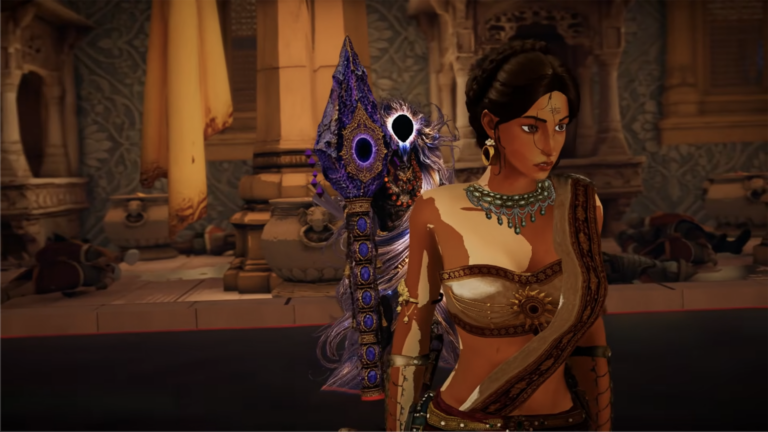
At the center of the game is a female protagonist who awakens the Eternal Arc, a power tied to the fabric of time itself, inside a palace where past and present have lost their separation. Her goal is to recover the Varunavarta — fragments of the timeline — before the world’s causal structure collapses entirely. What drives the story is not simply a journey through ruins but a race against unraveling fate, where every recovered fragment closes off a possibility that vanishes from the timeline permanently.
The emotional register is mythological weight pressed into personal stakes. This is not a protagonist navigating a vague fantasy world; she is caught at the intersection of ancient powers and factional conflict inside a single location that happens to exist in two historical states. The trailer’s dialogue snippets and environmental storytelling both lean into consequence: choices ripple across timelines, and the palace’s two versions reflect what has been lost and what might yet be preserved. The specific detail that grounds this — the bioluminescent flora lighting the older palace corridors against the austere stone-and-steel of the present-day version — makes the temporal distinction tactile and immediate rather than abstract.
The defining mechanical architecture of Mihira is seamless traversal between two versions of the same palace: one version set in the past, one in the present. Each version of a given space has different routes, different hazards, and different environmental states.
What this means in practice is that a corridor sealed by structural collapse in the present may be intact in the past. An enemy patrol that occupies an open courtyard in the present may not exist in the same space in the past, but the architecture of the past version may instead present a vertical traversal challenge that the present does not. Studio Yeoun describes the system as layered exploration designed to reward curiosity and experimentation rather than pointing players toward a linear path.
The production investment this implies is significant: every room in the game is effectively built twice, with both states requiring their own environmental narrative, hazard placement, and spatial logic. Games that have implemented dual-timeline spatial systems at scale — the most notable precedent being The Legend of Zelda: Ocarina of Time‘s child/adult Hyrule toggle and Dishonored 2‘s Clockwork Mansion mission, as well as the indie title Cris Tales (2021), which displayed past, present, and future simultaneously on screen — typically treat the mechanic as a set piece rather than the governing structural logic of the entire game.
Studio Yeoun appears to have made the dual-timeline shift the core traversal tool of the full experience rather than a discrete puzzle sequence.
The combat system the gameplay trailer presents is fast-paced, close-range, and committed in the souls-like tradition: each strike has visible startup, each enemy attack telegraphs with a readable windup, and the overall philosophy is one of timing and pattern recognition rather than output-per-second. The lineage of this design approach traces back to Demon’s Souls (2009), FromSoftware’s foundational title that introduced many of the core elements defining the soulslike genre. The Steam community tags for the game confirm the souls-like classification alongside action-adventure and Metroidvania, which aligns with the type of spatial architecture the dual-timeline system produces.
The primary boss-type enemies are called Timekeepers, and they operate as more than simple difficulty gates. Hunting a Timekeeper is directly tied to recovering Varunavarta fragments, meaning the boss encounter loop and the narrative progression loop are the same loop — a structural choice that prevents the boss design from feeling decorative. The Timekeepers must be tracked before they are fought, with the stealth system (see below) providing a non-combat approach to the stalking phase before open conflict begins.
The stealth mechanic Studio Yeoun has built into Mihira is a crowd-blending system: the protagonist uses the presence of other people in a space to mask her movement, tail a Timekeeper without triggering open conflict, and execute a target without drawing a fight. The mechanic has a direct lineage in the original Assassin’s Creed (2007), which formalized social stealth — the practice of remaining undetected by behaving in socially normal ways amid a crowd rather than hiding behind physical cover — as a central traversal innovation in action games.
The architectural implication of combining this with a dual-timeline system is the article’s most significant design observation: when the protagonist shifts between the past and present versions of the palace, the crowd composition of each timeline likely differs. The past version of a courtyard may hold a different population of civilians than its present counterpart. That means which stealth approaches are available at any given moment is not solely determined by spatial positioning — it is determined in part by which timeline the player is currently occupying. Stealth availability becomes a function of temporal state, layering the two systems in a way that makes each timeline change a tactical as well as a navigational decision. No major prior indie title has combined all three systems — souls-style combat, dual-timeline spatial exploration, and social-stealth crowd-blending — into a single coherent design where each interacts with the others.
Mihira: The Eternal Arc targets PC via Steam as a single-player experience, with Steam Achievements, Steam Cloud, and Family Sharing support confirmed. The recommended specification calls for an AMD Ryzen 5 2600X or Intel i7-6700K processor paired with an AMD RX Vega 56 or Nvidia GTX 1070 graphics card.
The GTX 1070 launched in 2016 and the Ryzen 5 2600X in 2018, making the recommended hardware approximately seven to eight years old at the time of the game’s release — a deliberate choice by Studio Yeoun to maximize the addressable PC audience rather than target cutting-edge systems. For players wondering whether Mihira will run on older hardware, the answer from the system requirements is affirmative.
Mihira: The Eternal Arc is currently listed as coming soon on Steam, with no firm release date announced. The level of polish visible in the gameplay trailer, combined with the game’s presence during TGS 2026’s five-day run, suggests a release may be closer than the coming-soon placeholder implies, but Studio Yeoun has not confirmed a window.
The game is available to wishlist now on its Steam page.
Most souls-like indie titles combine precision combat with either linear world design or Metroidvania-style ability gating. Mihira adds two systems that interact with each other: a dual-timeline toggle that makes every room in the palace exist in two temporal states simultaneously, and a social stealth layer built around crowd-blending. The mechanically rare combination is that timeline shifts change which stealth options are available — a crowd that exists in the past version of a courtyard may not exist in the present, or vice versa — meaning the player is making tactical as well as navigational decisions when switching timelines.
Studio Yeoun has not announced a firm release date. The game is listed as coming soon on Steam. The gameplay trailer premiered during Tokyo Game Show 2026, which runs through September 21, but no release window has been tied to that appearance.
Dual-timeline games let the player shift between two distinct temporal versions of the same space. Notable examples include The Legend of Zelda: Ocarina of Time‘s child/adult Hyrule toggle, Dishonored 2‘s Clockwork Mansion mission, and the indie title Cris Tales (2021), which displayed past, present, and future simultaneously on a split screen. Mihira applies the mechanic to an entire palace environment as the governing exploration logic rather than a sequence-specific set piece.
Yes, according to the gameplay trailer and Studio Yeoun’s description of the stealth system. The crowd-blending mechanic specifically enables players to tail Timekeepers — the game’s primary boss-type enemies — without triggering open combat. An execution option is available for players who complete the stalking phase without being detected, allowing the entire encounter to be resolved outside of direct melee combat. This is unusual in the souls-like genre, where direct boss combat is typically the only available resolution path.