November 10, 2026:


Impossible Metals said Monday that its autonomous Eureka robot recovered about 450 grams (16 ounces, or 1 pound) of polymetallic nodules from the Clarion-Clipperton Zone seabed at more than 4,000 meters (13,123 feet, or 2.5 miles) during a September expedition, Reuters reported the test. The company calls it the first selective recovery of deep-ocean nodules by a fully autonomous robot.
The announcement arrives 10 days before the first US seabed mineral lease sale, which the company’s April 2025 request helped set in motion, Interior records show. It also leaves open how much seabed life survives even a gentle harvest.
The dive was marine scientific research, not production. The company says the nodules go to research partner Viridian Biometals to study bacteria populations living in them. That makes the result a test of a mechanism: whether a hovering robot can find, choose and lift nodules at abyssal depth. It is not a test of environmental outcome, although Richard Smith told Reuters the robot works “without disturbing the environment.” Smith is a FedEx executive and an investor, so that is an investor’s characterization, and the company’s release does not describe independent monitoring of the dive.
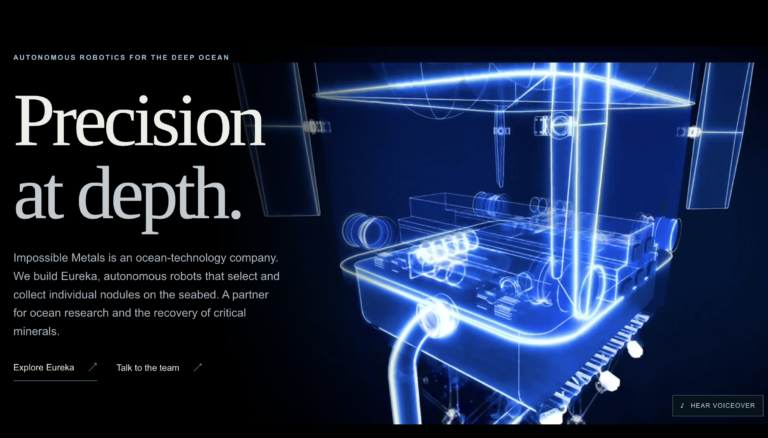
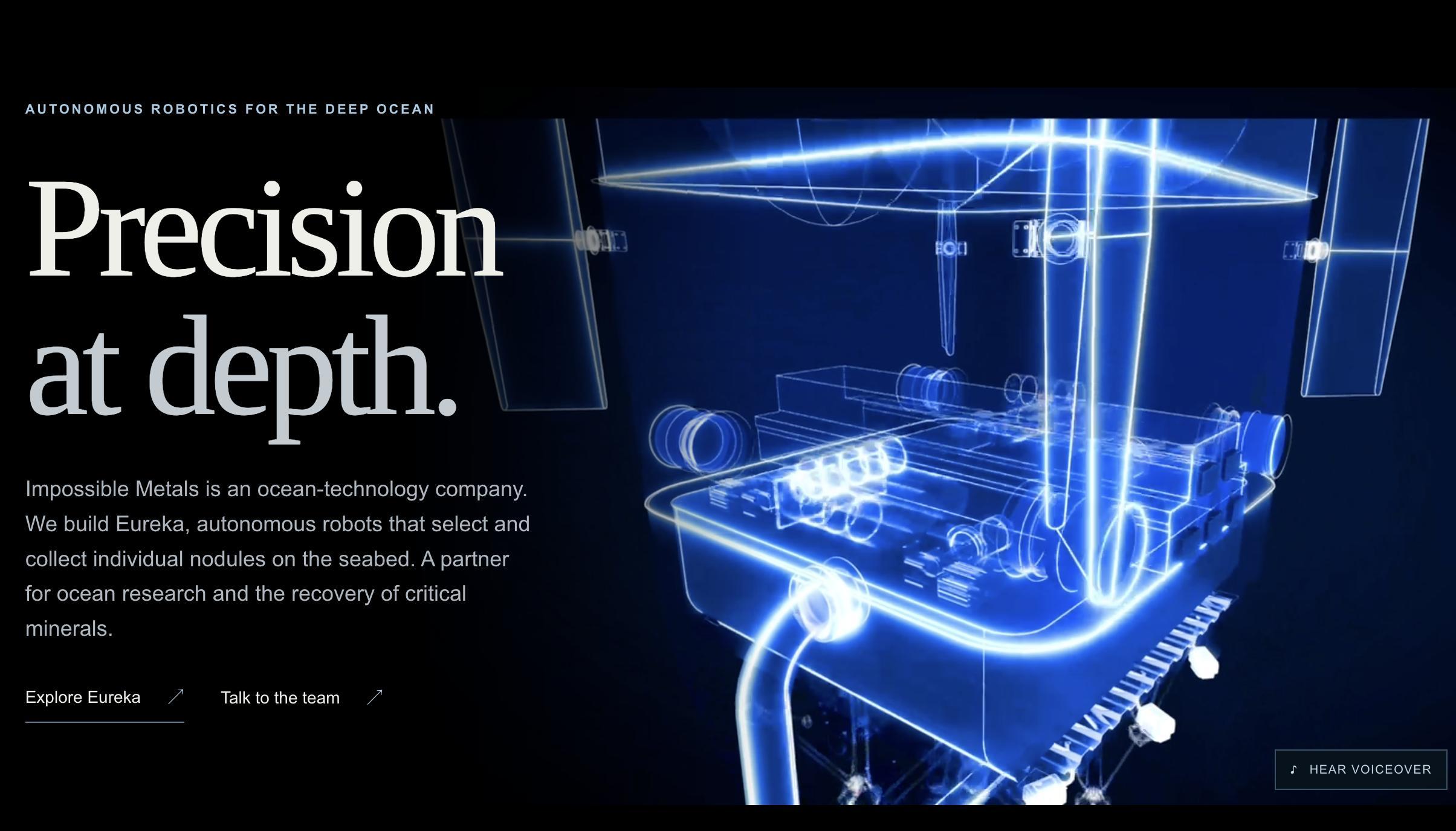
Eureka does not drive across the seabed on tracks or pump nodules up kilometers of pipe. According to the company, a buoyancy engine lifts its payload by harnessing the physics of water displacement, which removes the need for a riser pipe and the process-water discharge and cost that come with one. Robotic arms select individual nodules, and a perception system identifies nodules carrying visible life and leaves them in place.
The design is now patented. US patent 12,704,065, granted Aug. 11, 2026, names co-founders Oliver Gunasekara and Jason Gillham as inventors, according to the release. Its claims describe a hovering vehicle, buoyancy-driven vertical movement, arms that select individual nodules, and a perception system that leaves nodules carrying visible animals in place. In 2025, the company told AFP its commercial version would be about the size of a shipping container, with 16 arms instead of three. Steve Curnutte, executive chairman and CEO, said in the release that Eureka is “proven, patented, and ready.”
The tradeoff is perception. Reuters noted that many companies in the industry plan vacuum-like devices to retrieve nodules, a method that has drawn environmentalist criticism. Eureka’s vision system targets visible life, and the company has acknowledged it cannot detect microscopic life.
The company’s FAQ says Eureka is initially set to leave 60% of nodules undisturbed, adjustable as requirements change. Another FAQ section says the commitment is 30% of nodules by weight, which works out to 60% by number. The gap exists because the robot targets larger nodules, so the company’s techno-economic analysis says it would leave 30% by mass undisturbed while collecting roughly 70% of nodule mass.
That number is a setting, not a regulatory requirement. The company’s own model says Eureka stays profitable picking only 1% of nodules and reaches peak economics when it leaves 94% undisturbed. Because the International Seabed Authority’s rulebook is unfinished, no international rule yet tells any operator what share to leave.
Marine biologist Douglas McCauley of the University of California, Santa Barbara, told AFP that nodules themselves harbor living organisms, so removing them, even selectively, destroys habitat. Duncan Currie of the Deep Sea Conservation Coalition said too little is known about seabed biodiversity to assess any harvesting method’s impact. Nodules grow about 1 to 2 millimeters (0.04 to 0.08 inches) per million years, according to GEOMAR, so nothing taken is replaced on human timescales.
The strongest evidence comes from the conventional approach. In spring 2021, Belgium’s Global Sea Mineral Resources drove a remotely controlled pre-prototype collector for 74 hours at more than 4,000 meters (13,123 feet) in the same zone, covering about 32 kilometers (20 miles) and harvesting nodules from 54,000 square meters (about 581,000 square feet, or 13 acres). A preliminary shipboard report from the German research vessel SONNE, based on January 2026 survey work, found megafauna in the collector’s mined area 4.5 years later at less than 10% of the numbers in surrounding areas. GEOMAR said sea anemones, soft corals and stalked sponges are absent where nodules have been removed.
That cruise also surveyed an area selected for a potential Eureka III trial. A follow-up expedition, SO322, is scheduled to run from Oct. 17 through Dec. 9 from San Diego, revisiting the 2021 test tracks. Chief scientist Matthias Haeckel of GEOMAR said, “Likely, we will not see any recovery.” Those results measure a tracked collector, not Eureka. They do show what loss of nodule habitat looks like, which is the variable Eureka’s leave-behind share is meant to control.
Impossible Metals asked the Bureau of Ocean Energy Management on April 8, 2025, to hold a lease sale off American Samoa, according to an Interior Department press release. A final leasing notice published Oct. 20 schedules a Nov. 19 sale of two leases covering nodules and ferromanganese crusts, the first time the United States has offered such leases. The two areas total about 31.5 million acres. Reuters reported that the Marine Minerals Administration’s review would start with a lease sale, followed by consideration of an operational permit based on scientific data.
Opponents are in court. On Oct. 19, a Samoan council of chiefs and two community groups, represented by Earthjustice, sued to block the sale. The groups argue that the Marine Minerals Administration lacks authority to sell the leases and that the Outer Continental Shelf Lands Act does not authorize mineral leasing in US territories. The notice also came amid a separate pending suit by an Earthjustice-led coalition, according to PINA’s report. American Samoa’s governor, Pulaali’i Nikolao Pula, does not support commercial extraction at this time and has called for any initial work to focus on research, studies, mapping and monitoring.
International waters follow a different track. The International Seabed Authority’s 36-member Council met July 13 to 24 and again failed to finalize rules for commercial mining; members chose to continue at their next scheduled session in March 2027. Forty-five countries have called for a moratorium or precautionary pause.
The US route in international waters runs through NOAA. A final rule effective January 21, 2026, created a consolidated process for exploration licenses and commercial recovery permits under the 1980 Deep Seabed Hard Mineral Resources Act. That law is valid domestically, but its legality under international law is disputed. A Congressional Research Service analysis says NOAA-issued exploration licenses appear to lack international recognition. After President Donald Trump signed an executive order on seabed mining in April 2025, China’s Foreign Ministry said the US authorization violates international law.
The routes matter to Eureka because Impossible Metals plans robots-as-a-service for licensed resource holders, who would contract it to operate the Eureka Collection System. Its July non-binding memorandum of understanding with Deep Sea Minerals Corp. covers prospective exploration license areas, if licenses are awarded, and that company’s US subsidiary has applied to NOAA for an exploration license that remains under review. An October agreement makes Eco Minerals’ subsidiary its exclusive offshore exploration partner, subject to equipment availability.
The Smith family of FedEx founder Fred Smith joined the Series A round, which closed earlier this year, and is now the second-largest shareholder, according to Reuters’ report. The company declined to give the round’s size, while media reports put it near $25 million at a valuation of roughly $110 million. Richard Smith, whom the company’s release identifies as chief executive officer of FedEx Airline and chief operating officer of FedEx International, described his investment as substantial without giving a figure. The release quotes him saying his father cared about securing nodules for American industry and national security. The release also names In-Q-Tel as investor, which it describes as the strategic investor for the US intelligence and national security community.
The first checkpoint is the Nov. 19 sale and any court ruling before it. The second is the end of SO322 on Dec. 9. The third is the ISA Council’s March 2027 session. The fourth is Eureka III’s trial in 2027 aboard RV SONNE, under an environmental impact study initiated by Germany’s Federal Institute for Geosciences and Natural Resources, according to the release. The company says it will publish all data from the September dive and works with a standing group of nine independent scientists free to disagree with it in public.
For readers deciding how much weight to give the word “selective,” three questions apply: what share of nodules is left behind by mass rather than count, who monitors the seabed independently, and which legal route the operator uses. Until independent monitoring data exists, the September dive supports a claim about engineering, and the claim about habitat remains a design goal.
Eureka hovers above the seabed rather than driving across it, selects individual nodules with robotic arms and a perception system, and rises with its payload using a buoyancy engine that harnesses water displacement instead of pumping nodules up a pipe, according to the company.
The International Seabed Authority, created under the UN Convention on the Law of the Sea, regulates mineral activities there. The United States is not a party to the convention.
It may reduce habitat loss, but the evidence is incomplete. Researchers say nodules host animals, a 2021 collector site shows megafauna numbers below 10% of surrounding areas, and the company’s release does not describe independent monitoring of Eureka’s dive.
They are potato-shaped rocks on the abyssal seafloor that Reuters says are used in electric vehicles and electronics, and AP reports they are rich in manganese, copper, nickel and cobalt.