HomeAuto Immigrant Visa Ban Overturned, Interviews Canceled: Court Win Leaves Applicants Stranded
Immigrant Visa Ban Overturned, Interviews Canceled: Court Win Leaves Applicants Stranded
August 27, 2026:
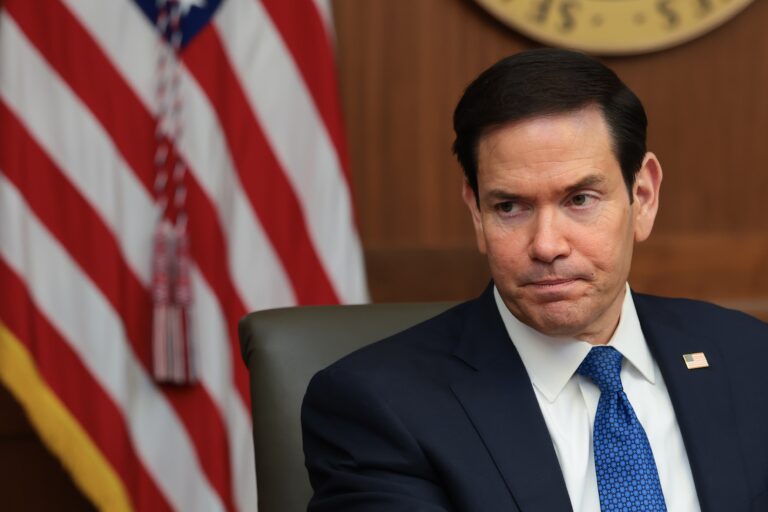
Secretary of State Marco Rubio (C) speaks during a Cabinet meeting at Camp David, the presidential retreat, on July 31, 2026 in Camp David, Maryland. Anna Moneymaker/Getty Images
A federal court in New York handed legal immigrants a significant victory last week — then a new State Department action immediately threatened to leave them in the same waiting-room limbo. On August 21, U.S. District Judge Jeannette Vargas vacated the Trump administration’s seven-month ban on immigrant visa processing for nationals of 75 countries, ruling it exceeded the Secretary of State’s statutory authority. By the time that ruling was being celebrated, the State Department had paused immigrant visa interviews at every embassy and consulate worldwide — this time without targeting any specific nationality — as consular officers undergo new public charge screening training. For hundreds of thousands of green card applicants, the question now is whether a court-ordered restoration of legal process has any practical effect when the processing machinery is administratively halted.
What the Court Actually Said — and Why It Matters
The Trump administration announced the 75-country ban on January 14, 2026, directing U.S. consular officers worldwide to refuse all immigrant visas to nationals of countries including Afghanistan, Brazil, Colombia, Iran, Russia, Somalia, and Yemen. The stated justification for the ban was that immigrants from these countries were statistically more likely to use public benefits — the legal term is “public charge” — citing Council of Economic Advisers data claiming more than 30 percent of households with immigrants from the affected nations had received some form of government assistance. The ban took effect January 21, 2026, and remained in place for seven months, applying to every application for lawful permanent residence — family-sponsored green cards, employment-based immigrant visas, and diversity visas — regardless of the individual applicant’s actual financial circumstances.
What the court found was not that the public charge concept was misapplied but that the mechanism was unlawful. Judge Vargas ruled that Secretary of State Marco Rubio had exceeded his statutory authority under the Immigration and Nationality Act. Most critically, she found that the ban violated Section 1152(a)(1)(A) of the INA, which expressly prohibits nationality-based discrimination in the issuance of immigrant visas. Under existing immigration law, consular officers already have authority to deny a visa if they determine an individual applicant is likely to become a public charge — but that determination requires case-by-case review of factors including the applicant’s age, health, financial resources, education, and work history. The 75-country policy instructed officers to refuse visas based solely on the applicant’s nationality, without that individualized assessment. As Judge Vargas summarized the policy’s effect: the outcome of any visa application from one of the 75 countries was predetermined regardless of what the individual’s file showed.
The ruling vacated the entire policy — meaning it is no longer legally operative — and set aside prior visa denials that were based solely on the nationality ban, potentially reopening those cases for reconsideration under standard immigration rules. Applicants whose cases were refused on other grounds — independent public charge determinations, criminal history, health bars — remain denied; only nationality was removed as a basis.
Who Brought the Case — and What They Say
The lawsuit was filed February 2 in the Southern District of New York by the National Immigration Law Center, Democracy Forward, The Legal Aid Society, the Western Center on Law & Poverty, the Center for Constitutional Rights, and Colombo & Hurd, on behalf of two nonprofit organizations and 11 individual plaintiffs.
Catholic Legal Immigration Network, Inc. (CLINIC) is a nationwide network of immigration legal service providers. Anna Gallagher, CLINIC’s executive director, said the ruling affirmed the dignity of every person and recognized the family as the foundation of society, adding that the ban had separated spouses, parents, and children who were simply following the legal immigration process. African Communities Together, a Harlem-based nonprofit serving African immigrant communities, called the ban unlawful and said through Deputy Executive Director for Policy and Advocacy Diana Konate that it had caused immeasurable harm, cruelly keeping families and loved ones apart.
The individual plaintiffs included six U.S. citizens who had filed family-based immigration petitions for relatives stuck abroad, and five people seeking to immigrate through employment-based pathways. The State Department, reached following the ruling, said it remained focused on protecting the American people by upholding the highest standards of screening and vetting of visa applicants and declined to comment on the litigation.
Does a Court Win Mean Resumed Processing? Not Yet.
Here is where the practical question becomes complicated. The administration cannot appeal the ruling in a way that reinstates the ban immediately — the vacatur stands unless a higher court grants a stay or reverses the decision. But on August 26, just days after the ruling, Reuters reported that the State Department was pausing or rescheduling immigrant visa interview appointments at U.S. embassies and consulates worldwide while consular officers undergo new training.
The training initiative was launched in early August — before the ruling — and is focused on public charge screening: specifically, ensuring that consular officers evaluate whether individual applicants would become dependent on government assistance. Applicants who had interviews already scheduled have been receiving notices that their appointments are being rescheduled, with no new dates yet provided. The State Department has not announced when normal global appointment scheduling will resume.
This is a crucial structural distinction from the policy Judge Vargas struck down. The 75-country ban was nationality-based and categorical — it applied regardless of the individual applicant’s circumstances. The training pause applies to everyone, regardless of nationality. That difference is legally significant: Section 1152(a)(1)(A)’s prohibition on nationality-based discrimination cannot be invoked against a pause that does not discriminate by nationality. Whether a nationality-neutral, indefinite freeze on processing falls within the Secretary’s statutory authority is a separate legal question that has not been litigated in CLINIC v. Rubio.
Immigration attorneys are watching whether the administration’s new approach — pausing processing to enforce more rigorous individualized public charge screening — accomplishes operationally what the nationality-based ban could not sustain legally. For the individual applicant, the practical effect is similar: their interview date has been wiped from the calendar, with no replacement date in sight.
When Did the State Department Start Losing in Court?
The CLINIC v. Rubio ruling is one in a series of federal court defeats for the administration’s legal immigration restrictions. Through its travel ban alone, the Trump administration had halted the legal immigration process for roughly 20 percent of people in the system, according to a review by the Cato Institute. In June 2026, a separate federal judge struck down a different administration policy that had placed immigrants from dozens of countries in what that court described as indeterminate legal limbo, according to the Associated Press. The accumulated pattern — a sweeping administrative action, a court challenge, a ruling finding the action exceeded statutory authority — has become the defining litigation rhythm of the administration’s legal immigration policy.
The administration had argued in CLINIC v. Rubio that Supreme Court precedent from the 2018 travel ban case supported its authority to suspend immigrant visa issuance. Judge Vargas rejected that argument, distinguishing presidential versus consular authority over visa decisions. The court found the distinction between presidential authority to restrict who may physically enter the United States — which the Supreme Court has upheld — and the separate question of whether the Secretary of State may prohibit consular officers from issuing visas to applicants who otherwise satisfy the statutory eligibility criteria. Those are different powers, derived from different sources of law, and the court found the latter was exceeded here.
What Could Happen Next
Judge Vargas gave the parties until September 11, 2026 to submit proposals addressing remaining issues in the case. The Trump administration can appeal the ruling; as of publication, no publicly confirmed stay or appeal had been filed. If the government appeals, it could seek an emergency stay while the case proceeds — which would re-freeze the processing the ruling unlocked, potentially for months.
Separately, the Associated Press reported that the administration is preparing to revoke B-1 and B-2 tourist and business visas issued between 2016 and 2026 for as many as 200,000 foreign nationals who have applied for or are currently seeking asylum in the United States. Legal experts cited in that report noted that for asylum seekers already inside the country with pending cases, revocation of a business or tourist visa they entered on carries limited immediate consequence — it cannot by itself compel departure of someone with an active asylum case. The administration’s own officials, according to the AP, described the primary purpose as deterrence: making clear that applicants should not enter on a tourist visa intending to seek asylum.
The broader economic consequence of the legal immigration restrictions is becoming clearer. According to analysts at Allianz Trade, combined legal and illegal immigration restrictions could drag U.S. GDP growth below 2 percent annually and cut legal immigration nearly in half compared to pre-2025 levels.
Is Your Immigrant Visa Case Affected?
For applicants whose cases were refused between January 21 and August 21, 2026, solely because of the 75-country nationality-based ban, the ruling removes that refusal as a legal basis — those cases can be reopened and sent back to consular officers for standard, individualized review. However, applicants must still satisfy all other eligibility requirements, including individual public charge assessment. A prior denial based on anything other than the nationality ban — criminal history, independent public charge determination, fraud — remains in effect. Applicants should monitor communications from the specific embassy or consulate handling their case, and should consult an immigration attorney before taking any action on a case that was previously denied.
For applicants with scheduled interviews — regardless of what country they are from — the global training pause means those appointments may be rescheduled, with no confirmed restart date. The State Department has not issued guidance on how consular posts should resume scheduling after the training concludes. Applicants should monitor communications from the specific embassy or consulate handling their case, and should consult an immigration attorney before taking any action on a case that was previously denied.
Frequently Asked Questions
If my immigrant visa was denied because of the 75-country ban, what should I do now?
Your denial based solely on the nationality-based ban is now subject to reconsideration under the court’s ruling. The ruling vacated the policy and set aside refusals that relied on it, meaning those cases return to standard, individualized review. Contact an immigration attorney who can review your specific case and, if appropriate, notify the consular post that your denial should be reconsidered. Be aware that you still must satisfy all other eligibility requirements — the ruling removes nationality as a basis for refusal, but not the other legal criteria.
Does the worldwide appointment freeze mean the court ruling has no practical effect?
Not exactly, but it does complicate matters. The court’s ruling removed the legal basis for refusing visas based solely on nationality — that bar is gone. However, the State Department’s separate training-based pause means that even applicants whose path was cleared by the ruling may not receive interview dates in the near term. The key difference is legal: the training pause is nationality-neutral, which means it faces different legal vulnerabilities than the nationality-based ban the court struck down. Whether the pause can be challenged as an indefinite de facto suspension of visa processing is a question for ongoing litigation. For now, applicants should monitor embassy communications and consult counsel.
What is the “public charge” rule that both the ban and the new training are based on?
Under U.S. immigration law, a person who is likely to become primarily dependent on certain forms of government assistance can be denied an immigrant visa as a public charge. Consular officers already have authority to make this determination — but it must be individualized, considering each applicant’s specific circumstances including age, health, financial resources, education, and work history. The court ruled the 75-country ban violated that requirement by refusing visas categorically based on nationality, without any individual assessment. The new training initiative appears aimed at having consular officers apply public charge screening more rigorously on an individual basis — a different legal posture.
Who brought the lawsuit that vacated the 75-country ban, and can ordinary applicants join it?
The case was brought by two nonprofit organizations — Catholic Legal Immigration Network (CLINIC) and African Communities Together — along with 11 individual plaintiffs, filed February 2, 2026 in the Southern District of New York. Ordinary applicants were not direct parties, but the ruling’s vacatur applies broadly: any consular officer who denied a visa based solely on the 75-country ban policy is now operating under an unlawful framework. Individuals can raise the ruling in their own proceedings, though they should consult an immigration attorney for guidance specific to their case.