IFA 2026: FITUEYES Challenges Wall-Mounting Conventions With Ergonomic Data

August 28, 2026:

IFA 2026: FITUEYES Challenges Wall-Mounting Conventions With Ergonomic Data
IFA Berlin 2026
Ifa-berlin.com

Most wall-mounted televisions in American homes are installed well above the ergonomically correct viewing height — not because engineers recommend it, but because convention, furniture clearance, and aesthetics push installers to place screens where they look impressive from a standing position rather than where they perform best from a seated one. With IFA Berlin 2026 set to open September 4, premium audiovisual furniture brand FITUEYES will use its three-year presence at the world’s largest consumer electronics and home appliances show to make exactly that argument — and to propose that flexible, floor-standing furniture is the engineering-grounded answer to a problem most households don’t know they have.

The brand’s 2026 booth concept, called “In Between,” is built around a pointed design question: why does the living room organize itself around a screen rather than the other way around? Both the booth concept and FITUEYES’ IFA 2026 details are described on the brand’s dedicated IFA 2026 page.

Why Conventional Wall Mounting Is Harder on Your Neck Than You Think

The Society of Motion Picture and Television Engineers recommends a minimum subtended viewing angle of 30 degrees for immersive front-projection viewing, a standard that has become a reference point in residential home theater design. At the same time, engineering records document a structural problem with how most people actually install wall-mounted flat panels: the average seated viewer’s eye level sits roughly 38 inches (97 cm) from the floor, but industry convention — driven by furniture clearance, fireplace surrounds, and aesthetic preference — routinely places the center of a wall-mounted screen at approximately 67 inches (170 cm). The resulting upward viewing angle of 18.5 degrees is measurably inconsistent with ergonomic guidance that places the most comfortable vertical viewing range within ±15 degrees of the horizontal, with downward or level viewing preferred.

The problem is architectural, not just a matter of personal preference. Once a screen is fixed to a wall at that height, it cannot move. The room reorganizes around it. The sofa goes where it must to face the screen, not where the occupants would choose to place it otherwise. Cable management requires either exposed runs along baseboards or wall modifications that create lasting physical changes to the living space.

A floor-standing TV stand using the VESA mounting standard — the Video Electronics Standards Association’s universal bolt-pattern specification that governs how panels attach to both wall mounts and free-standing structures — allows the screen center to be positioned at seated eye level and adjusted incrementally without any structural commitment. It can also swivel, typically between 30 and 35 degrees left or right, addressing the off-axis color shift and contrast degradation that modern OLED panels exhibit when viewed from angles beyond roughly 30 degrees horizontal. The SMPTE and VESA engineering record addresses both the viewing angle standard and floor-stand compatibility.

FITUEYES Arrives at IFA With a Three-Year Track Record

FITUEYES’ 2026 appearance at Messe Berlin — Hall 22, Booth H22-105 — will mark its third consecutive year at IFA, per the brand’s IFA 2026 page. At IFA 2025, the brand debuted under the design theme “Find ( ),” centering on spatial minimalism, and introduced the Eiffel V2 FT88 floor-standing TV stand, which accommodates screens from 55 to 88 inches, with adjustable height, a swivel mechanism, silent wheels for repositioning, and integrated cable management. That same year, the company also expanded into wall-mounted TV stands, making the brand’s 2026 pivot — now arguing against fixed-position mounting as an organizing principle — a deliberate change in emphasis rather than a change in product lineup.

The “In Between” booth concept will present three distinct lifestyle environments: Home Cinema, Music Corner, and Living Space. Rather than displaying products in isolation against a trade-show backdrop, each environment will show audiovisual furniture functioning as part of a complete interior, asking visitors to consider how a screen, a speaker, and a room can relate to each other when furniture is treated as a spatial element rather than equipment the home accommodates. The brand will offer a dedicated Media Tour through each environment, opening broader conversations about changing viewing habits, flexible living, and the increasingly blurred line between consumer technology and interior design.

Design research from MIT’s Integrated Design Management program on adaptability and furniture lifecycle supports FITUEYES’ underlying premise: qualitative studies find that people evaluate furniture based on its ability to adapt over time to changing layouts, lifestyles, and emotional needs, rather than solely on function or appearance. Products that cannot respond to how a household changes become obsolete not because they break but because they cannot meet new needs — a constraint that fixed wall installations embody by design.

Is TV Stand vs. Wall Mount Really a Technical Question?

For most buyers, the choice between a floor-standing TV stand and a wall mount has felt like a matter of aesthetics and budget. Wall mounting is clean, saves floor space, and reads as contemporary; floor stands take up room and feel like a compromise when space is tight. What FITUEYES is asserting at IFA 2026 — and what the engineering record supports — is that the framing itself is wrong. The more accurate question is: what does permanence actually cost, and in what living environments does that cost outweigh the benefit?

In a home with genuinely fixed furniture arrangements, a large dedicated home theater room, and walls capable of bearing the structural load, a well-installed articulating wall mount addresses the ergonomic shortcomings of fixed-height mounting. But the 2024 EIA Residential Energy Consumption Survey found that roughly 132.54 million homes in the United States used televisions in 2024, the majority in multipurpose living rooms that serve as entertainment areas, work environments, and social settings across different times of day. In those multi-use spaces, the flexibility cost of a fixed wall installation — room locked into a single orientation, screen angle immovable, height fixed regardless of viewing context — is real and measurable.

FITUEYES frames this as the territory of “In Between”: not the fully committed home theater installation, and not the improvised speaker-on-a-shelf setup, but the space where most households actually live with their screens and where furniture capable of responding to how life actually moves has the most to offer. The full “In Between” concept is detailed on FITUEYES’ IFA 2026 page.

IFA Berlin 2026: Context for the Conversation

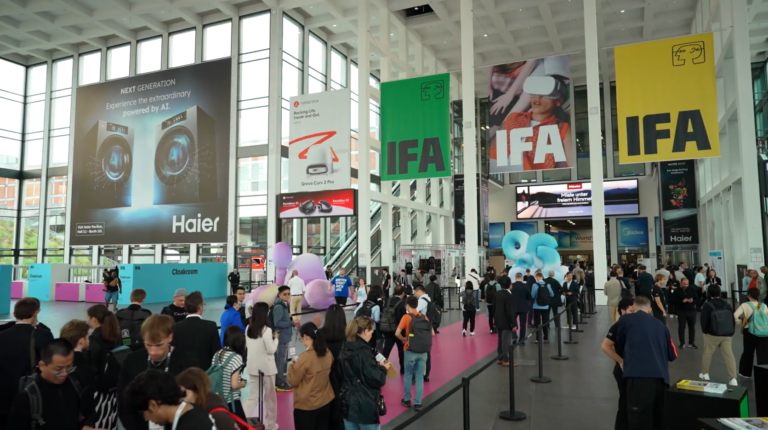
The backdrop for FITUEYES’ campaign is IFA Berlin, the world’s most significant consumer electronics and home appliances event, which will open its doors September 4 at Messe Berlin — Messedamm 22 (33 ft / 10 m) from Berlin’s iconic Funkturm radio tower — and run through September 8. In 2025, the show attracted 220,000 visitors globally from 140 countries, with more than 1,900 exhibitors. The 2026 edition spans five core content tracks — World of AI and Future of Tech, Smart and Sustainable Living, Retail and Future of Commerce, Marketing and Creativity, and Culture and Lifestyle — across three dedicated stages.

The IFA 2026 program is particularly well-suited to the conversation FITUEYES is trying to start. On September 6, Shane Lee, Chief Designer and General Manager at TCL Industries, and Lisa Yong, Director of Consumer Tech at global trend forecaster WGSN, will share the Dream Stage for a session titled “The Sensory Intelligent Home: Designing Future Living Experiences” — an examination of how sensory intelligence, AI, and design can transform the smart home into a seamless, human-centric ecosystem rather than a collection of devices demanding accommodation. Both that session and FITUEYES’ “In Between” concept are wrestling with the same underlying question about how technology belongs in a room rather than simply occupying it.

The September 5 Innovation Stage will feature David Reger, founder and CEO of NEURA Robotics — a Metzingen, Germany-based company that develops cognitive robots designed to operate alongside humans in everyday environments, which in January 2025 raised €120 million Series B (approximately $131 million, at current exchange rates; exchange rate as of August 28, 2026 — conversions are approximate) — presenting on the next phase of robotics in everyday environments.

The show’s five days run 9:30 a.m. to 6 p.m. CET for trade visitors. Consumer visitors will gain access from noon on opening day, Friday September 4, and from 10 a.m. Saturday through Tuesday.

How to Find FITUEYES at IFA 2026

FITUEYES will exhibit at Hall 22, Booth H22-105, Messe Berlin, September 4–8. Media tour requests and general product information are available at the FITUEYES IFA 2026 page. Trade visitor tickets for IFA Berlin 2026 are available at the IFA Berlin trade visitor ticket page.


Frequently Asked Questions

Is wall mounting a TV better than using a floor TV stand?

Neither is unconditionally superior — the engineering record complicates the conventional preference for wall mounting. Industry convention typically installs the center of a wall-mounted screen at roughly 67 inches (170 cm) from the floor, significantly above the approximately 38-inch (97 cm) seated eye level at which viewing is most comfortable, creating an upward neck angle that ergonomic guidance identifies as suboptimal for sustained viewing. The tilting wall mount patent record documents this 18.5-degree upward viewing angle problem directly. Floor-standing TV stands using the VESA mounting standard can be height-adjusted to align with seated eye level and repositioned without structural modification — meaningful advantages in multi-use living rooms where furniture arrangements change. Wall mounting has genuine advantages in dedicated fixed-use home theater spaces where the room is designed around the screen and an articulating mount addresses the height and angle problems. The right answer depends on how the room actually gets used.

What is VESA mounting, and does it matter for TV stands?

VESA — the Video Electronics Standards Association — publishes the Flat Display Mounting Interface standard that defines the bolt-hole patterns on the back of flat-panel televisions and the corresponding mounting points on both wall brackets and floor-standing structures. Common patterns range from 75×75 mm to 600×400 mm depending on screen size and weight. Because both wall mounts and premium floor stands use the VESA standard, they are direct, interchangeable alternatives at the panel interface — the TV itself does not know or care which kind of structure it is mounted to. VESA compatibility is the primary specification a buyer should confirm when considering any mounting solution. The VESA and SMPTE standards are documented in the tilting wall mount patent record.

What is IFA Berlin 2026, and why does it matter for home entertainment?

IFA Berlin — Internationale Funkausstellung, or International Radio Exhibition — is the world’s largest annual consumer electronics and home appliances trade show, now in its 102nd year. It will run September 4–8 at Messe Berlin in Germany, with more than 1,900 expected exhibitors and a program spanning AI, smart home, mobility, sustainability, gaming, and content creation. The trade.gov listing for IFA Berlin 2026 confirms the event dates and scale. For home entertainment specifically, IFA is where brands typically confirm the second half of the year’s product cycle — new display technologies, smart home integrations, and increasingly, design-led arguments about how screens belong in domestic spaces. FITUEYES’ “In Between” concept is arriving at a show where the question of how technology integrates into daily life rather than dominating it is already a central theme across multiple keynote sessions.

Can I actually adjust the viewing angle on a floor TV stand the same way as on a wall mount?

Premium floor-standing TV stands typically include a swivel mechanism that allows the panel to rotate 30–35 degrees left or right and a pole height adjustment that positions the screen center across a range of heights. This addresses the two primary ergonomic variables: vertical angle (height relative to seated eye level) and horizontal angle (orientation toward different seating positions). Fixed wall mounts without articulating arms offer neither adjustment after installation; full-motion wall mounts add both at the cost of increased structural requirement and price. For most living room configurations — particularly those where the primary seating position can shift depending on activity — a quality floor stand offers equivalent or superior adjustability without the permanent structural commitment. FITUEYES’ floor-standing options and their IFA 2026 booth experience demonstrate these capabilities across their three lifestyle environments.

Source link