
Iceye Spain Grant: Valencia Pays Nearly €2 Million for Satellites Labeled Signals Intelligence

November 15, 2026:

Iceye Spain Grant: Valencia Pays Nearly €2 Million for Satellites Labeled Signals Intelligence
ICEYE Satellite
Iceye.com

Valencia’s regional government awarded Iceye España €1,955,872.60 (approximately $2,161,630) to build and integrate satellites at its Paterna site. Regional coverage of the resolution describes the funded spacecraft as signals intelligence (SIGINT) satellites, a passive radio-listening mission that differs from the radar imaging the Finnish company is known for. Valencia News reported on Nov. 12 that four projects from members of the regional aerospace cluster Espai Aero CV received €7.5 million in the same call, and the wording matters to anyone tracking where European defense space money is going.

Award Listing Describes SIGINT Satellites While Iceye Sells Radar Imagery

Iceye operates synthetic aperture radar (SAR) satellites, which transmit their own microwave pulses and build images from the echoes, day or night and through cloud. SIGINT satellites do the opposite: they transmit nothing and instead record radio emissions from radars, communications gear and ship transmitters.

The SIGINT description appears in regional coverage by Castelló Extra and Valencia Extra, and in Castellón Plaza’s report on the call. Iceye’s own account, as relayed by Infoespacial on Nov. 14, emphasized radar applications such as emergency management and critical infrastructure and did not use the SIGINT term. The two descriptions are not necessarily in conflict, but Iceye has not publicly specified the payload of the satellites the grant supports.

The listing is not out of nowhere. El Español’s April report covered Iceye’s push into new capabilities from Valencia, and Breaking Defense’s June report covered the company’s German joint venture for space-based intelligence, surveillance and reconnaissance. Neither report says what Paterna will build, so the grant listing remains the only public link between the funding and a SIGINT payload.

How Do Satellites Find Radio Emitters Without Imaging Them?

A single satellite can hear an emission but cannot easily say where it came from. Commercial operators solve this by comparing what several spacecraft receive: time difference of arrival (TDOA) uses the tiny gaps in when a signal reaches each satellite, and frequency difference of arrival (FDOA) uses Doppler shifts caused by the satellites’ motion.

HawkEye 360, the best-known commercial example, flies clusters of three satellites in low Earth orbit and computes emitter positions from the differences between them. France’s Unseenlabs says its newest satellites can geolocate emitters individually, reducing dependence on multi-satellite formations for some missions.

The engineering constraint for formation-based systems is geometry and clock accuracy, because the position fix depends on precise relative navigation and timing between spacecraft. Vendors also pitch radio-frequency geolocation as a complement to imagery, which is the context in which a radar-imaging firm with a SIGINT-labeled grant draws attention. That is industry context, not a statement of Iceye’s plans.

Paterna Anchors Iceye’s Multi-Site Push Toward 100 Satellites Per Year

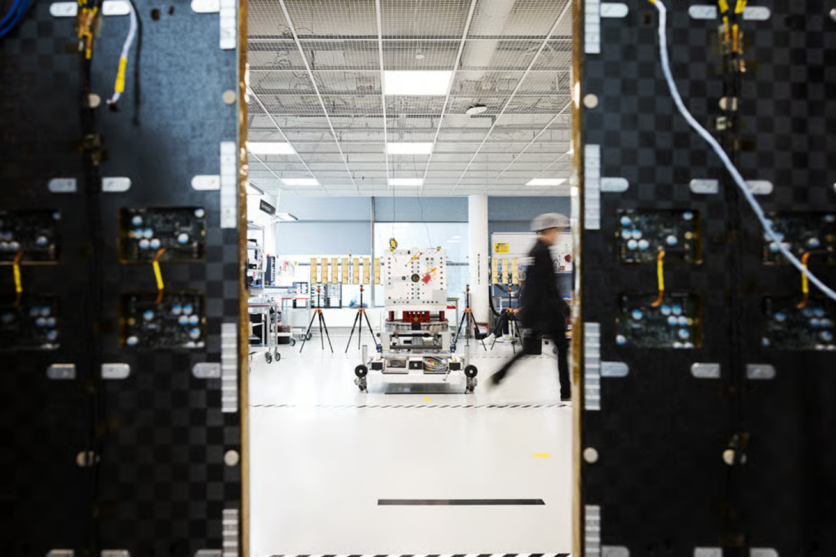
Iceye opened the Paterna center on May 7, 2025, as a research, development and manufacturing hub in Valencia. Gonzalo García-Muñoz, Iceye’s global operations chief and head of its Spanish unit, called Paterna the second most important center for the company worldwide, according to Valencia News.

The company has capital to scale. Iceye raised €450 million (approximately $497,340,000) in a Series F round led by General Atlantic on June 9, 2026, at a valuation above €10 billion (approximately $11,052,000,000), in a round exceeding €1 billion (approximately $1,105,200,000) when a secondary placement is included. Business Finland’s final €28.3 million continuation grant (approximately $31,277,160), announced June 1, 2026, funds research and development in radar, software and artificial intelligence.

Production targets differ by source. The June 1 Iceye release set a goal of 100 satellites per year by 2028, while Defense News reported a late-2027 target to double radar satellite capacity, and Aerotime noted the 2027 versus 2028 gap between company statements. Greek press reports describe a planned satellite factory in Athens covering more than 5,000 square meters (53,820 square feet) with up to 150 satellites per year of capacity.

Valencia Spreads €23.49M ($25,961,148) Across Nine Projects

The regional strategic-projects call began with €12.65 million (approximately $13,980,780) and grew by €11.22 million (approximately $12,400,344) to €23.49 million in awards (approximately $25,961,148), covering nine projects in eight municipalities. Defense and security were newly added as a priority sector in this call.

Company Municipality Award

Arkadia

Almassora

€2,149,706.61 (approximately $2,375,856)

Nerva

Vilanova d’Alcolea

€2,029,896.39 (approximately $2,243,441)

Iceye España

Paterna

€1,955,872.60 (approximately $2,161,630)

Orbotix

Massanassa

€1,342,334.97 (approximately $1,483,549)

Together these four awards total €7,477,810.57 (approximately $8,264,476). Other recipients in the call include Kartogroup in Burriana, TMRW Silicon València, Kerionics in Paterna, Construcciones Industrializadas Modulares La Romana and Solar Earth in Alicante.

Eligibility was broader than an investment threshold. Under the call’s published criteria, projects had to meet at least two of five tests, one of which was mobilizing €10 million or more in private investment; the others were leading an emerging sector, creating 100 or more direct jobs in 2026 to 2028, sector-wide innovation and decarbonization.

Payload Details Remain Unconfirmed

Three facts are public: the amount, the Paterna site and the regional listing’s SIGINT wording. Not public are the payload, the frequency bands, the satellite count and the customer, so readers should treat any claim about what Paterna will launch as unverified until Iceye or the Generalitat publishes the resolution text or a technical description.

Currency conversions in this article use the European Central Bank reference rate of 1.1052 U.S. dollars per euro on Nov. 13, 2026, and are approximate.


Frequently Asked Questions

What is a SIGINT satellite?

A signals intelligence (SIGINT) satellite passively collects radio emissions such as radar pulses, communications and ship transmitters, then locates them, typically by comparing arrival times and Doppler shifts across several spacecraft.

How much did Iceye España receive and why?

Iceye España received €1,955,872.60 (approximately $2,161,630) from Valencia’s strategic-projects call to build and integrate satellites in Paterna.

Does the grant mean Iceye is building spy satellites?

Not necessarily. Regional coverage of the resolution uses SIGINT wording, but Iceye has publicly described radar applications and has not specified the payload, so the grant alone does not settle it. A radar company adding passive radio collection would pair two complementary sensing methods, which is why the wording is worth watching.

Is Paterna Iceye’s second-largest site?

García-Muñoz described Paterna as the company’s second most important center, though a planned Athens plant could change that ranking.

Source link